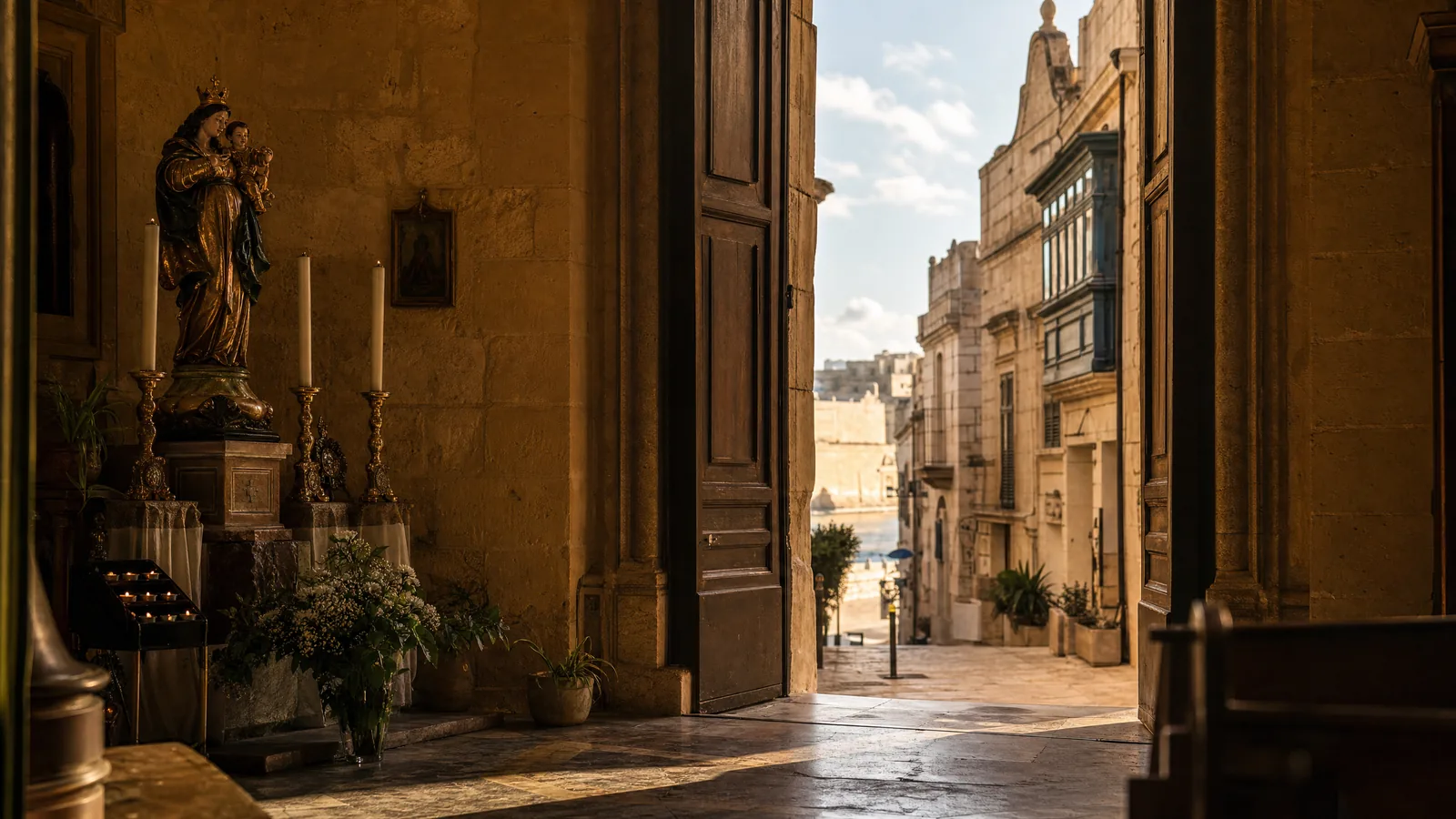
There is a sentence in the Maltese Lord's Prayer that stops visitors cold the first time they hear it.
"Missierna, li inti fis-smewwiet, jitqaddes ismek." Our Father, who art in heaven, hallowed be thy name. Standard enough. But when the prayer continues, and the congregation speaks of God's will, God's kingdom, God's glory, the word they use for God is "Alla."
Not "Deus," the Latin of their Roman inheritance. Not "God," the English of their most recent colonial rulers. Alla. The same root as the Arabic "Allah." The same word that a Muslim would use in prayer five hundred miles to the south. Said, every Sunday, in a Catholic church, in a European Union member state, by a population that is among the most devout in the Western world.
This is not a paradox. It is not a confusion. It is simply Malta, which has always been more interesting than the easy summary allows.
Where the word comes from
The Arabic-speaking Aghlabid dynasty from North Africa took Malta in 870 AD, displacing the Byzantine Greek population that had been there since Roman times. The Arabs held the island for roughly two centuries. When the Normans arrived in 1091 and brought Christianity back with them, they did not bring a new language. The population they found spoke Arabic, or a dialect of it, and that is what survived.
Maltese is the only Semitic language written in a Latin script and the only Semitic language that carries official EU status. It is the direct descendant of the Siculo-Arabic dialect spoken by the Muslim population of medieval Malta and Sicily. Over the centuries it has absorbed Italian, Sicilian, English, and French vocabulary, but its grammatical bones, its verb system, its root structure, its word for God, are Arabic.
The Akkademja tal-Malti, the Maltese Language Academy, is the official body responsible for the language. Its work makes clear that Maltese is not Arabic with additions: it is a distinct language with its own evolution. But the Semitic substrate runs through everything. When a Maltese Catholic says "Alla," they are using a word shaped by eight centuries of a language carried by Muslim traders and settlers, applied to the God of Catholic Christianity. The word predates the Normans' arrival. The faith came after. The word stayed.
What this tells you about Maltese Catholicism
Malta is the most Catholic country in the European Union by almost every measure. According to Eurobarometer survey data, over 90% of the Maltese population identifies as Catholic, and religious practice rates, Mass attendance, reception of sacraments, are dramatically higher than the European average. In France, a self-described Catholic country, weekly Mass attendance is in the single digits as a percentage of the population. In Malta it remains, depending on the survey, between 40% and 60%.
The Church here is not a historical memory or a cultural vestige. It is a living institution with genuine social power. Malta was the last EU country to legalise divorce, doing so only after a bitterly contested 2011 referendum that the Church actively opposed and very nearly won. Abortion remains illegal under any circumstances, one of only a handful of complete prohibitions in Europe. The Concordat between the Maltese state and the Holy See, signed in 1993 and expanded since, governs the Church's role in education, marriage law, and public life in ways that have no parallel in Western Europe.
This is not a theocracy. Malta is a liberal democracy with a functioning civil society and a free press. But it is a country where the Church remains a genuine participant in public life rather than a relic of it, and where religious identity is still, for most people, a matter of lived daily experience rather than nominal affiliation.
The feast days and what they reveal
You cannot understand Maltese Catholicism from a theological or political description. You have to see the feast days.
Every village in Malta has its patron saint. Every patron saint has a festa, a festival that combines deep religious devotion with something that looks, to an outsider, entirely like a competition. The fireworks are competitive: villages and rival factions within the same village engage in pyrotechnic arms races that can last for days. The decorations are competitive: the church facade illuminated, the silver plate carried in procession, the band marching. The Band Clubs, which are both musical organisations and social institutions, are organised along parish festa lines, and rivalries between them run centuries deep.
The Malta Tourism Authority's guide to festas gives you the calendar. But no guide prepares you for the experience. The combination of sincere, intense Catholic piety, the kind that weeps at the sight of the parish statue carried through the streets, with the competitive roar of the band and the crack of the fireworks overhead is not something that has a parallel in Northern European Catholicism. It is something particular to Malta, shaped by its history as a place where faith has always coexisted with commerce, with military necessity, and with a complicated relationship to the cultures that surrounded and sometimes occupied it.
What this means for the Catholic family relocating to Malta
I am a practicing Catholic. I have ten children. When I advise Catholic families on Malta, I do not sell them the tax regime and then mention the Church as a footnote. The Church is, for many of our clients, one of the primary reasons they come.
The practical realities are these. Malta has church schools at every level, from primary through secondary, operating under the Education Act and the Church-State Concordat. These are not fringe institutions. They are among the most sought-after schools on the island, and many of our clients specifically target church school admission as part of their relocation planning. Our guide to Malta's education system for Catholic families covers this in detail.
The calendar of religious life is embedded in the national calendar. Public holidays track the liturgical year: the Feast of St Paul's Shipwreck in February, Good Friday processions that are among the most elaborate in Europe, the Feast of the Assumption, the Immaculate Conception. A Catholic family raising children in Malta raises them in a country where the faith is publicly legible and culturally reinforced in a way that has almost entirely disappeared from Northern Europe.
This does not mean Malta is a Catholic paradise with no complications. The Church has faced its own scandals, the generational tensions between tradition and modernity are real, and the political battles over divorce and abortion have left their marks. Malta is not a medieval enclave preserved in amber. It is a contemporary European country with all the pressures that implies.
But it is also a country where the word for God carries eight centuries of linguistic history in its two syllables, where the Sunday morning church is full, where the feast day of the village patron is the most important day of the year, and where a Catholic can live a Catholic life without constant, quiet apology for it.
Alla. Two syllables, two civilisations, one faith. That is Malta.
If you are a Catholic family considering Malta, I would be glad to speak with you about the practical realities of relocating there. Book a consultation to start the conversation.