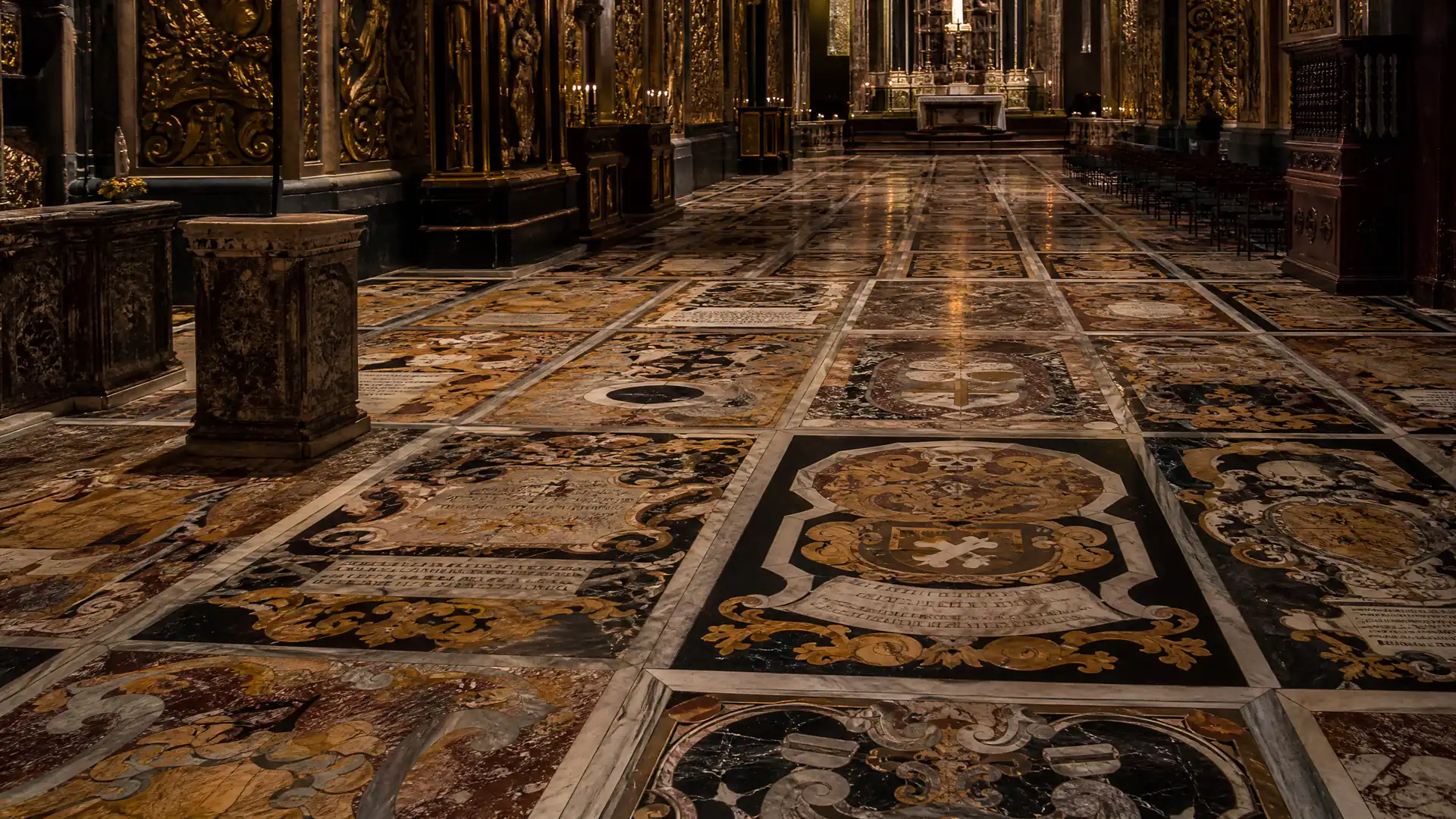
I was only on my way to Mass. That is the plain truth of it. Not on a tour, not following a guidebook, just crossing the floor of St John’s Co-Cathedral in Valletta on a quiet weekday morning, the way you cross any church floor, when a name stopped me. Nikolaus von Enzberg. Cut into the marble in Latin, Nicolaus de Enzberg, set among four hundred others.
For anyone who has not stood inside St John’s, the floor is the thing you carry away. The whole nave is paved with the inlaid tombstones of the Knights of the Order of St John, a continuous carpet of polychrome marble intarsia in black, white, yellow and red. Skeletons hold up scrolls. The Angel of Fame lifts her trumpet. Coats of arms blaze under your feet, and the Latin epitaphs speak of triumph, victory and death. It has been called, without much exaggeration, the most beautiful floor in the world, and the list of more than four hundred tombs reads like a roll call of Catholic Europe’s noble houses. You are meant to look down, and to remember that you too are mortal.
What stopped me was not the artistry. It was the geography. Enzberg is not a Maltese name, nor a French or Spanish one. The family seat is Mühlheim an der Donau, a small town on the upper Danube in what is today the district of Tuttlingen, in Baden-Württemberg. It is the same southwest corner of Germany I come from. Freiburg, my own city, sits roughly a hundred kilometres to the west. To find that name here, three centuries old, on a Mediterranean island, felt less like history and more like running into a neighbour very far from home.
A family older than most countries
The Freiherren von Enzberg are an ancient Swabian house, the kind of lineage that makes modern nation states look young. They acquired the lordship of Mühlheim in 1409 and made it their seat, and they hold it still. That is more than six hundred years in one place, through the Reformation, the Thirty Years War, Napoleon and two world wars. The family lost its sovereign rights when the small territories of the old Empire were swallowed up at the start of the nineteenth century, and Mühlheim passed to Württemberg, but the Enzbergs themselves never left. They remain part of the town to this day.
It was a house with a strong military and Catholic tradition, exactly the kind that fed sons into the great religious orders of chivalry. The name Nikolaus runs through the line. A General Nikolaus Friedrich von Enzberg lived from 1650 to 1726, a soldier of the Holy Roman Empire. Our knight, who died in 1752, belonged to the same world: younger sons of land-rich, cash-careful nobility, for whom a career in the Order of St John offered honour, purpose and a place in the wider Europe their small valley could not provide on its own.
What it meant to be a knight of the German tongue
The Order was, for its time, a genuinely international institution. It was divided into “tongues”, or langues, rough national groupings, each with its own auberge in Valletta and its own chapel in St John’s. The German tongue gathered knights from Germany, Austria, Switzerland and Bohemia, and its chapel in the church is the Chapel of the Three Kings, the Trium Regum, dedicated to the three Magi who came from distant lands to a single altar. The symbolism was not lost on anyone.
Entry was not a matter of money. The German tongue was the strictest of all the langues, demanding proof of sixteen quarterings of nobility, the most exacting standard in the Order. A candidate had to document that every one of his sixteen great-great-grandparents was noble. Once admitted, a knight entered a novitiate, took simple vows and later solemn ones, and sailed on the “caravans”, the patrols of the galleys that fought corsairs and the Ottoman fleet across the Mediterranean. The estates of the Order back home, the commanderies, paid for all of it. A young man from the Danube could thus end his days fighting for a Mediterranean island he had never seen as a boy, under a rule that bound a German, a Frenchman and a Spaniard into one brotherhood.
Nikolaus von Enzberg, and the competition for a place in the floor
Of the man himself, the record is honest and a little spare. He died on 12 February 1752. His individual deeds, his offices, the ships he served on, have not come down to us in any detail. What survives is something more telling about the world he lived in.
When he died, Enzberg was first buried in a modest spot near the German chapel, in the passageway to the sacristy, alongside another German knight. He might have stayed there, quietly, the way most knights did. Instead, his remains were later lifted and moved into the main nave, and a proper inlaid tombstone was laid over them. He became tomb no. 43 in the Main Nave, and one of only three German knights honoured in the nave itself rather than in the German chapel.
This was not a small thing. A place in the nave was the most coveted ground in the church, shared with grand masters, admirals and grand priors. Of the German knights recorded in the Order’s death register who were buried without a chapel slab, Enzberg alone was later judged worthy of promotion into that company. Somebody, family or executor or the langue itself, decided that this man from the upper Danube belonged among the elect, and arranged it. The floor of St John’s was, in that sense, a fiercely competitive afterlife, and Nikolaus von Enzberg won his place in it.
Why a German in Malta notices
I stood there longer than I had time for, with Mass about to begin, and thought about what this name was doing under my feet.
The Order of St John was one of the first truly pan-European institutions, centuries before anyone drew up a treaty for it. A man could be born in a walled town on the Danube, swear his vows in Valletta, fight in the same fleet as Frenchmen and Spaniards, die on the island, and be remembered there in marble forever. National origin was the organising principle, through the tongues, and yet the whole thing was a single sovereign body with one faith and one Latin tongue over all the others. That same Order, stripped of its galleys and its island, still exists today as a sovereign charitable institution, running hospitals and relief work in more than a hundred countries. Continuity, it turns out, is the family business of these old houses, whether the house is the Enzbergs or the Order itself.
There is a quieter resonance too. I am a German who has spent twenty-five years living elsewhere, and I find myself a German in Malta now, going to Mass in the same church. Nikolaus von Enzberg left Mühlheim and was claimed by this island. Three centuries later another man from the same corner of Germany walks across his grave on an ordinary Tuesday. The lesson the floor presses on you, Flecte lumina, mortalitatem agnosce, bend down and acknowledge your mortality, is also a lesson about belonging. You can leave the valley you were born in and still be received somewhere else, fully, and remembered there. A name in the marble is proof of it.
We tend to think of mobility, of choosing where to live and where to be buried, as a modern privilege. It is not. Men like Enzberg understood it perfectly well. They simply called it a vocation, and carved it in stone.
Andere reden. Wir setzen es um.