Contents
- 1. Malta: Country Overview
- 2. Putting Malta on the Map
- 3. What Others Say About Malta
- 4. Tax Benefits: What Malta Has to Offer
- 5. Tax Rates at a Glance
- 6. Tax Residency: What Triggers It
- 7. Double Tax Treaties
- 8. Avoid Remaining Tax Resident at Home
- 9. Tax Considerations When Leaving Your Home Country
- 10. Company Setup & Corporate Tax
- 11. Who Should (and Shouldn't) Move to Malta
- 12. Visas and Residence Permits
- 13. Path to Citizenship
- 14. Banking in Malta
- 15. What Makes Malta Genuinely Attractive
- 16. Cost of Living in Malta
- 17. Buying Real Estate in Malta
- 18. Retiring in Malta
- 19. US Citizens: What You Need to Know
- 20. Correct Preparation
- 21. Automatic Exchange of Information (OECD CRS)
- 22. Further Relocation Formalities
- 23. How We Help With Your Move to Malta
I.
Malta: Country Overview
Malta is a sovereign archipelago in the central Mediterranean, lying 80 kilometres south of Sicily and 350 kilometres north of Libya. It comprises three inhabited islands — Malta, Gozo, and Comino — covering 316 km² with a population of approximately 540,000. The capital, Valletta, is the smallest capital in the European Union by population and a UNESCO World Heritage Site in its entirety: a sixteenth-century fortified city built by the Knights of St. John on a rocky peninsula between two natural harbours, with limestone bastions falling away to the sea.
The country operates in English and Maltese, both of which are official languages. English is the language of business, banking, government, and the courts; Maltese is a Semitic language with significant Italian influence and is the language of daily life among the Maltese population. The legal system is a hybrid of English common law (procedural and commercial) and continental civil law (substantive law derived from the Code Napoleon). The currency is the Euro. Malta has been a member of the European Union since 2004 and the Eurozone since 2008, and is part of the Schengen Area.
On the tax side, Malta operates one of the most useful remittance-basis regimes in the European Union. Individuals who are resident in Malta but not domiciled in Malta are taxed only on Maltese-source income and on foreign income remitted to Malta. Foreign income kept abroad is not taxed. Foreign capital gains are never taxed in Malta — not even if remitted. This last feature distinguishes Malta from every other remittance-basis jurisdiction including the United Kingdom (whose own non-dom regime was abolished in April 2025). There is no inheritance tax, no estate tax, no gift tax, no annual wealth tax, and no net-worth tax. Personal income tax on Maltese-source income runs at progressive rates from 0% to 35%, with the top rate reached at €60,000 of chargeable income. Corporate tax is 35% on profits, but Malta operates a full imputation system with shareholder refunds that reduce the effective rate to 5% for trading income (the 6/7ths refund) or 10% for passive interest and royalties (the 5/7ths refund). VAT is 18% — among the lowest in the European Union.
Malta has 76+ active double tax treaties, including with all major OECD economies, providing a deep network for cross-border planning. The country is fully EU-compliant, on no European or OECD blacklist, and operates as a transparent, regulated jurisdiction rather than an opaque tax haven. The financial services sector is sophisticated, the regulatory environment is mature, and the country has a long history of attracting HNW residents — a tradition that goes back to the days of the Knights of Malta and continues through the modern Malta Permanent Residence Programme (MPRP), the Global Residence Programme (GRP), and the Malta Retirement Programme (MRP).
What to be aware of. From 1 January 2026, Malta has introduced a Qualified Domestic Minimum Top-up Tax (QDMTT) and a 15% Final Tax option for Pillar Two compliance, applying to multinational groups with consolidated revenues above €750 million. For these large groups, the traditional 5% effective rate may not survive Pillar Two top-up calculations. For HNW individuals operating below this threshold, the regime continues unchanged. Malta's MPRP financial thresholds were raised substantially in 2025 — minimum assets of €500,000, minimum property purchase of €375,000 (€220,000 in Gozo and South Malta), minimum annual rent of €14,000. The €5,000 minimum annual tax for non-domiciled residents applies only when foreign income exceeds €35,000 in a year. None of these are deal-breakers, but they should be factored into the planning realistically.
II.
Putting Malta on the Map
Malta — central Mediterranean, between Sicily and the North African coast
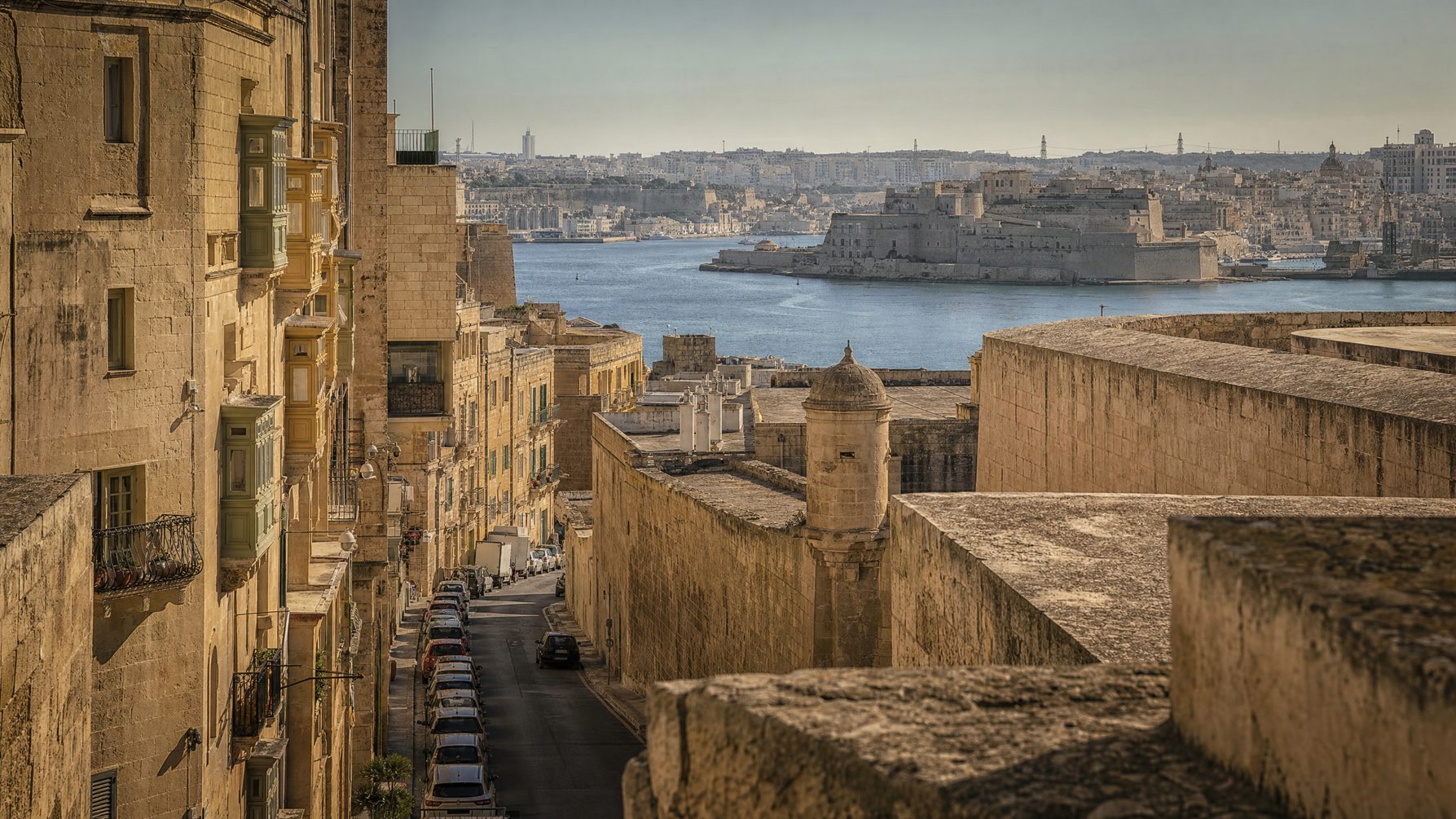
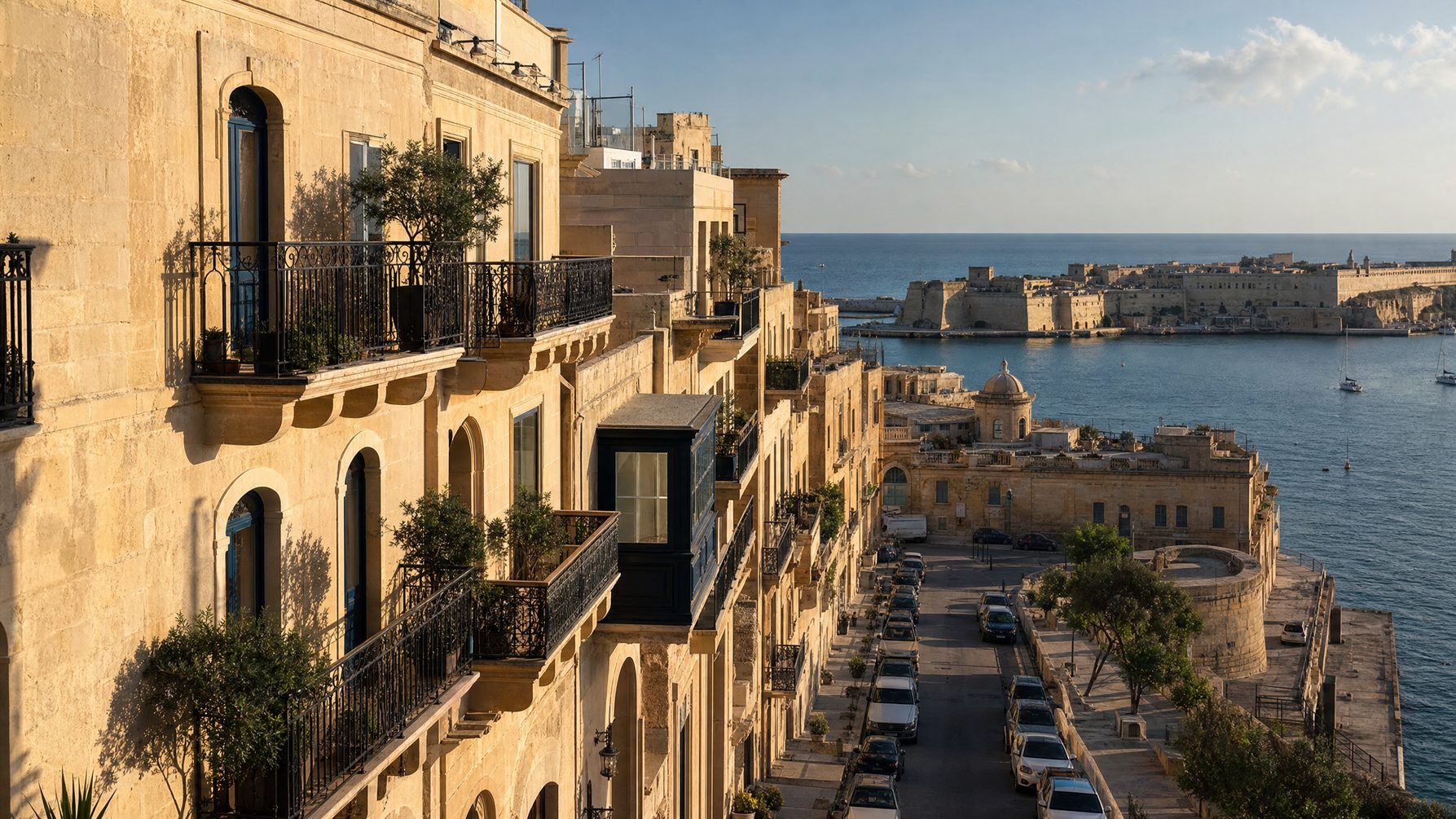
Malta arrives in the colour of limestone. Everything in the country — the bastions of Valletta, the dry-stone walls of the countryside, the fishing villages of Marsaxlokk and Birgu, the watchtowers of Comino — is built from the same pale honey-coloured stone, quarried locally and warming to gold in late afternoon light. The country is small enough that you can drive from one end to the other in an hour, but the density of history, food, and architectural pleasure per square kilometre is unrivalled in the Mediterranean.
Valletta itself is the city that was built in fifteen years by the Knights of St. John after the Great Siege of 1565 — Europe's first comprehensively planned Renaissance city, laid out on a grid by the Italian engineer Francesco Laparelli, with St. John's Co-Cathedral (containing two Caravaggios), the Grand Master's Palace, and the long axial streets that fall to the sea on either side. The view from Upper Barrakka Gardens across the Grand Harbour to the Three Cities — Vittoriosa, Senglea, and Cospicua — is one of the great sights in Europe. Rabat and Mdina, the silent walled city in the centre of the island, were the original Roman and Arab capitals; the Mdina cathedral is built on the spot where St. Paul reputedly converted the Roman governor in AD 60.
Sliema and St. Julian's, on the coast north of Valletta, are the modern commercial and residential hubs — high-rise apartment buildings, marinas, restaurants, banks, and the offices of the financial services industry that drives much of the economy. Spinola Bay in St. Julian's is the social heart of expat Malta: the cafés, the gelato shops, the bars and restaurants that fill from early evening with the Maltese, the British, the Italians, the Russians, and the increasingly diverse community of Northern European entrepreneurs and digital nomads who have made Malta their base.
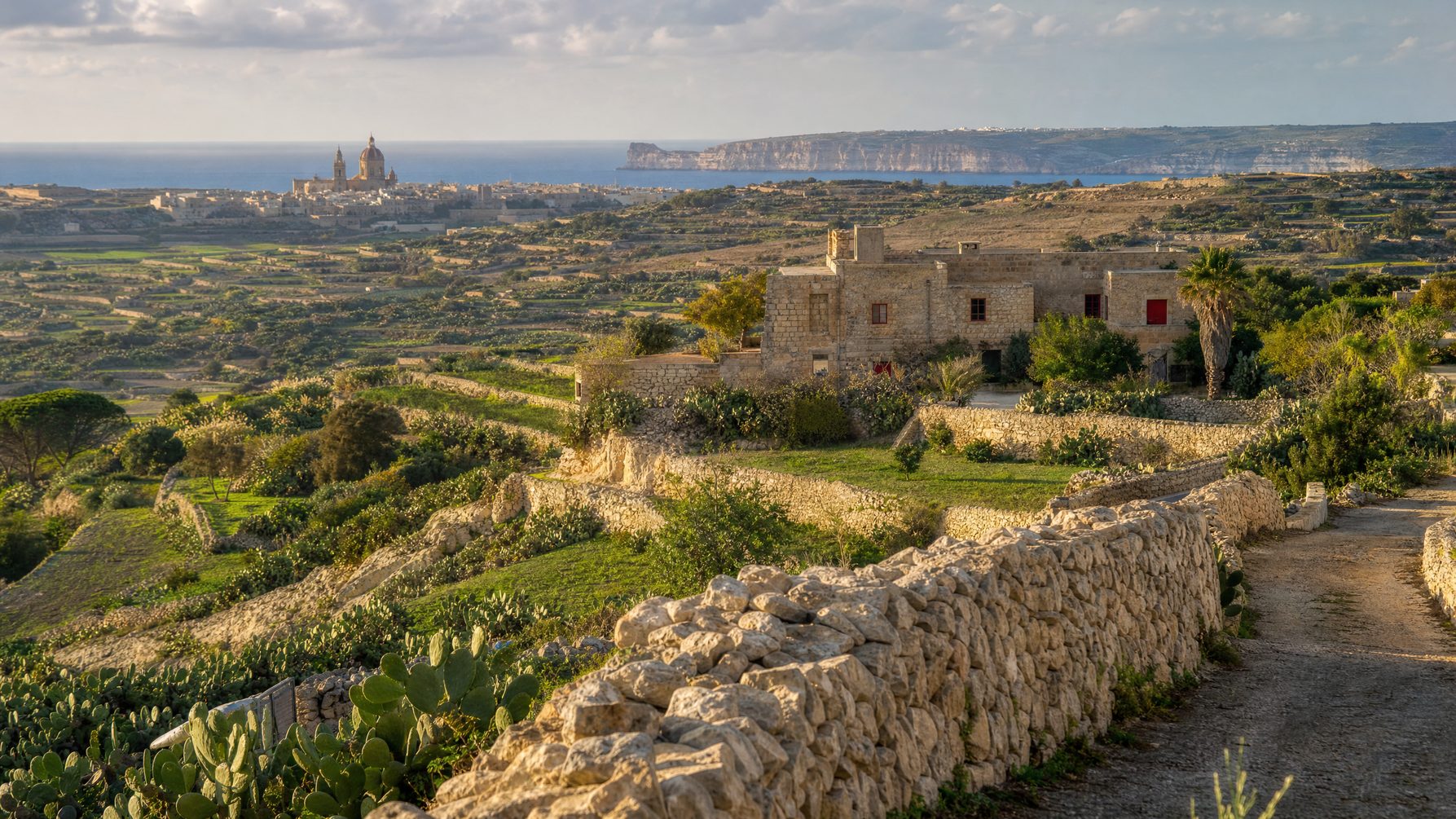
Gozo, the smaller sister island reached by a 25-minute ferry from Cirkewwa to Mgarr, is the agricultural and rural counterpoint to Malta's urbanity. The island is greener, slower, and more traditional — the Cittadella above Victoria, the prehistoric Ggantija temples (older than the Pyramids and Stonehenge), the Salt Pans on the north coast, and the sea caves and diving spots that make Gozo one of the great Mediterranean dive destinations. Property in Gozo is materially cheaper than on Malta, and the island has its own MPRP minimums (€220,000 for purchase) — making it the natural alternative for HNW clients who want the lifestyle without the urban density.
Comino, the third island, is small (3.5 km²), nearly uninhabited, and dominated by the Blue Lagoon — a cove of luminous turquoise water that has become one of the most photographed swimming spots in the Mediterranean. In summer it is overrun; in winter it is empty and exquisite.
The country sits at the strategic crossroads of the Mediterranean — central to flight networks across Europe, North Africa, and the Middle East. Malta International Airport (MLA) operates direct flights to London (3 hours), Frankfurt, Paris, Rome (1 hour), Munich, Vienna, Zurich, Geneva, Madrid, Istanbul, Dubai (5 hours), and most major European hubs. Air Malta, Ryanair, easyJet, Lufthansa, British Airways, and Emirates all serve the country. From Malta you can be in Rome for lunch, Frankfurt for an evening meeting, Dubai by the next morning — the connectivity is one of the country's most underrated practical advantages.
III.
What Others Say About Malta
"Valletta is what every Renaissance prince hoped his city would become and almost none of them achieved. It was built on a single plan, by serious men, in a hurry, and they got every important thing right."
— Norman Lewis, The Mediterranean: A Cultural Landscape, 1991
"What I love about Malta is that the tax system is genuinely sophisticated and the bureaucracy is genuinely English. After fifteen years on the non-dom regime, I have never had to argue with a tax inspector — every conversation has been civil, in English, and based on rules that everyone agreed on at the start."
— British investor, Sliema, 2024
"I came for the tax, I stayed for the lunch. The Maltese understand that good food, good wine, and a long midday meal in the shade are not luxuries — they are the basis of a civilised life."
— European entrepreneur, Gozo, 2025

IV.
Tax Benefits: What Malta Has to Offer
Malta is one of the very few EU jurisdictions that operates on a remittance basis for non-domiciled residents — and the only one that exempts foreign capital gains from tax even when remitted. Combined with no inheritance tax, no wealth tax, an effective 5% corporate tax via the imputation refund system, English as an official language, and 76+ double tax treaties, Malta is genuinely useful for HNW relocation in a way that few European jurisdictions can match.
- ›Foreign income taxed only on remittance — under the resident non-domiciled regime, foreign-source income is taxed in Malta only to the extent that it is remitted (transferred) to Malta. Foreign income kept abroad is not subject to Maltese tax. Personal income tax on remitted foreign income is at progressive rates 0%–35% under the standard regime, or a flat 15% under the Global Residence Programme.
- ›Foreign capital gains never taxed — even when remitted — this is the structural feature that distinguishes Malta from every other remittance-basis jurisdiction. Foreign-source capital gains (sale of foreign shares, foreign real estate, foreign businesses) are exempt from Maltese tax regardless of whether the proceeds are brought into Malta. Combined with the absence of CGT in many home jurisdictions for non-resident sellers, this can produce a fully tax-free disposal of substantial foreign assets.
- ›No inheritance, estate, gift, or wealth tax — Malta does not impose any inheritance tax, estate tax, gift tax, or annual wealth tax. Real estate transfers between family members are subject to a small stamp duty under standard rules; otherwise, intergenerational wealth transfers are entirely outside the Maltese tax net.
- ›€5,000 minimum annual tax — only if foreign income exceeds €35,000 — non-domiciled residents whose foreign income exceeds €35,000 in a year and who do not remit the full €35,000 to Malta pay a minimum annual tax of €5,000 (per couple for married). Where foreign income is below €35,000, no minimum tax applies. Where it exceeds €35,000 but the resulting progressive tax on remittances exceeds €5,000, the higher amount applies.
- ›Corporate tax — effective 5% via the full imputation refund system — Malta's headline corporate tax rate of 35% is reduced to an effective 5% for trading income through the 6/7ths shareholder refund (or 10% for passive interest and royalties via the 5/7ths refund). The Malta Fiscal Unit regime (introduced 2019, expanded 2024–2026) allows groups to pay the net 5% directly, eliminating the historical 12–18 month wait for refunds.
- ›Global Residence Programme (GRP) — for non-EU/EEA/Swiss nationals: flat 15% tax on foreign income remitted to Malta, minimum €15,000 annual tax. Property acquisition €275,000 (€220,000 in Gozo and South Malta) or rental €9,600/year (€8,750 Gozo/South Malta).
- ›Residence Programme (RP) — same scheme for EU/EEA/Swiss nationals: flat 15% tax on remitted foreign income, minimum €15,000 annual tax, identical property requirements.
- ›Malta Retirement Programme (MRP) — for non-Maltese pensioners receiving foreign pension income: flat 15% tax on remitted pension income, minimum €7,500 annual tax. Pension must constitute at least 75% of total chargeable income in Malta.
- ›Nomad Residence Permit — flat 10% tax on remote-work income — for foreign nationals working remotely for foreign employers/clients with annual income above €42,000. First 12 months of approved remote-work income may be exempt; thereafter 10% flat.
- ›76+ active double tax treaties; EU/Eurozone/Schengen member — a deep DTA network including Germany, UK, US, France, Italy, all major EU partners, Australia, Canada, China, India, Singapore, UAE, Switzerland. Malta is fully integrated in the European single market and is a Schengen Area member — making travel and residence within Europe seamless.
V.
Tax Rates at a Glance
The most important tax rates in Malta are as follows. Note that these have been simplified and should be used as general guidance only.
| Tax | Rate | Notes |
|---|---|---|
| Personal Income Tax — top rate | 35% | Reached at €60,000 chargeable income (single rates) |
| Personal Income Tax — bottom rate | 0% | First €12,000 (single) tax-free |
| Tax basis — resident non-domiciled | Remittance | Foreign income taxed only when remitted; foreign CG never taxed |
| Tax basis — resident domiciled | Worldwide | Worldwide income at progressive rates 0–35% |
| Tax basis — non-resident | Maltese-source only | Income arising in Malta only |
| Minimum annual tax — non-dom | €5,000 | Only if foreign income exceeds €35,000 (per couple if married) |
| Foreign Capital Gains | 0% | Never taxed, even if remitted |
| Maltese Capital Gains | 0–35% | Progressive; certain stock-exchange disposals exempt |
| Inheritance Tax | 0% | None |
| Gift Tax | 0% | Real estate transfers subject to standard stamp duty only |
| Wealth Tax | 0% | None |
| Stamp Duty — property purchase | 5% | Of property value; reduced rates for first-time buyers and Gozo |
| Stamp Duty — share transfers | 2% | (5% for property-rich companies) |
| Corporate Income Tax — headline | 35% | Flat rate on worldwide income for resident companies |
| Corporate Income Tax — effective | 5% | After 6/7ths refund on trading income |
| Corporate Income Tax — passive interest/royalties | 10% effective | After 5/7ths refund |
| Pillar Two — QDMTT / 15% Final Tax | 15% | MNE groups ≥€750M consolidated revenue (from 2026) |
| Participation exemption | 100% | On qualifying participating holdings |
| VAT | 18% | One of the lowest in the EU |
| VAT — reduced | 5% / 7% | On certain goods, hotel accommodation |
| VAT registration threshold | €35,000 services / €70,000 goods | Mandatory above |
| Withholding tax — dividends to non-residents | 0% | Generally none under full imputation |
| Withholding tax — interest to non-residents | 0% | Generally none |
| Withholding tax — royalties to non-residents | 0% | Generally none |
| Global Residence Programme (GRP) | 15% flat | Foreign income remitted; €15K min annual tax |
| Residence Programme (RP) | 15% flat | EU/EEA/Swiss; €15K min annual tax |
| Malta Retirement Programme (MRP) | 15% flat | Pension income remitted; €7,500 min annual tax |
| Nomad Residence Permit | 10% flat | Remote-work income after first 12 months |
| MPRP — minimum assets | €500,000 | Of which €150,000 in financial assets |
| MPRP — minimum property purchase | €375,000 | €220,000 in Gozo / South Malta |
| MPRP — minimum annual rental | €14,000 | €8,750 in Gozo / South Malta |
| MPRP — government contribution | €30,000–€60,000 | Plus €30,000 NGO donation |
| DTAs | 76+ | All major OECD economies |
Cryptocurrency and Crypto Assets
Malta is one of Europe's most established crypto-friendly jurisdictions, with comprehensive regulation under the Virtual Financial Assets Act (VFA) and full alignment with the EU MiCA framework. Personal crypto trading is treated under general tax principles: occasional or capital-nature disposals by non-domiciled residents are foreign capital gains and not taxed in Malta even if remitted (the exception that distinguishes Malta from other remittance-basis jurisdictions). Habitual or professional trading is treated as business income and taxed at progressive rates. Staking, yield farming, and DeFi rewards are generally treated as income at fair market value on receipt. Companies operating under VFA licensing are subject to standard 35% corporate tax with the imputation refund mechanism reducing the effective rate to 5%. For HNW crypto investors with significant unrealised gains held offshore, the Malta non-dom regime combined with the foreign-CG exemption is one of the most efficient EU planning options available.
VI.
Tax Residency: What Triggers It
Under Maltese tax law, an individual is considered a tax resident of Malta if they meet any one of the following criteria:
- ›183-day rule: You spend 183 or more days in Malta during a calendar year. This is the most common trigger.
- ›Habitual residence: Malta is your habitual or ordinary place of residence — even with fewer than 183 days, if you treat Malta as your principal home and centre of personal and economic interests.
- ›Special programmes: Beneficiaries of the Global Residence Programme (GRP), Residence Programme (RP), Malta Retirement Programme (MRP), or Nomad Residence Permit are tax resident under the terms of their programme regardless of day count.
Tax residency in Malta interacts with domicile status to determine the scope of taxation:
- ›Resident and domiciled in Malta — taxed on worldwide income at progressive rates 0–35%. Most expats relocating to Malta retain their original domicile and do not acquire Maltese domicile.
- ›Resident but not domiciled in Malta (the typical expat profile) — taxed only on Maltese-source income and on foreign income remitted to Malta. Foreign income kept abroad is not taxed. Foreign capital gains are never taxed even if remitted. €5,000 minimum annual tax applies if foreign income exceeds €35,000.
- ›Not resident but domiciled in Malta — taxed only on Maltese-source income.
- ›Not resident and not domiciled — taxed only on Maltese-source income.
Domicile is a separate legal concept from residence. A foreign national relocating to Malta will, as a general proposition, retain their foreign domicile of origin. Maltese domicile is acquired only through birth in Malta to a Maltese-domiciled parent, or through deliberate adoption of Malta as a permanent home with the intent to remain indefinitely (a high evidentiary bar). The non-domicile position is the structural foundation of the favourable tax treatment, and it can typically be retained indefinitely.
Documentation matters. Establishing and maintaining Malta tax residency and non-domicile status requires evidence: a registered lease agreement or property title, utility bills, bank account statements, travel records, and — for special programme participants — annual compliance with the programme's specific conditions (minimum annual tax, property/rental thresholds, health insurance, no Maltese employment for some programmes). The Commissioner for Tax and Customs (CFR) is the competent authority and can issue tax residency certificates on request, which are useful for invoking double tax treaty protection.
VII.
Double Tax Treaties
Malta has concluded 76+ double tax agreements (DTAs) that are currently in force — one of the most comprehensive treaty networks among EU member states. These treaties reduce or eliminate withholding taxes on dividends, interest, and royalties; provide tie-breaker mechanisms for residency conflicts; and allow residents to invoke treaty benefits for international income flows.
Key treaty partners include:
- ›Australia
- ›Austria
- ›Belgium
- ›Bulgaria
- ›Canada
- ›China
- ›Croatia
- ›Cyprus
- ›Czech Republic
- ›Denmark
- ›Egypt
- ›Estonia
- ›Finland
- ›France
- ›Germany
- ›Greece
- ›Hungary
- ›Iceland
- ›India
- ›Ireland
- ›Israel
- ›Italy
- ›Japan
- ›Jersey
- ›Korea (South)
- ›Latvia
- ›Lithuania
- ›Luxembourg
- ›Mauritius
- ›Mexico
- ›Netherlands
- ›Norway
- ›Pakistan
- ›Poland
- ›Portugal
- ›Qatar
- ›Romania
- ›Russia (suspended)
- ›San Marino
- ›Saudi Arabia
- ›Serbia
- ›Singapore
- ›Slovakia
- ›Slovenia
- ›South Africa
- ›Spain
- ›Sweden
- ›Switzerland
- ›Tunisia
- ›Turkey
- ›Ukraine
- ›United Arab Emirates
- ›United Kingdom
- ›United States
The US–Malta DTA is in force and provides for reduced withholding rates on dividends (5%/15%), interest (10%), and royalties (10%). The treaty contains a savings clause preserving the US right to tax its citizens regardless of treaty residence — meaning US citizens in Malta remain subject to US worldwide taxation and rely on the Foreign Earned Income Exclusion and Foreign Tax Credit rather than treaty relief. The Germany–Malta DTA is also in force and provides standard residence tie-breaker rules under Article 4 — useful for German nationals establishing Maltese residency.
The DTA network combines with Malta's EU directive entitlements (Parent-Subsidiary, Interest and Royalties, Mergers Directives) to provide one of the most flexible cross-border planning frameworks in Europe. EU directives generally eliminate withholding tax on intra-EU corporate flows that meet the relevant participation thresholds.
The existence of a DTA does not automatically resolve all tax conflicts. The treaty must be invoked correctly, residency must be properly established, and the specific provisions of each treaty must be reviewed for the income type and circumstances. Several Malta DTAs include modified Limitation on Benefits (LoB) provisions and anti-abuse rules under the OECD Multilateral Instrument (MLI), to which Malta is a signatory.
VIII.
Avoid Remaining Tax Resident at Home
Relocating to Malta does not automatically end your tax obligations elsewhere. The critical question is whether you have genuinely severed tax residency in your country of origin — and this is determined not by where you have registered an address, but by where you actually live, where your ties are, and how your life is organised.
This matters particularly for Malta because the country is small enough (316 km², 540,000 people) that some clients attempt to use Malta as a paper residence while continuing to spend most of their time in their original country. Most high-tax tax authorities are familiar with this pattern and have the legal tools to challenge it.
The most common triggers that can keep you tax-resident at home:
- ›Available dwelling: Any long-term residence that remains available for your use — a flat you own, a property you rent on an ongoing basis, even a room in a family home — is sufficient to maintain a taxable domicile in many countries. The dwelling does not need to be your primary home; it only needs to be available. Surrendering it before departure is a precondition of a clean exit in Germany (§1 EStG Wohnsitz), Austria, Switzerland, and many other jurisdictions.
- ›Centre of vital interests: If your family, your business, your social connections, and your financial affairs remain in your home country, most tax authorities will argue that your centre of life has not genuinely moved — regardless of where you have registered. Spouse and minor children remaining in the home country are particularly powerful indicators.
- ›183-day rule (home country): Spending more than 183 days in your home country in a calendar year will typically trigger residency there, overriding any claim to Malta residency for that year. Malta's standard 183-day rule means clients must not spend more time in their previous home country than they spend in Malta.
- ›Extended unlimited tax liability (Germany): Germany's erweiterte unbeschränkte Steuerpflicht under §2 AStG can keep you taxable in Germany for up to ten years after departure if you move to a low-tax country and retain significant ties. Malta is generally not classified as a low-tax country under §2 AStG (because the headline corporate rate is 35% and the effective rate via refunds is treated as a corporate rather than personal advantage), but the analysis is fact-specific and should be confirmed before relying on it.
A genuine relocation to Malta requires that you actually live there — that your home is there, your daily life is there, and that you can demonstrate this with documentation. A registered address and a bank account are not sufficient.
The test is not where you are registered. The test is where you live. Tax authorities in Germany, Austria, the UK, and Switzerland are experienced at identifying sham relocations and have the legal tools to challenge them. Proper advice before you move — not after — is essential.
IX.
Tax Considerations When Leaving Your Home Country
Before you relocate, you need to understand what tax consequences arise in your current country of residence at the point of departure. These rules vary significantly by country and must be assessed individually — there is no universal answer.
Many countries impose an exit tax or deemed disposal charge when a tax resident leaves. This typically applies to unrealised capital gains on shares, business interests, real estate, or other assets — taxing you as if you had sold everything on the day you departed. The rules differ widely: some countries apply this to all assets above a threshold, others only to substantial shareholdings or business interests. Some have look-back periods that can catch you even after you have left.
Among the countries that levy a meaningful exit tax or deemed-disposal charge:
- ›Germany. Applies an exit tax on unrealised gains in shareholdings of 1% or more under §6 AStG. The Germany–Malta DTA provides standard tie-breaker rules. Note: Malta is generally not classified as a low-tax country under §2 AStG, but the analysis is fact-specific.
- ›United States. The "expatriation tax" under IRC §877A treats long-term residents and citizens as having sold all worldwide assets at fair market value on the day they relinquish citizenship or residency. The US–Malta DTA contains a savings clause preserving US worldwide taxation of US citizens.
- ›France. Exit tax applies to unrealised gains on securities and company rights above €800,000 when a French tax resident relocates abroad. Within EU/EEA (Malta qualifies), a deferral mechanism applies.
- ›Netherlands. Deemed disposal applies to substantial shareholdings (5% or more) at the point of emigration. EU/EEA deferral mechanism available.
- ›United Kingdom. Statutory Residence Test exit-date analysis is required. The new FIG regime (from 6 April 2025) governs new UK arrivals, not departures. UK pensioners moving to Malta face UK-source pension taxation under domestic rules and the UK–Malta DTA.
- ›Australia. Departing residents are treated as having disposed of most assets at market value on the date they cease to be Australian tax residents.
- ›Canada. The "departure tax" deems most property to have been disposed of at fair market value on the date of emigration.
- ›Denmark. Applies exit taxation on shares and other securities held at the time of departure, with deferred payment options for moves to other EU/EEA states (including Malta).
Beyond exit tax, you may remain subject to limited tax liability in your home country after the move — for example, on rental income from property you continue to own there, on dividends from domestic companies, or on pension payments. Severing tax residency does not necessarily sever all tax obligations.
The timing of your departure, the structure of your assets, and the sequence of any business disposals all have material consequences. In some cases, restructuring assets before departure — or deferring the move by a few months — can make a significant difference to the tax outcome.
⚠ Obtain Local Tax Advice in Your Home Country. The information above provides a general overview of the departure tax rules that commonly apply when leaving high-tax jurisdictions. It is not legal or tax advice. The rules in your specific home country — Germany, Austria, Switzerland, the UK, the US, or any other jurisdiction — are complex, change frequently, and depend entirely on your personal circumstances: your nationality, the nature and location of your assets, your business structure, your family situation, and the timing of your departure. Before you take any steps to relocate, obtain written advice from a qualified tax adviser who is licensed in your home country and experienced in international relocations. A consultation with us is a good starting point — but it does not substitute for country-specific legal advice from a practitioner in your jurisdiction of departure. The cost of getting this wrong is almost always greater than the cost of getting proper advice upfront.
X.
Company Setup & Corporate Tax
Malta offers several corporate structures, each with distinct tax implications. The most common for foreign entrepreneurs and investors are:
- ›Private Limited Liability Company (Ltd): The standard vehicle for most businesses. Minimum share capital is €1,165, of which 20% must be paid up. Corporate tax is 35% on worldwide profits for resident companies, reduced to an effective 5% on trading income through the 6/7ths shareholder refund mechanism (10% on passive interest and royalties via the 5/7ths refund). Registration takes 1–3 business days. Can be 100% foreign-owned. Beneficial ownership disclosure is mandatory under Maltese and EU law.
- ›Holding Company structure: Malta is widely used for international holding structures because of the participation exemption — qualifying dividends and capital gains from "participating holdings" (typically 5%+ equity holdings, or holdings with sufficient voting/economic rights) are 100% exempt from Maltese corporate tax. Combined with the 0% withholding tax on outbound dividends, interest, and royalties, this makes Malta one of Europe's most efficient holding jurisdictions.
- ›Malta Fiscal Unit (introduced 2019, expanded 2024–2026): A tax consolidation regime that allows groups to pay the net 5% effective rate directly to the Commissioner for Revenue, eliminating the historical 12–18 month wait for the 6/7ths refund. Major liquidity advantage for groups. Eligible for parent companies meeting specific control thresholds over Maltese subsidiaries.
- ›Pillar Two — QDMTT and 15% Final Tax (from 2026): Malta has introduced a Qualified Domestic Minimum Top-up Tax and an elective 15% final tax option, applying to multinational groups with consolidated revenues above €750 million. For these large groups, the 5% effective rate may not survive Pillar Two top-up calculations and the 15% final tax becomes the more efficient path. For HNW individuals and SMEs operating below the €750M threshold, the regime continues unchanged at 5% effective.
- ›Branch / Permanent Establishment: Foreign companies can register a branch in Malta. Branch taxation is similar to subsidiary taxation but with branch-specific procedural rules.
Dividends paid by Malta resident companies to non-resident shareholders are not subject to withholding tax under the full imputation system. The participation exemption applies to qualifying inbound dividends and capital gains from participating holdings. The combination — 0% outbound WHT, 100% inbound participation exemption, 76+ DTAs, EU directive entitlements — makes Malta exceptionally efficient as a holding jurisdiction.
Malta also offers R&D tax credits (175% deduction from 2026 for qualifying R&D), seed investment tax credits (35% credit on investments up to €5M in qualifying startups, extended through end of 2026), and a wide range of sector-specific incentives for shipping, aviation, gaming, and financial services.
Permanent establishment risk is the central warning for any client structuring a Malta company. If the company is effectively managed from another country — board meetings held there, day-to-day decisions made there, key staff located there — that country's tax authority may treat the Malta company as resident there for tax purposes (substance over form). Malta companies must have genuine substance in Malta to obtain the intended tax treatment: directors who actually meet in Malta, key decisions taken in Malta, accounting and operations meaningfully conducted from Malta. Substance is now a matter of EU and OECD scrutiny, not just Maltese internal practice.
XI.
Who Should (and Shouldn't) Move to Malta
Section 11 is where the relocation decision becomes practical. Malta can be an excellent fit for some profiles and a poor fit for others; the decisive question is whether the tax rules, lifestyle, residence requirements, banking, healthcare, and family situation point in the same direction.
Good Fit
- › HNW investors, entrepreneurs, and families with substantial foreign-source investment income, foreign capital gains, and foreign business interests — the categories Malta's non-dom regime treats most favourably.
- › Holding-company structuring for international groups — Malta's participation exemption, 0% outbound WHT, 76+ DTA network, and EU directive entitlements make it one of Europe's most efficient holding jurisdictions.
- › Retirees with foreign pension income who can use the Malta Retirement Programme — flat 15% tax on remitted pension, €7,500 minimum annual tax, EU member state benefits.
- › Remote workers and digital nomads earning from foreign employers/clients above €42,000/year — the Nomad Residence Permit at 10% flat after the first 12 months is competitive within Europe.
- › HNW clients who specifically value EU/Eurozone/Schengen membership for travel, banking, and family mobility — Malta is one of the few non-domicile-style regimes inside the EU.
- › English-speaking clients (or clients with English-speaking children) — English is an official language; international schools are well-established; the legal and banking system operates in English.
Poor Fit
- × Those who cannot genuinely spend 183+ days per year in Malta and must remain primarily resident in a high-tax country — the non-dom regime requires real residence.
- × Clients seeking a zero-cost regime — the €5,000 minimum tax, the €15,000 minimum under GRP/RP, the €7,500 minimum under MRP, and the MPRP financial thresholds (€500K assets, €375K property or €14K rent) make Malta a serious-money jurisdiction, not a budget option.
- × Multinational groups above €750M consolidated revenue — the 5% effective rate is at risk under Pillar Two QDMTT/IIR; the 15% Final Tax may be more practical, eroding part of the historical advantage.
- × Clients seeking absolute privacy — Malta is fully CRS-compliant, EU-regulated, and beneficial-ownership-transparent. The attraction is the legal tax position, not anonymity.
- × US citizens expecting Malta status to eliminate US tax filing — the US–Malta DTA's savings clause preserves US worldwide taxation; FBAR, FATCA, PFIC, CFC issues all remain.
- × Anyone choosing the jurisdiction only because of the marketing without testing housing, schooling, healthcare, summer-heat tolerance, and the realities of living on a small Mediterranean island year-round.

XII.
Visas and Residence Permits
Malta offers several distinct residence pathways for foreign nationals. The right route depends on nationality (EU/EEA/Swiss vs third country), income type, and whether the goal is residence, tax-residence with a flat-rate programme, or eventual citizenship.
For EU/EEA/Swiss nationals:
- ›Free movement under EU treaty rights — citizens of EU/EEA member states and Switzerland can establish residence in Malta freely. Registration with the Identity Malta agency is required after 3 months. No visa or permit application; the right is treaty-based.
- ›Residence Programme (RP): Optional flat-rate tax programme — 15% flat tax on foreign income remitted to Malta, €15,000 minimum annual tax, property purchase €275,000 (€220,000 Gozo/South Malta) or rental €9,600/year (€8,750 Gozo/South Malta).
For third-country nationals (non-EU/EEA/Swiss):
- ›Malta Permanent Residence Programme (MPRP): The flagship golden-visa-style residence-by-investment programme. Requirements: minimum €500,000 in assets (of which €150,000 in financial assets); minimum property purchase €375,000 (€220,000 Gozo/South Malta) or annual rental €14,000 (€8,750 Gozo/South Malta); government contribution €30,000–€60,000; €30,000 NGO donation; valid health insurance. Grants permanent residence in Malta with renewable 5-year residence card. MPRP itself is not a tax regime — beneficiaries are taxed as ordinary residents (non-domiciled) at progressive rates with €5,000 minimum tax, unless they additionally apply for the GRP.
- ›Global Residence Programme (GRP): Optional flat-rate tax programme for non-EU/EEA/Swiss nationals — 15% flat tax on foreign income remitted to Malta, €15,000 minimum annual tax. Property and rental thresholds same as RP.
- ›Malta Retirement Programme (MRP): For non-Maltese pensioners. Pension income must constitute at least 75% of chargeable income in Malta. 15% flat tax on remitted pension, €7,500 minimum annual tax. Same property/rental thresholds.
- ›Nomad Residence Permit: For remote workers and digital nomads earning from foreign employers/clients. Minimum gross annual income €42,000. 10% flat tax on approved remote-work income (after first 12 months, which may be exempt). Property purchase or rental required.
- ›Highly Qualified Persons Rules / Key Employee Initiative: For executives in qualifying sectors (financial services, gaming, aviation, life sciences). Flat 15% rate on Maltese employment income up to €5M per year, for up to 10 years (extendable). Note: the 2026 Income Tax Rules have streamlined this regime.
The clean planning order is: (1) define the goal — passport, residence, tax residence, business base, lifestyle base; (2) confirm nationality (EU/EEA/Swiss vs third country); (3) select the appropriate programme; (4) handle the application through Identity Malta and/or the Residency Malta Agency.
Visa and permit rules can change. Always verify current requirements with Identity Malta or the Maltese High Commission in your country of residence before making any plans. We can assist with the preparation of documentation and coordination with local authorities as part of our relocation service.
XIII.
Path to Citizenship
Malta offers two paths to citizenship: standard naturalisation through long-term legal residence, and the (highly restricted) Citizenship by Naturalisation for Exceptional Services by Direct Investment (MEIN) route.
- ›Standard naturalisation requires:
- ›5 years of legal residence in Malta within the 6 years immediately preceding the application
- ›Proof of intention to continue residing in Malta
- ›Adequate knowledge of Maltese or English (one is sufficient)
- ›Good character (clean criminal record)
- ›Oath of Allegiance to the Republic of Malta
- ›Citizenship by Naturalisation for Exceptional Services (MEIN, formerly the Individual Investor Programme): Malta's investment-based citizenship route was significantly restricted following EU Court of Justice decisions and political pressure. The current MEIN regime requires:
- ›Direct investment of €600,000 (with 36 months prior residence) or €750,000 (with 12 months prior residence)
- ›Property acquisition €700,000+ or annual rental €16,000+ (held 5 years)
- ›€10,000 philanthropic contribution
- ›Strict due diligence including tier-1 background checks
- ›Approval at the discretion of the Maltese government
The European Commission has historically challenged the IIP/MEIN programme on EU-law grounds. As of 2026, the programme continues to operate but is no longer aggressively marketed. Applicants should obtain current legal advice before pursuing this route.
Dual citizenship is permitted in Malta — Maltese citizens can hold one or more other nationalities. This is a significant advantage for clients wishing to retain their original nationality.
For most HNW clients, the practical citizenship path is 5 years of legal residence under MPRP/GRP/RP/MRP, followed by standard naturalisation. This is the cleanest, EU-compliant route, and produces a Maltese passport with EU citizenship rights — visa-free access to 180+ countries, the right to live and work anywhere in the EU/EEA, and the protection of EU diplomatic missions worldwide.
The Maltese passport currently ranks among the strongest in the world (Henley Passport Index), with visa-free or visa-on-arrival access to 180+ countries including the United States (under the Visa Waiver Program), Canada, Japan, Australia, and most of Asia.
XIV.
Banking in Malta
Malta's banking sector is well-developed, fully EU-regulated, and accessible to foreigners — though it has tightened substantially since the 2017–2018 Pilatus Bank scandal and subsequent FATF enhanced monitoring. Account opening today requires meaningful documentation and patience.
Major banks operating in Malta:
- ›Bank of Valletta (BOV) — the largest local bank, full retail and commercial services, strong national presence
- ›HSBC Malta — international bank with comprehensive private banking offering for HNW residents
- ›APS Bank — local commercial bank, strong service for HNW and high-net-worth international clients
- ›Lombard Bank — local institution with a focus on commercial and HNW retail banking
- ›MeDirect Bank Malta — digital-first institution, multi-currency, popular with internationally mobile clients
- ›Sparkasse Bank Malta — private bank focused on wealth management and HNW services
- ›FCM Bank Malta, IIG Bank, and others — smaller institutions serving specific market segments
Account opening for non-residents is possible at most institutions with a passport, residence card or proof of residence application, source-of-funds documentation, and a bank reference. Multi-currency accounts (EUR, USD, GBP) are standard. Online banking is well-developed. SWIFT and SEPA transfers are available at all banks. Malta is in the SEPA zone (Single Euro Payments Area) with same-day-as-domestic euro transfers across the EU.
The banking sector has been subject to enhanced FATF and ECB scrutiny since 2018, and account opening processes have lengthened materially. Expect 4–8 weeks for retail account opening; 8–16 weeks for HNW private banking accounts with comprehensive due diligence on source of wealth. The country was removed from the FATF grey list in 2022 but enhanced compliance protocols remain.
For Malta tax residents (MPRP, GRP, RP, MRP, Nomad), the typical banking architecture is:
- ›Local Maltese account — for the annual flat tax payment, residence administration, property maintenance, daily expenses, and proof of operational presence required for the relevant programme.
- ›Primary international booking centre — Switzerland, Singapore, the UAE, Luxembourg, the UK, or the US — for the bulk of investment portfolios, where private banking depth, custody quality, and multi-currency capability are stronger than even Malta's larger institutions can provide.
Important: not all banks are compatible with all residencies. Some Swiss and Singaporean private banks have explicit due diligence requirements for Malta-resident clients, particularly those who arrived through MPRP or MEIN. Source of wealth documentation must be impeccable. Several private banks impose minimum asset thresholds (typically USD/EUR 1–5 million) for Malta-resident HNW clients.
Important: not all banks are compatible with all residencies. Some Swiss and Singaporean private banks have restrictions on clients resident in certain jurisdictions, and compliance requirements vary. Residency status, income profile, source of wealth, and business type all affect which institutions will accept you and on what terms. We help clients navigate this before they commit to any banking structure.
XV.
What Makes Malta Genuinely Attractive
Malta is attractive when it is judged as a complete relocation platform, not as a slogan. The point is not that Malta is perfect for everyone. The point is that, for the right person, the combination of tax position, EU membership, language, lifestyle, climate, and long-term stability can produce a genuinely coherent base.
- ›The only EU non-dom regime that exempts foreign capital gains even when remitted. The UK abolished its non-dom remittance basis in April 2025; Cyprus and Ireland tax foreign capital gains; Italy's Article 24-bis flat tax is fixed at €300,000 (from 2026) regardless of asset size. Malta is the structurally cleanest EU jurisdiction for HNW clients with substantial unrealised foreign capital gains — and it is inside the EU, with all the practical benefits of EU citizenship rights, freedom of movement, and Schengen Area integration.
- ›The lifestyle case is real. 300 days of sunshine, English as an official language, a Mediterranean food culture, world-class diving on Gozo and Comino, a UNESCO-listed capital city, and a flight network that puts Rome, Frankfurt, and London within easy reach. Malta is one of the few places where the daily lived experience matches the marketing.
- ›It can function as a real operating base. Mature financial services, English-speaking lawyers and accountants, EU-regulated banking, sophisticated holding-company infrastructure, and the participation exemption + DTA network that makes Malta one of Europe's preferred jurisdictions for international corporate structuring.
- ›It rewards the right profile. It suits HNW investors and entrepreneurs with significant foreign-source investment income and capital gains, retirees with substantial foreign pensions, and remote-working professionals — clients whose income mix matches the remittance-basis architecture. It suits less well clients whose income is primarily Maltese-source or whose foreign income is below €35,000.
- ›The attraction has to be handled honestly. The €5,000 minimum tax is real. The MPRP financial thresholds are serious. The summer heat (32–35°C, sometimes higher) is challenging for those who haven't lived in the Mediterranean before. Property markets in Sliema/St. Julian's are expensive and supply-constrained. Healthcare specialists are competent but for complex care, clients travel to Italy or the UK. None of these are deal-breakers, but they should be evaluated honestly before commitment.
XVI.
Cost of Living in Malta
Malta is a moderately expensive Mediterranean country — significantly cheaper than the UK, Germany, or Switzerland, but materially more expensive than most of Eastern Europe or the typical Caribbean equivalents. For internationally mobile clients, the question is the budget required for Western-level housing, schooling, healthcare, and lifestyle in an EU member state.
Typical monthly costs for an internationally mobile professional or family in Malta (2026 planning ranges):
| Category | EUR/month | GBP/month | USD/month |
|---|---|---|---|
| 1-bed apartment, Sliema/St. Julian's | €1,200–2,200 | £1,000–1,850 | $1,300–2,400 |
| 2-bed apartment / townhouse, prime areas | €1,800–4,000 | £1,500–3,400 | $1,950–4,300 |
| Premium villa, Mellieha / Madliena / Gozo | €3,500–8,500 | £3,000–7,200 | $3,800–9,200 |
| International school (annual per child) | €8,000–18,000 | £6,800–15,300 | $8,650–19,500 |
| Private health insurance (annual individual) | €1,200–4,500 | £1,000–3,800 | $1,300–4,900 |
| Restaurant meal, mid-range (per person) | €25–55 | £21–47 | $27–60 |
| Monthly groceries, single person | €350–650 | £300–550 | $380–700 |
| Utilities and internet, apartment | €120–280 | £100–240 | $130–300 |
| Car (used, mid-range, one-time) | €12,000–28,000 | £10,200–23,800 | $13,000–30,300 |
- ›Comfortable single professional (no children): €3,000–5,500/month (£2,550–4,650 / $3,250–5,950)
- ›Family of four with private schooling: €6,500–13,000/month (£5,500–11,000 / $7,000–14,000)
These figures are planning ranges, not promises. The actual budget in Malta depends heavily on housing quality, neighbourhood (Sliema/St. Julian's are the most expensive; Gozo, Mellieha, and the south of Malta are materially cheaper), school choice, healthcare needs, car ownership, travel frequency, and whether you maintain a Western expatriate standard or a more local lifestyle.
- ›Travel costs are a real factor. Most Malta-based expat families travel internationally regularly. Direct flights to London run £100–400 (Ryanair / easyJet) or £400–1,500+ (BA, Lufthansa). Direct flights to Frankfurt, Paris, Rome, and Munich are similarly priced. Malta International Airport's connectivity is one of the country's underrated practical advantages.
- ›Healthcare: Malta has a public healthcare system that is genuinely good for routine care; expats with EU residence cards have access. For private care and HNW clients, private clinics in Sliema, San Gwann, and Birkirkara provide reasonable specialist services. For complex specialist treatment, clients typically travel to Italy (60-minute flight to Rome), the UK, or specialised European centres. Comprehensive international health insurance is essential; Bupa Global, Cigna, AXA, and Allianz Care are the standard options for HNW families, with premiums of €1,500–5,000+ per individual annually.
XVII.
Buying Real Estate in Malta
Buying real estate in Malta can be useful for lifestyle, residence planning, and meeting MPRP/GRP/RP/MRP property thresholds. It can also be an investment in its own right — Maltese property has appreciated significantly over the past decade and rental yields are reasonable. But it should not be treated as a simple shortcut to tax residence: property is a factual tie that supports a relocation story when used properly, but it can also create tax, inheritance, financing, and exit issues if bought before the wider plan is clear.
For internationally mobile buyers, the main points in Malta are:
- ›Ownership rules: EU/EEA/Swiss nationals can buy freely. Non-EU nationals require an Acquisition of Immovable Property (AIP) permit for purchases outside designated Special Designated Areas (SDAs). The AIP permit is normally granted for primary residences. Multiple property ownership for non-EU clients is generally restricted to SDAs (which include most modern luxury developments — Tigne Point, Portomaso, Pendergardens, Ta' Monita, Fort Cambridge, etc.).
- ›Transaction costs: Stamp duty 5% of purchase price (reduced rates for first-time buyers and Gozo); notary fees ~1%; legal due diligence ~1%; agent commission typically paid by seller (5%). Total buyer-side cost typically 7–8% of purchase price. AIP permit fee €1,160 if applicable. Build these costs into the offer.
- ›Market and rental profile: Sliema, St. Julian's, Valletta, and the central areas dominate the prime market — supply is tight and prices have appreciated substantially since 2015. Mellieha (north), Marsascala (south), and Gozo offer materially better value. Rental yields run 4–7% gross; the short-term holiday rental market is regulated through the Malta Tourism Authority licensing scheme.
- ›Residence and tax angle: Property satisfies the MPRP/GRP/RP/MRP property thresholds (€375K/€275K respectively, or €220K Gozo/South Malta). MPRP property must be held for 5 years minimum; GRP/RP property must be held for the duration of the programme. Property held in personal name has no annual property tax (Malta has no recurring property tax). Property held via Maltese company is subject to corporate compliance.
The practical approach is to decide first whether the property is primarily for lifestyle, residence threshold satisfaction, rental yield, or some combination. Those are different purchases. A good real estate decision in Malta begins with title due diligence, AIP permit assessment, programme threshold matching, tax-residence planning, inheritance review, and a realistic exit strategy — not with glossy developer brochures.
Transaction cost table (Malta):
| Cost item | Typical amount | Notes |
|---|---|---|
| Stamp duty (buyer) | 5% | Of declared purchase price; reduced rates for first-time buyers |
| Notary fees | ~1% | Plus disbursements |
| Legal due diligence | ~1% | Optional but recommended |
| AIP permit (non-EU buyers, where required) | €1,160 | One-off |
| Real estate agent | 5% | Typically paid by seller |
| Annual property tax | 0% | None — Malta does not impose recurring property tax |
| Capital gains on resale (resident) | Property Transfer Tax (PTT) at 8% | Of sale price (final WHT in most cases) or 5% for property held 5+ years |
| Capital gains on resale (non-resident) | 8% PTT | Of sale price |
| Title registration | ~€500 | Public registry fee |
XVIII.
Retiring in Malta
Malta is one of Europe's most established retirement destinations. The combination of warm climate, English as an official language, EU healthcare access, strong expat community, the formal Malta Retirement Programme (MRP), and the absence of inheritance and wealth tax makes it a serious option for retirees with substantial foreign pension and investment income.
The Malta Retirement Programme (MRP) is the flagship retirement-specific framework. Eligibility:
- ›Non-Maltese national receiving foreign pension income that constitutes at least 75% of total chargeable income in Malta
- ›Pension income remitted to Malta
- ›Property purchase ≥€275,000 (€220,000 Gozo/South Malta) OR annual rental ≥€9,600 (€8,750 Gozo/South Malta)
- ›Valid health insurance covering Malta and the EU
- ›Cannot take up employment in Malta (limited non-executive directorships permitted)
Tax treatment under MRP: flat 15% tax on remitted pension income, with a minimum annual tax of €7,500. Other foreign income remitted to Malta is taxed at 35% (or under standard non-dom rules); foreign capital gains remain exempt regardless.
For retirees outside the MRP framework (or who do not meet the 75% pension requirement), the standard non-dom regime applies — same remittance basis, foreign capital gains exempt, €5,000 minimum annual tax if foreign income exceeds €35,000.
For retirees with foreign pension income, the tax treatment depends on the source country. Malta does not impose tax on pension income kept abroad. Pension-source countries may continue to tax pension at source under domestic rules; Malta's 76+ DTA network typically allocates taxing rights between source and residence countries:
- ›UK state pension and most UK private pensions: Under the UK–Malta DTA, generally taxable in residence country (Malta) — meaning UK retirees can structure to pay 15% Malta tax (under MRP) instead of UK rates of 20–45%. Public service pensions remain UK-taxable.
- ›US Social Security: US citizens are taxed on worldwide income regardless of residence; FEIE does not apply to pension income; FTC available against US tax.
- ›German Rente: Germany–Malta DTA allocates taxing rights; specific treatment depends on pension type.
- ›Australian, Canadian, French, and other DTA partner pensions: treaty-specific allocation.
- ›Climate: Mediterranean — mild winters (10–17°C), hot summers (28–35°C, occasionally higher), 300+ days of sunshine per year. The summer heat can be intense; July–September is hot and dry. Spring and autumn are exceptional.
- ›Healthcare: Public healthcare is free for EU residents (S1 form for UK/EU/Swiss state pensioners). Private healthcare is available through Mater Dei Hospital (the main public hospital) and several private institutions. For complex specialist treatment, retirees travel to Italy (1 hour), the UK (3 hours), or specialised European centres. Comprehensive international health insurance is essential.
- ›Cost of living: see Section XVI. A comfortable single retiree budget runs €3,000–5,500/month; a couple €4,500–8,000/month including private healthcare and travel. Significantly cheaper than the UK, Germany, or Switzerland; significantly more expensive than Spain or Portugal.
- ›Community: Malta has well-established British, German, Italian, Scandinavian, and increasingly Eastern European retirement communities. The British community in particular is large and long-established, with a network of clubs, churches, restaurants, and social events. Sliema, St. Julian's, Naxxar, Mellieha, and Gozo are the principal retirement areas.
XIX.
US Citizens: What You Need to Know
US citizens and long-term green card holders are taxed by the United States on their worldwide income, regardless of where they live. Relocating to Malta does not end US tax obligations — it changes the picture, but does not eliminate it.
Key considerations for US citizens in Malta:
- ›Foreign Earned Income Exclusion (FEIE): US citizens who qualify as bona fide residents of Malta or pass the physical presence test can exclude up to US$132,900 of foreign earned income from US federal income tax for 2026 (up from US$130,000 in 2025; indexed annually). This applies to wages and self-employment income — not passive income such as dividends, interest, capital gains, foreign pensions, or rental income.
- ›Foreign Tax Credit: Maltese income tax paid can generally be credited against US tax on the same income, reducing or eliminating double taxation. Particularly useful for non-FEIE-excluded passive income.
- ›US–Malta DTA: In force, providing reduced withholding rates on dividends (5%/15%), interest (10%), and royalties (10%). Contains a savings clause preserving US worldwide taxation of US citizens — meaning treaty residence in Malta does NOT relieve US citizens from US tax. Tie-breaker rules apply for residency conflicts but do not override the savings clause.
- ›FBAR (FinCEN Form 114): US persons with Maltese bank accounts exceeding US$10,000 in aggregate at any point during the year must file FinCEN Form 114 (FBAR) annually. Failure to file carries severe penalties.
- ›FATCA (Form 8938): Malta has a Model 1 IGA with the United States under FATCA. Maltese financial institutions identify US account holders and report account information. US persons must additionally file Form 8938 with thresholds of US$50K-US$600K depending on filing status and residence.
- ›PFIC (Passive Foreign Investment Company): US citizens holding non-US mutual funds, ETFs, or pooled investments (including Maltese-domiciled funds and many EU UCITS funds) face the punitive PFIC regime under IRC §1291–1298 unless QEF or mark-to-market elections are made. This is a significant compliance and tax issue for US citizens with foreign investment portfolios — and a particular consideration in Malta given the depth of the EU UCITS market.
- ›CFC and Subpart F: US citizens holding majority stakes in Maltese companies face Controlled Foreign Corporation reporting and Subpart F passive-income inclusion under IRC §951. Form 5471 filing is required.
- ›Self-Employment Tax: There is no totalisation agreement between Malta and the United States. Self-employed US citizens in Malta may owe US self-employment tax (15.3% on first US$168,600 of SE income for 2026) on their net earnings, in addition to having that income subject to US federal income tax.
- ݤ877A Expatriation: US citizens who renounce citizenship and meet "covered expatriate" tests face mark-to-market deemed sale of worldwide assets at fair market value on the day before expatriation. Important for any US citizen who acquires Maltese citizenship and considers later renunciation of US citizenship.
- ›OBBBA (One Big Beautiful Bill Act, July 2025): Made TCJA brackets permanent; raised QSBS Section 1202 cap to US$15M for stock issued after 4 July 2025; raised federal estate tax exemption permanently to US$15M from 2026.
US citizens considering Malta should work with a qualified US international tax adviser alongside local Maltese counsel. The interaction between US tax law and Maltese tax law is manageable but requires careful coordination — particularly around PFIC issues with EU UCITS investments, the US–Malta DTA's savings clause, and any contemplation of future expatriation.
XX.
Correct Preparation
Before your move to Malta, a number of important questions need to be answered. The following section addresses the most common ones.
Do I need to give up my home country property?
To genuinely shift your centre of life to Malta, surrendering your principal residence in your home country is generally non-negotiable for non-domiciled tax planning purposes. Retaining a home that is available for your long-term use can be sufficient to maintain tax residency in your country of origin. For German nationals in particular, the §1 EStG Wohnsitz test is strict — any available accommodation can re-establish German residency. UK departers must clear the Statutory Residence Test sufficient-ties analysis.
Should I pursue MPRP, GRP, RP, or MRP?
This depends on nationality and income type. EU/EEA/Swiss nationals typically use the Residence Programme (RP) for the 15% flat-rate framework. Non-EU nationals choose between MPRP (residence only — does not give the 15% rate by itself) and GRP (which provides the 15% flat-rate framework). Retirees with substantial foreign pension income (≥75% of total chargeable income) should consider the MRP for the lower €7,500 minimum tax. Many HNW clients combine MPRP for residence with GRP for the tax framework.
How quickly can I open a bank account?
Account opening for non-residents typically takes 4–8 weeks for retail accounts; 8–16 weeks for HNW private banking accounts with comprehensive due diligence on source of wealth. Multi-currency accounts (EUR, USD, GBP) are standard. Have lease agreement, source-of-funds documentation, and bank reference ready before applying. Malta is in the SEPA zone (same-day euro transfers across the EU).
What happens to my existing company?
A relocation abroad has consequences for your existing business. A limited company can generally continue to operate from your previous jurisdiction with the same management, although your personal tax exposure as a director may change. For German nationals, §6 AStG exit tax applies on departure for shareholdings ≥1%. UK departers face the same Statutory Residence Test framework and any UK-side CGT events. Discuss the best structure with your adviser before moving. If considering a sale, completing it before departure typically simplifies the tax outcome.
Do I need to set up a Malta company?
Not necessarily. If you generate income as a private investor or from foreign sources, a Malta company is not required and may add complexity. The non-dom regime taxes you on remittance — there is no personal tax advantage to routing personal investment income through a Malta company. Malta corporate structures (Ltd, holding company, Fiscal Unit) become relevant when there is a genuine business reason: an active investment fund, family office, holding structure for international subsidiaries, or trading business. The 5% effective corporate tax via the imputation refund is exceptionally efficient when used appropriately.
How much money should I transfer in advance?
You can transfer unlimited funds to a Maltese bank account before you formally relocate, subject to bank source-of-funds documentation. At the time of transfer, your tax domicile is still in your home country — so the transfer itself is not a taxable event in Malta. Pre-2024 funds (or pre-residency funds in general) are not assessable foreign income under the non-dom remittance rules. If you have substantial capital, transferring a larger sum in advance (with clear documentation of pre-residency origin) gives you a clean capital base from day one.
What is the language situation?
Both English and Maltese are official languages. English is the language of business, banking, government, the courts, and international schools. Maltese is the language of daily life among the Maltese population. There is no language test for any of the residence or tax programmes. For HNW clients, Malta is one of the most linguistically accessible EU jurisdictions — significantly easier than Italy, Spain, or Germany for English-speaking arrivals.
What about MPRP minimum stay?
MPRP grants permanent residence with a renewable 5-year residence card, but does not impose a minimum physical presence requirement to maintain status. Tax residency, however, is a separate question — for the non-dom regime to apply, the standard 183-day rule applies. Clients combining MPRP with the non-dom regime typically spend 183+ days per year in Malta.
Deregistering from your home country
The final step is a proper deregistration — both with the residents' register and with the tax authority in your home country. For German nationals, the Abmeldung at the Bürgeramt is mandatory. For UK departers, HMRC notification via the SA109 Self Assessment Residence form is required. For US citizens, no deregistration is possible — citizenship-based taxation continues regardless. A tax clearance certificate from your home country authority provides clean documentary evidence of departure.
XXI.
Automatic Exchange of Information (OECD CRS)
Malta participates in the OECD Common Reporting Standard (CRS), the global framework for automatic exchange of financial account information between tax authorities. Malta has been exchanging information with partner jurisdictions since 2017.
In practical terms, this means: if you hold bank accounts or financial assets in Malta, the Maltese financial institution will report your account details — balance, income, account holder identity, and tax residence information — to the Maltese Commissioner for Tax and Customs (CFR), which will then automatically share this information with the tax authority of your country of tax residence on an annual basis.
The key point is that CRS follows tax residence, not nationality or citizenship. For example, a German citizen who has genuinely become tax resident in Malta is treated, for CRS purposes, as a tax resident of Malta — not as a German reportable person merely because of the passport. The same principle applies to any nationality: the account is reported to the country of declared tax residence, not automatically to the country of citizenship.
CRS does not create a tax liability — it creates transparency. If you are properly tax resident in Malta and have correctly severed residency in your home country, CRS reporting simply confirms what should already be declared. The risk arises when individuals attempt to maintain dual residency, leave old tax-residence indicators unresolved, or claim Maltese residency without genuinely living there.
Malta is also fully compliant with EU directives on tax transparency, including DAC2 (CRS), DAC6 (mandatory disclosure of cross-border arrangements), and DAC7 (digital platform reporting). The country was removed from the FATF grey list in June 2022 after enhanced compliance reforms; ongoing FATF Mutual Evaluation reporting confirms substantial compliance with international standards.
US citizens are different. The United States does not participate in CRS in the same way. Americans are affected by FATCA instead: Maltese financial institutions identify US persons under FATCA procedures and report account information to the US authorities through a Model 1 IGA, regardless of whether the person is tax resident in Malta or anywhere else. US citizens who hold Maltese accounts must additionally file FBAR (FinCEN 114) and FATCA Form 8938 directly with the US authorities.
Key point: CRS and FATCA are not problems for those who have relocated correctly. They are problems for those who have not. Proper tax residency planning — with genuine physical presence and documented ties to Malta — is the only sustainable approach. CRS follows tax residence; FATCA follows US-person status; neither creates new tax liabilities, but both make inconsistencies visible to the relevant tax authorities.
XXII.
Further Relocation Formalities
Upon establishing residence in Malta, the practical administrative requirements are well-organised but should be completed methodically.
- ›Identity Malta registration: EU/EEA/Swiss citizens register their residence within 3 months of arrival. Third-country nationals register through their applicable programme (MPRP, GRP, RP, MRP, Nomad).
- ›Tax Identification Number (TIN): Issued by the Commissioner for Tax and Customs. Required for the annual flat-tax payment, programme compliance, opening bank accounts, and signing leases or property purchase agreements.
- ›Place of abode evidence: Document from day one. A registered lease agreement (or property title at the Public Registry), utility bills, and bank statements showing the local address are the standard evidentiary package.
- ›Driving licences: EU/EEA driving licences are valid in Malta indefinitely. Non-EU licences are valid for 12 months from the date of taking up residence; thereafter must be exchanged for a Maltese licence (subject to country-specific exchange agreements). Malta drives on the left (a colonial-era inheritance from British rule).
- ›Health insurance: Required for all programmes. EU/EEA residents may use the European Health Insurance Card (EHIC) for emergencies; long-term residents typically register with the public healthcare system (free) or maintain comprehensive private cover. International health insurance (Bupa Global, Cigna, AXA, Allianz Care) costs €1,500–5,000+ per individual annually.
- ›Importing personal effects: Household goods may be imported duty-free under EU customs rules for EU residents bringing in goods used for at least 6 months. Cars from EU countries can be re-registered in Malta with VAT and registration tax payable.
- ›Schools: International schools include Verdala International School, San Andrea School, San Anton School, Chiswick House School, and the QSI International School, serving the British, American, and broader international community. Annual fees €6,000–18,000+ per child. Application deadlines typically 3–6 months before the academic year (which runs September to July).
- ›Annual compliance calendar: Calendar reminders for the annual flat-tax payment (under GRP/RP/MRP), annual tax return filing (typically by June 30), residence permit renewals, health-insurance renewals, and any property-tax assessments help prevent administrative gaps.
XXIII.
How We Help With Your Move to Malta
We offer comprehensive tax and legal support for your relocation to Malta. We follow a proven process — and where Malta requires specialist local input, we coordinate with our network of Malta-licensed lawyers, accountants, real-estate professionals, and bankers, while remaining responsible for overall coordination.
The results speak for themselves: we have helped over 100 entrepreneurs and business owners significantly reduce their tax burden through carefully planned relocations. Careful planning, thorough advice, and comprehensive support are our standard. Legally sound structuring within the framework of international tax law is our highest priority.
Our services typically include one or more of the following:
- →Tax advice on the consequences of relocating abroad: analysis, projections, assessments
- →Programme selection: MPRP vs GRP vs RP vs MRP vs Nomad — based on your nationality, income type, and goals
- →Non-domiciled tax planning: remittance strategy, foreign capital gains optimisation, €5,000 minimum tax management
- →Home-country departure tax analysis BEFORE relying on Malta residence — particularly for German (§6 AStG, §1 EStG Wohnsitz), UK (Statutory Residence Test, FIG regime considerations for UK departers), and US citizens (FEIE, FTC, PFIC, expatriation considerations)
- →Real estate strategy: programme threshold satisfaction, lifestyle property selection, AIP permit (where applicable), Special Designated Areas advice
- →Banking strategy: local Maltese accounts plus primary international private banking; source-of-wealth documentation file
- →Malta company formation and structuring: Ltd, holding company, Fiscal Unit, participation exemption planning
- →Coordination with your home-country tax adviser, US international tax counsel (where relevant), and the Maltese Commissioner for Revenue for ongoing annual compliance
- →Schooling, healthcare, insurance, and lifestyle coordination for relocating families
- →Annual compliance management: programme renewals, tax filings, Maltese tax residency certificate maintenance
Our fees are generally billed on a time basis; fixed prices apply for certain services such as company formation and standard programme applications.
As a first step, we recommend booking a consultation to discuss your plans — by phone, Zoom, or Signal. Together we find the best approach and establish contact with our local partners. As project coordinator, we keep all the threads in hand that are necessary for the successful implementation of your plans.