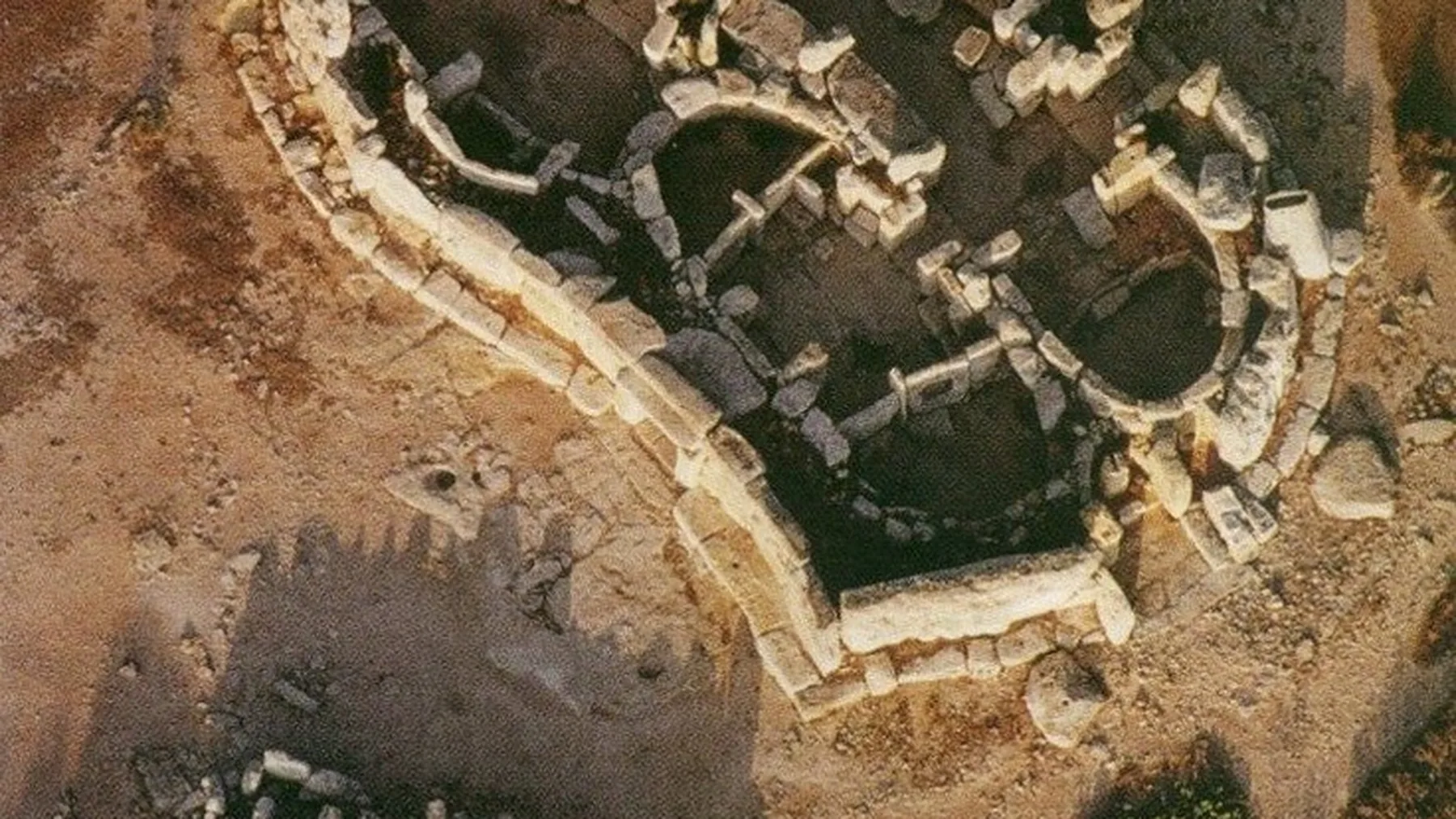
There is a moment that happens to almost everyone who visits Ħaġar Qim for the first time.
You park the car. You walk through the visitor centre. You come out the other side, past the protective membrane that shields the stone from further weathering, and you stand in front of something that the human mind struggles to process properly.
These stones were placed here five and a half thousand years ago. The civilisation that built them had no metal tools, no wheel, no writing. They quarried limestone blocks weighing up to 20 tonnes and moved them, somehow, across a small island — and then arranged them with astronomical precision, so that at the summer solstice sunrise, a shaft of light enters a specific window in the temple and illuminates the inner chamber with the accuracy of a laser.
The Maltese temples predate Stonehenge by a thousand years. They predate the Egyptian pyramids by several centuries. They are, by some measures, the oldest free-standing stone structures on Earth.
What We Know and What We Don’t
The Temple Period civilisation built at least seven major temple complexes across Malta and Gozo between approximately 3600 and 2500 BC. The major sites are:
Ħaġar Qim and Mnajdra (southern Malta, cliff-edge location above the sea): The best preserved and most visited. Mnajdra in particular has extraordinary astronomical alignment — the solstice light-shaft, and an equinox alignment where the sunlight frames the entire entrance doorway precisely.
Tarxien (near Valletta): The most decorated, with spiral carvings and animal reliefs. A colossal statue of a goddess — only the lower half survives — was found here, suggesting the temples were ceremonial sites centred on a deity or deities.
Ġgantija (Gozo): The oldest surviving temples, dating to approximately 3600 BC. The name means “belonging to the giantess” — Gozitan folklore attributed the construction to a female giant, because no ordinary human could move stones of this size. A reasonable reaction.
The Ħal Saflieni Hypogeum (Paola, Malta): Not a surface temple but an underground complex — three levels cut into the rock, used as a sanctuary and a burial site. The remains of approximately 7,000 individuals were found here. The acoustic properties of the central chamber — a resonance that concentrates sound in a particular frequency range — may have been deliberate, designed to enhance ritual use.
What we do not know: who built them, what they believed, why the civilisation disappeared around 2500 BC. The people who built these structures vanished from the archaeological record — replaced, eventually, by a different population. The temples were left, used intermittently, and then abandoned to the hillsides for millennia.
Why Malta Has This Heritage and What It Means
The concentration of Neolithic monument building in Malta — more major temple complexes per square kilometre than almost anywhere on Earth — is still not fully explained. One theory: island isolation allowed a culture to develop intensely without external disruption or invasion. The sea was a barrier that protected the Temple People from the conflicts that swept across the mainland.
Malta’s geography as protective barrier is a recurring theme in its history. The temples. The Great Siege. The Second World War. The island sits at the centre of the Mediterranean — exposed to everything, and yet, repeatedly, surviving.
The Visitor Reality in 2026
Ħaġar Qim and Mnajdra are managed by Heritage Malta and are within a 40-minute drive of Valletta. They are covered by a protective tensile membrane installed in 2009 to protect the limestone from acid rain — an aesthetic compromise but a conservation necessity.
For residents: The temples are worth multiple visits, not just one. The solstice sunrise (21 June) at Mnajdra, when the light-shaft phenomenon occurs, attracts a crowd but is a genuinely extraordinary experience. Book ahead.
The Hypogeum: Visitor numbers are strictly controlled — a maximum of 80 visitors per day, booked months in advance for peak periods. If you are moving to Malta, book Hypogeum tickets before you arrive. This is not an exaggeration. The waiting list in high season can be 3–6 months.
For families with children: The temples are a natural history lesson that no classroom replicates. Children who visit Ħaġar Qim with a good guide — rather than a laminated information sheet — often come away genuinely altered in their understanding of what human beings have been capable of across deep time.
The Bigger Point
I include this article in Malta Unlocked not because it is a tax point or a residency requirement.
I include it because choosing where to live is not only about choosing a tax rate or a residency programme. It is about choosing a place. A context. A civilisation to embed yourself and your family in.
Malta offers something that most jurisdictions in the world cannot: a place where human civilisation has been continuously present for 7,000 years, where the stones in the walls of the house you buy were quarried by Romans, where the language carries the fingerprints of Phoenicians and Arabs and Normans and Crusader knights, where the church at the end of the street has been in continuous use since the Council of Trent.
This is not a commodity. It cannot be replicated in a new-build apartment complex in a low-tax desert emirate or a purpose-built financial services district. It is the accumulated weight of time, and Malta has more of it per square kilometre than almost anywhere.
That matters. It matters to how a place feels. It matters to how children grow up. It matters to what kind of life you are actually building when you move.
The temples are the oldest expression of it. But it runs through everything.