There is a version of Holy Week that most Western Catholics under sixty have never experienced. They know the liturgy — Palm Sunday, Holy Thursday, Good Friday, the Easter Vigil. They have attended the services. But they have attended them in churches that were half-empty, in societies that treat the week as a long weekend, in cultures where the most visible signs of Easter are chocolate eggs in supermarkets.
Holy Week in Malta is public, communal, serious, and alive. It involves the entire country in a way that has no parallel in Britain, Ireland, Australia, or North America. For a Catholic family that has relocated here, or is considering it, Holy Week is one of the experiences that confirms the decision.
Palm Sunday
The week begins with Palm Sunday processions across the island. Each parish distributes olive branches and palms blessed at the morning Masses. Children in their Sunday best. Families walking to church together. The streets of village centres quiet in the morning hours.
In Valletta, the Cathedral and the Co-Cathedral of St John both hold solemn ceremonies. The Baroque interiors — gold, marble, the floor of knights’ tombs, the Caravaggio hanging above the side altar — are full.
Holy Thursday: The Seven Churches
Ħamis ix-Xirka — Holy Thursday — is the day of the seba’ knejjes: the Seven Churches tradition.
The faithful spend the evening of Holy Thursday visiting seven churches to pray before the Altar of Repose — the elaborate installation where the Blessed Sacrament is reserved for veneration. The tradition originates in Rome but has been maintained in Malta with particular devotion.
In Valletta and Mdina, the churches fill from early evening. Families walk the streets — often covering several kilometres across multiple churches — stopping to pray at each altar. The altars of repose are elaborate constructions of flowers, candles, and silver — each parish competing (in the Maltese way) to produce the most beautiful installation.
The atmosphere is unlike any other evening of the year. The streets are busy with people walking between churches, but the mood is quiet. People are doing something real.
Good Friday: The Procession
Il-Ġimgħa l-Kbira — the Great Friday — is the day that most visibly marks Malta’s Holy Week as something distinct.
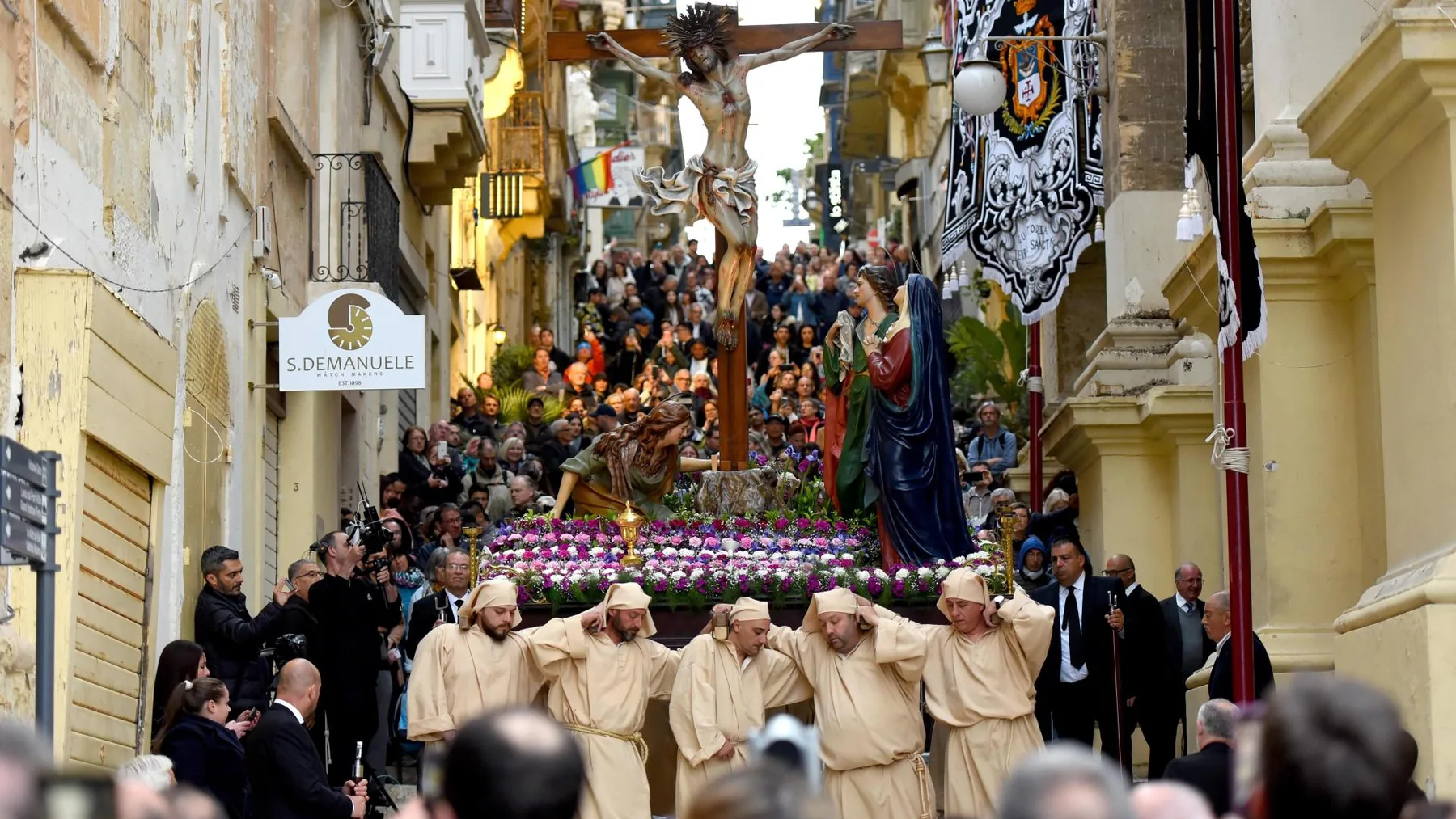
Good Friday processions take place across the island. The largest and most solemn are in Valletta and Rabat/Mdina. Elaborately carved and painted statues — some centuries old — depicting the Passion narrative are carried through the streets on the shoulders of confraternity members dressed in robes of white, red, or purple, depending on the confraternity.
The processions are long — two to three hours — and genuinely moving. There is no equivalent spectacle in Northern Europe. The statues are extraordinary objects: life-sized figures of Christ carrying the cross, of the Sorrowful Mother, of the disciples, all processed through the limestone streets of a medieval city in absolute silence, accompanied only by the slow beat of drums and the occasional mournful blast of a brass instrument.
The crowd is not a tourist crowd. The Maltese attend. Families line the route. Old women in black pray silently as the statues pass. Children watch from their fathers’ shoulders.
For a Catholic who has spent their life in countries where this kind of public expression of faith is either invisible or embarrassing, the Valletta Good Friday procession is a recalibration of what is normal.
The Easter Vigil
The Vigil of Easter Saturday night is, liturgically, the central celebration of the Christian year. The lighting of the new fire, the Exsultet, the readings from salvation history, the baptisms, the first Alleluia of Easter — in most Western parishes, this ceremony is attended by a fraction of the Christmas crowd.
In Malta, the Easter Vigil is attended by full churches. Not out of social obligation — Maltese Catholicism has enough of that — but because the Easter Vigil in Malta has not been allowed to decline into obscurity.
Easter Sunday
Easter Sunday is the great feast. After the solemnity of Holy Week, Easter Sunday in Malta is pure celebration. Churches decorated with flowers. Masses packed. Il-Qagħqa tal-Għid — the Easter ring cake — on every table. Families together. The bells that were silenced from Holy Thursday ring again at the Gloria.
The contrast with the preceding days is vivid. That contrast — darkness to light, fasting to feast, the weight of Good Friday releasing into the joy of Easter Sunday — is not merely liturgical. In Malta, it is social and cultural and public.
Why This Matters for the Decision to Move
I have written in other articles about why Malta’s Catholic culture matters for families making a relocation decision. Holy Week is the clearest single expression of what I mean.
This is a country where the most important week in the Christian calendar is treated as the most important week in the national calendar. Where children see their parents, their grandparents, their neighbours, the whole community, engaging with the faith in public. Where faith is not a private opinion held quietly — it is the architecture of the year.
For Catholic families from Britain, Ireland, or Australia who have worried that moving abroad means losing something of their religious and cultural heritage — Malta does not take that from you. It gives you more of it than you have known.
That is worth knowing before you make the decision.
Book a consultation to discuss building a life in Malta. End of Batch 03 — Articles 21–30
Next batch (Articles 31–40) covers: Malta vs Cyprus head-to-head, The Maltese Foundation for estate planning, Yacht registration deep-dive, Financial services licensing (MFSA), Malta for remote workers and the iGaming workforce, Cost of company formation comparison across EU jurisdictions, The five mistakes we see again and again, Less state more life (political philosophy piece), Holy week follow-up — building community in Malta, and the final anchor piece on 13 years of client experience.