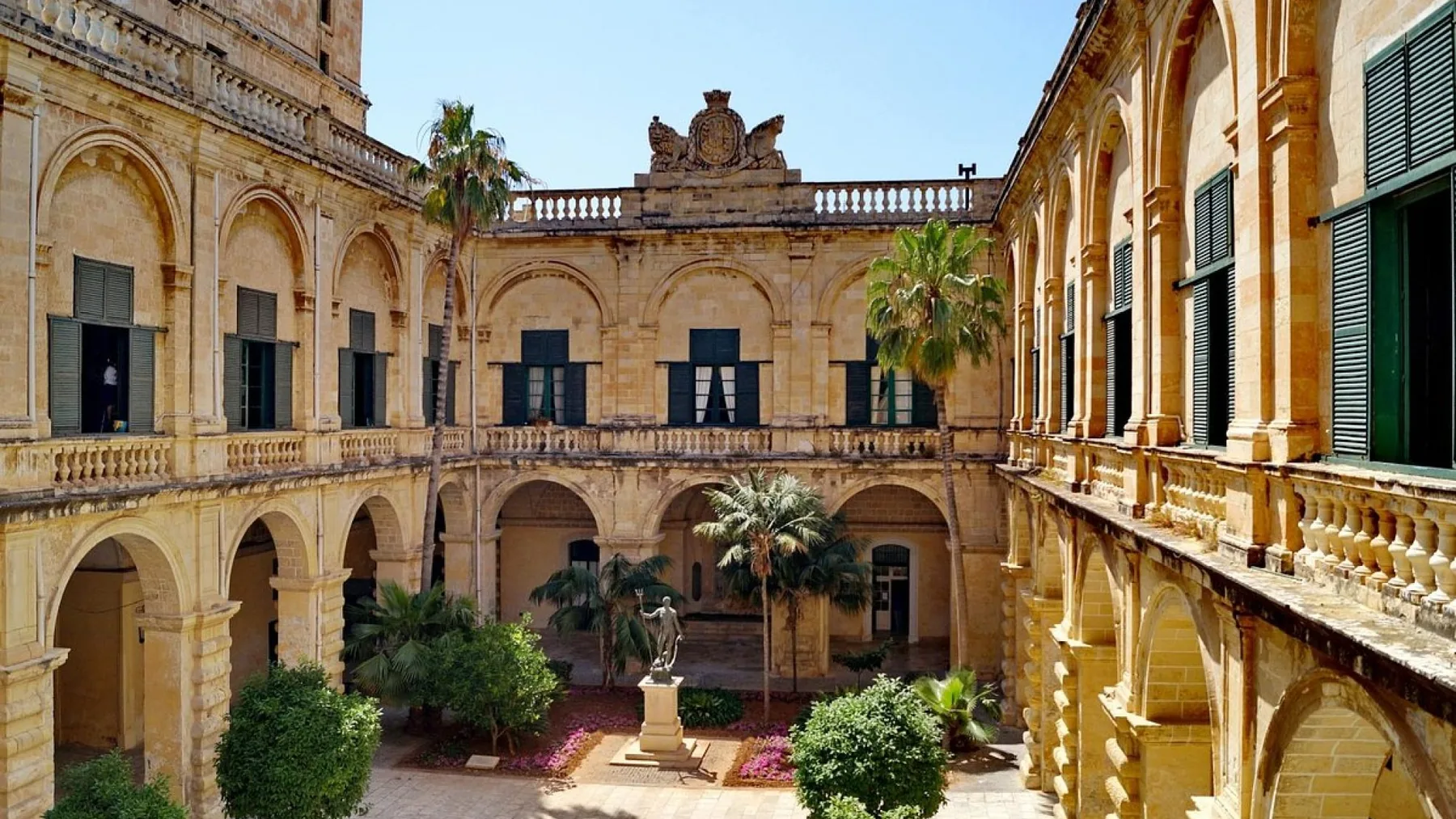
Malta is 316 square kilometres. It has no rivers, almost no natural resources, and sits at the crossroads of a sea that has been fought over for three thousand years. By any rational calculation, it should be an afterthought — a dot in the Mediterranean with nothing particularly special to recommend it.
Instead it is a UNESCO World Heritage capital, one of the most fortified cities in the world, the site of two of history’s most consequential sieges, and the base from which a tiny order of Christian knights held the line between European civilisation and Ottoman expansion.
History made Malta what it is. Understanding that history makes the place make sense — and gives you context for everything from the legal system to the tax framework to the culture of the people you will live among.
Before the Knights: The Long Story
Malta has been continuously inhabited since approximately 5200 BC. The Megalithic Temples — Ħaġar Qim, Mnajdra, Tarxien, Ġgantija on Gozo — were built between 3600 and 2500 BC. They predate Stonehenge by a thousand years. They predate the Egyptian pyramids. The civilisation that built them remains mysterious; its people left no written language, and their temples are among the oldest free-standing stone structures on Earth.
The Phoenicians came. Then the Carthaginians. Then Rome, from 218 BC. Under Rome, Malta was a prosperous provincial outpost — and then, in AD 60, came the shipwreck that changed everything.
St. Paul, on his way to trial in Rome, was driven ashore in a storm. He spent three months on the island. He converted the Roman governor Publius, who became the first Bishop of Malta. Malta has been Christian — without interruption — ever since. Nearly two thousand years of unbroken Christian tradition is not a small thing. It explains the 359 churches, the public prayer in parliament, the constitutional establishment of Catholicism, and the culture that still orders daily life.
The Arabs came in 870 AD and ruled for over two centuries, leaving their mark in the Maltese language — the only Semitic language written in Latin script, a linguistic fingerprint of the Arab period that has survived eight centuries. The Normans expelled the Arabs in 1091 and restored the Catholic faith. Then Aragon. Then Castile. Then the gift — or burden — that defined the island for the next 268 years.
The Knights of St John: 1530–1798
In 1530, the Holy Roman Emperor Charles V gave Malta to the Order of St John of Jerusalem — the Knights Hospitaller — effectively in perpetuity, in exchange for an annual tribute of one Maltese falcon paid to the Viceroy of Sicily on All Saints’ Day. The knights had been expelled from Rhodes by Suleiman the Magnificent in 1522. They needed a base. Charles needed the Mediterranean defended.
The arrangement produced one of history’s most remarkable institutions.
The Knights of St John were a military-religious order founded in Jerusalem in the eleventh century to care for sick pilgrims. By 1530 they had been fighting Islam for four centuries, and they brought to Malta both a military culture of extraordinary discipline and a tradition of hospitality — their great hospital in Valletta, the Sacra Infermeria, was one of the finest medical institutions in Europe, treating patients regardless of nationality or faith.
The Great Siege of 1565 is the event that defines Malta’s identity more than any other. Suleiman the Magnificent — at the height of his power, commanding the most formidable military force in the world — sent approximately 40,000 troops to take the island. The Knights, with perhaps 6,000 defenders including Maltese irregulars, held on for four months. The siege was brutal beyond description — Fort St Elmo fell, and the Knights crucified their Turkish prisoners and floated their bodies across the harbour; Mustafa Pasha responded by beheading all Maltese prisoners and using their headless bodies as rafts. When relief finally came from Sicily in September, the Ottomans withdrew. Perhaps 35,000 were dead on both sides.
Europe celebrated. The news spread across the continent. Pope Pius V called it the greatest Christian victory since the Crusades. Malta had held the western Mediterranean. The Ottoman advance into Europe had been stopped.
The Knights built Valletta immediately after — named for Jean de la Valette, the Grand Master who had led the defence — on a peninsula between two of the finest natural harbours in the world. It was built as a statement, a fortress-city, Baroque in its architecture and military in its logic. Every street runs in a grid to allow cannon fire down any line. The walls are thirty feet thick in places. The Grand Harbour is still, five centuries later, one of the most dramatic urban waterfronts on Earth.
1798 and After
Napoleon took Malta in 1798, almost without a fight. The Knights — by then wealthy, comfortable, and divided — capitulated after two days. The Maltese rose against the French within months, called on Britain for help, and the British came. Malta became a British Crown Colony in 1800 and remained so until independence in 1964.
The British period gave Malta its legal system (common law, with civil law elements), its left-hand traffic, its passion for football, HSBC, the English language as the language of commerce and government, and the George Cross — awarded to the entire island in 1942 by King George VI for its extraordinary resistance during the Second World War siege. Twice in its history Malta has been the hinge on which the Mediterranean turned. Both times it held.
Why This Matters for People Moving Here
I am not writing a history textbook. I am writing for people deciding where to live.
Here is what the history means for that decision.
Malta has institutional depth. A country with 5,000 years of continuous habitation, two millennia of Christianity, 268 years of the most disciplined military-religious order in Western history, and 164 years of British colonial administration does not produce shallow institutions. The legal system works. The courts function. Property rights are respected. The currency is the euro. The government is democratically elected and changes peacefully.
Malta has strategic self-awareness. It has survived because it understood its position and used it. The Knights turned a dot of limestone into the most fortified position in the Mediterranean. The Maltese resisted Napoleon, resisted the Luftwaffe, and joined the EU in 2004. The tax framework — the non-dom regime, the residency programmes, the corporate structure — is a modern continuation of this logic: attract valuable people and capital to a small island that has always needed to offer something the larger powers could not.
Malta has identity. There are places in Europe where you can live comfortably but feel you are nowhere in particular. Malta is not one of them. Every street in Valletta tells you exactly where you are. The language, the religion, the architecture, the food, the village festas, the particular quality of the light on limestone at six in the evening — these things are irreducibly Maltese. If you are looking for a place with a soul, you will find one here.
The knights are long gone. The Maltese cross still flies everywhere. The history did not leave.