There is a piece of folk wisdom they apparently teach the young men at Goldman Sachs, handed down quietly like a family recipe: to stay rich, avoid the second wife, the third house, and the first boat. There is a coarser version too, the kind a man only hears once the lunch has run long and the ties have come loose. Anything that floats, flies, or fs is cheaper to rent than to own.* Vulgar, yes. But like most vulgar things, it is also true.
I have carried that line with me for years, and it has rescued me from more than one moment of weakness on a pontoon somewhere, staring at a hull and quietly imagining myself at the helm of it. I have never bought a boat. Not the smallest dinghy, not the prettiest little classic with varnished teak. And yet I have spent some of the finest days of my life on the water. The trick, it turns out, is to rent the day and keep your freedom.
I have done it in the Philippines, slipping between islands on a slender outrigger. I have done it off Rhodes, where the Aegean lay flat as a sheet of beaten silver. And most recently I did it in Malta, with my son.
Portomaso, the address I once called home
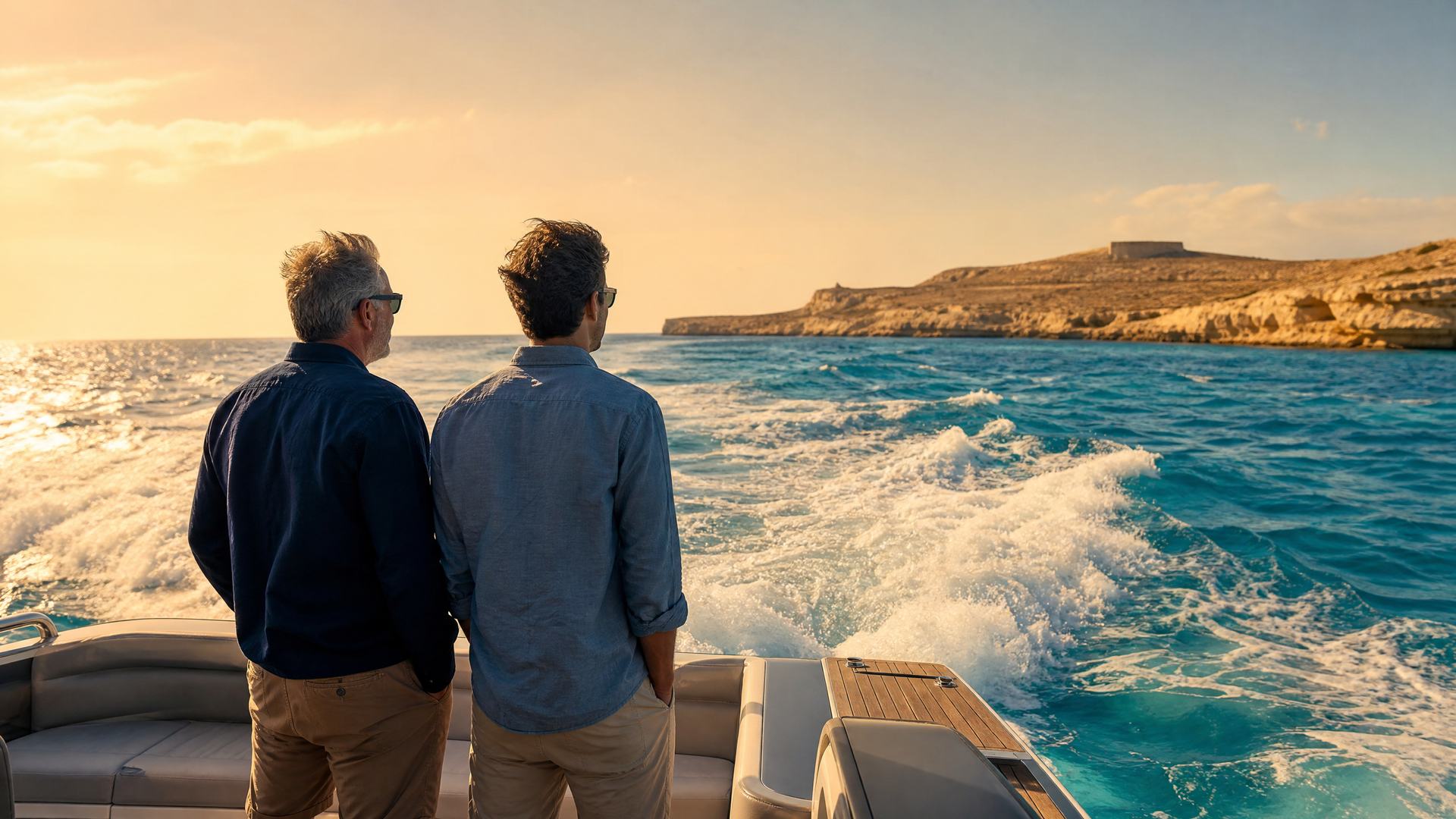
That day it was just the two of us. My boy is twenty-five now, a chef, and at that moment he was between kitchens, which is to say he was at that restless age when a man is still deciding what kind of man he wants to be. We took a taxi out to Portomaso, the marina in St Julian’s where I lived for a stretch of my life, and stepped onto a fifteen-metre motor boat with three engines bolted to her stern and a great deal of menace coiled in them.
Portomaso is the kind of place that makes you understand why people lose their heads over harbours. It sits in the mouth of St Julian’s Bay, tucked behind a solid breakwater so the water inside lies still and dark and expensive. Above it climbs the tower, one of the tallest things on the island, with a glass wine lounge near its summit where the whole bay turns gold at dusk. The berths run for more than a kilometre of waterfront, lined with sailing yachts, sleek motor cruisers, and the occasional superyacht that looks less like a boat than a small embassy. It is, by some distance, Malta’s most coveted address, and you can wander the quay for free and pretend, for an hour, that one of those hulls is yours. You can read more about the marina at Portomaso here.
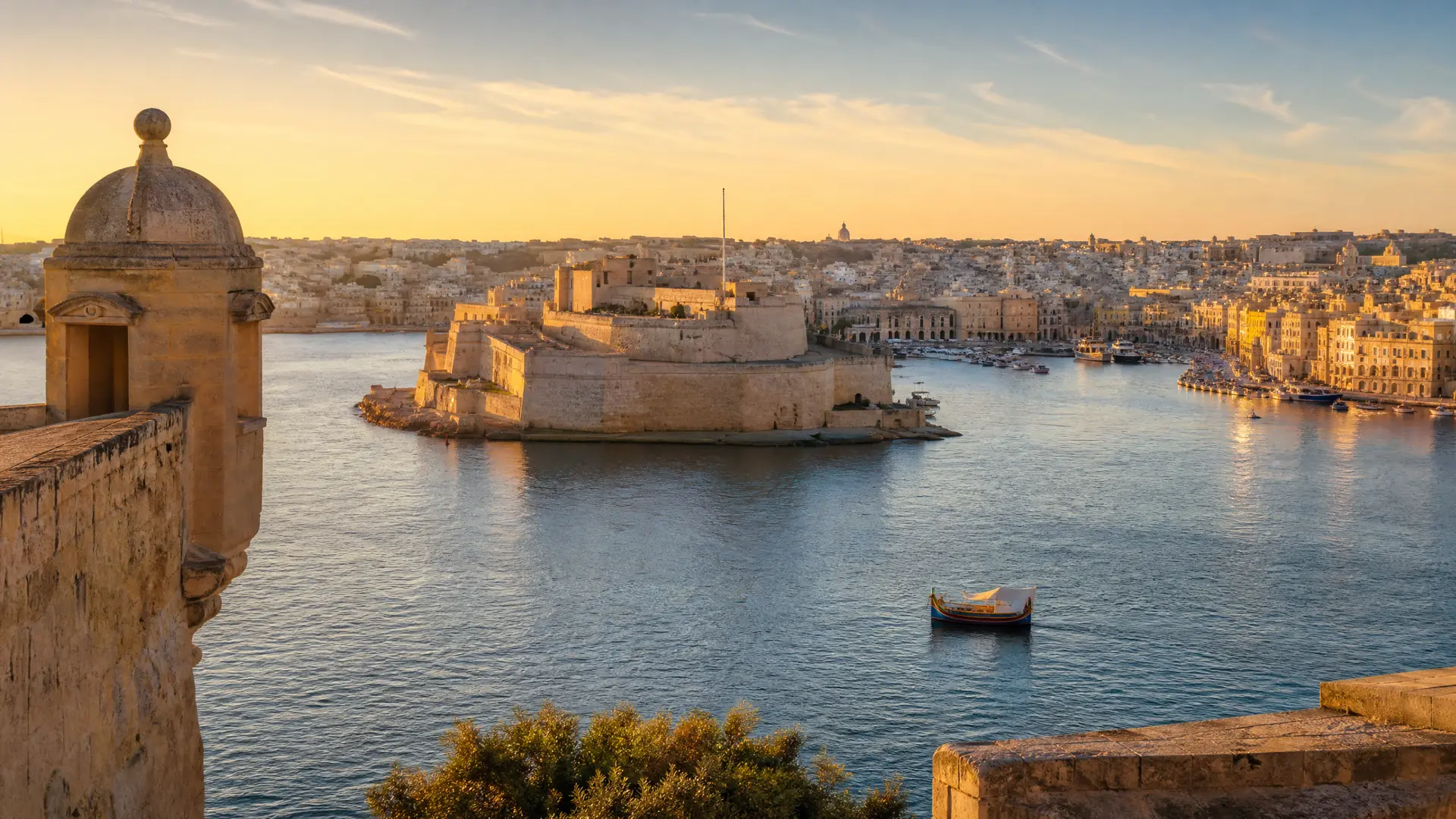
Malta itself is a serious yachting nation, far more serious than its size suggests. The island flies one of the largest ship registers in Europe, hosts the Rolex Middle Sea Race every autumn, and shelters fleets at Grand Harbour, Msida, Ta’ Xbiex, and across the channel at Mgarr on Gozo. For a sun-baked rock in the middle of the Mediterranean, it punches absurdly above its weight on the water. And the best part, for a man of my convictions, is that almost all of it can be chartered by the day. No registration, no winter storage, no slow financial bleed. Just the morning, the fuel, and the open sea.
A guys’ day out
There is something I cannot quite name about a guys-only day out. No itinerary to negotiate, no one to please but each other, no performance. Just two men, an engine, and a horizon. I am convinced that men bond best over a shared activity, shoulder to shoulder rather than face to face, the conversation arriving sideways while the hands are busy and the eyes are on the water.
We opened the throttle and ran north, the bow lifting, Malta falling away behind us in a smear of honey-coloured limestone. We raced across to Gozo, the greener, gentler sister island, all terraced hills and conical knolls, and then doubled back to Comino, the little uninhabited rock that sits between the two like a stepping stone the giants left behind. The Knights of St John once kept Comino as a hunting ground and, when one of their own misbehaved, as a kind of open-air prison. There are worse places to be sentenced.
And then, of course, the Blue Lagoon. You have seen it whether you know it or not, that impossible sheet of turquoise between Comino and its even tinier neighbour Cominotto, where the white sand bottom throws the light back up through the water until the whole bay glows like something lit from below. We dropped over the side and swam in it, and the water was so clear it played tricks on the depth, so that you reached for a bottom that was always a little further than your feet expected. It has become so beloved that you now need a pass to set foot there, the island quietly buckling under the weight of its own beauty. You can find the official Blue Lagoon and Comino guide here.
From there we ran round to Dwejra, on Gozo’s western shoulder, to the place that once held the Azure Window. For more than a century a great limestone arch stood there, twenty-eight metres of stone reaching out over the sea, framing the blue like a doorway carved by the gods. Daenerys Targaryen was married beneath it on screen. Long before that, Perseus fought titans in its shadow. And then, on a gale-lashed March morning in 2017, with nobody there to watch, it gave way. A witness on the cliff said there was a great raging sea, then a single deep whoomph, then a wall of spray, and when the spray cleared there was simply nothing. The arch had folded into the Mediterranean and was gone. Today divers swim through its bones on the seabed, and the rest of us stand at the rail and look at the empty stretch of horizon where a wonder used to be. You can read the full story of the Azure Window here. There is no better monument to the truth that nothing is yours to keep, that the most beautiful things are only ever on loan.
A sea with an edge
The sea was calm that day, or what passes for calm. But it carried an edge to it, noticeably choppier than Rhodes had been. Around Malta the water never quite settles. The island sits exposed in the centre of the Mediterranean with no shelter to soften the swell, and the wind has names here, the Majjistral from the northwest, the Grigal from the northeast, the hot Xlokk that drives up from Africa. Even on a gentle morning the channel between the islands shoulders a short, busy chop that slaps the hull and throws a fine salt mist back across the deck. Off Rhodes, in the lee of the Anatolian coast, the Aegean had lain almost lazy. Here the sea was awake, alert, a little wild, and it made the day feel earned rather than handed to us.
The skipper every man secretly wants to be
But the truth is that the highlight of any boating trip is never the boat. It is the skipper. He is the man every man secretly wants to be, weathered and unhurried, reading the water like a page he wrote himself. And in Malta we were not disappointed.
Our skipper was no hired hand. He was the owner, which changes everything, because a man treats his own boat the way he treats his own name. He had run restaurants on the island his whole life, sold up two years ago, and now kept a second boat in the Seychelles where he ran private cruises through that other paradise. He had the easy authority of a man who has built things and let them go.
And he turned out to be a godsend for my son. Because in Malta, almost nothing runs on paperwork. It runs on people. It is a small, tight-knit island where everyone is two phone calls from everyone else, where a kitchen job is filled not through an advertisement but through a name spoken over a coffee, where who you know is the whole economy. The skipper knew the entire restaurant scene, every chef and every owner, and he took my boy seriously. He gave him tips, real ones, the kind you only get from someone who has stood in the heat of the pass for thirty years. And then he picked up the phone and introduced him to a friend who runs a restaurant on the island, a man who happened to be looking for exactly someone like my son.
So what is the lesson?
By the end of the day my son was quieter than usual, in the good way, the way a man goes quiet when something has settled into place. It was not the boat that did it, nor the swimming in that absurd clear water, nor the islands. Those were only the canvas. The thing that mattered was the camaraderie of it, the older man taking the younger one seriously, the door that opened over a handshake at sea. I could see exactly what it meant to him, and as a father there is no finer feeling in the world than watching that happen to your child.
So what is the lesson here? It is not really about boats at all. Do not buy the boat. Rent the day, keep the freedom, and travel light enough to say yes to whatever the morning offers. Because in the end it will not be the things you owned that made the day. It will be the people you met by chance, or by providence, depending on what you believe. They are the ones who make a life, and you cannot buy a single one of them. You can only show up, throttle open, and let the sea bring them to you.