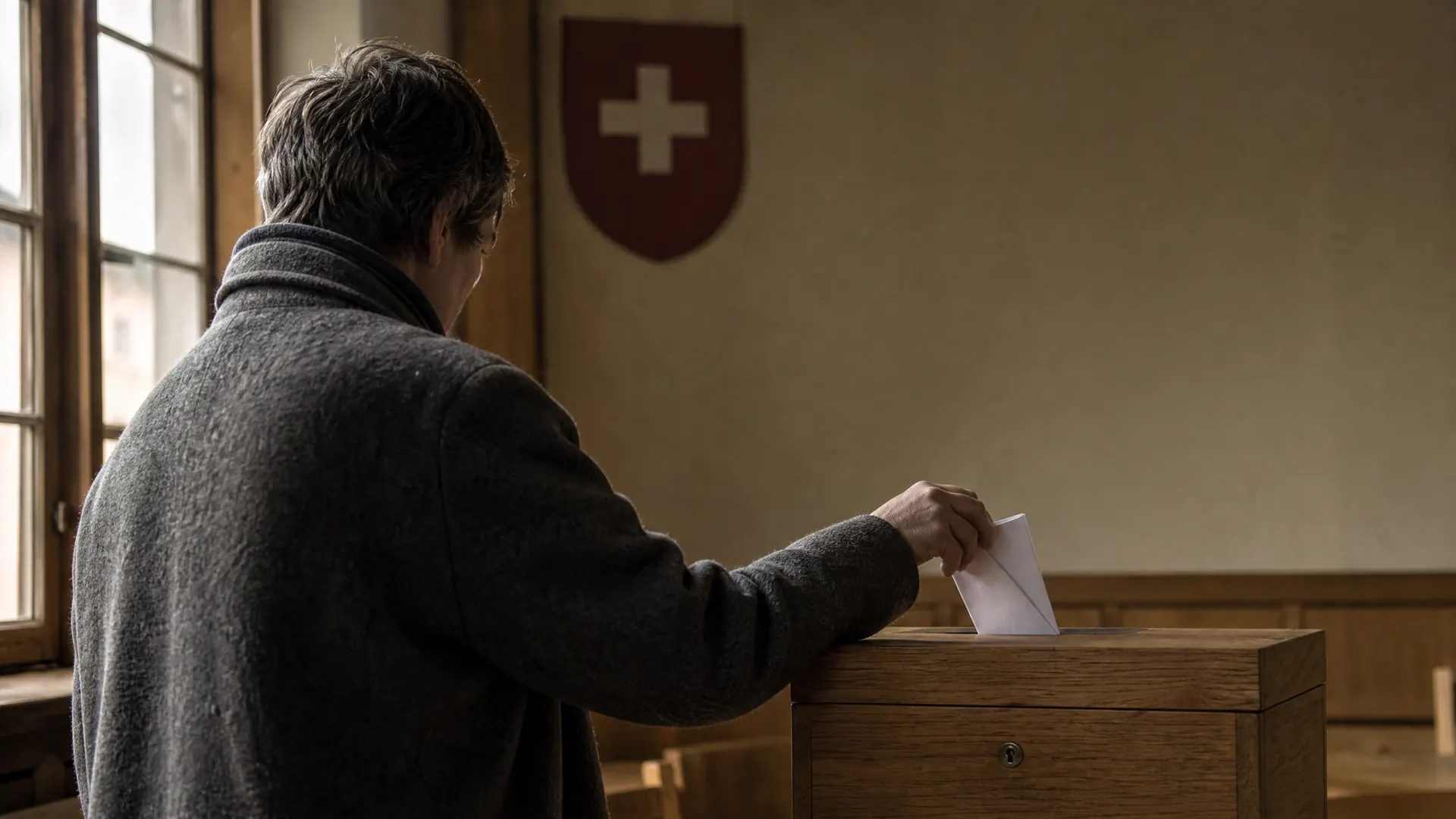
There is a particular stillness to a Swiss Sunday. The shutters are down, the bells carry across the valleys, and once or twice a year the country steps quietly into a side room and decides its own future. On 14 June 2026, beneath that familiar Alpine calm, Switzerland chose a direction for the next generation. The strange thing is how few people seem to grasp what was actually decided.
On paper, the verdict reads as a simple rejection. Voters threw out the SVP initiative to cap the population at ten million, and they did not do it narrowly. Roughly 55 percent voted No against 45 percent Yes, and the proposal failed the cantonal majority too, losing across town and country alike. Turnout pushed past 58 percent, high by Swiss standards. The business federations exhaled. Brussels offered its congratulations inside the hour, and Ursula von der Leyen noted that the Swiss people had spoken and promised deeper cooperation still to come.
That last detail is the one worth sitting with.
The vote was never really about ten million people
Let me concede the obvious first. The cap was a blunt instrument. A hard number written into the constitution, with automatic triggers at 9.5 million, was a clumsy way to manage a real and felt pressure. Rents, trains, hospitals, the slow concreting-over of the landscape: the Dichtestress is not imaginary. A country of 9.1 million, where foreigners already make up nearly 28 percent of the population and where the trajectory points to ten million by the early 2040s, is allowed to ask where the line is. The SVP asked the right question with the wrong tool, and a comfortable majority noticed the tool.
But strip away the mechanics and look at what the ballot actually measured. It measured a mood. The No campaign did not win on demographics. It won on a single sentence, repeated until it became reflex: do not pick a fight with Europe, not now, not in a world of Putin, Trump tariffs and general instability. The vote, fittingly, was compared all week to Britain’s 2016 referendum. Switzerland looked at its own Brexit moment and flinched.
So here is my reading, and I will say it plainly. This was a referendum on integration, dressed up as a referendum on migration. A clear majority of Swiss voters are now, in instinct if not in slogan, pro-EU, pro-NATO, pro-Brussels-stability. Put the question of EU accession on a ballot today, or NATO membership, and I suspect you would see something close to the same 55 percent. The famous scepticism has not vanished, but it has quietly changed sides.
A pendulum that has stopped swinging
For thirty years the Swiss kept Europe at a deliberate arm’s length. In 1992 they rejected the European Economic Area by the thinnest of margins, 50.3 percent No. In 2001 they buried an outright EU-accession initiative under a crushing 76.8 percent. Even in 2014 the Masseneinwanderungsinitiative squeaked through at 50.3 percent Yes, a country wary of opening its borders too far.
The pendulum that produced those results has, I think, come to rest. Today’s electorate is younger, more urban, more frightened of isolation than of integration. The cities now outvote the valleys with confidence, and the valleys know it. SVP president Marcel Dettling said as much on Sunday: the country is being outvoted by its own metropolises. He is right. And a movement that cannot win its signature issue against a wall of money, media and establishment unity has to ask what its alliances are still worth.
The road is already paved
This is where the prediction sharpens, because the next vote is already loaded into the chamber. In March 2026 Bern and Brussels signed Bilaterale III, the package now working through parliament under threat of an optional referendum. Economiesuisse read Sunday’s result correctly and instantly: a population cap rejected is a dress rehearsal for the treaty vote to come, and the same coalition that won today will line up to win that one.
The trajectory from here is not mysterious. It is Bilaterale III first, with its dynamic alignment to EU law and its court of last resort sitting in Luxembourg, and then, once the principle of alignment is normalised, the slow gravitational pull into full integration. The euro will not arrive by referendum slogan. It will arrive the way these things always arrive, as the logical last step of a road everyone has already agreed to walk.
And do not expect Switzerland to be handed a comfortable special arrangement, a Swiss Extrawurst, somewhere along the way. Brussels has spent the last decade making one lesson unmistakable, most recently to London: you do not get the privileges of the club without the obligations. The EU refused the United Kingdom any à-la-carte access to the single market, insisting that the four freedoms are indivisible and that cherry-picking is not on the menu. There is no reason on earth to think a smaller, surrounded, landlocked Switzerland will be offered terms a nuclear-armed former member could not get. It will be the alignment, the court, the contributions and, in time, the currency. All of it.
My prediction: the Sonderfall has about ten years left
So I will make a bold call, and I am happy to be held to it. The Switzerland we have all quietly relied upon, the independent, freedom-loving country with the rock-hard franc, will be gone within ten years. Not invaded. Not coerced. Voted away, one reasonable-sounding Sunday at a time, until alignment becomes membership and the franc becomes the euro, and the Sonderfall Schweiz becomes simply another federal region of a continental project.
The neutrality is already more memory than policy. The banking discretion is long gone. The low, predictable taxation is under pressure from the same harmonisation logic that is dismantling tax competition everywhere in Europe. What is left is a beautiful, orderly, increasingly ordinary EU-adjacent state that has decided stability matters more than singularity. That is a respectable choice. It is simply not the choice the country was famous for.
What this means if you were counting on Switzerland
Here is the practical part, because The Brief exists to turn analysis into action.
If your Plan B rested on Switzerland as the final destination, the safe harbour at the end of the journey, revise it. The qualities that made it the haven, monetary independence, distance from Brussels, a culture allergic to the harmonised European mainstream, are precisely the qualities now on a timer.
That does not make it useless. Switzerland will remain pleasant, functional and wealthy for years yet, and as a pitstop it still has its place. If you need somewhere solid to stand while you arrange the larger move, somewhere to bank, to base, to breathe before relocating to a jurisdiction with a longer runway of genuine sovereignty, then by all means use it. Use it deliberately, and use it knowing the clock is running.
But do not mistake the calm of a Swiss Sunday for permanence. The valleys are quiet because the decision has already been made. The realities, as the losing side rightly noted, always vote too, and they get the last word. On Sunday the country chose its road. The honest among us should at least be clear-eyed about where it leads.
Andere reden. Wir setzen es um.