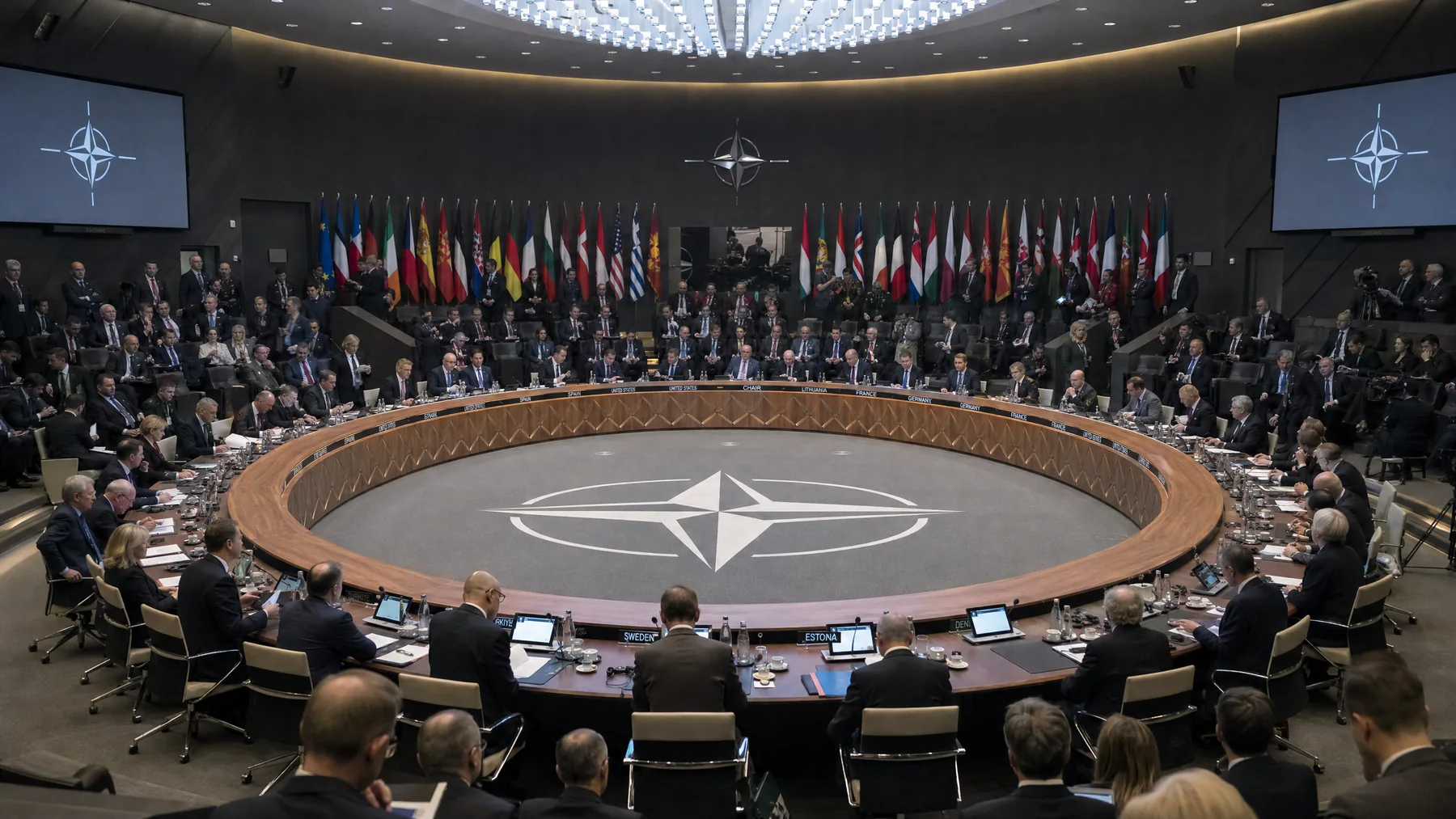
Donald Trump told reporters this week that he was considering pulling the United States out of NATO, or at minimum dramatically restructuring the American commitment to the alliance. The statement was described as "shocking" by European politicians and "unprecedented" by security analysts.
It is neither. Trump said essentially the same things in his first term. He has been saying them for thirty years. The shock is a performance. The underlying complaint is legitimate.
What Trump Is Actually Saying
Strip away the inflammatory delivery and the threat of withdrawal, and the core argument is this: the United States spends approximately 3.4% of its GDP on defence. Most European NATO members spend less than 2%, the alliance's own target. Germany, the continent's largest economy, spent 2.1% in 2025 — finally reaching the target after years of falling short, and still significantly less than the threat environment justifies.
The US has, for eighty years, subsidised European security. This was a deliberate post-war policy choice, designed to prevent the re-emergence of the conditions that produced two world wars. It made sense in 1949. It made less sense in 1989, when the Soviet threat collapsed. And in 2026, with a European economy larger than America's in GDP terms, it makes no sense at all that American taxpayers should be primarily responsible for defending a continent that has the wealth but not the will to defend itself.
Trump is rude about this. He is not wrong about it.
What Europe Has Failed to Do
The failure of European defence investment is not accidental. It is the product of a conscious political choice, made repeatedly across multiple governments in multiple countries, to spend money on welfare states rather than defence, and to rely on America to underwrite the security that made those welfare states possible.
This is not merely a fiscal choice. It reflects a deeper ideological assumption: that the liberal international order, backed by American military power, is a permanent feature of the world rather than a contingent one that requires maintenance.
That assumption is now visibly failing. Russia's invasion of Ukraine demonstrated that military aggression in Europe is not a historical relic. America's political unreliability under Trump demonstrated that the American backstop is not unconditional. China's growing military capability and its support for Russia during the Ukraine conflict demonstrated that the threat environment has become more complex than it has been at any point since 1945.
Europe is beginning to respond. Germany's Sondervermögen, Poland's 4% of GDP defence spending, the Baltic states' fortification programmes — these are serious responses to a serious situation. But they are belated, and the question of whether they will be sufficient before the political window closes is genuinely uncertain.
What This Means for My Clients
The NATO question has direct implications for anyone holding significant assets in Eastern or Central Europe, or in countries close to Russia's sphere of influence.
The probability of direct NATO-Russia conflict remains low. But the probability of further Russian adventurism in the event that NATO's credibility is perceived to have weakened is not negligible.
For clients with significant exposure to real estate, businesses, or financial assets in the Baltic states, Poland, or other frontline NATO members, the current period calls for a clear-eyed assessment of what their exit plan looks like if the security environment deteriorates further.
This is not counsel of despair. It is the same prudence I always advocate: build structures that can absorb a wider range of outcomes than the optimistic scenario. The optimistic scenario — that NATO holds together, Russia is deterred, and European security stabilises — remains the most likely outcome. But likely is not certain, and certain is not the standard you should plan to.
Work with Sebastian
If European geopolitical risk is a variable in your asset planning and you want to think through what resilience actually looks like for your specific situation, this is exactly the conversation I have with clients who are taking the long view seriously. Book a consultation.