Last night on German prime time television, something happened that you should pay attention to if you still hold everything you have ever built inside one country.
A man who sat at the centre of German security policy for over two decades, a former brigadier general of the Bundeswehr and the former military adviser to Chancellor Angela Merkel, raised his voice on national television and said one sentence that should now define the next several years of European risk planning.
His name is Erich Vad. The programme was Markus Lanz on ZDF, broadcast on 21 May 2026. And what he said was this:
"If we keep going like this, we will land in a war with Russia."
That was not a fringe commentator. That was not a Telegram channel. That was the man who, for years inside the Chancellery, was responsible for the military situation briefings that Merkel actually read.
The Sentence That Was Not in This Morning's Headlines
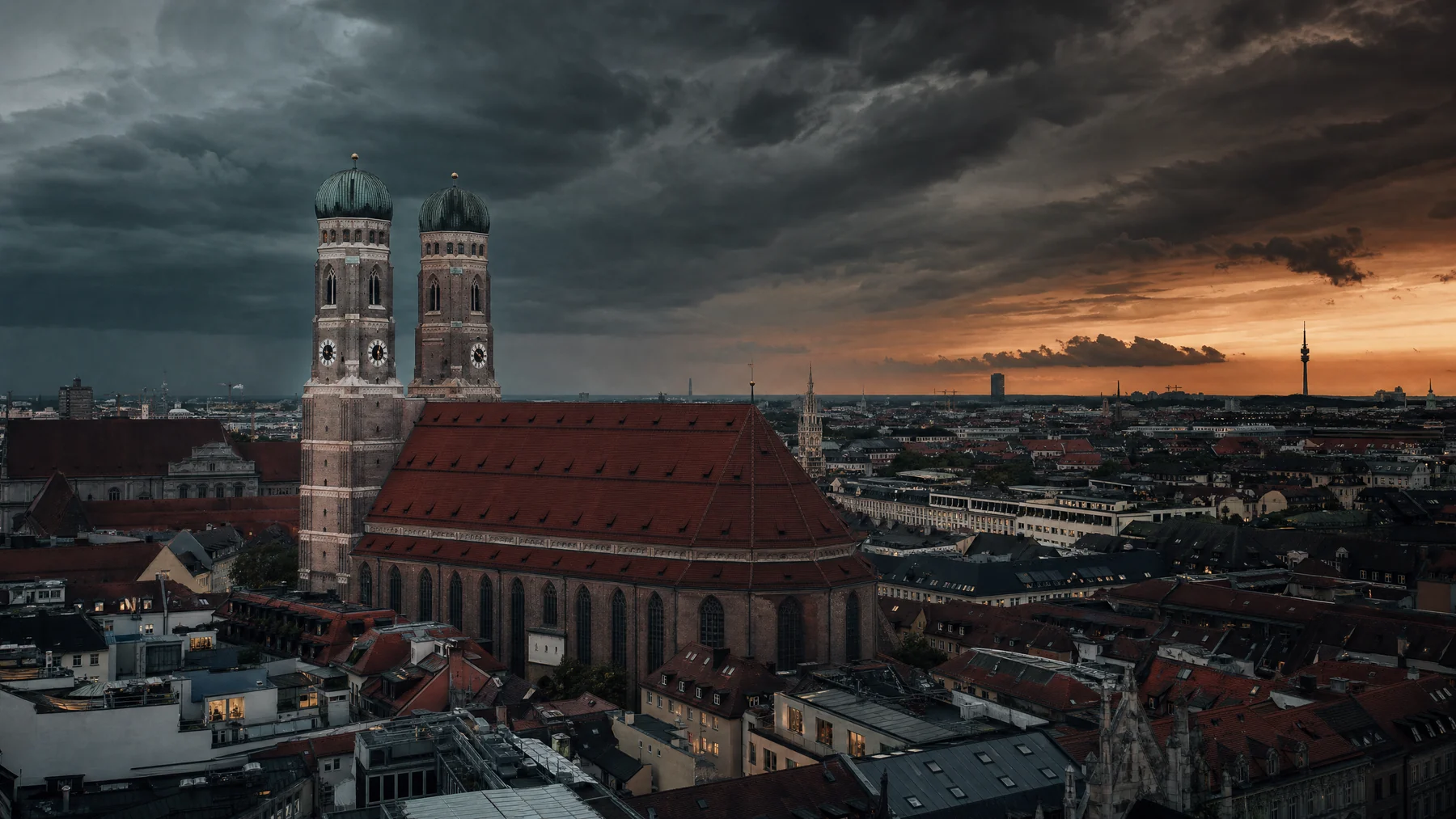
Vad then said the second sentence, the one almost none of the major outlets put into their lead this morning. He said that Moscow has already placed Munich into its targeting planning.
His exact framing on the broadcast: Munich is a hotspot of the German defence industry. The Russians have publicly named the companies involved in Ukrainian deep-strike drone production. They have stated openly that these companies are now part of their targeting. Several of them sit in and around Munich.
Translate that out of military language. Munich is, today, a military target on a foreign great power's published list. Not in 2029. Not in some abstract escalation scenario. Today.
His sparring partner in the studio, CDU politician Roderich Kiesewetter, pushed back. We do not negotiate over Ukraine, Kiesewetter said. Ukraine must be strengthened. Russia must withdraw. Full stop.
And then came the moment that made this video possible at all. Vad turned to Kiesewetter and said, almost verbatim, "You would make a superb Ukrainian defence minister. You see everything only from Ukraine's point of view." And then he raised his voice:
"I do not want a war in Germany from a German point of view. We are NATO's staging area. We are NATO's logistical hub. If there is a European war, it runs through our country."
Sit with that for a second. If there is a European war, it runs through Germany. Not in a far-away country. Not in the Donbas. Not in the Baltics. In Bavaria. In Munich. In the country where most of my German-speaking readers woke up this morning.
What Moscow Has Been Saying While You Were Not Watching
While the Lanz debate played out in front of a German prime-time audience, something else was happening on the other side of the equation. Something that almost nobody in the German mainstream coverage of that broadcast bothered to connect. Let me lay it out for you in order.
6 May 2026: Russia's ambassador to Berlin, Sergey Nechaev, gave a long interview to Izvestia. His message, in plain language: Germany is heading for military confrontation with Russia. That was the official ambassador speaking, not a talk show guest.
7 May 2026: Dmitry Medvedev, deputy chairman of Russia's Security Council, published a long-form essay on RT. He wrote that even the slightest move by Germany toward acquiring nuclear weapons, or seriously exploring a French-British nuclear umbrella for Berlin, would constitute a legitimate casus belli under Moscow's current strategic doctrine. In the same piece he wrote, explicitly, that Europe needs to feel "animal fear" of Russia. A former president of the Russian Federation wrote that. In May 2026. About you.
20 May 2026: The Russian Federation Council passed a law authorising the use of the Russian Armed Forces to protect Russian citizens abroad. Read that one more time. Protect Russian citizens abroad. That is the exact legal construction that was used for Crimea in 2014 and for the Donbas in 2022. It now applies to the Baltics, where large Russian-speaking minorities live. It also applies to Germany, where over two million Russian-speakers live.
Running parallel to all of this, Russian state television continues its rhetorical escalation. Vladimir Solovyov, the Kremlin's most visible TV propagandist, has been openly listing the European cities Russia should "destroy" and "liberate" on prime time Russia-1. Berlin. Vienna. Paris. This is not a fringe figure. This is the man who sets the temperature in the average Russian living room.
And the German government itself is not denying any of this. Foreign Minister Johann Wadephul stated publicly that German intelligence services warn Russia is creating, at minimum, the option to wage war against NATO by 2029. Vad's response to that on Lanz last night was direct: "It starts earlier, if we keep going like this."
The Berlin Phone Line to Moscow No Longer Exists
Here is the part of the Vad interview that should bother every reader who still does business inside the European Union.
Vad made this point on camera. The Americans have been negotiating with the Russians on every channel for the last eighteen months. The British have channels. The Turks have channels. The Saudis have channels. The German government is proud of the fact that it does not talk to Moscow.
In Vad's own words: under every previous chancellor, including Merkel, Berlin maintained hot lines into the Kremlin. Those lines are now all cut.
Translate that operationally. The country that is geographically in the middle. The country that is NATO's logistical hub. The country that hosts the key defence industry. That country no longer has a direct phone line to the man who decides whether the missiles fly.
Vad called the broader situation, where Europe is shut out of the negotiations between Washington and Moscow, "unbearable." His phrasing: a former real-estate broker from Brooklyn and the American president's son-in-law are negotiating over our heads, over our fate.
Meanwhile the new German chancellor Friedrich Merz is writing letters to the EU leadership proposing an "associated membership" for Ukraine. That is the German response to the most dangerous European security environment in forty years. Letters about EU procedure.
What Berlin Is Actually Planning Behind the Curtain
In April 2026, the Federal Republic of Germany approved a military strategy that, for the first time in its history, names Russia explicitly as the principal threat. The Bundeswehr is now planning, on paper, for the movement of up to 800,000 troops and 200,000 military vehicles through German territory in the event that NATO's collective defence clause is triggered on the eastern flank.
The internal Bundeswehr assessment, reviewed by Bloomberg and reported by Euromaidan Press, describes hybrid attacks on critical infrastructure as a "warm-up phase" for open war. That is the literal phrase used inside the German Defence Ministry. Warm-up phase.
Sweden, Norway and Finland have already distributed civil-defence pamphlets to their citizens explaining how to prepare for the possibility of conflict on European soil. The Munich Security Report 2026 opens with the assessment that Europe's security environment is "bleak and uncertain" and that ceasefire negotiations have so far been "if not outright damaging to the prospects for long-lasting peace."
The European Union Institute for Security Studies, in its January 2026 risk survey, named a disruptive Russian hybrid attack on EU critical infrastructure as the single most likely high-impact scenario for the coming year. Subsea cable sabotage. Coordinated power grid disruption. Logistics paralysis. CEPA's 2026 outlook went further and called this Europe's "year of living dangerously." The Atlantic Council has published a five-scenario analysis of how Russia could probe NATO, and the Belfer Center at Harvard has published a detailed northeastern-flank threat assessment describing how the Russian military could employ Kinzhal and Kalibr systems against targets from Germany to the United Kingdom.
None of this is conspiracy material. All of it is mainstream policy analysis, written by people who do this for a living, published in the last six months.
The Uncomfortable Question
Here is the question I want you to actually answer, not in your head, on a piece of paper.
If your own foreign minister is warning about 2029. If your own military planners are planning for 800,000 troops moving east through your country. If the former military adviser to the chancellor goes on television and says the timeline is earlier than 2029. If the Russian ambassador in Berlin says publicly that Germany is heading into confrontation. If the Russian deputy security council chairman is writing that German moves toward nuclear capability would be a casus belli. If the Federation Council has just passed a law that mirrors exactly the legal pretext used in 2014 and 2022.
If all of that is true, what is your plan?
Are you waiting? Are you hoping that the foreign minister is wrong? Are you hoping that Vad is wrong? Are you hoping that Medvedev is bluffing? Are you hoping that the German government, which does not even have a hotline to the Kremlin, will, somehow, get you out at the right moment?
That is a plan. It is just not a good one.
The Plan B Logic, Without the Drama
Let me tell you how I see this, because my job, for over twenty years, has been exactly this question.
I left Germany in the year 2000. I have lived since then across Switzerland, the UK, the US, Malta, Ireland and Scotland. Back in 2000, people asked me why I was leaving. Everything was fine. There was peace. Nobody was talking about war with Russia. Munich was a business city, not a hotspot on a foreign general staff's target map.
I think about my great-grandfather Nikolaus Ehlen often when I write pieces like this. In the 1930s, in Germany, he saw which way the country was going and he said so out loud. The regime imprisoned him for it and imposed a Redeverbot, a formal ban on speaking in public. He stayed in the country. He survived. But the generation that lived through that decade learned, painfully, what happens when you wait too long to act on what is clearly in front of you.
I am not telling you Germany is the Reich. It is not. I am telling you something different, and arguably more uncomfortable. I am telling you that Germany, by the explicit planning of its own military, is the staging ground for the next European war if that war comes. The columns that would be sent to fight Russia run through your country. The logistics that would supply that fight sit in your country. And in the symmetrical Russian planning, the missiles intended to destroy that logistics land in your country.
That is not apocalyptic speculation. That is the open statement of a brigadier general on German prime time television, 21 May 2026.
What an Adult Plan B Actually Looks Like
If you are in this situation, sensible families have done the same thing for centuries, when they were sensible. They never held everything in one jurisdiction. Not their capital. Not their tax residence. Not their family. Not their operating business. Not their passports.
Concretely, in 2026 terms, that means a small number of moves that you can begin this quarter:
A second residence, ideally outside the NATO staging area. Paraguay, Uruguay, Panama, the UAE, Mauritius, Costa Rica. Each of these is achievable inside two to six months for someone willing to commit.
A second passport, sized to your family situation and capital base. Maltese, Irish, Caribbean. The window on most of these programmes is narrowing every year.
A bank account outside the reach of your home jurisdiction's crisis legislation. Not for hiding anything. For optionality.
A meaningful slice of your assets held in physical form, outside your home country, outside the euro, and outside the political reach of a single legislator.
None of this is illegal. None of this is tax evasion. All of it is standard risk management at every serious Swiss, British or American family office. The only place in the world where this kind of basic diversification is treated as morally suspect is the German-speaking media environment. Ask yourself who benefits from that framing.
The Window Closes Before the Headline
One thing I have learned with absolute certainty in the last twenty-five years of this work: it will always feel too early to build a Plan B, right up until the moment it is too late. There is no comfortable middle point.
When the headline gets large enough that your brother-in-law and your neighbour are also talking about it, the visa windows are closed, the bank accounts are no longer opening for new non-residents, the property prices in the obvious destination countries have risen thirty percent, and every serious immigration lawyer in your chosen jurisdiction is booked solid for the next twelve months.
Erich Vad did not say last night what you should do. That is not his job. His job was to read the military situation honestly in front of a national audience. My job is to tell you the operational consequence of his reading.
The operational consequence is that you do your homework now. Not in the autumn. Not after the next election. Not after the next drone lands inside Germany.
If you do not build a Plan B, you have implicitly chosen one. Your default plan is to trust that a government that does not even maintain hot lines to the Kremlin will, somehow, look after you when this gets serious. You are free to make that bet. Just make it deliberately, with your eyes open, and not by accident.
I run confidential consultations for entrepreneurs, investors and families who want to think through this seriously. Details and availability are on the Work With Me page. I do not take every enquiry. I do not sell dreams. I build optionality. Nothing more.
For twenty-four years I have lived this question, across more than ten countries and four continents. I can tell you from direct experience: life is not over when you leave Germany. It begins differently. With less tax, more sun, fewer rules, and far more responsibility for yourself. More money. More freedom. Less state.
That is the principle I have worked by for two decades. It has never been more relevant than the day a German brigadier general stated, on national television, that Munich is on the target list.
Do what you can. Do it now. Life is short and fleeting. One shot. Make it count.
Carpe Diem, Sebastian
Sebastian
Sources
Markus Lanz on ZDF, broadcast on 21 May 2026
openly listing the European cities Russia should "destroy" and "liberate"
up to 800,000 troops and 200,000 military vehicles
Europe's "year of living dangerously."
a five-scenario analysis of how Russia could probe NATO
Belfer Center at Harvard has published a detailed northeastern-flank threat assessment