A Narrow Strip of Water, and Everything That Lies Beyond It
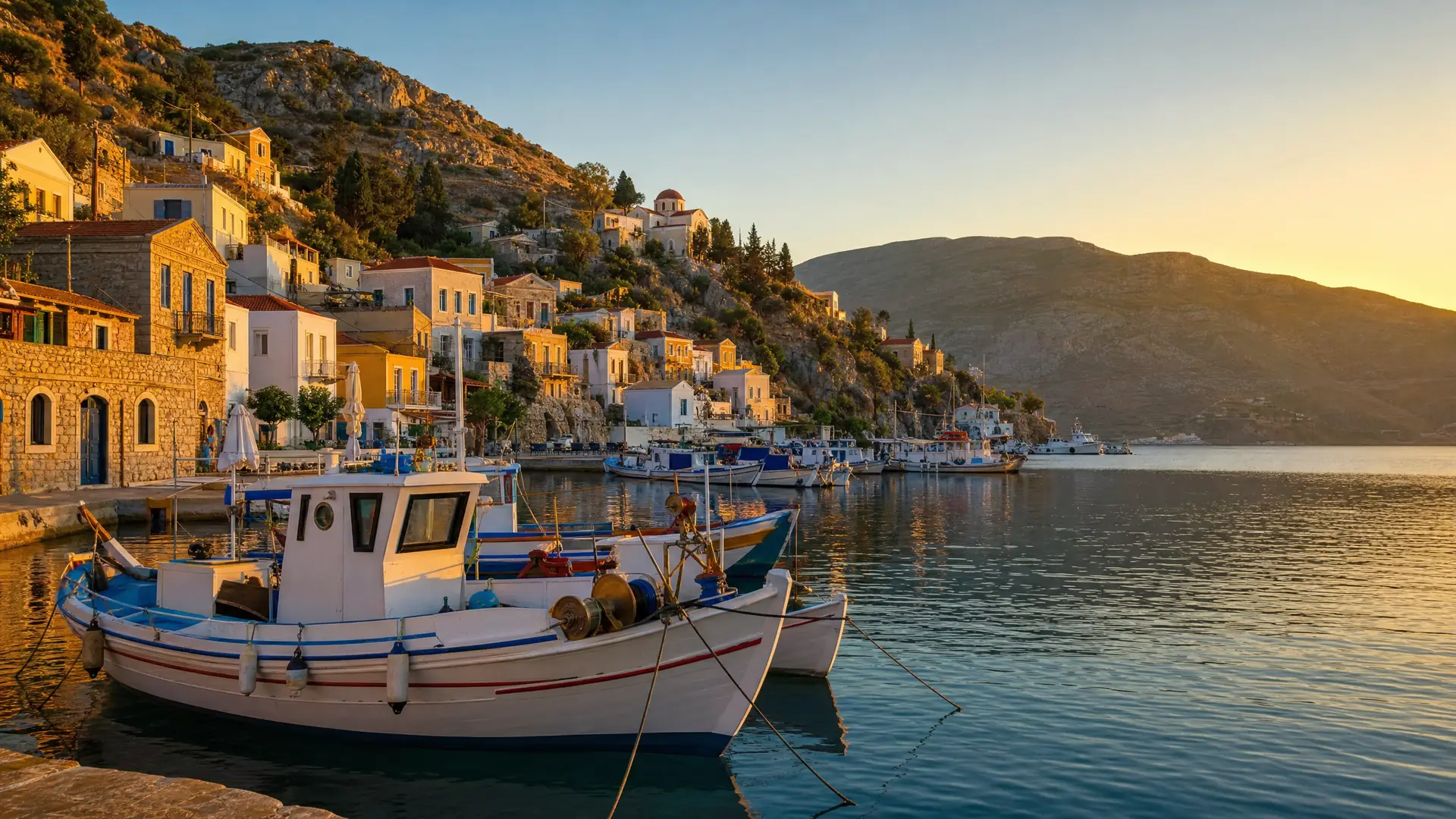
Standing at the stern of a wooden kaïki somewhere between Rhodes and the Turkish coast, which you can see clearly on the horizon — maybe fifteen kilometres away — the contrast is almost disorienting.
The water is clear enough to see the bottom. The air smells of salt and pine resin. A fisherman is hauling a net nearby, apparently unconcerned with anything beyond the weight of it.
And somewhere beyond that horizon, in a chain of countries stretching to the Gulf, the world is in a state that would have seemed like fiction five years ago. The 2026 Iran war has produced a fragile, repeatedly-violated ceasefire. The Strait of Hormuz — one of the world’s critical oil chokepoints — has been closed, reopened, and closed again. As of this week, US forces struck Iranian missile launch sites around the Strait while officials simultaneously insisted the ceasefire was “ongoing.” Twenty-six countries issue travel advisories. Thousands of Europeans were stranded in the Gulf in March. France had 400,000 nationals in the region requiring potential assistance.
The boat skipper put it well the day before. If there’s ever a zombie apocalypse, I’d just live on the sea. On this boat. He meant it as a statement about the Aegean. I take it as a statement about Greece.
The question this article addresses is practical: if you are not an EU citizen, how do you secure a legal foothold here?
The answer is the Golden Visa.
The EU Citizen Caveat — Read This First
Let’s be direct.
If you are a citizen of an EU member state, you do not need a Golden Visa. EU free movement already gives you the right to live, work, study, and retire in Greece without any investment threshold, any application, or any waiting period. You can buy property, register as a tax resident, and access every one of the tax programmes described in the companion article to this one — the non-dom €100,000 flat tax, the 7% pension regime, and the 50% new resident exemption — simply by virtue of your EU passport.
The Golden Visa exists for everyone else. Americans, Britons (post-Brexit), Australians, Canadians, Gulf nationals, Chinese, South Africans — anyone who currently needs a visa to stay in Europe beyond 90 days in any 180-day period. That is the audience this programme was designed for.
What the Programme Actually Gives You
The Greece Golden Visa grants a five-year renewable residence permit to non-EU citizens who invest in qualifying assets. You and your eligible family members can live in Greece and travel freely across the Schengen zone’s 26 countries.
The key features:
No minimum stay. You are not required to live in Greece to keep the permit. You can renew it without a minimum stay, as long as you retain the investment. Live in Singapore or São Paulo and still hold a valid Greek residence permit — your European door, left open.
Schengen access. With a Greek residence card, you travel freely within the Schengen Area for up to 90 days in any 180-day period without needing a separate visa. France, Germany, Italy, Spain — accessible as a tourist using your Greek card.
Family inclusion. Spouse or partner, dependent children, and in some cases parents can all be included on the primary applicant’s permit.
Path to citizenship. The permit doesn’t directly confer citizenship. Obtaining a Greek passport requires living in Greece for at least 183 days per year over 7 years. That’s a meaningful threshold — but it’s there for those who want it.
Tax residency is separate. The Golden Visa does not make you a Greek tax resident. Spend fewer than 183 days per year in Greece and you remain non-resident for Greek tax purposes. Only Greek-source income is taxed in Greece for non-residents. Many holders use the permit purely as a Plan B — a legal right to be in Greece if and when they need it — without triggering any Greek tax obligations at all.
The Investment: What You Need to Spend, and Where
This is where you need to read carefully, because Law 5100/2024 significantly revised the thresholds and the rules vary by location.
Real Estate — the most common route
€800,000 applies to Attica (all of Athens and the Athens Riviera), greater Thessaloniki, Mykonos, Santorini, and islands with populations above 3,100 people.
€400,000 applies everywhere else in Greece.
€250,000 is still available — but only for properties requiring renovation, including commercial-to-residential conversions.
Under both the €400,000 and €800,000 thresholds, you must purchase a single property of at least 120 m². No combining multiple smaller titles. Properties can be rented out — but only on a long-term basis (minimum one year). Short-term rentals such as Airbnb are strictly prohibited on Golden Visa properties.
One notable 2026 upside: property transfer tax is a flat 3%, and the VAT suspension on new builds has been extended through 31 December 2026 under Law 5246/2025.
Alternative routes
For those who don’t want to buy property: €350,000 or more invested in shares in investment funds, stocks, or Greek government bonds qualifies. This route requires a national D visa to enter Greece before applying — an additional procedural step.
Long-term hotel or tourist leases (minimum 10 years, minimum €400,000) also qualify, as do certain timeshare arrangements.
The Numbers Behind the Programme
From just 1,993 applications in 2021, the Greek Golden Visa reached a record 9,407 applications in 2024. In the first four months of 2025 alone, 3,506 applications were filed. American approvals were up approximately 49% year-over-year through late 2025.
This is not a niche programme. It has been running since 2013, it is well-tested, and it is gathering pace precisely because the world is getting more complicated. A prominent recent applicant: Novak Djokovic, who purchased a property in southern Athens for over €800,000, meeting the new threshold. When tennis’s all-time greatest player decides he needs a Greek base, it’s worth noting.
The Case for Greece Right Now
The ceasefire that technically ended the Iran war is being violated on a near-daily basis. The Strait of Hormuz remains the site of active brinkmanship. Lebanon continues to burn. The US State Department has issued travel advisories covering much of the Middle East.
Meanwhile, Greece’s bookings are up 34% year-on-year. The country has emerged as the clear safe haven of the Eastern Mediterranean — geographically stable, EU-anchored, NATO-backed, with infrastructure that handles tens of millions of tourists per year without breaking.
The boat skipper’s philosophy isn’t just colourful. It’s structurally sound. When the external environment gets unpredictable, you want a base with functioning institutions, a stable currency, access to the Schengen zone, warm weather, and a coastline that has absorbed three thousand years of upheaval and remained intact.
A Greek Golden Visa gives you a door into that. It gives your family a place to go. It gives you a real asset in one of Europe’s most beautiful property markets. And — for those who choose to activate the tax programmes alongside it — it gives you access to the non-dom flat tax, the 7% pension regime, and the 50% income exemption described in the companion piece to this article.
Quick Reference: Greece Golden Visa 2026
| Who can apply | Non-EU, non-EEA nationals aged 18+ |
| EU/EEA citizens | Not eligible — free movement already applies |
| Entry point (renovation/conversion) | €250,000 |
| Standard threshold (outside high-demand) | €400,000 |
| High-demand areas (Athens, Thessaloniki, Mykonos, Santorini, larger islands) | €800,000 |
| Alternative route (funds/bonds/stocks) | €350,000+ |
| Minimum property size | 120 m² (single property only) |
| Short-term rentals (Airbnb) | Prohibited on Golden Visa properties |
| Minimum stay requirement | None |
| Permit validity | 5 years, renewable |
| Family members included | Yes (spouse, children, parents) |
| Path to citizenship | 7 years at 183+ days/year in Greece |
| Processing time | 6–9 months |
| Greek tax residency triggered | Only if you spend 183+ days/year in Greece |
If you want to understand how the Golden Visa fits into a broader international structure — combining Greek residency with the right tax programme and the right asset base — that’s exactly the kind of conversation I have with clients every day.
Sebastian Sauerborn is an international tax and emigration adviser. He has lived across Switzerland, the UK, the US, Malta, Ireland, and Scotland over 25 years and currently divides his time between London and Austin, Texas.