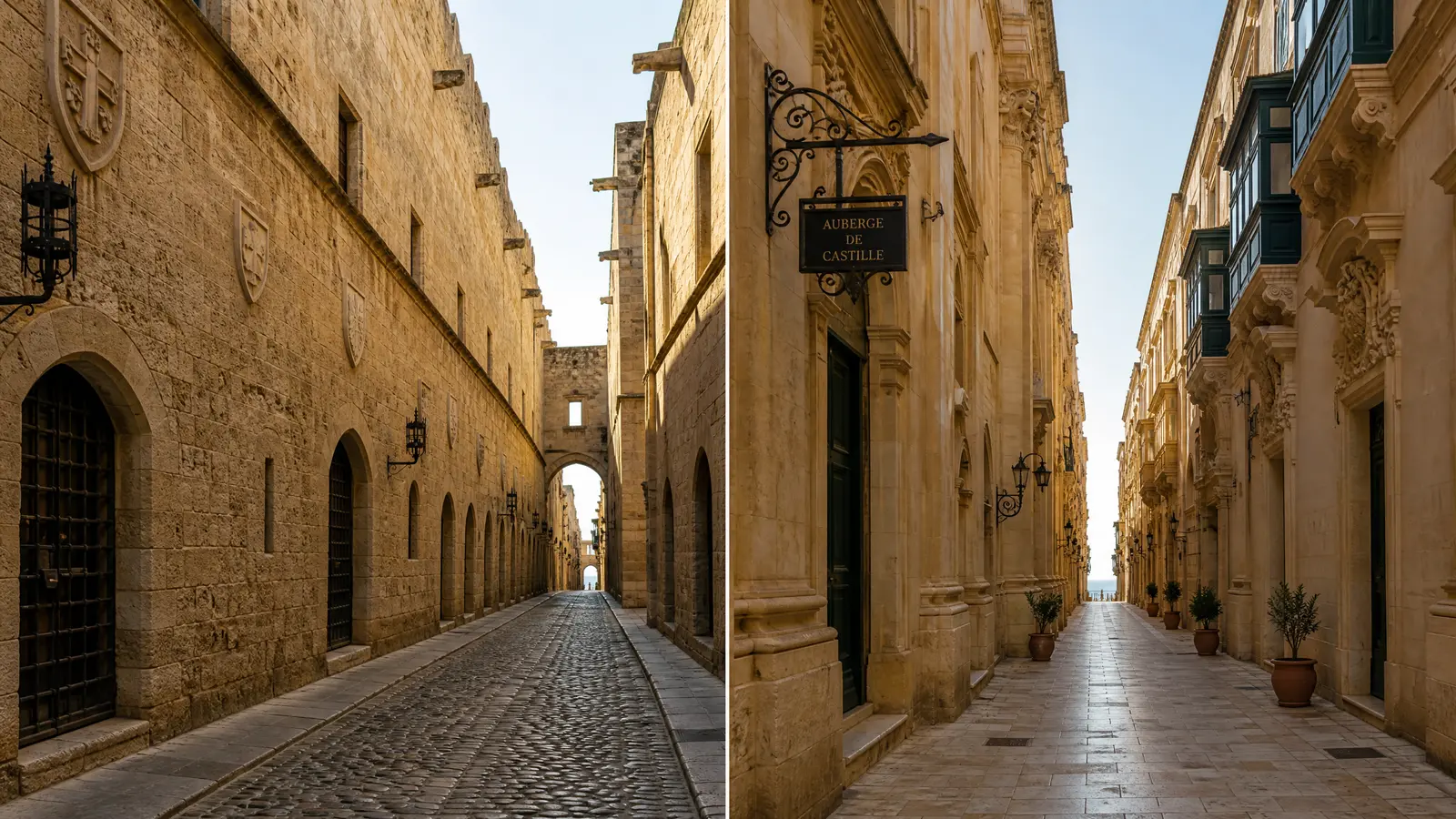
This is Part 5 of Malta vs the Mediterranean, our seven-part series comparing Malta with Mallorca, Ibiza, Sicily, Corsica, Rhodes, Madeira and Cyprus. As declared at the outset: the tax contest is over and Malta won it, non-dom architecture against the field, and yes, Greece fields respectable regimes for pensioners and large fortunes, but that verdict does not change. This series asks the other question, the human one: "Never mind tax. Where is the better life?" And with Rhodes, uniquely, we have a precedent to consult. The same people once owned both islands, and they chose.
Walk the Street of the Knights in Rhodes Old Town at seven in the morning, before the cruise ships exhale, and you will feel something uncanny if you know Valletta: you have walked this street before. The same honey stone. The same auberges of the langues, France, Italy, England, ranked along a rising lane. The same eight-pointed cross cut over the doors. This is no coincidence. The Knights Hospitaller ruled Rhodes for two centuries, were besieged out of it by Suleiman in 1522, wandered homeless for eight years, and in 1530 accepted a barren yellow rock further west for the rent of one Maltese falcon a year. Everything Valletta became, they had rehearsed in Rhodes. Malta vs Rhodes is not a comparison I invented. It is a decision history already made once, at swordpoint. Our job is gentler: would you make the same trade today, with no Ottoman fleet on the horizon?
The two islands at a glance
| | Malta | Rhodes | |---|---|---| | Population | ~570,000, a sovereign state | ~125,000, one island of Greece's far southeast | | Size | 316 km² | 1,400 km² | | Daily language | English (official) | Greek; fluent tourist English in season | | Serious healthcare | Mater Dei, 15 minutes away | General hospital; complex cases fly to Crete or Athens | | Sunshine | ~300 days | Among the sunniest places in Europe | | Winter life | Full | Rhodes Town lives; resorts close | | Cost feel | High | Refreshingly low | | Tax in one line | Non-dom, wins | Greek regimes decent, not decisive |
What Rhodes offers: sun, stone and softness
Rhodes is the sundial of Europe. Even Malta, no slouch at three hundred bright days, glances enviously at an island where sunshine is practically municipal infrastructure. Around that sun: the largest inhabited medieval town in Europe, a UNESCO citadel where people still live inside the walls; Lindos stacked white beneath its acropolis; valleys of butterflies, long sand at Tsambika, the wind-whipped beaches of Prasonisi where two seas meet. And around all of that, Greek island life at Greek island prices: the taverna lunch that costs less than a Valletta coffee ritual, rents and property that read like Malta a decade ago, and the deep, unhurried warmth of the Dodecanese, where philoxenia, the love of the stranger, is not a tourism slogan but a household law.
The vibe is the gentlest in this series so far. Not Ibiza's performance, not Sicily's opera, not Corsica's guardedness. Rhodes is soft. Life happens at kafeneio pace, in courtyards, at the temperature of late afternoon.
What the knights knew: the smallness problem
Now the harder truth, and the knights themselves teach it. Rhodes, for all its glory, is one island of 125,000 people at the far edge of Greece, and that fact carries consequences the brochures skip. The general hospital serves daily life; anything complex means a flight to Crete or, more likely, Athens, and in winter those flights thin toward a trickle routed through the capital. International schooling is essentially absent; your children live in Greek or they board elsewhere. The economy is tourism and little else, so the off-season empties not just the resorts but the ambition of the place; the island's own graduates leave for Athens the way Sicily's leave for Milan. And every administrative act, property, permits, disputes, proceeds in Greek, at Aegean tempo, with the capital far away in every sense.
Malta's counter-position is by now the series refrain, but notice how precisely it answers each gap: a sovereign state rather than a periphery, with the hospital fifteen minutes from every door and a public system open even to a newly self-employed arrival; English by statute in every court, contract and classroom; a full English-language school stack; an economy of finance, gaming, maritime and services that works in February; and an airport flying direct, year-round, to forty-plus cities rather than seasonally through a hub. The knights arrived on a rock with none of Rhodes' natural gifts and built all of this anyway, because what they carried was not landscape but institutions. Five centuries later, the institutions are still the product.
Beauty: a family argument
Comparing Valletta and Rhodes Old Town is comparing father and son: the medieval original against the Baroque perfection built by the same order in exile. Rhodes' walls are more romantic; Valletta's harbour is more sublime; the island of Rhodes is greener and better-beached than Malta will ever be. Call the beauty contest a draw between siblings, and note that no other island in this series can make Malta feel like family.
The verdict
Choose Rhodes if you want the softest, sunniest, cheapest good life in this series: a healthy retiree's paradise or a remote worker's dream, provided your health is sound, your children grown or unfazed by Greek school, and your winters portable.
Choose Malta if you need what the knights needed: a small place with large-country machinery, hospitals, schools, courts, flights and an economy that never closes, wrapped in the same golden stone.
In 1522 the knights lost paradise and were handed a rock. They turned the rock into the better fortress, the better hospital, and finally the better city. Rhodes is where the story began. Malta is where it worked. I choose the sequel.
Next in the series: Malta vs Madeira, the Atlantic garden that competes on eternal spring.