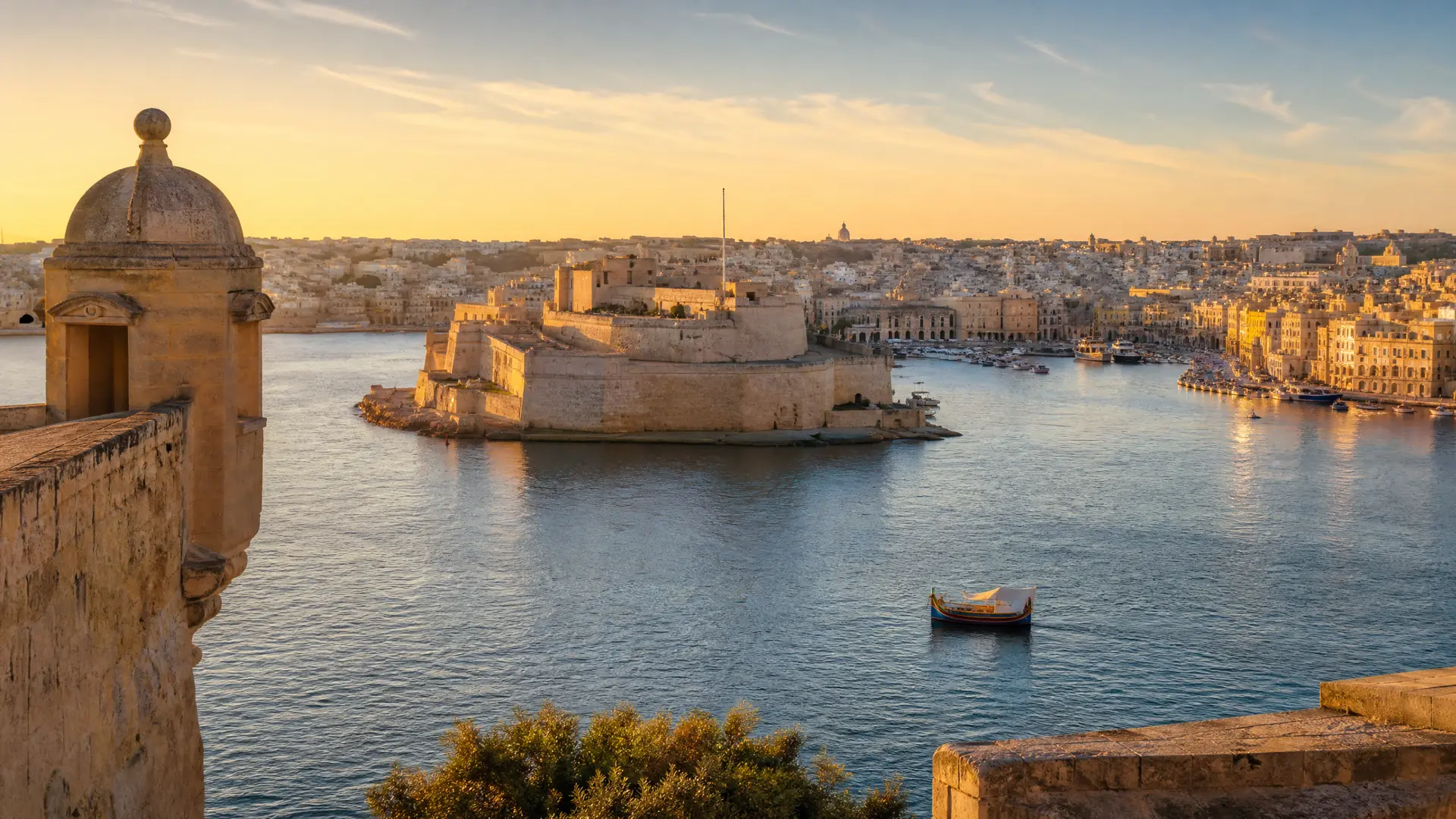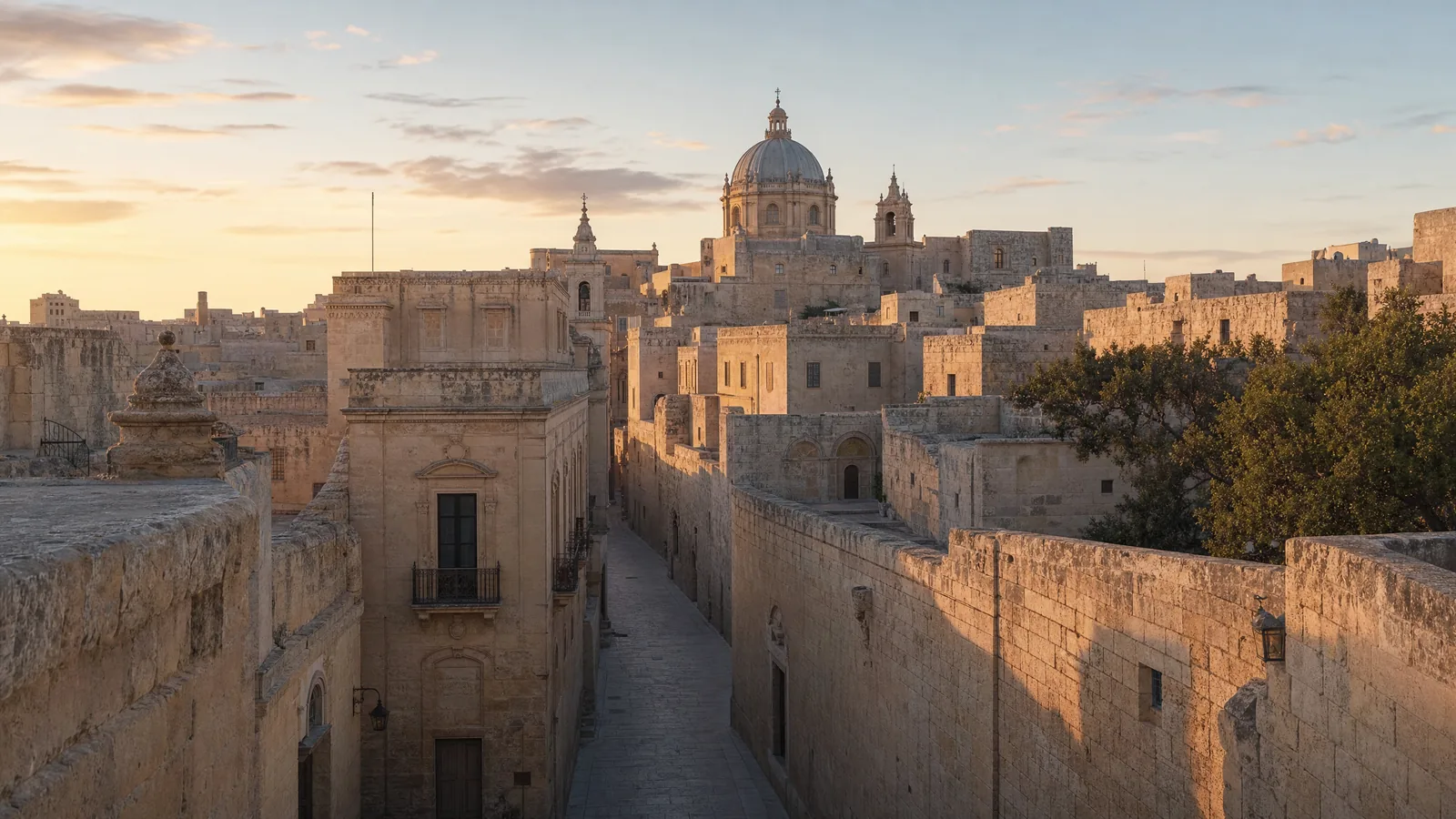
There is a particular hour in Malta — late afternoon, when the sun has stopped scorching and begun to forgive — when the limestone of Valletta turns the colour of warm honey and every doorway, every weathered balcony, every worn step seems lit from somewhere inside the stone itself. It was in that light, on a narrow street that smelled of sea salt and old churches, that I stopped at a jeweller’s window and did not move for a long while.
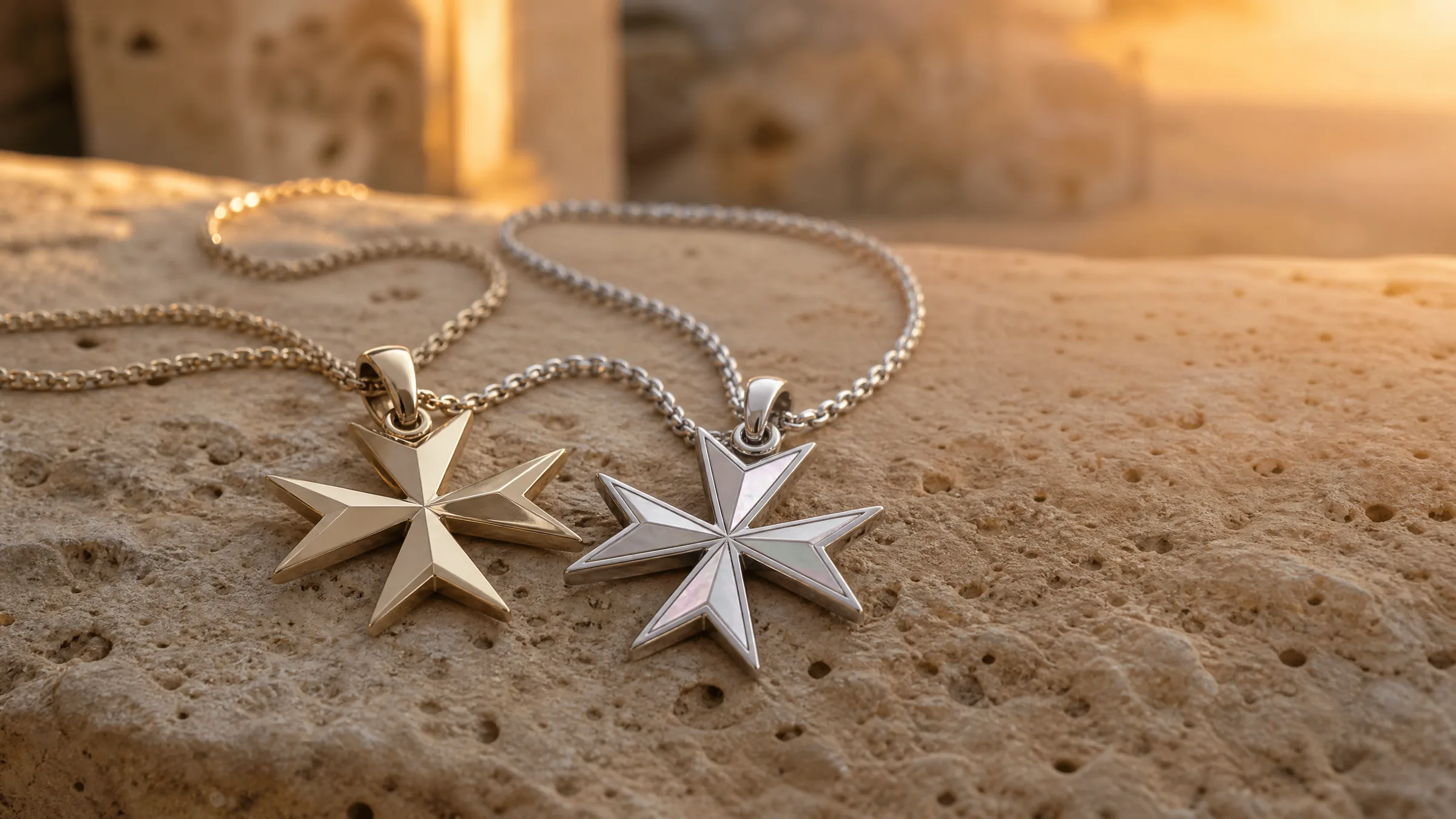
Two pieces held me. A Maltese cross in white gold — spare, luminous, almost weightless to the eye. And another in silver, its eight points inlaid with mother-of-pearl that caught the slanting light and threw it back in faint rose and grey. I bought them both. The white gold for the woman I am to marry; the mother-of-pearl for my teenage daughter.
I have given a good deal of jewellery in my life. These felt different. Not ornaments, but inheritances — small, portable pieces of a place and an idea I have loved for most of my adult life. I wanted the two people closest to my heart to carry that idea against the skin, in Austin and in London and wherever else the years take us.
So let me tell you about that cross, and why — of all the crosses a man might choose — it was the only one I would ever have brought home.
Four arms, eight points
Look closely at a Maltese cross and you see a small marvel of geometry. Four arms, each shaped like an arrowhead, narrow at the centre and flaring outward, meeting at a single point of origin and opening into eight sharp tips. It is perfectly symmetrical whichever way you turn it — a flower and a blade at once.
Nothing about it is accidental. The four arms have long been read as the four cardinal virtues — prudence, justice, temperance and fortitude — the load-bearing beams of a good life. And the eight points of the cross carry their own freight of meaning. They are said to stand for the eight Beatitudes of Saint Matthew — blessed are the poor in spirit, the meek, the merciful, the peacemakers. They stand, too, for the eight virtues a knight of the Order was meant to embody: loyalty, piety, honesty, courage, contempt for death, honour, solidarity with the poor and the sick, and respect for the Church.
And there is a third meaning that I confess gives me a private smile. The eight points also commemorate the eight langues — the “tongues,” the national groupings — into which the old Order was divided: Auvergne, Provence, France, Aragón, Castile-and-Portugal, Italy, Germany, and England, which counted Scotland and Ireland among its own. A German who has made his life in England, Scotland and Ireland finds something quietly fitting in that. Half my own biography is hammered into the points of a medieval cross.
A hospital before it was an army
Here is the part most people skip, and it is the part I love most: the Maltese cross began not on a battlefield but at a sickbed.
In the eleventh century, in Jerusalem, a community of monks under the Blessed Gerard ran a hospice for sick and exhausted pilgrims who had walked half a world to reach the Holy Land. From that hospital grew the Order of St John — the Knights Hospitaller. Their charism was captured in five Latin words still spoken today: Tuitio fidei et obsequium pauperum — the defence of the faith and assistance to the poor and the sick. Defence and care, sword and bandage, in the same hand. That tension is the whole of the thing.
Driven from the Holy Land, the knights regrouped on Rhodes in 1310, and when at last the Ottomans pushed them from there too, the Emperor Charles V granted them Malta in 1530. The annual rent was almost a joke and almost a poem: a single Maltese falcon, presented each year to the Viceroy of Sicily. (Yes — that falcon. The legend outlived the lease.) From that day the “cross of St John” became the “cross of Malta,” and it has belonged to these islands ever since.
Then came the Great Siege of 1565, the hinge on which the whole story turns. A vast Ottoman force — some forty thousand men — fell on the islands. Against them stood the aged Grand Master Jean Parisot de la Valette with a few hundred knights and the Maltese people beside them. For four murderous months through the summer heat they held. And — against every reasonable expectation — they won. Out of that victory rose a new fortress-capital, named for the old man who refused to break: Valletta.
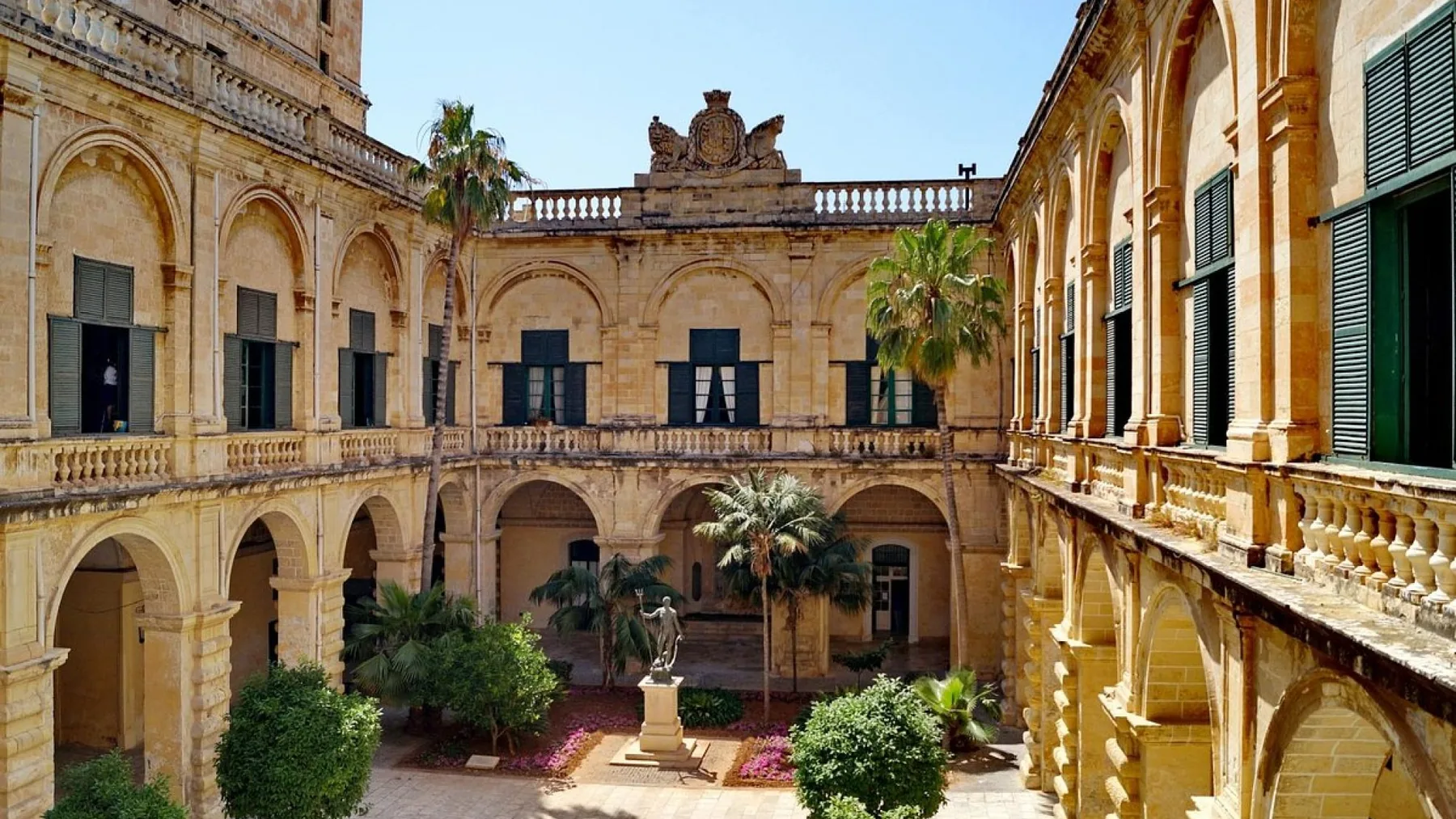
If you ever want to feel the full weight of it, stand inside the conventual church the Knights built — St John’s Co-Cathedral in Valletta. Its plain, almost fortress-like face gives way to one of the most overwhelming Baroque interiors in Europe, its floor a carpet of marble tombstones marking the knights buried beneath, Caravaggio’s darkness on the wall. You walk on the dead and beneath the sublime at the same time. The cross is everywhere — on the doorways, the bastions, the very euro coins in your pocket. The Order itself never died; it lives on in Rome as the Sovereign Military Order of Malta, still binding wounds and feeding the poor across the world. Nine centuries on, it is still keeping its oldest promise.
That is the idea I wanted around the necks of the women I love. Not a fashion. A vow that outlasted empires.
The two crosses I would never have chosen
Now, I love crosses. I am drawn to their history, their heraldry, the silent arguments they make. But there are two I would never have bought that afternoon, and it is worth saying why — because the reasons are the whole point.
The first is the Templar cross — the red cross pattée, arms flaring to broad squared ends. It is a noble shape with a hard history, but to a European eye, and most certainly to a German one, it carries an unfortunate after-image. In its bones it is the ancestor of the Iron Cross. There are silhouettes a man simply cannot hang at the throat of his bride or his daughter, however he reasons about them, because a symbol does not ask your permission before it speaks. I, of all people, know how heavy a symbol can become and how easily it is conscripted: my own great-grandfather was a Catholic philosopher silenced by a regime that understood, better than most, the power of signs. I will not put that shape on the people I love. It is not a debate I want hanging at the collarbone.
The second is the crusader cross — the Jerusalem cross, that big cross potent with four little crosses tucked into its quarters. I find it clunky, frankly. Heavy, martial, architectural rather than human — and yes, freighted with a controversy it cannot put down.
And here let me be plain, because what I am about to say is unfashionable, and I would rather be honest than safe. I am not embarrassed by the Crusades. A great deal of what is repeated about them is a comfortable tissue of half-truths — the greedy colonialist knight, the cartoon villain of the modern seminar room — and much of it collapses the moment you read the actual sources. Crusading was, for most who went, ruinous and penitential, not profitable; it was in large part a response, centuries late, to conquests already suffered. I am ready to defend that record, and I do not flinch from it.
But the deepest reason is simpler, and it is one I would press on anyone who reaches too quickly for judgement: it was a different age, and a different mind. The men of the eleventh and twelfth centuries lived inside fears, loyalties and certainties we have never had to carry. We who have never had to choose between faith and the sword, who judge in air-conditioned comfort, ought to be slower to sit in condemnation of the dead. The arrogance of measuring people of another age by the manners of our own afternoon is one of the great conceits of our time. How dare we, really? We would not last a week in their world; we should at least have the humility to read them on their own terms before we sentence them on ours.
So — no embarrassment, and no apology. Only a quiet refusal to wear the Crusades around my neck like a slogan.
Why this cross, and why on a woman
The Maltese cross says something the other two cannot.
It is, yes, the badge of fighting men — but it is first and last the badge of men who built hospitals; men whose deepest vow was the care of the poor and the sick. Defence and mercy. Sovereignty and service. Faith and freedom held in the same eight points. That is not a contradiction to me; it is the closest thing I know to a complete picture of a life well spent — to fight for what is yours and to kneel for those who have nothing. It is, more or less, the creed I have tried to live by.
And there is the plain, unembarrassed truth that it is simply the most beautiful of the three. The Templar cross is a statement; the crusader cross is a monument. The Maltese cross is a jewel. On a woman it does not announce a position or wage an argument. It catches the light, and it carries a thousand years of meaning lightly, the way grace is supposed to be carried.
So now there are two of them out in the world that did not exist in my life a few weeks ago. One in white gold, on the woman I will marry. One in silver and mother-of-pearl, on a daughter who is becoming, in front of my eyes, her own remarkable person. Each with eight points. Each a small piece of an island I love and an idea I have given my life to.
I think often of how much of all this comes down to time — how little of it we are given, and how much we are tempted to waste judging the past instead of building something worthy of being remembered. The knights understood that better than we do. They built for a thousand years, and got them.
Life is short and fleeting. One shot. Make it count.