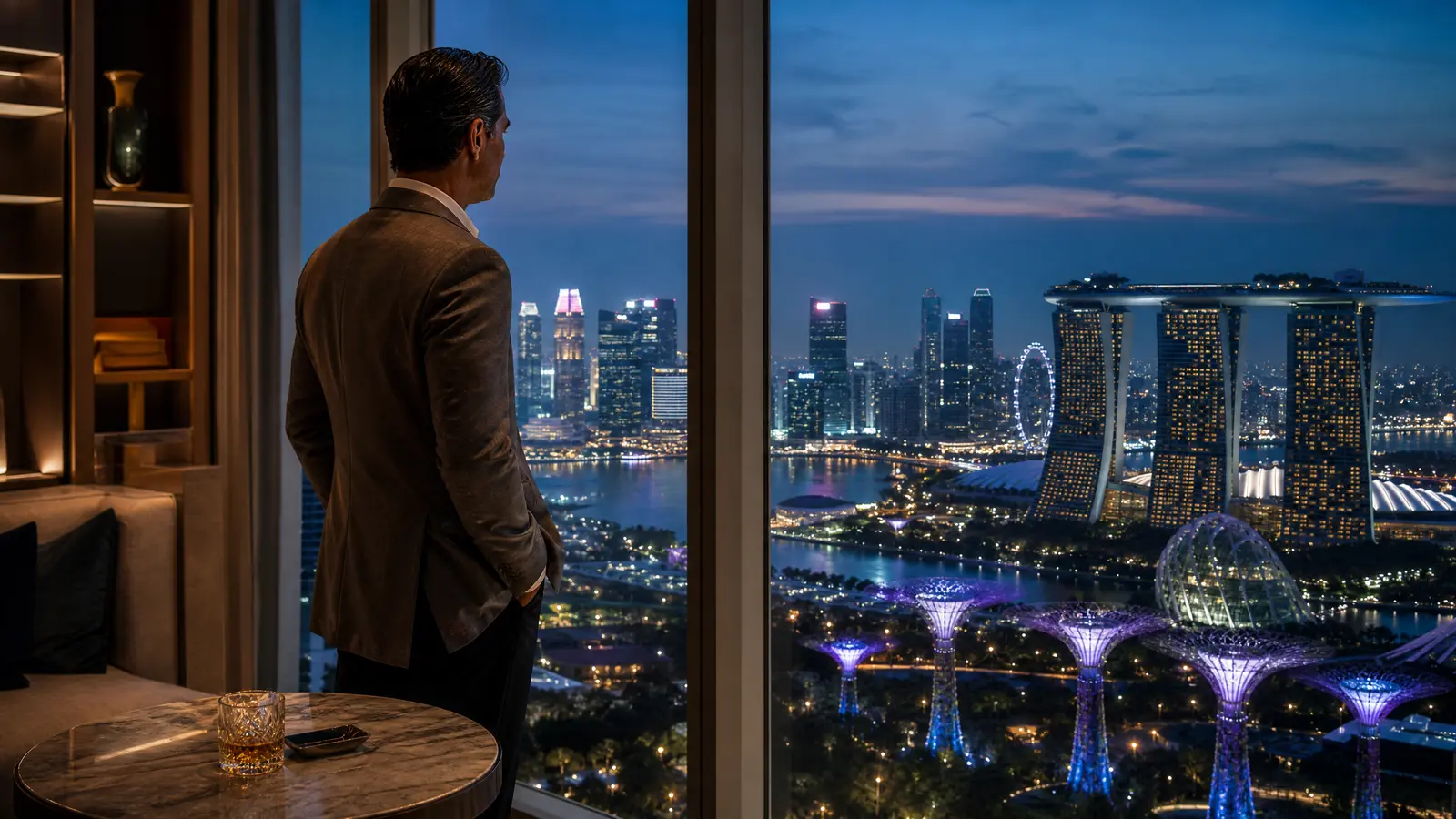
On 9 August 1965, a 41-year-old prime minister sat in front of television cameras and wept. Lee Kuan Yew had spent his entire adult life fighting for Singapore's merger with Malaysia. Now he had to tell 1.9 million people that Malaysia had thrown them out. A tiny island. No oil. No farmland. No army worth the name. Not even its own drinking water. The separation agreement literally had to guarantee that Malaysia would keep the taps open.
He called it his "moment of anguish." Most observers at the time would have filed Singapore's prospects somewhere between a struggling Caribbean micro-state and a post-colonial footnote.
Sixty years later, that swamp island has a GDP per capita of roughly $85,000, up from about $516 in 1965. That is a 165-fold increase in a single lifetime. Singapore has the highest density of millionaires on the planet, one of the world's three largest container ports, and the regional headquarters of nearly every multinational that matters in Asia. The numbers are laid out plainly in Singapore's own official archive of its post-independence survival strategy, and they still read like fiction.
I have spent 25 years helping wealthy families move themselves and their money across borders. I have lived in six countries. And I will tell you what I have learned from watching jurisdictions the way other men watch stocks: Singapore was not a miracle. It was a copy. And it has since been copied itself. Which means the single most valuable question you can ask in 2026 is not "how do I get into Singapore?" It is: "where is the next one, and how do I get in before everyone else does?"
Singapore Did Not Invent Itself. It Copied Switzerland.
I have written before on The Brief about Switzerland, the country where my own journey out of Germany began in 2000. Switzerland is the original template: a small, resource-poor, multilingual country surrounded by larger and historically hostile neighbours, which survived and then thrived by becoming three things at once. Neutral. Trustworthy. Expensive. A vault with mountains.
Lee Kuan Yew understood this with total clarity. Singapore's leadership did not talk about becoming the next Britain or the next America. The explicit national benchmark, later formalised by Goh Chok Tong, was to reach the Swiss standard of living. Think about what that meant in the 1960s and 70s. A tropical island of dockworkers and street hawkers, riddled with communist agitation, publicly declaring that its target was the richest, most stable, most discreet country in Europe.
And the copying was structural, not cosmetic:
Neutrality as a business model. Switzerland sat between France and Germany and banked for both. Singapore positioned itself between East and West, between China and America, between the Islamic world and the Anglosphere, and banked for all of them.
Rule of law as the export product. Switzerland sold predictability. Singapore took the English common law it inherited, stripped out the sentimentality, and sold contract enforcement, clean courts, and zero tolerance for corruption to multinationals who could not get any of those things elsewhere in Asia.
Radical openness where everyone else closed up. The development orthodoxy of the 1960s, pushed by the UN and the World Bank, said poor countries should protect infant industries behind tariff walls. Lee and his finance minister Goh Keng Swee did exactly the opposite: zero tariffs, English as the working language, and the Economic Development Board flying to the headquarters of Texas Instruments and Hewlett-Packard with ten-year tax holidays in hand. Texas Instruments arrived in 1968. HP in 1970. Unemployment fell from 14 percent to 4 percent in eight years.
Was it liberal? No. Lee's Singapore was, and in many ways remains, a velvet-gloved authoritarian state. The record of Lee Kuan Yew's methods includes detention without trial, tamed unions, and libel suits that bankrupted opponents. I am not asking you to admire everything. I am asking you to notice what works: small jurisdiction, hungry leadership, low taxes, open capital account, ruthless execution. That formula is now a proven, repeatable recipe.
Because someone else repeated it.
Dubai Copied Singapore, Line by Line
In the 1970s, Dubai was a pearl-diving town with a creek. Its oil was modest and everyone knew it would run out. The Maktoum family looked around the world for a survival strategy, and where did their delegations keep landing? Changi Airport.
The parallels are so precise they are almost funny:
Singapore built PSA, one of the world's great ports. Dubai built Jebel Ali, the largest man-made harbour on Earth, opened in 1979 when critics called it a folly in the sand.
Singapore built Singapore Airlines as the flag of national competence. Dubai built Emirates in 1985 with two leased aircraft, and used it to make a desert stopover the crossroads of the planet.
Singapore created free trade zones and tax holidays to seduce multinationals. Dubai created JAFZA and then dozens of free zones, offering 100 percent foreign ownership and zero tax in a region where both were unthinkable.
Singapore sold English common law in Asia. Dubai imported it wholesale: the Dubai International Financial Centre is a jurisdiction-within-a-jurisdiction with its own English-language common law courts, staffed with judges from London and Singapore, dropped into the middle of a civil law emirate. That is not inspiration. That is copy and paste, executed brilliantly.
Today oil is around one percent of Dubai's GDP. The city that was supposed to fade when the wells ran dry instead became the Singapore of the Middle East, and in the last five years, as Europe taxed and moralised and declined, it has hoovered up more millionaire migrants than almost anywhere on Earth.
So the sequence stands: Switzerland begat Singapore. Singapore begat Dubai. Roughly thirty to forty years between each generation. Anyone who understood the pattern and positioned themselves early, bought property, formed companies, moved residence, banked there before the crowds arrived, made generational, not incremental, returns.
Which brings me to what my firm actually does in Singapore today, and then to the only question that matters: who is next?
What We Do in Singapore Today
For our clients at STM Corporate Group, Singapore is no longer a speculation. It is infrastructure. The bet paid off decades ago; now you use the machine.
Singapore companies. We form and administer Singapore Pte Ltd companies for entrepreneurs and investors who want a first-world corporate vehicle in Asia: a 17 percent headline corporate rate softened by generous exemptions, no capital gains tax, no tax on foreign dividends properly structured, tax-free dividend distributions to shareholders, and a company register that commands instant respect from any bank, counterparty, or investor on the planet. A Singapore holding company is what a Swiss AG was in 1975: the passport your money carries.
Singapore bank accounts. This is where Singapore has quietly become irreplaceable. While European banks interrogate their own customers like suspects and American banks refuse anyone with a foreign address, Singapore's institutions, DBS, OCBC, UOB and the private banks above them, still do what banks are supposed to do: hold your money safely, in multiple currencies, in a jurisdiction with no debt crisis, no bail-in culture, and no appetite for confiscation. Our banking team coordinates account openings for both corporate structures and private clients, and demand has never been higher. Not because our clients are hiding anything. Because they have watched what Western governments do to visible, immobile wealth, and they have drawn the obvious conclusion.
Gold storage. And then there is the part of our Singapore work that has grown faster than everything else combined: physical gold. We help clients acquire and store allocated physical gold and silver in Singapore, through a vaulting partner whose facilities are trusted not only by private families but by foreign governments storing their own reserves. Think about what that means. When states themselves choose a private vault on this island over the traditional depositories of the West, they are making the same judgment our clients are making: Singapore will not confiscate, will not freeze, will not moralise. It will simply guard what is yours. The legal foundations are deliberate: Singapore abolished GST on investment-grade precious metals in 2012 with the openly stated ambition of becoming a global bullion hub, no capital gains tax touches your metal, and the jurisdiction has no history, none, of gold confiscation. Compare that with the United States, where Executive Order 6102 once made private gold ownership a crime, or with a Europe that increasingly treats private wealth as an unresolved policy problem.
And the world's largest players have noticed. In late 2025, reports swept through the bullion market that JP Morgan had moved its entire New York gold trading desk, more than fifty traders and their families, to Singapore within a single week. No press release. No gradual transition. A leaked internal memo over the Thanksgiving holiday, at the very moment the bank was making its largest physical gold deliveries since 2008 and Singapore's bullion trading volumes were overtaking the old centres. Whatever the full story behind that move, the direction of travel is unmistakable: the physical gold market is migrating east, and it is landing in Singapore. London holds the history. New York holds the paper. Singapore, increasingly, holds the metal. When the world's most powerful bank quietly repositions its gold desk to the same island where our clients hold their bars, you do not need me to draw the conclusion for you.
The Philippines corridor. Here is the part almost nobody in Europe understands. Singapore does not exist in isolation; it is the financial cortex of Southeast Asia, and its most interesting artery runs three and a half hours northeast, to the Philippines. We operate on both ends of that corridor. Our team on the ground in Davao supports clients relocating to the Philippines, while the corporate and banking substance sits in Singapore. The logic is beautiful: the Philippines taxes foreign residents only on Philippine-source income. Foreign-source income of a resident foreigner is simply outside the net. Combine that with a Singapore company for your international business, Singapore banking for your reserves, and a life in a country where your money buys ten times the lifestyle it buys in Munich or Zurich, and you have one of the most elegant structures available anywhere in 2026. English-speaking, pro-Western, demographically young, and increasingly courted by both Washington and Tokyo. Singapore is the vault, in paper and now in metal. The Philippines is the life. We build both ends.
The Only Question That Matters: Who Is Next?
Every generation gets one Singapore. The 1965 crowd got Singapore itself. The 1985 crowd got Dubai. The window is open again right now, and the recipe has never been more public: small or hungry jurisdiction, leadership with everything to prove, low taxes, imported rule of law, open doors to foreign capital, and a neighbourhood full of refugees from decline.
Nobody can name the winner with certainty. Lee Kuan Yew himself could not have guaranteed his own success in 1965; he wept, remember. But we can absolutely identify where the pattern is visibly assembling, because I spend my working life watching exactly this:
The Gulf's second wave. Saudi Arabia is attempting the Dubai playbook at ten times the scale, and Abu Dhabi is quietly out-executing everyone in asset management. The Gulf story is not finished; it is metastasising. But it is no longer early. Getting into Dubai in 2026 is like getting into Singapore in 1995: still excellent, no longer explosive.
Latin America's outsiders. Paraguay offers what Singapore offered in 1965 in fiscal form: a genuinely territorial tax system, residency measured in days of paperwork rather than years of waiting, and a government that has noticed the arbitrage. El Salvador has done something even more Singaporean: a small, dismissed country deliberately rebranding itself around security and radical policy, betting that the world will eventually reward boldness over caution.
Southeast Asia beyond Singapore. And this is where I am personally placing chips. The Philippines has the demographics Singapore never had: a median age of about 25, English everywhere, and 115 million people entering the global economy. Cities like Davao today feel the way I imagine Jurong felt in 1970: raw, unfinished, and unmistakably moving. Singapore itself became rich partly by being the safe harbour next to the boom. The next boom is its own neighbourhood.
Here is the uncomfortable truth about getting in early: it never feels safe. Singapore in 1965 looked like a bereaved swamp. Dubai in 1985 looked like a vanity airline in a war-adjacent desert. If a jurisdiction already feels safe, comfortable, and validated by your neighbours at the golf club, the generational returns are already gone. What remains is still good; Singapore today is magnificent. But the men who made fortunes there were the ones who arrived when the prime minister was still crying on television.
My great-grandfather learned under the Nazis what happens when you are locked inside one jurisdiction with no exit. I built my entire life, six countries, one business, on the opposite principle: you owe your family more than one flag, more than one bank, more than one plan. Singapore proved that a place can go from nothing to everything in sixty years. Dubai proved it was not a fluke. The third proof is being written somewhere right now.
The question is whether you will be reading about it in sixty years, or holding the deeds.
If you want to talk about Singapore companies, Singapore banking, gold storage in the world's new bullion capital, the Philippines corridor, or where we see the next window opening, my team and I do this every day. Get in early. It is the only trade that has never stopped working.