Contents
- 1. Liechtenstein: Country Overview
- 2. Putting Liechtenstein on the Map
- 3. What Others Say About Liechtenstein
- 4. Tax Benefits: What Liechtenstein Has to Offer
- 5. Tax Rates at a Glance
- 6. Tax Residency: What Triggers It
- 7. Double Tax Treaties
- 8. Avoid Remaining Tax Resident at Home
- 9. Tax Considerations When Leaving Your Home Country
- 10. Company Setup & Corporate Tax
- 11. Who Should (and Shouldn't) Move to Liechtenstein
- 12. Visas and Residence Permits
- 13. Path to Citizenship
- 14. Banking in Liechtenstein
- 15. What Makes Liechtenstein Genuinely Attractive
- 16. Cost of Living in Liechtenstein
- 17. Buying Real Estate in Liechtenstein
- 18. Retiring in Liechtenstein
- 19. US Citizens: What You Need to Know
- 20. Correct Preparation
- 21. Automatic Exchange of Information (OECD CRS)
- 22. Further Relocation Formalities
- 23. How We Help With Your Move to Liechtenstein
I.
Liechtenstein: Country Overview
Liechtenstein is a constitutional monarchy in the Alps, landlocked between Switzerland to the west and south and Austria to the east. It covers 160 km² — the size of a London borough — and has a population of approximately 40,000. The capital, Vaduz, sits on the eastern bank of the Rhine, dominated by Vaduz Castle (the residence of the Princely Family), with the Rätikon Alps rising directly behind. Liechtenstein is the fourth-smallest country in Europe by area, the only country that is doubly landlocked alongside Uzbekistan, and one of two countries (with the Vatican) governed by a hereditary monarchy with significant constitutional powers.
The country operates in German, with the local Alemannic dialect distinct from but mutually intelligible with Swiss German and Austrian German. The legal system is based on civil law derived from the Austrian Civil Code (ABGB) with strong Liechtenstein-specific developments — most notably in the law of foundations (Stiftungen), trusts, and private wealth structures. The currency is the Swiss Franc (CHF), used by treaty under the 1980 Customs and Currency Treaty between Liechtenstein and Switzerland; Liechtenstein and Switzerland form a customs and VAT union.
Liechtenstein is a member of the European Free Trade Association (EFTA), the European Economic Area (EEA) since 1995, and the Schengen Area since 2011 — but is NOT a member of the European Union. This unusual configuration provides full single-market access (free movement of goods, services, capital, and workers within the EEA) without subjecting the country to EU tax harmonisation directives. Liechtenstein retains full sovereignty over direct taxation.
On the tax side, Liechtenstein is one of the oldest and most sophisticated low-tax jurisdictions in Europe. Personal income tax is progressive — national rate up to 8% plus a communal multiplier of 150–180%, producing combined rates of 2.5%–22.4%. Wealth is integrated into the income tax system: a notional 4% return on net wealth is added to taxable income (rather than a separate annual wealth tax). There is no inheritance tax, no gift tax, no estate tax, and no exit tax for individuals. Capital gains on private securities and crypto are exempt. The flagship feature for HNW clients is lump-sum taxation (Pauschalbesteuerung) — for non-Liechtensteiners who have not lived in Liechtenstein in the previous 10 years, do not work in Liechtenstein, and finance their living costs from foreign wealth, taxation can be based on worldwide expenditure rather than income or wealth, with a 25% rate applied to deemed expenditure and a minimum annual tax of CHF 300,000.
The Stiftung (foundation) framework is central to Liechtenstein's HNW value proposition — a 100+ year-old legal vehicle for asset protection, succession planning, and family wealth structuring, with strong privacy protection (now tempered by EU and OECD transparency standards) and modern statutory underpinning. Trusts under Liechtenstein law (since 1926) are equally well-developed.
What to be aware of. The structural challenge of Liechtenstein is residence. Residence permits are tightly controlled and largely allocated by lottery (Auslosung) — half of available permits are awarded by drawing lots, with the other half awarded directly by the government at its discretion. Even for EEA nationals, the lottery limits practical access. For HNW clients, the most reliable route is the lump-sum-taxation framework combined with a direct government grant of residence — a path that requires meaningful local advisory support and is genuinely competitive. Liechtenstein implemented Pillar Two QDMTT and IIR at 15% from 1 January 2024 for MNE groups with consolidated revenue ≥€750 million; the 12.5% corporate rate continues for everyone else. The country participates fully in CRS, FATCA, and the OECD multilateral framework — privacy is now legal-tax efficiency, not anonymity.
II.
Putting Liechtenstein on the Map
Liechtenstein — Alpine principality between Switzerland and Austria, on the upper Rhine
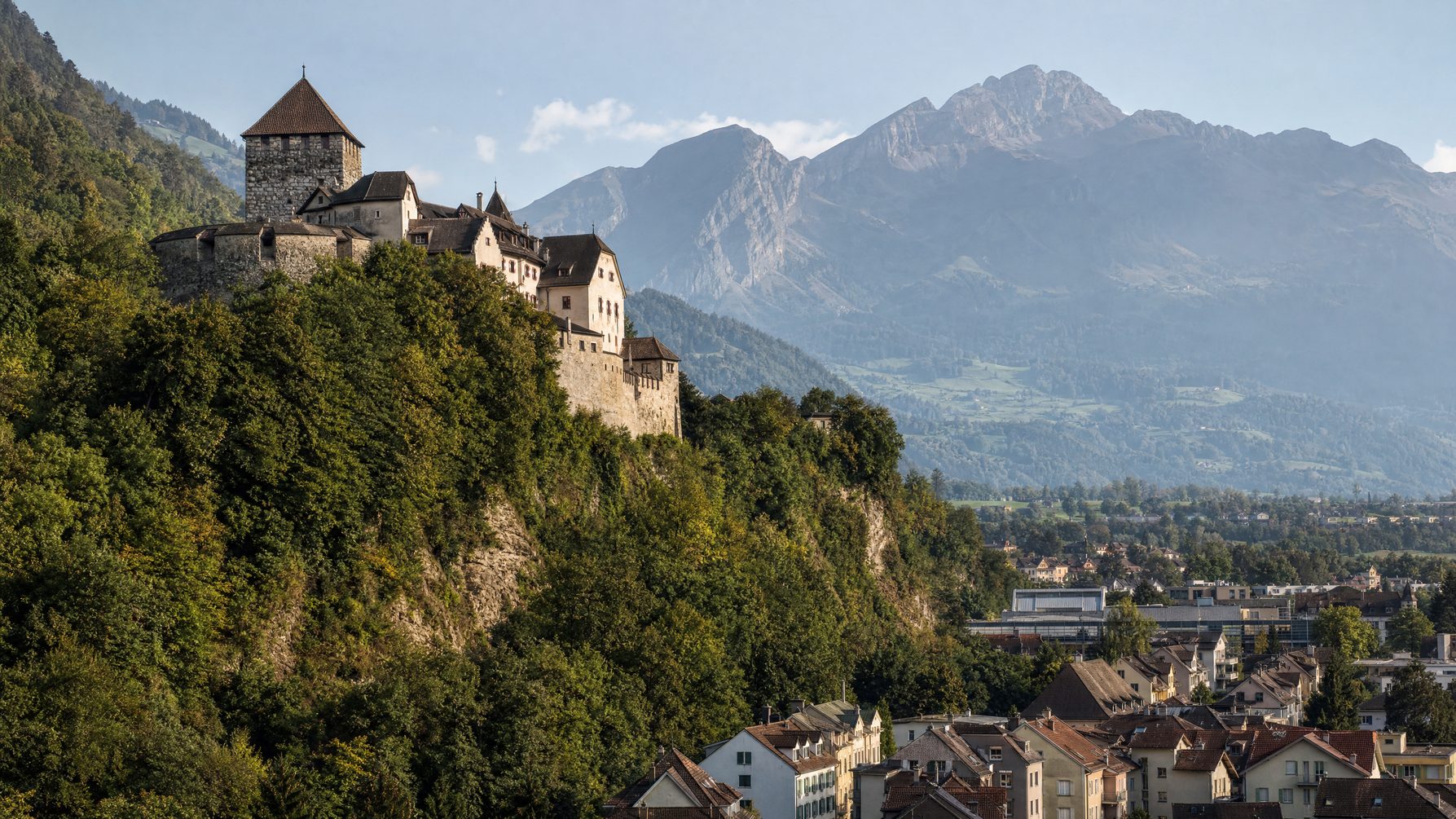
Liechtenstein arrives in the precision of a Swiss watch and the scale of a market town. The country is small enough that you can drive its entire length in 25 minutes, walk its widest point in 90 minutes, and yet it contains eleven municipalities, an active princely court, a parliamentary democracy, the headquarters of three of Europe's most established private banks, an opera house, a Modernist art museum (the Kunstmuseum, designed by Morger Degelo Kerez), several Michelin-starred restaurants, and approximately two cows for every three citizens.
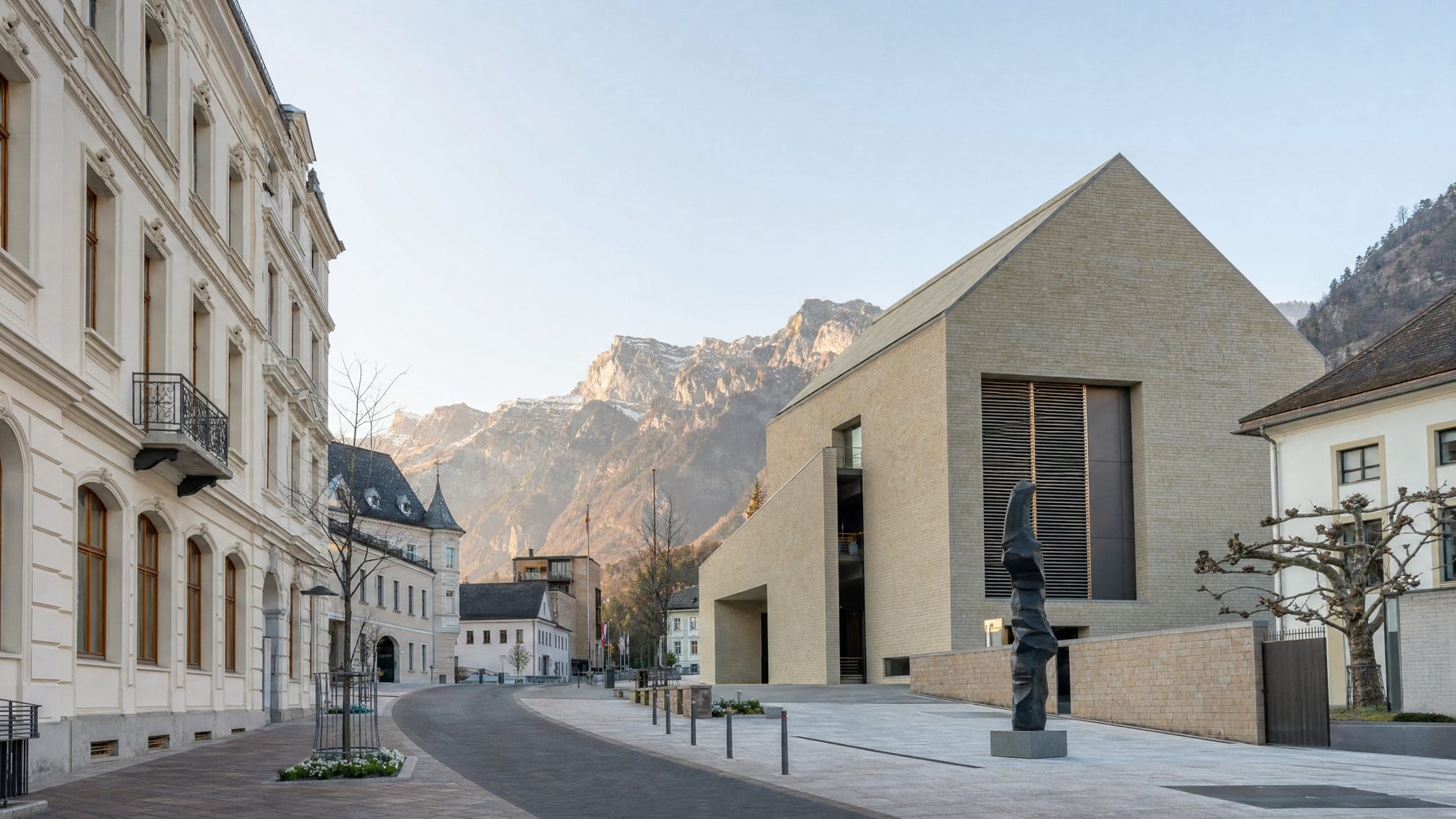
Vaduz is the capital and the seat of the Princely Family. Vaduz Castle sits on a rocky outcrop directly above the town — a fortress dating to the twelfth century, restored in the early twentieth, and still the private residence of HSH Hans-Adam II and the Princely Family. The castle is not open to the public; you can walk to its gates but no further. Below the castle, the Städtle (the pedestrianised old town centre) contains the Cathedral of St. Florin, the Princely Art Collection (one of the world's great private art collections, with Rubens, Cranach, Rembrandt), the Government Building, and the National Museum. The scale is intimate; everything in Vaduz is reachable on foot in fifteen minutes.
Schaan, just north of Vaduz, is the largest municipality by population and the country's commercial centre — Hilti Corporation, the global construction-tools manufacturer that is one of Liechtenstein's three industrial giants, has its headquarters here. Triesen and Triesenberg, climbing the slopes of the Rätikon, are residential and partly agricultural. Balzers, in the south, is dominated by Gutenberg Castle and the Hilcona food-manufacturing operations. Eschen, Mauren, Schellenberg, and Ruggell in the north are the country's flatter, more rural communities, with farmland running to the Austrian border.
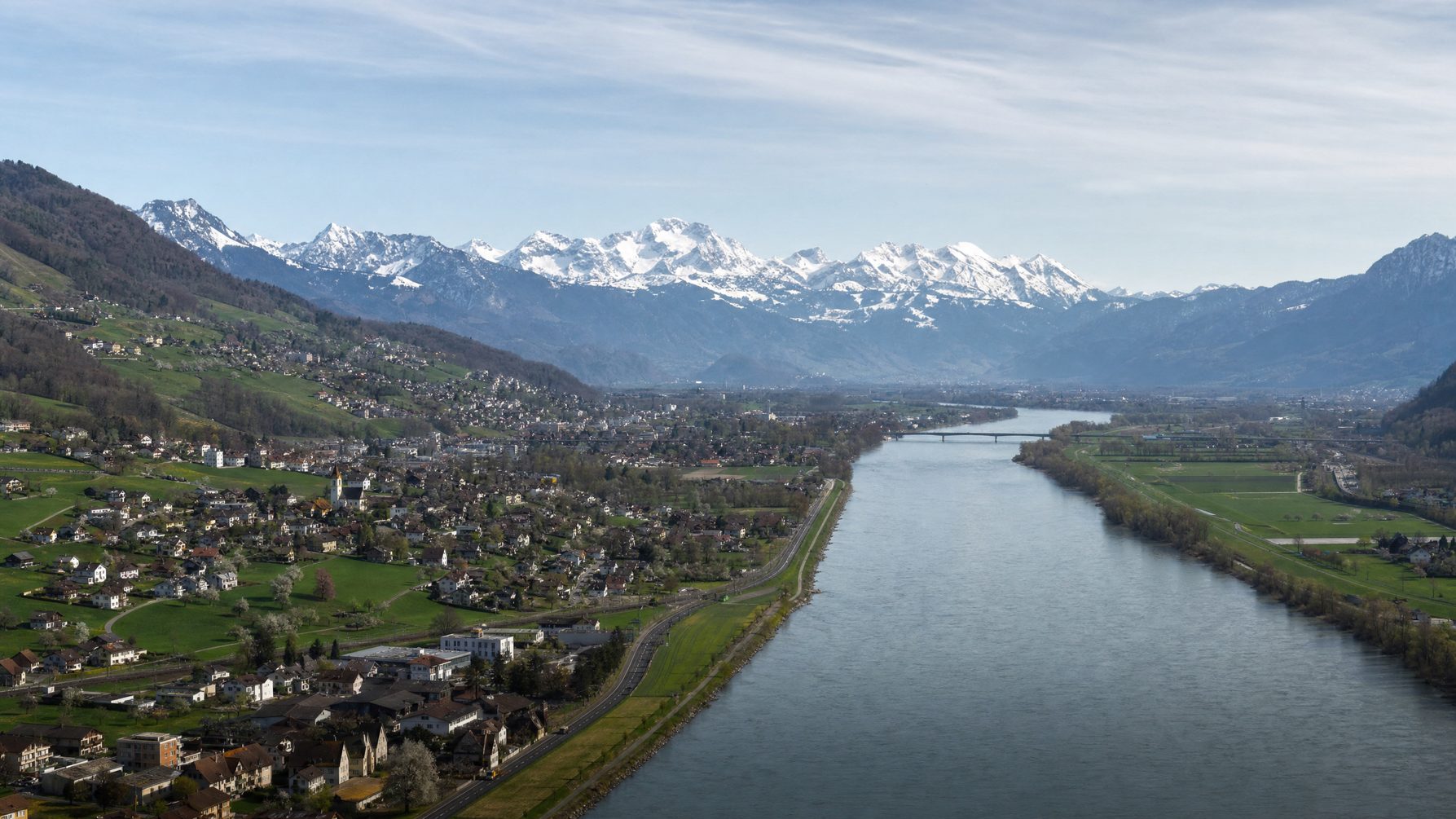
The Rhine runs along the entire western boundary, separating Liechtenstein from Switzerland. The river is canalised here — broad, fast, glacial-blue — and crossed by half a dozen bridges, including the famous Old Wooden Bridge (Alte Rheinbrücke) at Vaduz, one of the last covered wooden bridges in central Europe. Malbun, the country's only ski resort, sits at 1,600 metres in the southeast, in a high valley reached by a single road from Triesenberg — small (10 lifts, 23 km of pistes), family-friendly, and notoriously underrated by international skiers who all go to St. Anton or Davos instead.
The country sits at the strategic crossroads of Alpine Europe — Zurich is 80 minutes by road or train, Innsbruck 90 minutes, Munich 3 hours, Milan 3.5 hours, Vienna 7 hours. Liechtenstein has no airport of its own; the nearest international airports are Zurich (ZRH) and St. Gallen-Altenrhein (ACH). Connectivity is excellent for a country of 40,000 people: Zurich's airport handles direct flights to virtually every major European hub plus North America, the Middle East, and Asia. From Zurich Airport you are typically two hours from your front door in Vaduz.
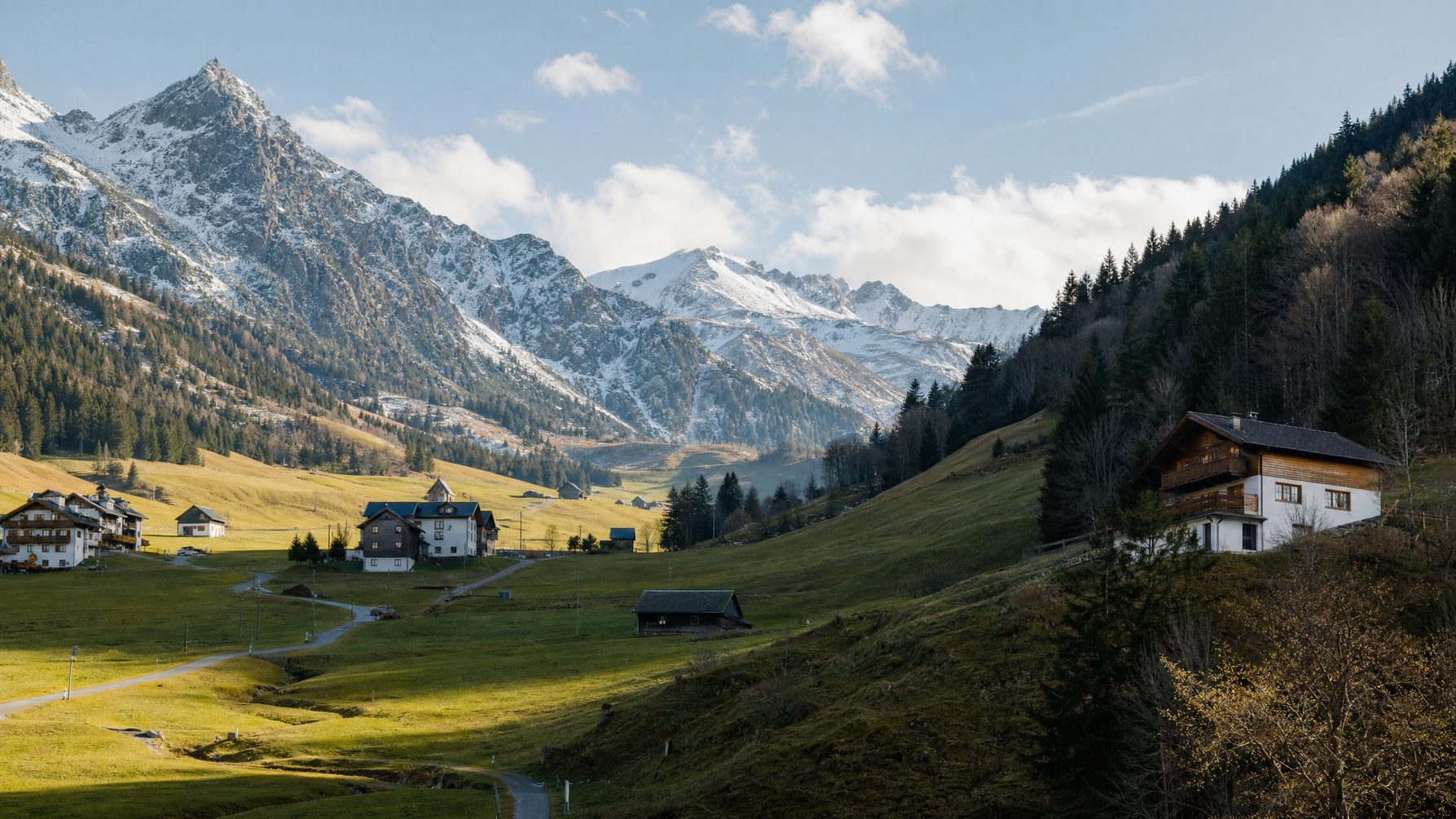
Hiking and skiing are central to local culture. The Liechtenstein Trail, a 75-kilometre walking path running the length of the country, traverses every municipality and every major historical site. Three Sisters (Drei Schwestern) is the highest accessible peak (2,053 m); the cable car from Triesenberg takes you to the start of one of the great Alpine hikes. Liechtenstein's natural setting is genuinely spectacular — and largely unknown to international visitors, who almost entirely overlook the country in favour of its larger neighbours.
III.
What Others Say About Liechtenstein
"There is no country in Europe where the relationship between the state, the bank, and the family is as unambiguous and well-organised as it is in Liechtenstein. Three centuries of continuity is what you are buying, not a tax rate."
— European private banker, Vaduz, 2023
"The Stiftung is the single most useful private wealth structure in continental Europe. It is older than most modern tax systems, it has survived multiple regime changes, and it does what a trust does in common-law jurisdictions while being recognisable to civil-law tax authorities."
— Wealth structuring lawyer, Liechtenstein Bar Association, 2024
"I came to Vaduz expecting a tiny version of Zurich. What I found was a country where the Prince's car can be parked next to mine at the supermarket and nobody finds it remarkable. The scale is unlike anywhere else in Europe."
— British relocation client, Triesen, 2025
IV.
Tax Benefits: What Liechtenstein Has to Offer
Liechtenstein is a premium HNW jurisdiction — one of the oldest, most stable, and most sophisticated tax bases in Europe. The combination of lump-sum taxation for ultra-HNW residents, 12.5% flat corporate tax, no inheritance/gift/estate tax, the Stiftung framework, EEA/Schengen membership without EU direct-tax constraints, and integration with Switzerland's economic and currency union makes it genuinely useful — but the residence-permit system makes it structurally accessible only to a narrow subset of HNW clients.
- ›Lump-sum taxation (Pauschalbesteuerung) — for ultra-HNW residents who do not work in Liechtenstein — taxation based on worldwide annual living expenses rather than income or wealth, at a 25% rate. Minimum annual tax CHF 300,000 (implying minimum CHF 1.2 million in deemed expenditure). Eligibility: take up first-time residence in Liechtenstein (or after 10+ years away), not a Liechtenstein citizen, do not work in Liechtenstein, finance living costs from foreign wealth or income. Application to the tax administration; granted as a formal decision; agreement covers a 5-year period subject to renewal.
- ›No inheritance, gift, estate, or exit tax — Liechtenstein imposes no inheritance tax, no gift tax, no estate tax, and no exit tax on individuals leaving the country. Wealth transfers between generations are entirely outside the Liechtenstein tax net. Forced heirship (Pflichtteil) rules apply but are dealt with as a private-law matter, not a tax matter.
- ›No capital gains tax on private securities and crypto — disposals of private securities (shares, bonds, ETFs) and cryptocurrency by individual investors are completely exempt from capital gains tax. Real estate gains in Liechtenstein are subject to a separate real estate gains tax. Business gains and substantial-shareholding gains may be taxable depending on circumstances.
- ›Personal income tax progressive 2.5%–22.4% — national rate up to 8% combined with a municipal multiplier of 150–180%, producing combined rates from 2.5% (lowest income, lowest-multiplier municipality) to 22.4% (highest income, highest-multiplier municipality). Wealth is integrated into income tax through a notional 4% return on net wealth added to taxable income — there is no separate annual wealth tax.
- ›Corporate income tax — flat 12.5% — one of the lowest in Europe (matching Ireland, below Switzerland's 14–21% range). Plus a CHF 1,800 annual minimum tax (creditable against profit tax). 5-year loss carry-forward. Notional interest deduction on equity (~3.75–4%) further reduces effective rate.
- ›Pillar Two — 15% QDMTT and IIR for MNE groups ≥€750M revenue (since 1 January 2024) — Liechtenstein has implemented the OECD global minimum tax for in-scope multinational groups. The 12.5% corporate rate continues to apply to all other companies. UTPR has not been implemented as of 2026.
- ›No withholding tax on dividends, interest, or royalties paid to non-residents — clean repatriation of profits from Liechtenstein companies to foreign shareholders. Major advantage for international holding structures.
- ›Stiftung (foundation) framework — flagship private wealth structure — flat 12.5% on income (with extensive exemptions for participation income, capital gains on substantial holdings, and foreign source income). Endowment from a non-resident founder of foreign assets is tax-free at the foundation level (other than a 3.5% endowment tax in the rare case the assets were already subject to Liechtenstein wealth tax). Distributions to non-resident beneficiaries are tax-free. Modern foundation law combined with the absence of inheritance/gift tax makes the Stiftung one of the most efficient private wealth structures in continental Europe.
- ›22+ double tax treaties; EEA and Schengen member — DTA network includes Germany, Austria, UK, Switzerland, UAE, Singapore, Hong Kong, Luxembourg, Malta, the Czech Republic, Uruguay, and others. EEA membership provides full single-market access including freedom of movement; Schengen membership eliminates internal border controls.
V.
Tax Rates at a Glance
The most important tax rates in Liechtenstein are as follows. Note that these have been simplified and should be used as general guidance only.
| Tax | Rate | Notes |
|---|---|---|
| Personal Income Tax — combined | 2.5%–22.4% | National rate (up to 8%) + municipal multiplier (150–180%) |
| Wealth Tax | Integrated into income tax | 4% notional return on net wealth added to taxable income |
| Capital Gains — private securities and crypto | 0% | Exempt for individual investors |
| Capital Gains — Liechtenstein real estate | Real estate gains tax | Progressive |
| Inheritance Tax | 0% | None |
| Gift Tax | 0% | None |
| Estate Tax | 0% | None |
| Exit Tax (individuals) | 0% | None |
| Lump-Sum Tax (Pauschalbesteuerung) | 25% on worldwide expenditure | Minimum annual tax CHF 300,000 |
| Lump-Sum — minimum deemed expenditure | CHF 1,200,000 | Implied by 25% × CHF 300,000 minimum tax |
| Lump-Sum — eligibility | Not LI citizen, no LI employment, foreign-funded | First-time / 10+ years away from LI |
| Lump-Sum — duration | 5-year periods | Renewable |
| Corporate Income Tax — flat | 12.5% | All companies |
| Corporate Minimum Tax (annual) | CHF 1,800 | Creditable against profit tax |
| Notional Interest Deduction | ~3.75–4% | On equity; reduces effective rate |
| Loss carry-forward | 5 years | Unlimited carry-back not permitted |
| Withholding tax — dividends | 0% | To non-residents |
| Withholding tax — interest | 0% | To non-residents |
| Withholding tax — royalties | 0% | To non-residents |
| Stiftung (foundation) | 12.5% | Charitable foundations may be exempt |
| Stiftung — endowment from non-resident founder | 0% | Foreign assets not previously subject to LI wealth tax |
| Stiftung — distributions to non-resident beneficiaries | 0% | Tax-free |
| Trust enterprise (legal personality) | 12.5% | Anstalt also 12.5% + CHF 1,800 minimum |
| Trust without legal personality | CHF 1,800 minimum | Per year |
| Anstalt (establishment) | 12.5% | Plus CHF 1,800 minimum |
| Endowment tax (rare) | 3.5% | When LI-resident assets endowed to non-taxable entity |
| Pillar Two — QDMTT / IIR | 15% | MNE groups ≥€750M consolidated revenue (since 1 Jan 2024) |
| Pillar Two — UTPR | Not yet implemented | As of 2026 |
| VAT (Swiss-LI customs union) | 8.1% standard / 2.6% reduced / 3.8% accommodation | Same as Switzerland since 1 Jan 2024 |
| Stamp duty on company formation / capital increase | 1% above CHF 1M | First CHF 1M exempt |
| Property transfer tax | None | But property gains tax on disposal |
| Real estate gains tax | Progressive | Cantonal-style; depends on holding period |
| DTAs | 22+ | Includes Germany, Austria, UK, Switzerland, UAE, Singapore, Hong Kong |
| EEA / Schengen | Yes / Yes | Member since 1995 / 2011 |
| EU | No | Sovereign in direct tax matters |
Cryptocurrency and Crypto Assets
Liechtenstein has been one of Europe's most progressive jurisdictions for digital assets — the Token and TT Service Provider Act (TVTG), in force since 2020, provides comprehensive regulation of tokens, blockchain services, and crypto businesses. Capital gains from private crypto trading by individual investors are fully tax-exempt — no holding period, no de-minimis threshold. Mining and staking rewards are generally treated as income and taxed at progressive rates. Crypto businesses (exchanges, custodians, token issuers) are subject to standard 12.5% corporate tax with TVTG licensing requirements. For HNW crypto investors, Liechtenstein combined with the Stiftung framework (0% on foundation-level capital gains from substantial holdings, 0% on distributions to non-resident beneficiaries) is one of the most efficient European structures for long-term crypto wealth planning.
VI.
Tax Residency: What Triggers It
Under Liechtenstein tax law, an individual is considered a tax resident of Liechtenstein if they meet either of the following criteria:
- ›Permanent residence (Wohnsitz): Domicile in Liechtenstein with the intention of staying — typically evidenced by an apartment or house, a residence permit, registration with the local authority (Einwohnerkontrolle), and the genuine establishment of a household.
- ›Habitual abode (gewöhnlicher Aufenthalt): Physical presence in Liechtenstein for a continuous period of typically more than 6 months, regardless of intent. Short interruptions do not break the period.
Tax residents of Liechtenstein are subject to unlimited tax liability — taxation on worldwide income and worldwide net wealth (the latter via the 4% notional return integration). Non-residents are subject to limited tax liability only on Liechtenstein-source income (Liechtenstein real estate, Liechtenstein-source employment income, Liechtenstein permanent establishments, Liechtenstein attendance fees, etc.).
The lump-sum tax framework operates alongside the standard residency framework. Individuals who qualify under the lump-sum regime are still tax residents of Liechtenstein under the Wohnsitz/Aufenthalt rules — they simply have their tax base calculated on expenditure rather than income/wealth. They retain full access to Liechtenstein's DTA network and can obtain Liechtenstein tax residency certificates.
- ›Documentation matters. Establishing and maintaining Liechtenstein tax residency requires evidence: a registered apartment or house lease (or property title), the corresponding residence permit, registration with the local Einwohnerkontrolle, utility bills, bank statements showing the local address, and — for lump-sum taxpayers — the formal lump-sum decision from the tax administration. The Liechtenstein Tax Administration (Steuerverwaltung) can issue tax residency certificates on request, which are useful for invoking double tax treaty protection.
- ›The interaction with the residence-permit system is critical. A Liechtenstein tax residency claim is meaningless if the underlying immigration permit is not in place. Permits are issued by the Office for Migration and Passports (Ausländer- und Passamt), not by the tax administration, and the immigration approval is a precondition of the tax framework — a point that catches some clients unprepared. See Section XII for the residence-permit detail.
VII.
Double Tax Treaties
Liechtenstein has concluded 22+ double tax agreements (DTAs) that are currently in force — a smaller network than larger jurisdictions like Switzerland or Malta, but including all the country's most important economic partners. The DTA network has been expanding steadily as Liechtenstein has aligned with OECD standards over the past 15 years.
Active DTA partners include:
- ›Andorra
- ›Austria
- ›Bahrain
- ›Czech Republic
- ›Germany
- ›Georgia
- ›Guernsey
- ›Hong Kong
- ›Hungary
- ›Iceland
- ›Italy
- ›Jersey
- ›Lithuania
- ›Luxembourg
- ›Malta
- ›Monaco
- ›Netherlands
- ›San Marino
- ›Singapore
- ›Switzerland
- ›United Arab Emirates
- ›United Kingdom
- ›Uruguay
The Germany–Liechtenstein DTA, in force since 2013, is the most important treaty for German-speaking HNW clients. It contains standard residence tie-breaker rules under Article 4 and provides withholding-tax relief on cross-border investment income.
The Switzerland–Liechtenstein DTA, in force in modern form since 2017, governs the close economic relationship between the two countries. The Customs and Currency Treaty (1980) provides for shared VAT, common customs, and the use of the Swiss franc; the income-tax DTA addresses cross-border income flows.
The UK–Liechtenstein DTA (in force since 2013) provides for reduced withholding rates on dividends (0%/15%), interest (0%), and royalties (0%) — and is particularly valuable for British clients moving to Liechtenstein given the UK's recent abolition of the non-dom remittance basis (April 2025) and the introduction of the FIG regime.
There is no income tax treaty between Liechtenstein and the United States. US citizens in Liechtenstein rely on the Foreign Earned Income Exclusion ($132,900 for 2026) and the Foreign Tax Credit rather than treaty relief. The 1973 Estate Tax Treaty between the US and Liechtenstein (extending the US-Switzerland framework) does provide some estate tax relief.
Liechtenstein is a signatory to the OECD Multilateral Instrument (MLI) and has implemented BEPS minimum standards (Actions 5, 6, 13, 14). Several DTAs incorporate Limitation on Benefits (LoB) provisions and principal-purpose tests.
The existence of a DTA does not automatically resolve all tax conflicts. The treaty must be invoked correctly, residency must be properly established, and the specific provisions of each treaty must be reviewed for the income type and circumstances.
VIII.
Avoid Remaining Tax Resident at Home
Relocating to Liechtenstein does not automatically end your tax obligations elsewhere. The critical question is whether you have genuinely severed tax residency in your country of origin — and this is determined not by where you have registered an address, but by where you actually live, where your ties are, and how your life is organised.
This is particularly important for Liechtenstein because of the country's small size (160 km², 40,000 people). Many high-tax tax authorities scrutinise Liechtenstein moves carefully — particularly German Finanzämter, given Liechtenstein's historical reputation and the Liechtenstein Affair of 2008 (when stolen Liechtenstein bank data triggered a major German tax-evasion enforcement campaign). Even though Liechtenstein is now fully transparent, the legacy of that period means German tax authorities apply enhanced scrutiny to claimed Liechtenstein residency.
The most common triggers that can keep you tax-resident at home:
- ›Available dwelling: Any long-term residence that remains available for your use — a flat you own, a property you rent on an ongoing basis, even a room in a family home — is sufficient to maintain a taxable domicile in many countries. The dwelling does not need to be your primary home; it only needs to be available. Surrendering it before departure is a precondition of a clean exit in Germany (§1 EStG Wohnsitz), Austria, Switzerland, and many other jurisdictions.
- ›Centre of vital interests: If your family, your business, your social connections, and your financial affairs remain in your home country, most tax authorities will argue that your centre of life has not genuinely moved — regardless of where you have registered. Spouse and minor children remaining in the home country are particularly powerful indicators.
- ›183-day rule (home country): Spending more than 183 days in your home country in a calendar year will typically trigger residency there, overriding any claim to Liechtenstein residency for that year.
- ›Extended unlimited tax liability (Germany — §2 AStG): Germany's erweiterte unbeschränkte Steuerpflicht under §2 AStG can keep German nationals taxable in Germany for up to ten years after departure if they move to a low-tax country and retain significant ties. Liechtenstein has historically been classified as a low-tax country under §2 AStG, making the extended-liability framework genuinely applicable. This must be planned for in advance.
A genuine relocation to Liechtenstein requires that you actually live there — that your home is there, your daily life is there, and that you can demonstrate this with documentation. A registered address and a bank account are not sufficient.
The test is not where you are registered. The test is where you live. Tax authorities in Germany, Austria, the UK, and Switzerland are experienced at identifying sham relocations and have the legal tools to challenge them. Proper advice before you move — not after — is essential. This is particularly important for German nationals given the §2 AStG framework.
IX.
Tax Considerations When Leaving Your Home Country
Before you relocate, you need to understand what tax consequences arise in your current country of residence at the point of departure. These rules vary significantly by country and must be assessed individually — there is no universal answer.
Many countries impose an exit tax or deemed disposal charge when a tax resident leaves. This typically applies to unrealised capital gains on shares, business interests, real estate, or other assets — taxing you as if you had sold everything on the day you departed. The rules differ widely: some countries apply this to all assets above a threshold, others only to substantial shareholdings or business interests. Some have look-back periods that can catch you even after you have left.
Among the countries that levy a meaningful exit tax or deemed-disposal charge:
- ›Germany. Applies an exit tax on unrealised gains in shareholdings of 1% or more under §6 AStG. Critically, because Liechtenstein is classified as a low-tax country under §2 AStG, Germany's "extended unlimited tax liability" can apply for up to 10 years after departure — taxing ongoing German-source income and certain foreign-source income flows. The Germany–Liechtenstein DTA provides residence tie-breaker rules but does not override §2 AStG. Pre-departure planning is essential.
- ›United States. The "expatriation tax" under IRC §877A treats long-term residents and citizens as having sold all worldwide assets at fair market value on the day they relinquish citizenship or residency. The exemption for 2026 is approximately US$890,000. There is no US-Liechtenstein income tax treaty, but there is an estate tax treaty (1973) extending the US-Switzerland framework.
- ›United Kingdom. Statutory Residence Test (SRT) exit-date analysis is required. The UK's new FIG regime (in force since 6 April 2025) governs new UK arrivals, not departures. UK pensioners moving to Liechtenstein face UK-source pension taxation; the UK–Liechtenstein DTA provides tie-breaker rules.
- ›France. Exit tax applies to unrealised gains on securities and company rights above €800,000 when a French tax resident relocates abroad. Liechtenstein is in the EEA (which qualifies for the deferral mechanism), but the analysis is fact-specific.
- ›Austria. Wegzugsbesteuerung applies to unrealised gains on shareholdings ≥1% at departure. The Austria-Liechtenstein DTA contains specific provisions; given the close geographic proximity, Austrian tax authorities apply careful scrutiny to claimed Liechtenstein moves by Austrian citizens.
- ›Netherlands. Deemed disposal applies to substantial shareholdings (5% or more) at the point of emigration. EEA deferral mechanism may apply.
- ›Switzerland. Generally no federal exit tax for individuals, but cantonal rules vary; cantonal wealth and income tax must be properly cleared. The proximity to Liechtenstein (Vaduz is 80 minutes from Zurich) and the close customs/currency union mean the Swiss-Liechtenstein cross-border interaction requires careful attention.
Beyond exit tax, you may remain subject to limited tax liability in your home country after the move — for example, on rental income from property you continue to own there, on dividends from domestic companies, or on pension payments. Severing tax residency does not necessarily sever all tax obligations.
The timing of your departure, the structure of your assets, and the sequence of any business disposals all have material consequences. In some cases, restructuring assets before departure — or deferring the move by a few months — can make a significant difference to the tax outcome.
⚠ Obtain Local Tax Advice in Your Home Country. The information above provides a general overview of the departure tax rules that commonly apply when leaving high-tax jurisdictions. It is not legal or tax advice. The rules in your specific home country — Germany, Austria, Switzerland, the UK, the US, or any other jurisdiction — are complex, change frequently, and depend entirely on your personal circumstances: your nationality, the nature and location of your assets, your business structure, your family situation, and the timing of your departure. Before you take any steps to relocate, obtain written advice from a qualified tax adviser who is licensed in your home country and experienced in international relocations. A consultation with us is a good starting point — but it does not substitute for country-specific legal advice from a practitioner in your jurisdiction of departure. The cost of getting this wrong is almost always greater than the cost of getting proper advice upfront.
X.
Company Setup & Corporate Tax
Liechtenstein offers some of Europe's most flexible corporate vehicles, with a 100+ year tradition of private wealth structures and international business law. The corporate tax rate is flat 12.5% with a CHF 1,800 annual minimum tax (creditable against profit tax). Notional interest deduction on equity (~3.75–4%) reduces the effective rate further.
The most relevant corporate structures for foreign entrepreneurs and investors:
- ›Aktiengesellschaft (AG / company limited by shares): The standard Liechtenstein joint-stock company. Minimum share capital CHF 50,000. Corporate tax 12.5%; 0% withholding tax on dividends to non-residents. Used for trading companies, holding companies, family offices, and operating subsidiaries.
- ›Gesellschaft mit beschränkter Haftung (GmbH / limited liability company): Closely-held private company. Minimum share capital CHF 30,000. Corporate tax 12.5%. Suitable for small to mid-sized operating businesses.
- ›Stiftung (foundation): Liechtenstein's flagship private wealth structure, developed since the 1926 Persons and Companies Act (PGR). Used for asset protection, succession planning, family wealth structuring, and (less commonly) charitable purposes. Endowment from a non-resident founder of foreign assets is tax-free at the Stiftung level. The Stiftung is taxed at 12.5% on income, but extensive exemptions (participation income, capital gains on substantial holdings, foreign source income, distributions from other foundations) reduce the effective rate well below the headline. Distributions to non-resident beneficiaries are tax-free. Privately Beneficial Foundations (Privatnützige Stiftungen) are the typical HNW structuring vehicle — beneficiaries are family members or specific named individuals.
- ›Anstalt (establishment): A unique Liechtenstein vehicle with legal personality, flexibility between trust-like and company-like operation. Can be owned by a single founder. Taxed at 12.5%; CHF 1,800 minimum. Used for trading, holding, and personal wealth-planning purposes. The Anstalt is one of the most flexible legal forms in continental Europe and has no exact equivalent in any other jurisdiction.
- ›Treuunternehmen (trust enterprise / business trust): A trust-form vehicle with legal personality, treated as a company for tax purposes. Taxed at 12.5%.
- ›Treuhänderschaft (Liechtenstein-law trust without legal personality): Liechtenstein has had statutory trust law since 1926 (one of the few civil-law jurisdictions to recognise trusts). Trusts without legal personality pay only the CHF 1,800 minimum tax. Liechtenstein adopted the Hague Trust Convention in 2006.
- ›Privatvermögensstruktur (PVS) / Private Asset Structure (PAS): A status available for foundations, establishments, and certain other vehicles holding only non-business private wealth (no trade or business activity, no commercial holding of operating subsidiaries). PAS entities pay only the CHF 1,800 minimum tax — exempt from regular profit tax. Suitable for pure family-wealth-holding purposes.
The participation exemption applies to qualifying inbound dividends and capital gains: dividends from holdings of ≥25% are generally tax-exempt, as are capital gains on disposals of ≥25% holdings. Combined with 0% withholding tax on outbound dividends, interest, and royalties, this makes Liechtenstein one of Europe's most efficient holding jurisdictions for groups that want a non-EU base with EEA single-market access.
Pillar Two — QDMTT and IIR at 15% from 1 January 2024 applies to MNE groups with consolidated revenue ≥€750 million. The 12.5% rate continues for everyone else. UTPR has not yet been implemented as of 2026.
Permanent establishment risk is the central warning. A Liechtenstein company that is effectively managed from another country may be treated as resident there for tax purposes. Genuine substance — directors meeting in Liechtenstein, key decisions taken locally, accounting and operations meaningfully conducted from Liechtenstein — is essential. Liechtenstein's small size makes substantive operations easier than they sound; the country has a developed pool of professional service providers, fiduciaries, accountants, and lawyers serving exactly this market.
XI.
Who Should (and Shouldn't) Move to Liechtenstein
Section 11 is where the relocation decision becomes practical. Liechtenstein can be an excellent fit for some profiles and a poor fit for others; the decisive question is whether the tax rules, lifestyle, residence-permit reality, banking, healthcare, and family situation point in the same direction.
Good Fit
- › Ultra-HNW investors and entrepreneurs with substantial foreign wealth who can clear the lump-sum minimum (CHF 300,000 annual tax / CHF 1.2M deemed expenditure) — this is where Liechtenstein genuinely competes with Monaco and Switzerland.
- › Family wealth-planning clients who want to use the Stiftung framework — for asset protection, succession, and intergenerational structuring — combined with personal residence in the same jurisdiction.
- › Multi-generational European families seeking premium stability, EEA membership without EU tax-harmonisation exposure, and the depth of Liechtenstein's private banking sector.
- › Crypto-wealthy individuals seeking the TVTG regulatory framework and 0% private-CGT environment.
- › Holding-company structuring for international groups — Liechtenstein's participation exemption, 0% outbound WHT, and EEA membership make it a strong holding base.
- › Clients who can actually obtain a residence permit — typically those who can demonstrate sufficient economic contribution to the country to receive a direct government grant rather than relying on the lottery.
Poor Fit
- × Those who cannot meet the lump-sum minimum (CHF 300,000/year tax) — at lower income/wealth levels, Switzerland or Liechtenstein's regular regime offers no decisive advantage over many alternatives.
- × Clients without a route to a residence permit — the lottery system means most EEA applicants without strong economic justification will simply not obtain a permit, and non-EEA applicants face even tighter restrictions.
- × Those who need a metropolitan environment — Vaduz is the smallest national capital in Europe. The cultural, social, and commercial scale of life is similar to a Swiss or Austrian small market town, not Zurich or Munich.
- × German nationals without proper §2 AStG planning — the extended-unlimited-liability framework means a botched move can result in 10 years of continued German tax exposure.
- × US citizens expecting Liechtenstein status to eliminate US tax filing — the US taxes citizens on worldwide income regardless of residence, and there is no US-Liechtenstein income tax treaty.
- × Anyone expecting privacy or banking secrecy — Liechtenstein is now fully CRS-compliant, EU-regulated (under EEA), and beneficial-ownership-transparent. The attraction is the legal tax position and the Stiftung framework, not anonymity.
XII.
Visas and Residence Permits
The residence-permit system is the central practical challenge of relocating to Liechtenstein. Permits are tightly controlled and largely allocated by lottery, reflecting the country's small size (40,000 people) and the political sensitivity of immigration.
The legal framework distinguishes between EEA/Swiss nationals (under the Free Movement of Persons Act, PFZG) and third-country nationals (under the Foreign Nationals Act, AuG):
- ›EEA / Swiss nationals — gainful employment in Liechtenstein: A residence permit may be issued upon application if the applicant has a long-term employment contract in Liechtenstein AND demonstrates that engaging in cross-border commuting is not reasonable (typically due to seniority, working hours, or family circumstances). Approval is at the discretion of the government.
- ›EEA / Swiss nationals — without gainful employment (the typical HNW route): Permits are awarded twice a year. Half of available permits are awarded by lottery (Auslosung); the other half are awarded directly by the government at its discretion based on public interest considerations. For HNW clients, the direct government-grant route is the realistic path — typically demonstrated through significant economic contribution (lump-sum tax framework, business establishment, family-office presence, Stiftung administration, or other meaningful local engagement).
- ›Third-country (non-EEA, non-Swiss) nationals: Significantly more restricted. The Foreign Nationals Act (AuG) generally limits permits to specific categories: employees of Liechtenstein employers (subject to labour-market test), family members of Liechtenstein/EEA residents, students, and exceptional cases. Investor-based residence is technically possible but rare.
Permit categories:
- ›Aufenthaltsbewilligung B (residence permit): The main residence permit. Typically valid for 5 years for EEA nationals and 1 year for third-country nationals (renewable). Can be obtained by lottery, direct government grant, or specific employment qualification.
- ›Niederlassungsbewilligung C (settlement permit): Issued after long-term residence (typically 10 years for EEA nationals, longer for third-country nationals). Permanent in nature; renewable but without need for re-justification.
- ›Kurzaufenthaltsbewilligung L (short-term permit): For specific short-term purposes — short-term employment, study, training, etc.
- ›The application is submitted to the Office for Migration and Passports (Ausländer- und Passamt). Decisions can be appealed to the government, with further appeal possible to the Supreme Administrative Court.
- ›For HNW clients, the practical reality is: the lottery is unreliable. The realistic path is a direct government-grant residence permit, which requires demonstrating meaningful economic contribution to Liechtenstein. The lump-sum tax framework (CHF 300,000+ annual tax) is the strongest such demonstration, and Liechtenstein advisory firms maintain relationships with the Office for Migration and Passports to support these applications. Expect a 6–12 month process from initial application to permit issuance.
- ›Visit visa exemption: EEA, Swiss, US, UK, Canadian, Australian, and many other passport holders can visit Liechtenstein visa-free for up to 90 days within any 180-day period under the Schengen framework. Visit status is independent of residence; it does not establish tax residency by itself.
XIII.
Path to Citizenship
Liechtenstein citizenship is one of the most difficult to obtain in Europe — reflecting the country's small population, careful preservation of political and cultural identity, and the constitutional structure under which citizenship requires both government and parliamentary approval.
The standard path to Liechtenstein citizenship (Einbürgerung) requires:
- ›30 years of legal residence in Liechtenstein under a Niederlassungsbewilligung C (years before age 20 count double) — making citizenship genuinely accessible only after 25–30 years of physical residence
- ›5 years of marriage to a Liechtenstein citizen as an alternative pathway, plus 5 years of residence in Liechtenstein
- ›Adequate knowledge of German (B1 level minimum) and proven knowledge of Liechtenstein civic, historical, and cultural matters
- ›Renunciation of previous citizenship (Liechtenstein generally does not permit dual citizenship for naturalised citizens, with limited exceptions)
- ›Approval by both the Liechtenstein Parliament and the local Gemeinde (municipality)
- ›Oath of Allegiance to the Prince and the Constitution
There is no citizenship-by-investment programme in Liechtenstein. There is no expedited route based on economic contribution, language proficiency alone, or business establishment. Citizenship is genuinely a long-term proposition.
For most HNW clients, Liechtenstein is a long-term residence destination, not a citizenship destination. The C-permit (Niederlassungsbewilligung) provides full economic and residence rights — the right to live, work, conduct business, and access public services — without requiring citizenship. Most internationally mobile families are content with permanent residence and retain their original citizenship.
The Liechtenstein passport is among the strongest in Europe by visa-free travel: visa-free or visa-on-arrival access to approximately 175 countries including the EU/EEA/Schengen Area, the United States (under the Visa Waiver Program), Canada, Japan, Australia, and most of Asia and Latin America. The passport also provides the right to live and work in any EEA country (under the EEA Agreement) and Switzerland (under the EEA-Switzerland Free Movement Agreement).
For HNW clients seeking EU citizenship more accessible than Liechtenstein's, Malta (5-year residence + naturalisation) and Cyprus (eventually, post-CBI) are the standard alternatives. Liechtenstein citizenship is a matter for the next generation, not the current one.
XIV.
Banking in Liechtenstein
Liechtenstein's banking sector is one of Europe's most established private-banking centres despite the country's small size. The sector is dominated by three major institutions plus a number of smaller specialist banks, all under the supervision of the Liechtenstein Financial Market Authority (Finanzmarktaufsicht, FMA). The country participates in the Single Supervisory Mechanism via the EEA Agreement and is fully integrated into European banking standards.
The major banks:
- ›LGT Bank (Liechtenstein Global Trust): The flagship institution — owned by the Princely Family of Liechtenstein, with offices across Europe, Asia, and the Middle East. One of the largest privately-held private banks in the world. Strong HNW and family-office focus.
- ›Liechtensteinische Landesbank (LLB): State-owned (majority Liechtenstein government), full retail and private banking services. Long history (founded 1861), broad service offering.
- ›VP Bank: Independent private bank, founded 1956 in Vaduz, with offices in Switzerland, Luxembourg, Singapore, and Hong Kong. Strong international HNW focus.
- ›Bank Frick: Specialist crypto-friendly bank, offering blockchain and digital-asset banking services alongside traditional private banking.
- ›Volksbank Liechtenstein, Bank Alpinum, Kaiser Partner — additional specialist institutions
Account opening for non-residents is possible but rigorous. Documentation requirements typically include passport, proof of address, residence permit (or evidence of pending application), comprehensive source-of-funds documentation, professional/employment background, banking references, and — for HNW relationships — a face-to-face meeting in Vaduz. Multi-currency accounts (CHF, EUR, USD, GBP) are standard.
The banking sector has undergone major transparency reform since 2008 (the year of the Liechtenstein Affair when stolen Liechtenstein bank data triggered tax-evasion enforcement campaigns in Germany, the US, and elsewhere). Today Liechtenstein is fully CRS-compliant, FATCA-compliant, beneficial-ownership-transparent, and on no FATF or EU watchlist. The country was removed from any historical concerns over a decade ago. Account opening is now a careful, documented compliance exercise — not an exercise in opacity.
For Liechtenstein tax residents (whether under standard income tax, lump-sum, or via Stiftung structures), the typical banking architecture is:
- ›Liechtenstein primary account — for the lump-sum tax payment (where applicable), residence administration, daily expenses, and private banking custody of investment portfolios. Liechtenstein's three major banks (LGT, LLB, VP Bank) provide world-class private banking depth competitive with anywhere in Europe.
- ›Secondary international booking centre — Switzerland, Luxembourg, Singapore, the UAE, or the UK — for asset diversification and to provide jurisdictional optionality.
Important: not all banks are compatible with all residencies. Liechtenstein banks themselves operate strict source-of-funds requirements; some Swiss and Singaporean private banks have specific protocols for Liechtenstein-resident clients. Source of wealth documentation must be impeccable. Several private banks impose minimum asset thresholds (typically CHF 1–5 million) for new HNW relationships.
Important: not all banks are compatible with all residencies. Some Swiss and Singaporean private banks have restrictions on clients resident in certain jurisdictions, and compliance requirements vary. Residency status, income profile, source of wealth, and business type all affect which institutions will accept you and on what terms. We help clients navigate this before they commit to any banking structure.
XV.
What Makes Liechtenstein Genuinely Attractive
Liechtenstein is attractive when it is judged as a complete relocation platform, not as a slogan. The point is not that Liechtenstein is perfect for everyone. The point is that, for the right person, the combination of tax position, EEA membership, Alpine location, lifestyle quality, banking depth, and long-term stability can produce a genuinely premium European base.
- ›One of Europe's two genuine ultra-HNW lump-sum jurisdictions, alongside Switzerland. The Liechtenstein lump-sum framework operates similarly to Swiss cantonal forfait fiscal — but in a single jurisdiction, with EEA membership, with the Stiftung framework, and at a clear minimum (CHF 300K). For clients clearing the threshold, this is genuinely competitive with anywhere in Europe.
- ›The Stiftung framework is the most useful continental-European private wealth structure. A 100+ year-old legal vehicle with modern statutory underpinning, recognised by every major DTA partner, used by some of the world's wealthiest families, and producing tax outcomes (0% endowment from non-resident founder, 0% distributions to non-resident beneficiaries, extensive participation exemptions) that are genuinely difficult to replicate elsewhere.
- ›EEA membership without EU direct-tax constraints. Liechtenstein has full single-market access (free movement of goods, services, capital, workers; mutual recognition of professional qualifications) without being subject to EU direct-tax harmonisation directives. The country sets its own tax rates and corporate framework.
- ›Alpine setting at a scale that genuinely works. Vaduz to Zurich is 80 minutes by road. Vaduz to Munich is 3 hours. The skiing in Malbun is small but excellent; the hiking is exceptional; the air is clean; the public services work. For families seeking the German-language Alpine experience (German schools, Alpine sports, central European cultural framework) at premium quality, Liechtenstein delivers.
- ›Political and constitutional stability that few places match. The Princely Family has reigned continuously since 1719. The constitution, while modernised in 2003, preserves substantial royal prerogatives. The country has not been invaded, occupied, or overthrown in over 300 years. The Swiss Customs and Currency Union has been stable since 1923 and 1980 respectively. For multi-generational wealth planning, this matters.
- ›The attraction has to be handled honestly. Residence permits are the structural barrier — without one, none of the rest matters. The lump-sum minimum (CHF 300K/year tax) is real money. The country is small and quiet — for clients seeking metropolitan diversion, this is not London or Zurich. The §2 AStG framework for German nationals is real and requires planning. Liechtenstein rewards clients who fit the profile carefully and is structurally inaccessible to those who do not.
XVI.
Cost of Living in Liechtenstein
Liechtenstein is one of the most expensive countries in Europe — comparable to Switzerland, materially more expensive than Germany or Austria, and significantly more expensive than most other EEA member states. Salaries, healthcare costs, housing, and private services all reflect Swiss-level pricing. For internationally mobile clients, the question is the budget required for Western premium-level housing, schooling, healthcare, and lifestyle in an Alpine setting.
Typical monthly costs for an internationally mobile professional or family in Liechtenstein (2026 planning ranges):
| Category | CHF/month | GBP/month | USD/month |
|---|---|---|---|
| 1-bed apartment, Vaduz/Schaan | CHF 1,800–3,200 | £1,650–2,950 | $2,000–3,600 |
| 2-bed apartment / townhouse, prime areas | CHF 2,800–5,500 | £2,580–5,070 | $3,150–6,180 |
| Premium villa, Triesenberg / Balzers | CHF 5,000–12,000 | £4,610–11,070 | $5,610–13,470 |
| International school (annual per child) | CHF 25,000–45,000 | £23,050–41,490 | $28,050–50,510 |
| Private health insurance (annual individual) | CHF 4,800–9,600 | £4,420–8,850 | $5,390–10,780 |
| Restaurant meal, mid-range (per person) | CHF 30–70 | £28–65 | $34–79 |
| Monthly groceries, single person | CHF 600–1,000 | £550–920 | $670–1,120 |
| Utilities and internet, apartment | CHF 200–400 | £185–370 | $225–450 |
| Car (used, mid-range, one-time) | CHF 25,000–45,000 | £23,050–41,490 | $28,050–50,510 |
- ›Comfortable single professional (no children): CHF 4,500–8,500/month (£4,150–7,840 / $5,050–9,540)
- ›Family of four with private schooling: CHF 10,000–22,000/month (£9,220–20,290 / $11,220–24,690)
These figures are planning ranges, not promises. Liechtenstein is not a budget destination; it is a premium HNW jurisdiction priced accordingly. Living costs are similar to Zurich or Geneva.
- ›Travel costs are a real factor. Most Liechtenstein-based families travel internationally regularly. Zurich Airport (80 minutes by road) handles direct flights to virtually every major European hub plus North America, the Middle East, and Asia. International school families typically also travel for university visits, family abroad, and holidays.
- ›Healthcare: Liechtenstein has a comprehensive social health insurance system; all residents are required to have health insurance (Krankenversicherung). The system is similar to the Swiss model — competitive private insurers offering basic and supplementary coverage. For complex specialist treatment, residents typically use Swiss hospitals (Zurich, St. Gallen, Chur) or specialist clinics in Munich. Comprehensive private health insurance for HNW residents costs CHF 4,800–9,600+ per individual annually depending on coverage level and age. The healthcare quality is genuinely first-rate.
XVII.
Buying Real Estate in Liechtenstein
Buying real estate in Liechtenstein is subject to significant restrictions under the Land Transfer Act (Grunderwerbsgesetz). The law's stated objectives are to prevent excessive alienation and to prevent concentration of property holdings — and in practice it makes property acquisition by non-residents and non-citizens genuinely difficult.
For internationally mobile buyers, the main points in Liechtenstein are:
- ›Permit requirement (Bewilligungspflicht): Both freehold acquisition and certain rights to land (construction rights, pre-emption rights, long-term rental and lease agreements over 10 years) require an authorisation from the Liechtenstein authorities. The authorisation depends on demonstrating a legitimate interest in the intended purchase — most reliably established by being domiciled in Liechtenstein and acquiring property to cover an existing residential need.
- ›Practical reality: Non-resident, non-citizen acquisition of Liechtenstein real estate is largely restricted in practice. The law was designed to prevent the country from becoming a holiday-home market for foreign HNW buyers, and the government applies it strictly. Liechtenstein residents can acquire property for their own residential use without unusual difficulty.
- ›Transaction costs: Notary fees ~1.5%; land registration fees and ancillary costs ~0.5%; real estate gains tax on resale (progressive, depending on holding period). There is no annual property tax in Liechtenstein — property is taxed only on transactions and via the wealth-tax integration into income tax.
- ›Rental market: Strong rental market in Vaduz, Schaan, and surrounding municipalities. Lease agreements are typically long-term (5+ years). Rental yields are modest (3–5%) due to high property prices.
- ›Residence and tax angle: For HNW clients planning a Liechtenstein move, renting rather than buying is typically the practical first step. Once permanent residence is established and the residence permit is secure, a property purchase under the Land Transfer Act becomes feasible. Buying property does not by itself create residence rights.
The practical approach is to secure the residence permit first, rent for the first 1–3 years, then explore property acquisition once the legitimate interest is established and the local-domicile requirement is clearly met. Property ownership without residence is not the planning route in Liechtenstein.
Transaction cost table (Liechtenstein):
| Cost item | Typical amount | Notes |
|---|---|---|
| Notary fees | ~1.5% | Of purchase price |
| Land Transfer Act authorisation | Standard fee | Required for foreign buyers; substantive review |
| Land registration fee | ~0.5% | Of purchase price |
| Annual property tax | 0% | None — taxed via wealth integration only |
| Real estate gains tax on resale | Progressive | Depends on holding period |
| Estate agent commission | 2–3% | Typically split buyer/seller |
XVIII.
Retiring in Liechtenstein
Liechtenstein is a viable retirement destination only for ultra-HNW clients who can clear the lump-sum minimum (CHF 300,000 annual tax) AND who can secure a residence permit. For clients meeting these conditions, the country offers a genuinely premium retirement environment — Alpine setting, world-class healthcare, German-speaking culture, EEA/Schengen membership, and the absence of inheritance and gift tax for succession planning.
There is no specific retirement visa in Liechtenstein. Retirees use the standard residence-permit framework (typically the EEA "without gainful employment" route via direct government grant) combined with the lump-sum tax framework if they qualify.
For retirees with foreign pension income, the tax treatment depends on:
- ›Standard regime (non-lump-sum): Foreign pension income is included in worldwide taxable income at progressive rates 2.5%–22.4% combined. Wealth tax (notional 4% on net wealth) applies. DTA relief reduces source-country taxation per the relevant treaty.
- ›Lump-sum regime: Foreign pension income is NOT separately taxed — the lump-sum tax (25% × worldwide expenditure, minimum CHF 300,000) replaces both income and wealth tax. This is structurally simple but only applies if the lump-sum eligibility conditions are met.
Pension-source country considerations:
- ›German Rente (state pension): Under Germany–Liechtenstein DTA, generally taxable in Liechtenstein for residents. Germany may retain limited withholding rights.
- ›UK state pension and most UK private pensions: Under UK–Liechtenstein DTA, generally taxable in residence country (Liechtenstein) — UK retirees can structure pension income to flow to Liechtenstein, where standard rates or lump-sum apply.
- ›Austrian state pension: Austria–Liechtenstein DTA standard tie-breaker rules.
- ›Swiss pensions: Switzerland–Liechtenstein DTA standard rules.
- ›US Social Security: US citizens are taxed on worldwide income regardless of residence; FEIE does not apply to pension income; FTC available against US tax.
- ›Climate: Alpine — cold winters (averaging −3 to 2°C with significant snow at higher elevations), mild summers (18–25°C), four distinct seasons. The valley floor is sheltered; higher elevations are typical Alpine. Skiing in Malbun runs December–March.
- ›Healthcare: Liechtenstein's healthcare system is integrated with Switzerland's. Primary care is excellent; for specialist treatment and complex care, residents typically use Swiss hospitals in Zurich, St. Gallen, or Chur. The system is among the best in Europe. Mandatory health insurance for all residents.
- ›Cost of living: see Section XVI. A comfortable single retiree budget runs CHF 4,500–8,500/month; a couple CHF 6,000–12,000/month including private healthcare and travel. This is Swiss-level expensive — significantly more than Spain, Portugal, or even Italy.
- ›Community: The expat retirement community in Liechtenstein is small (the country itself has only 40,000 people), but the German-speaking professional and HNW community is well-established, with social networks centred on private banks, family offices, and the Princely social calendar (the State Holiday on 15 August is a notable national event).
XIX.
US Citizens: What You Need to Know
US citizens and long-term green card holders are taxed by the United States on their worldwide income, regardless of where they live. Relocating to Liechtenstein does not end US tax obligations — it changes the picture, but does not eliminate it.
Key considerations for US citizens in Liechtenstein:
- ›Foreign Earned Income Exclusion (FEIE): US citizens who qualify as bona fide residents of Liechtenstein or pass the physical presence test can exclude up to US$132,900 of foreign earned income from US federal income tax for 2026 (up from US$130,000 in 2025; indexed annually). This applies to wages and self-employment income — not passive income such as dividends, interest, capital gains, foreign pensions, or rental income.
- ›Foreign Tax Credit: Liechtenstein income tax paid can generally be credited against US tax on the same income, reducing or eliminating double taxation. Particularly useful for non-FEIE-excluded passive income.
- ›No US-Liechtenstein income tax treaty: Unlike most major US partners, the United States and Liechtenstein do not have a comprehensive double tax agreement. The two countries have a Tax Information Exchange Agreement (TIEA) but no DTA on income. The US-Switzerland DTA does NOT extend to Liechtenstein for income-tax purposes (despite the customs and currency union).
- ›US-Liechtenstein Estate Tax Treaty (1973): The US-Switzerland Estate Tax Treaty extends to Liechtenstein under historical arrangement, providing limited estate tax relief for US-citizen Liechtenstein residents.
- ›FBAR (FinCEN Form 114): US persons with Liechtenstein bank accounts exceeding US$10,000 in aggregate at any point during the year must file FinCEN Form 114 (FBAR) annually. Failure to file carries severe penalties.
- ›FATCA (Form 8938): Liechtenstein has a Model 1 IGA with the United States under FATCA. Liechtenstein financial institutions identify US account holders and report account information. US persons must additionally file Form 8938 with thresholds of US$50K-US$600K depending on filing status and residence.
- ›PFIC (Passive Foreign Investment Company): US citizens holding non-US mutual funds, ETFs, or pooled investments face the punitive PFIC regime under IRC §1291–1298 unless QEF or mark-to-market elections are made. Liechtenstein investment funds and EU UCITS funds typically qualify as PFICs for US persons — a significant compliance and tax issue for US citizens with foreign investment portfolios.
- ›Foreign trusts and foundations: US citizens who establish or are beneficiaries of Liechtenstein Stiftungen face complex US foreign-trust rules. The Stiftung is typically classified as a foreign trust for US tax purposes. Form 3520 and Form 3520-A filing is generally required, and the throwback rules under IRC §667 can produce punitive outcomes for accumulated income distributed to US beneficiaries. US clients should not establish Liechtenstein Stiftungen without specific US tax advice.
- ݤ877A Expatriation: US citizens who renounce citizenship and meet "covered expatriate" tests face mark-to-market deemed sale of worldwide assets at fair market value on the day before expatriation. For HNW US citizens contemplating Liechtenstein residence followed by renunciation, the expatriation tax is the dominant planning issue.
- ›OBBBA (One Big Beautiful Bill Act, July 2025): Made TCJA brackets permanent; raised QSBS Section 1202 cap to US$15M for stock issued after 4 July 2025; raised federal estate tax exemption permanently to US$15M from 2026.
US citizens considering Liechtenstein should work with a qualified US international tax adviser alongside local Liechtenstein counsel. The interaction between US tax law and Liechtenstein tax law is complex — particularly around the Stiftung framework, PFIC issues with EU UCITS investments, and the absence of a US-Liechtenstein income tax treaty.
XX.
Correct Preparation
Before your move to Liechtenstein, a number of important questions need to be answered. The following section addresses the most common ones.
Do I need to give up my home country property?
To genuinely shift your centre of life to Liechtenstein, surrendering your principal residence in your home country is generally non-negotiable. Retaining a home that is available for your long-term use can be sufficient to maintain tax residency in your country of origin. For German nationals, the §1 EStG Wohnsitz test plus §2 AStG extended-liability framework make this especially important — Liechtenstein is classified as a low-tax country under §2 AStG and the consequences of an incomplete exit are real.
Can I actually obtain a residence permit?
This is the most important question, and it must be answered before any other planning. For most HNW clients, the lottery-route is unreliable and the realistic path is a direct government-grant residence permit, demonstrated through significant economic contribution to Liechtenstein. The lump-sum tax framework (CHF 300K+ annual tax), the establishment of a substantive Liechtenstein business, the administration of a Stiftung or family office, or the demonstration of comparable economic engagement are the typical justifications. Expect a 6–12 month process from initial inquiry to permit issuance. We can assess fit and likelihood before any commitment is made.
Should I pursue the lump-sum tax framework?
The lump-sum framework requires CHF 300,000 minimum annual tax (implying CHF 1.2M minimum deemed expenditure). For HNW clients with worldwide annual living expenses of CHF 1.2M+ AND who do not work in Liechtenstein AND who finance themselves from foreign wealth, the lump-sum is structurally simple and predictable — and gives access to the full Liechtenstein DTA network. For clients below this threshold or those who plan to work locally, the standard income/wealth tax regime applies.
How quickly can I open a bank account?
Liechtenstein bank account opening for HNW non-residents typically takes 6–12 weeks. Full source-of-funds documentation is required. Multi-currency accounts (CHF, EUR, USD, GBP) are standard. Liechtenstein's three major banks (LGT, LLB, VP Bank) provide private banking depth comparable to Zurich or Geneva.
What happens to my existing company?
A relocation abroad has consequences for your existing business. A limited company can generally continue to operate from your previous jurisdiction, although your personal tax exposure as a director may change. For German nationals, §6 AStG exit tax applies on departure for shareholdings ≥1%. Discuss the best structure with your adviser before moving. If considering a sale, completing it before departure typically simplifies the tax outcome — particularly given §2 AStG.
Do I need to set up a Liechtenstein company or Stiftung?
Not necessarily, but Liechtenstein structures often add value. The Stiftung (foundation) is one of the most useful private wealth structures in continental Europe — for asset protection, succession planning, and tax-efficient holding of substantial wealth. The 12.5% corporate rate combined with extensive participation exemptions and 0% outbound withholding makes Liechtenstein exceptionally efficient as a holding jurisdiction. Liechtenstein structures combined with Liechtenstein residence are the integrated planning approach that distinguishes the jurisdiction from alternatives like Monaco (no equivalent foundation framework) or Switzerland (different cantonal approaches).
How much money should I transfer in advance?
You can transfer unlimited funds to a Liechtenstein bank account before you formally relocate, subject to bank source-of-funds documentation. At the time of transfer, your tax domicile is still in your home country. Liechtenstein's wealth-tax integration means that transferred capital becomes subject to Liechtenstein wealth tax (via the 4% notional-return mechanism) once you are tax resident — but this is offset by the 0% income tax on the underlying capital gains and dividends.
What is the language situation?
The official language is German, with Liechtensteiner Alemannic dialect spoken locally. English is widely spoken in business, banking, and the private banking sector — but daily life, government, courts, and most retail interactions operate in German. For HNW clients without German, Liechtenstein is functional but not as accessible as Malta or Cyprus. German-speaking children integrate well into local schools.
Deregistering from your home country
The final step is a proper deregistration — both with the residents' register and with the tax authority in your home country. For German nationals, the Abmeldung at the Bürgeramt is mandatory; given the §2 AStG framework, the timing and documentation must be handled carefully. For UK departers, HMRC notification via the SA109 Self Assessment Residence form is required. For US citizens, no deregistration is possible — citizenship-based taxation continues.
XXI.
Automatic Exchange of Information (OECD CRS)
Liechtenstein participates in the OECD Common Reporting Standard (CRS), the global framework for automatic exchange of financial account information between tax authorities. Liechtenstein has been exchanging information with partner jurisdictions since 2017.
In practical terms, this means: if you hold bank accounts or financial assets in Liechtenstein, the Liechtenstein financial institution will report your account details — balance, income, account holder identity, and tax residence information — to the Liechtenstein Tax Administration (Steuerverwaltung), which will then automatically share this information with the tax authority of your country of tax residence on an annual basis.
The key point is that CRS follows tax residence, not nationality or citizenship. For example, a German citizen who has genuinely become tax resident in Liechtenstein is treated, for CRS purposes, as a tax resident of Liechtenstein — not as a German reportable person merely because of the passport. The same principle applies to any nationality: the account is reported to the country of declared tax residence, not automatically to the country of citizenship.
CRS does not create a tax liability — it creates transparency. If you are properly tax resident in Liechtenstein and have correctly severed residency in your home country, CRS reporting simply confirms what should already be declared. The risk arises when individuals attempt to maintain dual residency, leave old tax-residence indicators unresolved, or claim Liechtenstein residency without genuinely living there — particularly given Liechtenstein's small size and the historical sensitivity of German-Liechtenstein information exchange.
Liechtenstein is also a signatory to the OECD Multilateral Instrument (MLI), has implemented BEPS minimum standards (Actions 5, 6, 13, 14), and participates in Country-by-Country Reporting (CbCR). The Pillar Two QDMTT and IIR have been implemented from 1 January 2024. Beneficial ownership transparency has been significantly enhanced since the implementation of EU AML directives via the EEA framework.
US citizens are different. The United States does not participate in CRS in the same way. Americans are affected by FATCA instead: Liechtenstein financial institutions identify US persons under FATCA procedures and report account information to the US authorities through a Model 1 IGA, regardless of whether the person is tax resident in Liechtenstein or anywhere else. US citizens who hold Liechtenstein accounts must additionally file FBAR (FinCEN 114) and FATCA Form 8938 directly with the US authorities.
Key point: CRS and FATCA are not problems for those who have relocated correctly. They are problems for those who have not. Proper tax residency planning — with genuine physical presence and documented ties to Liechtenstein — is the only sustainable approach. The Liechtenstein Affair of 2008 (when stolen Liechtenstein bank data triggered tax-evasion enforcement campaigns in Germany, the US, and elsewhere) is a historical reminder that Liechtenstein is not, and has not been for many years, a secrecy jurisdiction.
XXII.
Further Relocation Formalities
Upon establishing residence in Liechtenstein, the practical administrative requirements are well-organised but should be completed methodically.
- ›Einwohnerkontrolle registration: All new residents must register with their local Einwohnerkontrolle (residents' registration office) within 14 days of arrival. Documentation: passport, residence permit, lease agreement, marriage and birth certificates (apostilled and translated where necessary).
- ›Tax registration: New residents are registered with the Liechtenstein Tax Administration (Steuerverwaltung) for income and wealth tax. For lump-sum taxpayers, the formal lump-sum decision is issued separately. Annual tax return required by 30 June following the tax year.
- ›AHV (Old Age Insurance) registration: Residents are typically required to register with the Liechtenstein AHV system unless covered by a treaty exemption (Switzerland, EU/EEA bilateral agreements). Self-employed and non-employed residents pay specific rates.
- ›Driving licences: EU/EEA driving licences are valid in Liechtenstein indefinitely. Swiss licences are recognised. Non-EEA licences must be exchanged within 12 months of taking up residence; the exchange procedure depends on country of origin.
- ›Health insurance: Mandatory Krankenversicherung (health insurance) for all residents. Selection from FMA-licensed insurers (Concordia, Sanitas, KBV, etc.); premiums vary by age, deductible, and supplementary coverage. For HNW residents, comprehensive private cover (international networks, private rooms, specialist access) typically costs CHF 4,800–9,600+ annually per individual.
- ›Importing personal effects: Household goods used for at least 6 months may be imported duty-free under the Swiss-Liechtenstein customs union. Cars from EU/EEA countries can be re-registered with appropriate inspection (MFK testing); import VAT may apply.
- ›Schools: International schooling options are limited given the small size of the country. The International School Rheintal (ISR) in Buchs (Switzerland, 15 minutes from Vaduz) is the principal English-language international school for the region. Formatio Privatschule in Triesen offers bilingual German-English education. Many international families also use Swiss boarding schools (Lyceum Alpinum Zuoz, Institut auf dem Rosenberg, Aiglon College) for older children.
- ›Annual compliance calendar: Calendar reminders for the annual tax return (June 30), lump-sum tax payment (where applicable), residence permit renewals, health insurance renewals, and Stiftung/company filing deadlines help prevent administrative gaps.
XXIII.
How We Help With Your Move to Liechtenstein
We offer comprehensive tax and legal support for your relocation to Liechtenstein. We follow a proven process — and where Liechtenstein requires specialist local input, we coordinate with our network of Liechtenstein-licensed lawyers, fiduciaries, foundation administrators, and bankers, while remaining responsible for overall coordination.
The results speak for themselves: we have helped over 100 entrepreneurs and business owners significantly reduce their tax burden through carefully planned relocations. Careful planning, thorough advice, and comprehensive support are our standard. Legally sound structuring within the framework of international tax law is our highest priority.
Our services typically include one or more of the following:
- →Tax advice on the consequences of relocating abroad: analysis, projections, assessments
- →Residence-permit feasibility assessment — whether a direct government-grant route is realistic for your specific profile, before any commitment
- →Lump-sum taxation eligibility and application: documentation, tax-administration submission, formal decision
- →Home-country departure tax analysis BEFORE relying on Liechtenstein residence — particularly for German nationals (§6 AStG, §2 AStG, the 10-year extended-liability framework given Liechtenstein's low-tax classification), Austrian nationals (Wegzugsbesteuerung), and US citizens (FEIE, FTC, expatriation considerations)
- →Stiftung (foundation) structuring: founder analysis, beneficiary structuring, asset endowment, governance, US Form 3520 / 3520-A planning where relevant
- →Liechtenstein company formation: AG, GmbH, Anstalt, Treuunternehmen, Privatvermögensstruktur (PAS)
- →Banking strategy and source-of-wealth documentation: introduction to Liechtenstein's three major private banks (LGT, LLB, VP Bank) and to specialist institutions
- →Real estate strategy: rental in the first phase, Land Transfer Act assessment for eventual purchase
- →Coordination with your home-country tax adviser, US international tax counsel (where relevant), and the Liechtenstein Tax Administration for ongoing annual compliance
- →Schooling, healthcare, insurance, and lifestyle coordination for relocating families
- →Annual compliance management: tax filings, lump-sum agreement renewals, AHV, residence permit renewals
Our fees are generally billed on a time basis; fixed prices apply for certain services such as company formation and standard Stiftung establishment.
As a first step, we recommend booking a consultation to discuss your plans — by phone, Zoom, or Signal. Together we find the best approach and establish contact with our local partners. As project coordinator, we keep all the threads in hand that are necessary for the successful implementation of your plans.