Contents
- 1. Malaysia: Country Overview
- 2. Putting Malaysia on the Map
- 3. What Others Say About Malaysia
- 4. Tax Benefits: What Malaysia Has to Offer
- 5. Tax Rates at a Glance
- 6. Tax Residency: What Triggers It
- 7. Double Tax Treaties
- 8. Avoid Remaining Tax Resident at Home
- 9. Tax Considerations When Leaving Your Home Country
- 10. Company Setup & Corporate Tax
- 11. Who Should (and Shouldn't) Move to Malaysia
- 12. Visas and Residence Permits
- 13. Path to Citizenship
- 14. Banking in Malaysia
- 15. What Makes Malaysia Genuinely Attractive
- 16. Cost of Living in Malaysia
- 17. Buying Real Estate in Malaysia
- 18. Retiring in Malaysia
- 19. US Citizens: What You Need to Know
- 20. Correct Preparation
- 21. Automatic Exchange of Information (OECD CRS)
- 22. Further Relocation Formalities
- 23. How We Help With Your Move to Malaysia
I.
Malaysia: Country Overview
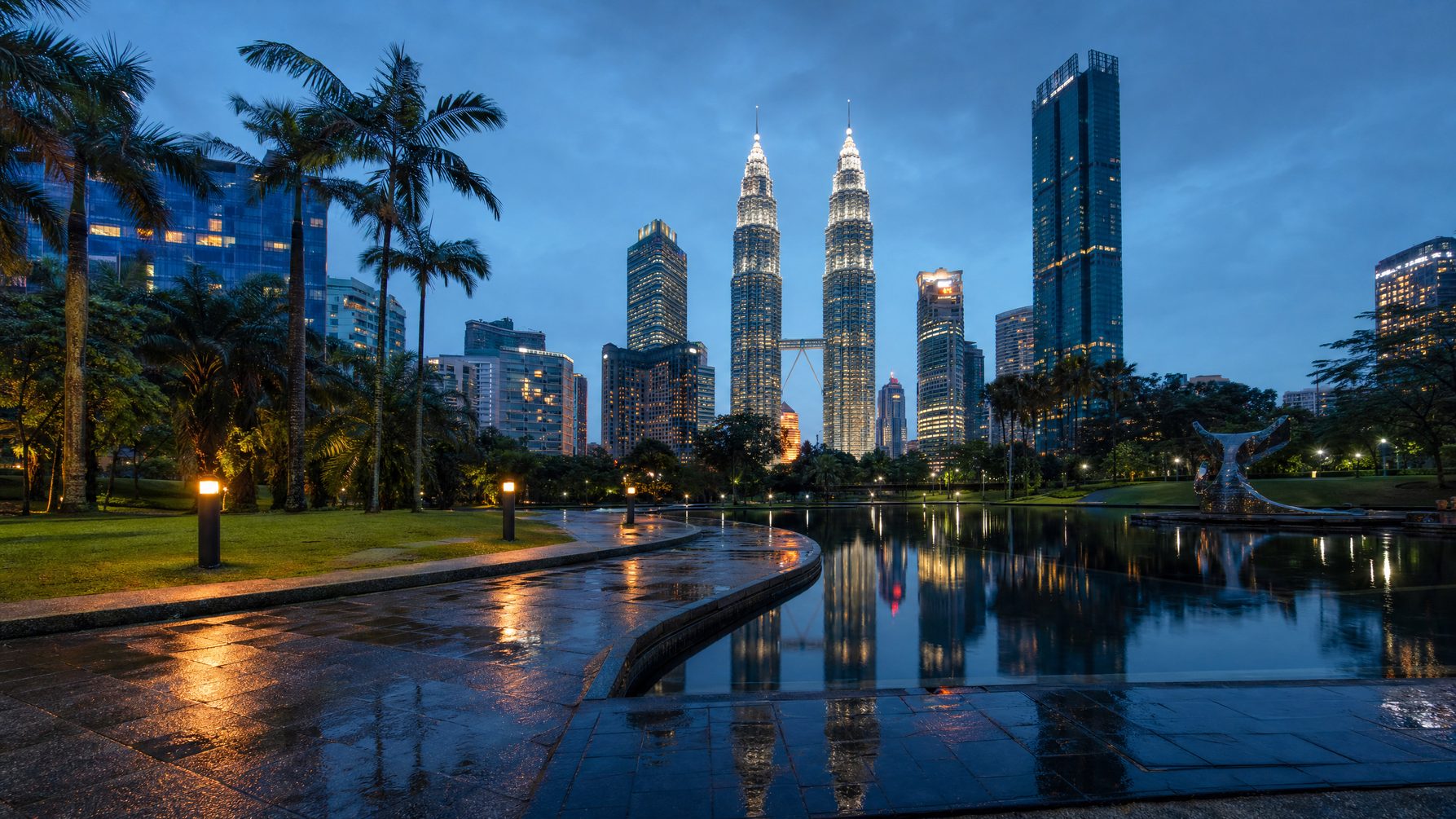
Malaysia is a federal constitutional monarchy in Southeast Asia, comprising eleven states and three federal territories on the Malay Peninsula plus two states (Sabah and Sarawak) on the island of Borneo. It covers 330,800 km² and has a population of approximately 34 million. The capital, Kuala Lumpur (KL), is a sophisticated multi-cultural metropolis of 8 million in the greater region — home to the Petronas Twin Towers (the world's tallest twin towers), the KLCC park, the Bukit Bintang shopping district, and one of Asia's most genuinely diverse food cultures.
The country operates in Malay (Bahasa Malaysia) as the official language, with English widely spoken in business, banking, government, the courts, professional services, and universities. The legal system is a hybrid of English common law (procedural and commercial law) and Islamic law (in matters of personal status for Muslims). The currency is the Malaysian Ringgit (MYR), a managed float. Malaysia is a member of ASEAN, the Commonwealth, the OIC, and APEC; it has long-standing diplomatic and commercial relationships with the UK, Australia, the US, China, India, and most major Asian economies.
On the tax side, Malaysia operates one of the most useful tax-friendly frameworks in Southeast Asia for HNW residents. The flagship feature is the foreign-sourced income exemption: Malaysian tax residents receive their foreign-sourced income free of Malaysian tax when remitted, provided the income has been taxed in its country of origin (or — under the practical effect of the rules — kept offshore and not remitted). This exemption was originally scheduled to expire on 31 December 2026 but was extended in Budget 2025 to 31 December 2036. For HNW clients with foreign investment portfolios, foreign rental income, foreign business income, and foreign pensions, Malaysia is one of the most efficient SE Asian bases. Personal income tax on Malaysian-source income is progressive from 0% to 30% (top rate above MYR 1 million). Corporate tax is 24% standard. There is no inheritance tax, no estate tax, no gift tax, and no annual wealth tax.
The flagship residence pathway is the MM2H (Malaysia My Second Home) programme, restructured in 2024 into four tiers (Platinum, Gold, Silver, SEZ/SFZ) with varying fixed deposit, property purchase, and visa duration requirements (5 to 20 years renewable). Annual cumulative presence is 90 days for ages 25–49 (no minimum for 50+). The Premium Visa Programme (PVIP) launched September 2022 provides an alternative 20-year multiple-entry visa for HNW investors at higher financial thresholds. The DE Rantau Pass for digital nomads launched in 2022 with lower income requirements.
What to be aware of. From 1 January 2024, foreign-sourced income remitted by Malaysian tax residents is in principle subject to tax — but the exemption (now valid through 31 December 2036) restores the practical zero-tax position provided the foreign income has been taxed in its country of origin or the income is kept offshore. For HNW clients with significant foreign-source investment income (which may not be taxed in source country, e.g. tax-free jurisdictions), careful planning is needed to use the exemption effectively. A 10% Capital Gains Tax on disposals of shares listed on Bursa Malaysia was introduced effective March 2024 (above MYR 100,000 in gains). Real Property Gains Tax (RPGT) applies to real estate disposals — 30% within 3 years, 5% after 5 years for individuals. The 2024 MM2H reforms raised financial thresholds substantially, pricing out some former applicants.
II.
Putting Malaysia on the Map
Malaysia — Peninsular Malaysia and Malaysian Borneo, at the heart of Southeast Asia
Malaysia arrives in the smell of laksa cooking on a side street in George Town, in the air-conditioned coolness of a KL shopping mall after the heat of the street, in the green of a tea plantation in the Cameron Highlands, in the orangutans of the Sepilok rehabilitation centre in Sabah. The country is two countries in one: Peninsular Malaysia, the urbanised western half running from Singapore to the Thai border, and Malaysian Borneo (Sabah and Sarawak), the wilder eastern half across the South China Sea. The two halves are radically different — the Peninsula is densely populated, infrastructure-rich, and dominated by the Klang Valley conurbation around Kuala Lumpur; Borneo is rainforest, mountains, indigenous cultures, and the second-largest island in the world.
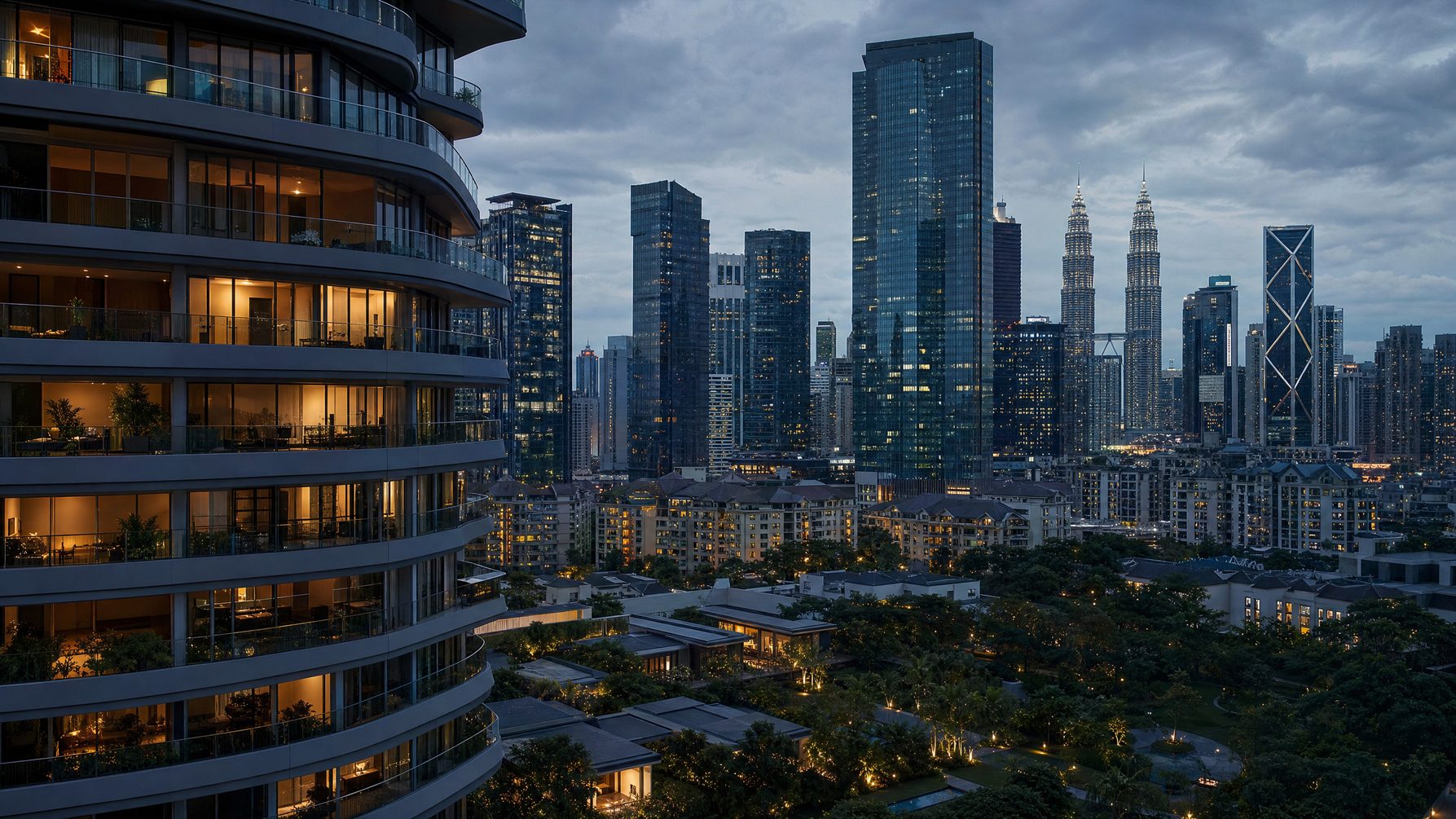
- ›Kuala Lumpur is the capital and the centre of expat life. The Petronas Twin Towers (452 m) defined the city's skyline from 1998; the Merdeka 118 (679 m, completed 2023) is now the world's second-tallest building. The KLCC area — KLCC Park, Suria KLCC, the Mandarin Oriental — is the modern commercial heart. Bukit Bintang (the shopping and nightlife district) and Bangsar (the expat residential quarter, with its bars, restaurants, and bookshops) are where most internationally mobile residents spend their time. Mont Kiara, Damansara Heights, and Bukit Tunku are the prestige residential neighbourhoods; the international schools cluster here.
- ›Penang (George Town) is the cultural counterpoint to Kuala Lumpur — a UNESCO World Heritage city with one of Southeast Asia's most extraordinary food cultures (laksa, char kway teow, Hokkien mee, nasi kandar), British colonial architecture, Chinese clan houses, and a thriving art and design scene that has made the island the cool-weekend destination of choice for KL professionals. Many MM2H holders choose Penang over KL for the slower pace and the food.
Langkawi, an archipelago of 99 islands off the northwest coast, is Malaysia's premier beach destination — duty-free shopping, the Sky Bridge over the rainforest, and direct flights from Singapore and KL. Malacca, on the Strait of Malacca, is another UNESCO city with Portuguese, Dutch, and British colonial layers and one of the great surviving multicultural town centres in Southeast Asia.
- ›Sabah and Sarawak on Borneo are entirely different: Mount Kinabalu (4,095 m, the highest peak in Southeast Asia) sits in Kinabalu National Park; the Danum Valley is one of the world's last great primary rainforests; the Maliau Basin is sometimes called the Lost World of Sabah. Diving on Sipadan, Mabul, and Layang Layang is among the best in the world. Kuching (Sarawak's capital) and Kota Kinabalu (Sabah's capital) are easy two-hour flights from KL.
- ›Singapore is 50 minutes by air from KL or 5 hours by land via the Causeway. Bangkok is 2 hours, Hong Kong 4 hours, Tokyo 7 hours, Sydney 8 hours, London 13 hours direct. KL International Airport (KLIA) is one of Southeast Asia's major hubs, served by Malaysia Airlines, Singapore Airlines, AirAsia, Cathay Pacific, Emirates, Qatar Airways, and most major European, US, and Asian carriers. The connectivity is one of the country's most underrated practical advantages.

III.
What Others Say About Malaysia
"Penang is the only city in Southeast Asia where you can eat ten different cuisines properly in three days, and have time left over for the beach. The Malaysians do not advertise this. They simply assume that everyone already knows."
— Anthony Bourdain, Parts Unknown — Malaysia, 2016
"What I love about Kuala Lumpur after fifteen years is that I have never had to ask for anything in any language other than English. The administrative culture is genuinely Anglo-Malaysian, the lawyers are first-rate, and the tax authorities answer their phones. After Hong Kong and Singapore, KL is the most professional jurisdiction in Asia."
— British MM2H holder, Mont Kiara, 2024
"If you measure a country by what it does well — food, music, multiculturalism, the way three religions and four languages share one street — Malaysia is the most successful country in Southeast Asia and one of the most successful in the world."
— Travel writer, George Town, 2025
IV.
Tax Benefits: What Malaysia Has to Offer
Malaysia is one of the most useful tax bases in Southeast Asia for HNW relocation clients. The combination of the foreign-sourced income exemption (now extended through 2036), no inheritance/wealth/gift tax, English-speaking common-law institutions, deep DTA network (76+), and the MM2H residence framework makes it a serious option for clients seeking an Asian base with portable foreign income.
- ›Foreign-sourced income exemption — extended through 31 December 2036 — Malaysian tax residents are exempt from Malaysian personal income tax on foreign-sourced income remitted to Malaysia, provided the foreign income has been taxed in its country of origin (the "subject to tax" condition). For HNW clients with foreign-source investment income, foreign rental income, foreign business income, and foreign pensions, this is the structural feature that makes Malaysia work. Originally scheduled to expire 31 December 2026; extended in Budget 2025 to 31 December 2036.
- ›Foreign income kept offshore — fully tax-free — even before the "subject to tax" exemption applies, foreign-source income kept outside Malaysia is not taxed. Malaysia operates effectively on a remittance basis for foreign-sourced income, with the additional layer of the "subject to tax" exemption protecting remittances of already-taxed foreign income.
- ›No inheritance tax, estate tax, gift tax, or wealth tax — Malaysia imposes no inheritance tax (abolished in 1991), no estate tax, no gift tax (other than as a transactional matter on real estate), and no annual wealth tax. Wealth transfers between generations are entirely outside the Malaysian tax net.
- ›Personal income tax on Malaysian-source income — progressive 0%–30% — Malaysian-source employment, business, and investment income is taxed at progressive rates. Top rate of 30% applies above MYR 1 million; 24% applies in the MYR 100,000–250,000 band; lower rates below. Tax residents (183+ days) are eligible for tax reliefs and rebates.
- ›MM2H (Malaysia My Second Home) — flagship long-term residence programme (5–20 years, renewable) — restructured in 2024 into four tiers (Platinum, Gold, Silver, SEZ/SFZ). Provides multiple-entry visa, right to bring family (spouse, children, parents), property ownership rights, and integration with the foreign-sourced income exemption. MM2H holders can become Malaysian tax residents (183+ days/year) and benefit from the foreign-income exemption.
- ›Premium Visa Programme (PVIP) — 20-year visa for HNW investors — launched September 2022. Higher financial thresholds than MM2H (MYR 1 million fixed deposit, MYR 40,000/month offshore income proof, MYR 50,000 application fee). 20-year visa with multi-entry access. Suitable for clients with significant offshore income who want longer visa duration.
- ›DE Rantau Pass — for digital nomads and remote workers — launched 2022. Designed for foreign remote workers earning from foreign employers/clients. Lower income thresholds than MM2H. Foreign-source remote work income remains within the foreign-source exemption framework.
- ›Corporate tax — 24% standard, 17% for SMEs on first MYR 600,000 — competitive within Southeast Asia. Single-tier dividend system: dividends paid by Malaysian resident companies to shareholders are tax-exempt at shareholder level (corporate tax already final). Deep R&D incentives, MIDA approvals for foreign manufacturers, Labuan offshore regime for international financial services.
- ›76+ active double tax treaties; English-speaking; common law — DTA network includes UK, US, Germany, Australia, Canada, Singapore, China, Japan, India, UAE, Switzerland, France, Italy, Spain, and most major economies. The English-speaking common-law foundation is a significant practical advantage over many SE Asian alternatives.
- ›Capital gains generally tax-free for individuals — Malaysia historically had no general capital gains tax. From March 2024, a 10% CGT applies to disposals of shares listed on Bursa Malaysia (only above MYR 100,000 in gains). Real Property Gains Tax (RPGT) applies to real estate (30% within 3 years, declining to 5% after 5 years for individuals; 0% after 5 years for citizens). Foreign capital gains kept offshore remain outside Malaysian tax.
V.
Tax Rates at a Glance
The most important tax rates in Malaysia are as follows. Note that these have been simplified and should be used as general guidance only.
| Tax | Rate | Notes |
|---|---|---|
| Personal Income Tax — bottom rate | 0% | First MYR 5,000 |
| Personal Income Tax — top rate | 30% | Above MYR 1,000,000 |
| Foreign-Sourced Income (FSI) — exempt | 0% | If "subject to tax" abroad; through 31 Dec 2036 |
| Foreign Income kept offshore | 0% | Not within Malaysian tax base |
| Capital Gains — Bursa Malaysia listed shares | 10% | On gains above MYR 100,000; from March 2024 |
| Capital Gains — unlisted Malaysian shares | Income tax rates | Treated as business income |
| Capital Gains — foreign shares (offshore) | 0% | Outside Malaysian tax base |
| Real Property Gains Tax — within 3 years | 30% | Individuals |
| Real Property Gains Tax — 4th year | 20% | Individuals |
| Real Property Gains Tax — 5th year | 15% | Individuals |
| Real Property Gains Tax — 6th year+ | 5% / 0% (citizens) | Individuals |
| Inheritance Tax | 0% | Abolished 1991 |
| Estate Tax | 0% | None |
| Gift Tax | 0% | Other than real estate transfers |
| Wealth Tax | 0% | None |
| Corporate Income Tax — standard | 24% | Resident companies; worldwide income |
| Corporate Income Tax — SME (first MYR 600K) | 17% | Tiered SME rate |
| Corporate Income Tax — SME (above MYR 600K) | 24% | Standard rate above threshold |
| Single-Tier Dividend System | 0% at shareholder | Corporate tax on profits is final |
| Withholding Tax — interest to non-residents | 15% | Reduced by DTA |
| Withholding Tax — royalties to non-residents | 10% | Reduced by DTA |
| Withholding Tax — service fees to non-residents | 10% | Reduced by DTA |
| Sales and Service Tax (SST) | 6%–10% | Replaced GST in 2018 |
| Stamp Duty — share transfers | 0.3% | Of consideration |
| Stamp Duty — property transfers | 1%–4% | Tiered by value |
| MM2H — Platinum tier fixed deposit | MYR 5,000,000 | Approx. USD 1.06M |
| MM2H — Gold tier fixed deposit | MYR 2,000,000 | Approx. USD 425K |
| MM2H — Silver tier fixed deposit | MYR 500,000 | Approx. USD 106K |
| MM2H — Platinum tier property minimum | MYR 2,000,000 | Approx. USD 425K |
| MM2H — Gold tier property minimum | MYR 1,000,000 | Approx. USD 213K |
| MM2H — Silver tier property minimum | MYR 600,000 | Approx. USD 127K |
| Premium Visa (PVIP) fixed deposit | MYR 1,000,000 | 20-year visa |
| DTAs | 76+ | Includes UK, US, Germany, Australia, Singapore, China |
| Malaysia tax residency threshold | 183+ days | In a calendar year |
Cryptocurrency and Crypto Assets
Malaysia does not currently classify cryptocurrency as legal tender, but tax treatment depends on the nature of the activity. Malaysia's Inland Revenue Board (LHDN) treats crypto disposals by active traders as business income (taxable at progressive rates). Casual investors and long-term holders are generally treated as falling outside the income tax base — capital gains from non-business crypto holdings are typically not taxed. Crypto received as employment compensation is taxed as employment income. Mining and staking conducted as a business is business income. Foreign-source crypto gains kept offshore are within the foreign-source exemption framework — for HNW crypto holders, Malaysia combined with offshore holding structures and the FSI exemption (now extended through 2036) is one of the most efficient SE Asian bases for digital assets.
VI.
Tax Residency: What Triggers It
Under Malaysian tax law, an individual is considered a tax resident of Malaysia for any year of assessment if they meet any one of the following criteria under Section 7 of the Income Tax Act 1967:
- ›183-day rule: Physical presence in Malaysia for 183 or more days in the calendar year. This is the primary trigger and the rule most commonly relied on by MM2H, PVIP, and DE Rantau holders.
- ›Linked-presence rule: Physical presence in Malaysia for a period of less than 183 days in a year, provided that period is linked by or to another period of 182 or more consecutive days throughout which the individual was in Malaysia in the year immediately preceding or following. A complex linkage test designed to capture cross-year residence patterns.
- ›Three-out-of-four rule: Tax resident in Malaysia for 3 of the 4 immediately preceding years of assessment AND present in Malaysia for at least 90 days in the relevant year.
- ›Continuing residence rule: Tax resident in Malaysia in the immediately following year and the 3 immediately preceding years (residence by historical pattern).
Tax residents are subject to Malaysian tax on Malaysian-source income (always) and on foreign-source income remitted to Malaysia — but the foreign-source income exemption (extended through 31 December 2036 in Budget 2025) generally exempts foreign-source income that has been taxed in its country of origin. Foreign-source income kept offshore is not within the Malaysian tax base regardless. Non-residents are taxed only on Malaysian-source income at a flat 30% rate.
For most HNW clients pursuing Malaysia residence through MM2H, PVIP, or DE Rantau, the standard 183-day rule is the simplest pathway — once 183 days are accumulated in a calendar year, full tax-resident status applies for that year. Some clients deliberately structure their first year to maximise the days-in-Malaysia count to establish residence; subsequent years can typically be maintained on lower day-counts using the three-out-of-four rule.
- ›Documentation matters. Establishing and maintaining Malaysia tax residency requires evidence: a registered lease agreement or property title, the corresponding visa (MM2H, PVIP, DE Rantau), passport stamps demonstrating physical presence, utility bills, bank statements showing the local address, and the annual tax return filing with LHDN. A Malaysia Tax Residency Certificate (Sijil Mastautin Cukai) can be issued by LHDN on request and is useful for invoking double tax treaty protection.
- ›The "subject to tax" condition for the FSI exemption. For foreign-source income to qualify for the Malaysian exemption, the income must have been taxed in its country of origin. In practice, this means: - Foreign income from countries that taxed it (UK, US, Germany, Australia, etc.) — qualifies for the Malaysian exemption regardless of headline rate - Foreign income from zero-tax jurisdictions (UAE personal income, Cayman investment income, etc.) — does NOT meet the "subject to tax" condition for the exemption when remitted to Malaysia, but remains exempt if kept offshore - Foreign income kept offshore — outside the Malaysian tax base regardless of source-country taxation
This last point is critical for HNW planning: the safe harbour for any foreign-source income is to keep it offshore and not remit it to Malaysia.
VII.
Double Tax Treaties
Malaysia has concluded 76+ double tax agreements (DTAs) that are currently in force — one of the most comprehensive treaty networks in Southeast Asia, reflecting the country's longstanding integration with the international economic system.
Active DTA partners include:
- ›Albania
- ›Argentina (limited)
- ›Australia
- ›Austria
- ›Bahrain
- ›Bangladesh
- ›Belgium
- ›Brunei
- ›Canada
- ›Chile
- ›China
- ›Croatia
- ›Czech Republic
- ›Denmark
- ›Egypt
- ›Fiji
- ›Finland
- ›France
- ›Germany
- ›Hong Kong
- ›Hungary
- ›India
- ›Indonesia
- ›Iran
- ›Ireland
- ›Italy
- ›Japan
- ›Jordan
- ›Kazakhstan
- ›Korea (South)
- ›Kuwait
- ›Kyrgyzstan
- ›Laos
- ›Lebanon
- ›Luxembourg
- ›Mauritius
- ›Mongolia
- ›Morocco
- ›Myanmar
- ›Namibia
- ›Netherlands
- ›New Zealand
- ›Norway
- ›Pakistan
- ›Papua New Guinea
- ›Philippines
- ›Poland
- ›Qatar
- ›Romania
- ›Russia
- ›San Marino
- ›Saudi Arabia
- ›Senegal
- ›Seychelles
- ›Singapore
- ›Slovak Republic
- ›South Africa
- ›Spain
- ›Sri Lanka
- ›Sudan
- ›Sweden
- ›Switzerland
- ›Syria
- ›Thailand
- ›Turkey
- ›Turkmenistan
- ›United Arab Emirates
- ›United Kingdom
- ›United States (limited shipping/aircraft only)
- ›Uzbekistan
- ›Venezuela
- ›Vietnam
- ›Zimbabwe
The UK–Malaysia DTA is in force and provides reduced withholding rates and standard residence tie-breaker rules — particularly useful for British MM2H clients with UK-source pension and investment income.
The Germany–Malaysia DTA is in force and provides standard tie-breaker rules — useful for German nationals establishing Malaysian residency.
The US–Malaysia DTA is limited in scope — covering only shipping and aircraft income. There is no comprehensive US-Malaysia income tax treaty. US citizens in Malaysia rely on the Foreign Earned Income Exclusion (US$132,900 for 2026) and the Foreign Tax Credit rather than treaty relief. The savings clause issue does not arise because there is no comprehensive treaty.
The Singapore–Malaysia DTA is the most-used regional treaty given the deep economic integration between the two countries — useful for cross-border employment, investment, and residence patterns common among MM2H holders who maintain Singaporean business interests.
Malaysia is a signatory to the OECD Multilateral Instrument (MLI) and has implemented BEPS minimum standards. Several DTAs incorporate Limitation on Benefits (LoB) provisions and principal-purpose tests.
The existence of a DTA does not automatically resolve all tax conflicts. The treaty must be invoked correctly, residency must be properly established, and the specific provisions of each treaty must be reviewed for the income type and circumstances.

VIII.
Avoid Remaining Tax Resident at Home
Relocating to Malaysia does not automatically end your tax obligations elsewhere. The critical question is whether you have genuinely severed tax residency in your country of origin — and this is determined not by where you have registered an address, but by where you actually live, where your ties are, and how your life is organised.
This is particularly important for Malaysia because the MM2H minimum cumulative presence (90 days/year for ages 25–49, no minimum for 50+) leaves substantial room for clients to spend most of their time elsewhere. If "elsewhere" happens to be a high-tax country where the client retains a home, family, and business interests, the home-country tax authority will likely conclude that tax residency was never severed.
The most common triggers that can keep you tax-resident at home:
- ›Available dwelling: Any long-term residence that remains available for your use — a flat you own, a property you rent on an ongoing basis, even a room in a family home — is sufficient to maintain a taxable domicile in many countries. The dwelling does not need to be your primary home; it only needs to be available. Surrendering it before departure is a precondition of a clean exit in Germany (§1 EStG Wohnsitz), Austria, Switzerland, and many other jurisdictions.
- ›Centre of vital interests: If your family, your business, your social connections, and your financial affairs remain in your home country, most tax authorities will argue that your centre of life has not genuinely moved — regardless of where you have registered. Spouse and minor children remaining in the home country are particularly powerful indicators.
- ›183-day rule (home country): Spending more than 183 days in your home country in a calendar year will typically trigger residency there, overriding any claim to Malaysian residency for that year. Achieving Malaysian tax residence requires 183+ days in Malaysia, leaving fewer than 182 days for the home country.
- ›Extended unlimited tax liability (Germany — §2 AStG): Germany's erweiterte unbeschränkte Steuerpflicht under §2 AStG can keep German nationals taxable in Germany for up to ten years after departure if they move to a low-tax country and retain significant ties. Malaysia is not classified as a low-tax country under §2 AStG in most analyses (because the headline rates on Malaysian-source income are progressive to 30% and the foreign-income exemption is conditional), but the analysis is fact-specific and should be confirmed before relying on it.
A genuine relocation to Malaysia requires that you actually live there — that your home is there, your daily life is there, and that you can demonstrate this with documentation. A registered address and a bank account are not sufficient.
The test is not where you are registered. The test is where you live. Tax authorities in Germany, Austria, the UK, Australia, and Switzerland are experienced at identifying sham relocations and have the legal tools to challenge them. Proper advice before you move — not after — is essential.
IX.
Tax Considerations When Leaving Your Home Country
Before you relocate, you need to understand what tax consequences arise in your current country of residence at the point of departure. These rules vary significantly by country and must be assessed individually — there is no universal answer.
Many countries impose an exit tax or deemed disposal charge when a tax resident leaves. This typically applies to unrealised capital gains on shares, business interests, real estate, or other assets — taxing you as if you had sold everything on the day you departed. The rules differ widely: some countries apply this to all assets above a threshold, others only to substantial shareholdings or business interests. Some have look-back periods that can catch you even after you have left.
Among the countries that levy a meaningful exit tax or deemed-disposal charge:
- ›Germany. Applies an exit tax on unrealised gains in shareholdings of 1% or more under §6 AStG. The Germany–Malaysia DTA provides standard tie-breaker rules. §2 AStG extended liability is generally not triggered by Malaysian residence, but should be confirmed.
- ›United States. The "expatriation tax" under IRC §877A treats long-term residents and citizens as having sold all worldwide assets at fair market value on the day they relinquish citizenship or residency. The exemption for 2026 is approximately US$890,000. There is no comprehensive US–Malaysia income tax treaty — only a limited shipping/aircraft treaty. US citizens in Malaysia rely entirely on FEIE and FTC.
- ›United Kingdom. Statutory Residence Test (SRT) exit-date analysis is required. The new FIG regime (in force since 6 April 2025) governs new UK arrivals, not departures. UK pensioners moving to Malaysia face UK-source pension taxation; the UK–Malaysia DTA provides tie-breaker rules and (under MM2H + the foreign-income exemption to 2036) effective residence-country taxation in many cases.
- ›Australia. Departing residents are treated as having disposed of most assets at market value on the date they cease to be Australian tax residents. CGT Event I1 applies. The Australia–Malaysia DTA is in force and provides standard tie-breaker rules — particularly relevant given the substantial Australian retiree presence in Malaysia.
- ›France. Exit tax applies to unrealised gains on securities and company rights above €800,000 when a French tax resident relocates abroad. Malaysia is non-EU/EEA, so the deferral mechanism available for moves within the EU does not apply.
- ›Netherlands. Deemed disposal applies to substantial shareholdings (5% or more) at the point of emigration.
- ›Canada. The "departure tax" deems most property to have been disposed of at fair market value on the date of emigration.
- ›Singapore. No general exit tax on individuals, but specific anti-avoidance rules may apply for substantial-shareholding situations. Many Malaysian clients have prior Singapore tax-residence patterns; the Singapore-Malaysia interaction requires careful planning.
Beyond exit tax, you may remain subject to limited tax liability in your home country after the move — for example, on rental income from property you continue to own there, on dividends from domestic companies, or on pension payments. Severing tax residency does not necessarily sever all tax obligations.
The timing of your departure, the structure of your assets, and the sequence of any business disposals all have material consequences. In some cases, restructuring assets before departure — or deferring the move by a few months — can make a significant difference to the tax outcome.
⚠ Obtain Local Tax Advice in Your Home Country. The information above provides a general overview of the departure tax rules that commonly apply when leaving high-tax jurisdictions. It is not legal or tax advice. The rules in your specific home country — Germany, Austria, Switzerland, the UK, the US, Australia, or any other jurisdiction — are complex, change frequently, and depend entirely on your personal circumstances: your nationality, the nature and location of your assets, your business structure, your family situation, and the timing of your departure. Before you take any steps to relocate, obtain written advice from a qualified tax adviser who is licensed in your home country and experienced in international relocations. A consultation with us is a good starting point — but it does not substitute for country-specific legal advice from a practitioner in your jurisdiction of departure. The cost of getting this wrong is almost always greater than the cost of getting proper advice upfront.
X.
Company Setup & Corporate Tax
Malaysia offers a sophisticated corporate environment — a deep mix of standard onshore vehicles, the Labuan offshore regime, MIDA-approved manufacturing incentives, and sector-specific regimes for digital services, financial services, and Islamic finance.
The most relevant corporate structures for foreign entrepreneurs and investors:
- ›Sdn Bhd (Sendirian Berhad / Private Limited Company): The standard Malaysian onshore company. Minimum share capital MYR 1. Corporate tax 24% on worldwide income (residents). SME rate of 17% on first MYR 600,000 of chargeable income (where paid-up capital ≤MYR 2.5M). Single-tier dividend system: dividends paid to shareholders are tax-exempt at shareholder level. Can be 100% foreign-owned in most sectors; some sectors require Bumiputera (ethnic Malay) participation under Malaysia's affirmative-action framework.
- ›Bhd (Berhad / Public Limited Company): Public company structure for businesses listing on Bursa Malaysia or seeking public investment. Same 24% corporate tax base.
- ›Labuan Offshore Companies: Labuan (a federal territory of Malaysia in the South China Sea) operates a separate offshore tax regime under the Labuan Business Activity Tax Act. Trading companies pay either 3% of audited net profits OR a flat MYR 20,000 tax (taxpayer's election). Non-trading companies (holding) pay 0% under specific conditions. Significant economic substance requirements apply since 2019 reforms. Suitable for international holding, captive insurance, fund management, and financial services.
- ›LLP (Limited Liability Partnership): Hybrid structure combining partnership flexibility with limited liability. Subject to corporate tax treatment.
- ›Branch / Permanent Establishment: Foreign companies can register a branch in Malaysia. Branch taxation is similar to subsidiary taxation but with branch-specific procedural rules.
The single-tier dividend system is a key feature: corporate tax on profits is final, and dividends paid by Malaysian resident companies are tax-exempt in the hands of shareholders (whether resident or non-resident). This eliminates economic double taxation and is particularly favourable for HNW shareholders.
Malaysia offers extensive corporate tax incentives:
- ›Pioneer Status: 70%–100% income tax exemption for promoted activities (typically 5–10 years)
- ›Investment Tax Allowance (ITA): 60%–100% allowance on qualifying capital expenditure
- ›MSC Malaysia Status: Multimedia, ICT, and digital companies — tax incentives + foreign workforce flexibility
- ›R&D Tax Incentives: Double deduction for qualifying R&D expenditure
- ›Halal Industry Master Plan incentives: For halal food manufacturing, processing, and certification
- ›Islamic Finance incentives: For Islamic banking, takaful, and Islamic capital market activities
- ›Special Economic Zone (SEZ) and SFZ regimes: Specific tax holidays in designated zones (Iskandar, Forest City)
Permanent establishment risk is the central warning. A Malaysian company that is effectively managed from another country may be treated as resident there for tax purposes. Genuine substance — directors who actually meet in Malaysia, key decisions taken in Malaysia, accounting and operations meaningfully conducted in Malaysia — is essential. Malaysia has detailed transfer pricing rules in line with OECD BEPS guidance; cross-border related-party transactions require contemporaneous transfer-pricing documentation.
XI.
Who Should (and Shouldn't) Move to Malaysia
Section 11 is where the relocation decision becomes practical. Malaysia can be an excellent fit for some profiles and a poor fit for others; the decisive question is whether the tax rules, lifestyle, residence requirements, banking, healthcare, and family situation point in the same direction.
Good Fit
- › HNW retirees, investors, and remote-working entrepreneurs with substantial foreign-source investment income, foreign rental income, foreign business income, or foreign pensions — these are the categories the Malaysian foreign-sourced income exemption (now extended through 2036) treats most favourably.
- › Internationally mobile clients seeking a Southeast Asian base with English-speaking common-law institutions — a significant advantage over Thailand, Vietnam, Indonesia, or Cambodia for clients accustomed to Anglo-Saxon legal frameworks.
- › Families with school-age children — Malaysia has one of the deepest international-school networks in Southeast Asia (Marlborough College Malaysia, Alice Smith School, International School of Kuala Lumpur, Mont'Kiara International School, Garden International School, EITON in Penang, and many others).
- › Retirees and HNW residents seeking premium Southeast Asian lifestyle quality at a fraction of Singapore or Hong Kong cost — Penang and Kuala Lumpur in particular offer genuine cultural depth, healthcare quality, and food culture at materially lower cost.
- › Australian, New Zealand, and Singaporean clients seeking a regional base — Malaysia is well-connected, English-speaking, and DTA-protected for these nationalities.
- › Crypto-wealthy individuals using offshore holding structures combined with the FSI exemption — the framework is genuinely efficient when structured properly.
Poor Fit
- × Those who cannot meet the MM2H tier financial thresholds — Silver tier requires MYR 500K fixed deposit + MYR 600K property = ~USD 234K commitment. Below this, alternatives like Thailand's Privilege Card, Indonesia's Second Home Visa, or Cambodia's MyAnchor scheme may be more accessible.
- × Clients seeking a zero-cost regime — the MM2H/PVIP financial thresholds, real estate purchase requirements, and ongoing compliance costs make Malaysia a serious-money jurisdiction, not a budget option.
- × Those with primarily Malaysian-source business or employment income — the 0%–30% progressive personal income tax and 24% corporate tax mean Malaysia is not a low-tax jurisdiction for locally-derived income; only foreign-source income gets the favourable treatment.
- × US citizens expecting Malaysia status to eliminate US tax filing — the US taxes citizens on worldwide income regardless of residence, and there is no comprehensive US-Malaysia DTA.
- × Clients seeking absolute privacy — Malaysia is fully CRS-compliant, FATCA-cooperative, and beneficial-ownership-transparent.
- × Anyone choosing Malaysia only because of the tax marketing without testing housing, schooling, healthcare, the tropical climate, and the realities of living in a Muslim-majority country with specific cultural and legal frameworks (alcohol restrictions in some states, Islamic family law for Muslims, etc.).

XII.
Visas and Residence Permits
Malaysia offers several distinct residence pathways for foreign nationals — the right route depends on age, financial profile, family situation, and whether the goal is residence-only, residence-with-business-rights, or short-term remote-working access.
- ›MM2H — Malaysia My Second Home (flagship long-term programme): Restructured in 2024 into four tiers:
- ›Platinum tier: 20-year visa. MYR 5,000,000 (~USD 1.06M) fixed deposit + MYR 2,000,000 (~USD 425K) property purchase. Allows business activity and employment. Minimum age 25.
- ›Gold tier: 15-year visa. MYR 2,000,000 (~USD 425K) fixed deposit + MYR 1,000,000 (~USD 213K) property. No employment rights (limited part-time for 50+). Minimum age 25.
- ›Silver tier: 5-year visa. MYR 500,000 (~USD 106K) fixed deposit + MYR 600,000 (~USD 127K) property. No employment rights. Minimum age 25.
- ›SEZ/SFZ tier: 5–20 year visa. Property purchase exclusively in designated Special Economic Zones (Forest City, Iskandar). No proof of offshore income required. Minimum age 21.
All MM2H tiers require: medical insurance, medical examination, clean criminal record, application via licensed MM2H agent (direct submission no longer permitted), 90 cumulative days/year presence (ages 25–49; no minimum 50+).
- ›Premium Visa Programme (PVIP) — 20-year multiple-entry visa: Launched September 2022. MYR 1,000,000 (~USD 213K) fixed deposit. MYR 40,000/month offshore income proof. MYR 50,000 application fee. Provides 20-year residence with multi-entry access; broader business and employment rights than MM2H Silver/Gold; suitable for HNW investors prioritising visa duration over tier flexibility.
- ›DE Rantau Pass (Digital Nomad Visa): Launched 2022. For foreign remote workers earning from foreign employers/clients. Annual income threshold approximately USD 24,000 (digital nomads in tech) or USD 60,000+ (premium tier). 12-month visa extendable to 24 months. Allows holders to work remotely from Malaysia for foreign employers; foreign-source remote-work income within FSI exemption framework.
- ›Employment Pass: For foreigners employed by Malaysian employers. Tied to specific employer; renewable. Required for any locally-employed work. Three categories (I, II, III) based on salary.
- ›Permanent Resident (PR) status: Entry-Permit-based. Available after long-term legal residence (typically 5+ years on Employment Pass with significant Malaysian-source income, or via marriage to Malaysian citizen, or via specific government-discretionary grants for HNW investors). PR holders enjoy near-citizen rights but cannot vote.
- ›Long-Term Social Visit Pass: For foreigners with specific qualifying connections (spouse, parent, dependent of Malaysian citizen).
The clean planning order is: (1) define the goal — long-term residence with business rights, retirement, remote work, employment, or PR; (2) match financial capacity to the appropriate tier or programme; (3) handle the application through a licensed MM2H agent (mandatory) or direct submission to the relevant authority for non-MM2H pathways.
Visa and permit rules can change. Always verify current requirements with the Malaysian High Commission or Embassy in your country of residence or with a licensed MM2H/visa agent before making any plans. We can assist with the preparation of documentation and coordination with local authorities as part of our relocation service.
XIII.
Path to Citizenship
Malaysian citizenship is difficult to obtain for foreign nationals — reflecting Malaysia's careful preservation of its multi-ethnic political balance and the constitutional structure under which citizenship is closely controlled. There is no citizenship-by-investment programme, no expedited route based on wealth, and limited dual-citizenship recognition.
The standard paths to Malaysian citizenship are:
- ›Naturalisation: Requires 12 cumulative years of residence in Malaysia (10 years out of the 12 immediately preceding the application), good character, adequate knowledge of Malay language and Malaysian civic matters, and intention to reside permanently. Ministerial discretion is significant; approval is not automatic even where requirements are met.
- ›Registration (for spouses of Malaysian citizens): Available for spouses of Malaysian male citizens (with qualifying period of marriage and residence). The framework is gendered and follows traditional patrilineal naturalisation patterns.
- ›Birth in Malaysia to Malaysian citizen parents: Standard ius sanguinis transmission.
- ›Malaysia generally does not permit dual citizenship. Naturalised Malaysian citizens are typically required to renounce their previous citizenship. Some bilateral arrangements (with specific countries) exist but do not change the general rule.
- ›There is no Malaysian citizenship-by-investment programme. The MM2H, PVIP, and PR pathways provide long-term residence rights but do not lead to citizenship under accelerated criteria. Even after 12+ years of legal residence, naturalisation remains a discretionary ministerial decision.
For most HNW clients, Malaysia is a long-term residence destination, not a citizenship destination. Permanent Resident (PR) status, achievable after 5+ years on Employment Pass with significant Malaysian-source income contribution, or under specific government-discretionary HNW-investor schemes, provides full residence and economic rights without requiring renunciation of the original passport.
The Malaysian passport is moderately strong by international rankings (visa-free access to approximately 180+ countries including Schengen, the UK with ETA, and most Asian countries; visa required for the US, Canada, and Australia). For most internationally mobile HNW clients, retaining their existing strong-passport citizenship while holding Malaysian PR is the pragmatic outcome.
XIV.
Banking in Malaysia
Malaysia's banking sector is well-developed, English-speaking, and accessible to foreigners — one of the most user-friendly banking environments in Southeast Asia. The country has a sophisticated mix of local Malaysian banks and international banking institutions, all under the supervision of Bank Negara Malaysia (BNM, the central bank).
The major banks operating in Malaysia:
- ›Maybank (Malayan Banking Berhad): The largest bank in Malaysia and one of the largest in Southeast Asia. Comprehensive retail, commercial, and private banking services. Strong international presence.
- ›CIMB Bank: Second-largest by assets. Regional Southeast Asian bank with strong corporate and HNW services.
- ›Public Bank: Major retail bank with strong service quality reputation.
- ›RHB Bank: Full-service domestic bank.
- ›Hong Leong Bank: Major retail and SME bank.
- ›HSBC Malaysia: International HSBC operations; strong HNW and private banking offering for internationally mobile clients.
- ›Standard Chartered Malaysia: International StanChart presence; strong HNW and private banking.
- ›OCBC Malaysia, UOB Malaysia, Citi Malaysia: Other major international banks with significant Malaysian operations.
- ›Labuan banks (offshore): RBC, AmIslamic, Affin Bank, and various international banks operate offshore licences in Labuan for international financial services.
Account opening for non-residents is accessible. Standard requirements: passport, proof of address (Malaysian or foreign), MM2H/PVIP/employment pass, and source-of-funds documentation. Multi-currency accounts (MYR, USD, EUR, SGD, AUD, GBP) are standard at major banks. Online banking and mobile apps are well-developed; English-language interfaces are universal. SWIFT transfers are standard.
The banking sector is fully CRS-compliant since 2018, FATCA-cooperative, and follows OECD transparency standards. Banks maintain rigorous source-of-wealth documentation requirements for HNW clients, particularly for MM2H Platinum and PVIP applicants.
For Malaysian tax residents (whether under MM2H, PVIP, DE Rantau, or Employment Pass), the typical banking architecture is:
- ›Malaysian primary account — for MM2H/PVIP fixed deposit, residence administration, daily expenses, property maintenance. Most major Malaysian banks provide world-class service for HNW clients at a fraction of Singapore or Hong Kong cost.
- ›Secondary international booking centre — Singapore (75-minute flight from KL), Hong Kong, the UAE, Switzerland, or the UK — for the bulk of investment portfolios where private banking depth and custody quality may be greater. Singapore is the natural complement to Malaysia for HNW banking given the geographic proximity, the close legal and economic relationships, and the deep private banking sector in Singapore.
Important: not all banks are compatible with all residencies. Some Swiss and Singaporean private banks have specific protocols for Malaysian-resident clients, particularly those who arrived through MM2H. Source of wealth documentation must be impeccable. Several private banks impose minimum asset thresholds (typically USD/SGD 1–5 million) for new HNW relationships.
Important: not all banks are compatible with all residencies. Some Swiss and Singaporean private banks have restrictions on clients resident in certain jurisdictions, and compliance requirements vary. Residency status, income profile, source of wealth, and business type all affect which institutions will accept you and on what terms. We help clients navigate this before they commit to any banking structure.
XV.
What Makes Malaysia Genuinely Attractive
Malaysia is attractive when it is judged as a complete relocation platform, not as a slogan. The point is not that Malaysia is perfect for everyone. The point is that, for the right person, the combination of tax position, English-language Anglo-Saxon institutional framework, lifestyle, geography, banking, and connectivity can produce a genuinely useful Southeast Asian base.
- ›One of the few SE Asian jurisdictions combining genuinely favourable foreign-income treatment with a serious institutional foundation. The 2025 Budget extension of the FSI exemption to 2036 gives clients ten years of structural certainty — significantly longer than the year-by-year political risk in some neighbouring jurisdictions.
- ›English-speaking common-law institutions. This is genuinely valuable. The legal system, the courts, the banks, the lawyers, the accountants, the international schools, and most of daily life operate in English. For internationally mobile families accustomed to Anglo-Saxon institutional frameworks, Malaysia is significantly easier to navigate than Thailand, Vietnam, Indonesia, Cambodia, or the Philippines.
- ›The lifestyle case is real and varied. Kuala Lumpur (cosmopolitan capital), Penang (UNESCO heritage city with Asia's best food culture), Langkawi (tropical island duty-free), Borneo (genuine wilderness), the Cameron Highlands (cool tea-country retreat). Malaysia gives more lifestyle options than any single SE Asian country.
- ›It can function as a real operating base. Mature financial services, sophisticated multinational presence, deep international school network, world-class healthcare (Malaysia is among the world's leading medical-tourism destinations), and KL's connectivity to every major Asian and European hub.
- ›The connectivity is exceptional. KL to Singapore in 50 minutes. KL to Bangkok in 2 hours. KL to Hong Kong in 4 hours. KL to Tokyo in 7 hours. KL to London direct in 13 hours. For families maintaining international ties (business, university, extended family), the flight network is one of the country's most underrated practical advantages.
- ›The attraction has to be handled honestly. The MM2H tier thresholds are real money. The "subject to tax" condition for the FSI exemption requires careful planning for clients with income from zero-tax source jurisdictions. The Bumiputera affirmative-action framework affects some sectors and corporate structures. Property ownership has minimum thresholds varying by state. The tropical climate (28–34°C year-round, high humidity) is challenging for those who haven't lived in the tropics. Malaysia rewards clients who fit the profile carefully and is not a one-size-fits-all destination.
XVI.
Cost of Living in Malaysia
Malaysia is one of the most cost-effective SE Asian premium destinations — significantly cheaper than Singapore, Hong Kong, or Tokyo, while offering comparable healthcare, schooling, and lifestyle quality for those who position themselves correctly. For internationally mobile clients, the question is the budget required for Western-level housing, schooling, healthcare, and lifestyle in a tropical SE Asian setting.
Typical monthly costs for an internationally mobile professional or family in Malaysia (2026 planning ranges):
| Category | MYR/month | GBP/month | USD/month |
|---|---|---|---|
| 1-bed apartment, Mont Kiara/KLCC | MYR 4,500–9,000 | £840–1,680 | $960–1,920 |
| 2-bed apartment / townhouse, prime areas | MYR 7,000–15,000 | £1,310–2,800 | $1,490–3,200 |
| Premium villa, Bukit Tunku / Damansara Heights | MYR 18,000–45,000 | £3,360–8,400 | $3,830–9,580 |
| International school (annual per child) | MYR 60,000–150,000 | £11,200–28,000 | $12,770–31,910 |
| Private health insurance (annual individual) | MYR 6,000–18,000 | £1,120–3,360 | $1,280–3,830 |
| Restaurant meal, mid-range (per person) | MYR 50–150 | £9–28 | $11–32 |
| Monthly groceries, single person | MYR 1,200–2,800 | £225–525 | $255–595 |
| Utilities and internet, apartment | MYR 350–800 | £65–150 | $75–170 |
| Car (used, mid-range, one-time) | MYR 60,000–180,000 | £11,200–33,600 | $12,770–38,300 |
- ›Comfortable single professional (no children): MYR 8,000–18,000/month (£1,500–3,360 / $1,700–3,830)
- ›Family of four with private schooling: MYR 25,000–60,000/month (£4,670–11,200 / $5,320–12,770)
These figures are planning ranges, not promises. The actual budget in Malaysia depends heavily on housing quality, neighbourhood (Mont Kiara, Bangsar, KLCC are most expensive in KL; Penang is materially cheaper), school choice, healthcare needs, car ownership, travel frequency, and whether you maintain a Western expatriate standard or a more local lifestyle. For HNW retirees in particular, Malaysia delivers a Western-equivalent quality of life at 30%–50% of equivalent Western cost.
- ›Travel costs are a real factor. Most Malaysia-based families travel internationally regularly. KL to Singapore costs USD 50–150 (AirAsia / Scoot). KL to Bangkok USD 80–300. KL to London USD 600–2,500+ (economy). KLIA's connectivity is one of the country's underrated practical advantages.
- ›Healthcare: Malaysia is among the world's leading medical-tourism destinations. Major private hospitals — Gleneagles, Pantai, Sunway Medical Centre, Prince Court, Sime Darby Medical — offer Western-trained specialists and modern equipment at 40–60% of equivalent Western cost. Routine and complex specialist care is generally available locally without the need for medical evacuation. Comprehensive private health insurance for HNW families costs USD 1,500–4,000+ per individual annually with international networks (Bupa Global, Cigna, AIA, AXA).
XVII.
Buying Real Estate in Malaysia
Buying real estate in Malaysia can be useful for MM2H/PVIP threshold satisfaction, lifestyle, residence planning, and rental yield. The market is open to foreign buyers (with state-by-state minimum purchase prices) and the legal framework is well-developed.
For internationally mobile buyers, the main points in Malaysia are:
- ›Ownership rules: Foreigners can own freehold and leasehold property in Malaysia, subject to state-by-state minimum purchase prices for foreign buyers (typically MYR 1,000,000 in Kuala Lumpur, Selangor, Penang; MYR 600,000 in some other states; can be higher in specific localities). MM2H tiers have their own minimum property values overlaying state minimums. Foreign ownership is restricted for properties classified as Bumiputera-reserved units (typically 30% of new developments).
- ›Transaction costs: Stamp duty 1%–4% (tiered by value); legal fees ~1%; agent commission typically 2.5–3% paid by seller; property gains tax (RPGT) on resale (30% within 3 years declining to 5% after 5 years for individuals). Total buyer-side cost typically 3–5% of purchase price.
- ›Market and rental profile: Kuala Lumpur (Mont Kiara, KLCC, Bangsar, Damansara) is the prime market with deep rental demand from expats and locals. Penang (George Town, Tanjung Bungah) offers lower prices and strong tourism rental potential. Iskandar (south Johor near Singapore) has extensive new development with infrastructure links to Singapore. Forest City (SEZ developer project) is a specific tier under MM2H/SFZ. Rental yields typically run 3–6% gross.
- ›Residence and tax angle: MM2H tier requires property purchase (Platinum MYR 2M; Gold MYR 1M; Silver MYR 600K; SEZ/SFZ varies). Property must be held for the duration of the MM2H visa (subject to upgrade-only sale rules). PVIP holders are not required to purchase property. For non-MM2H residents, property purchase is optional.
The practical approach is to decide first whether the property is primarily for MM2H tier compliance, lifestyle, or rental yield. Those are different purchases. A good real estate decision in Malaysia begins with title due diligence, state-minimum compliance verification, MM2H tier matching, tropical-climate property quality assessment (humidity, pest control, maintenance), and a realistic exit strategy.
Transaction cost table (Malaysia):
| Cost item | Typical amount | Notes |
|---|---|---|
| Stamp duty — first MYR 100K | 1% | Tiered |
| Stamp duty — MYR 100K–500K | 2% | Tiered |
| Stamp duty — MYR 500K–1M | 3% | Tiered |
| Stamp duty — above MYR 1M | 4% | Tiered |
| Legal fees | 0.5%–1% | Tiered by purchase price |
| Real estate agent | 2.5–3% | Typically paid by seller |
| Annual quit rent / assessment | Negligible | Small annual amounts |
| Annual property tax | Small fixed | Cukai Pintu (assessment tax) modest |
| RPGT on resale (within 3 years) | 30% | Of gain; individuals |
| RPGT on resale (4th year) | 20% | Of gain |
| RPGT on resale (5th year) | 15% | Of gain |
| RPGT on resale (6th year+) | 5% | Individuals; 0% for citizens |

XVIII.
Retiring in Malaysia
Malaysia is one of the world's leading retirement destinations, particularly for British, Australian, Japanese, and increasingly Northern European retirees. The combination of MM2H residence flexibility, foreign-pension tax-favoured treatment, Western-equivalent healthcare at 40–60% of cost, English-language environment, year-round tropical climate, and substantial retiree community makes it a serious option for HNW retirement.
The MM2H programme is structured to be retirement-friendly. Ages 50+ are exempt from the 90-day minimum cumulative presence requirement (which applies to ages 25–49). Spouse, dependent children, and parents can be included as MM2H dependents. The 5–20 year visa duration provides long-term certainty.
For retirees with foreign pension income, the tax treatment under MM2H is:
- ›Foreign pension income kept offshore: Outside Malaysian tax base.
- ›Foreign pension income remitted to Malaysia: Within the foreign-sourced income exemption (extended through 31 December 2036) provided the pension was taxed in source country. UK State Pension, US Social Security, German Rente, Australian superannuation pensions — all generally meet the "subject to tax" condition.
- ›Malaysian-source income (if any): Taxed at progressive rates 0%–30%.
Pension-source country considerations:
- ›UK state pension and most UK private pensions: Under the UK–Malaysia DTA, generally taxable in residence country (Malaysia) — meaning UK retirees can structure to receive UK pension in Malaysia under the FSI exemption with effective 0% Malaysian tax + UK rates. UK State Pension is paid gross in many cases. Public service pensions remain UK-taxable.
- ›Australian superannuation pensions: Australia–Malaysia DTA standard tie-breaker; structured properly, Australian super can be received free of significant Australian tax + within Malaysian FSI exemption.
- ›US Social Security: US citizens are taxed on worldwide income regardless of residence; FEIE does not apply to pension income; FTC available against US tax. No comprehensive US-Malaysia DTA, so treaty relief is not available.
- ›German Rente: Germany–Malaysia DTA standard rules.
- ›Canadian, French, Italian, Spanish pensions: treaty-specific allocation under each respective DTA.
- ›Climate: Tropical — 28–34°C year-round, high humidity, two monsoon seasons (October–March on east coast; May–September on west coast). Air-conditioned indoor environments are universal. Highland areas (Cameron Highlands, Genting) offer cooler escapes.
- ›Healthcare: Malaysia is internationally recognised as a leading medical-tourism destination. Private healthcare is excellent and affordable — major private hospitals (Gleneagles, Pantai, Sunway Medical, Prince Court) offer Western-trained specialists, modern equipment, and English-speaking service at 40–60% of equivalent Western cost. Most complex specialist care is available locally without medical evacuation. Comprehensive international health insurance for retirees costs USD 1,500–4,000+ annually depending on age and coverage.
- ›Cost of living: see Section XVI. A comfortable single retiree budget runs MYR 8,000–18,000/month (USD 1,700–3,830); a couple MYR 12,000–25,000/month (USD 2,550–5,320) including private healthcare and travel. Significantly cheaper than the UK, Germany, Australia, or even most southern European retirement destinations. Penang in particular offers excellent value combined with cultural depth.
- ›Community: Malaysia has well-established British, Australian, Japanese, and increasingly Northern European retirement communities. Penang (George Town, Tanjung Bungah, Batu Ferringhi) is the principal retirement hub for English-speaking expats; Kuala Lumpur (Mont Kiara, Bangsar, Damansara Heights) for those who want urban amenities; Langkawi for beach lifestyle; Cameron Highlands for cooler climate.
XIX.
US Citizens: What You Need to Know
US citizens and long-term green card holders are taxed by the United States on their worldwide income, regardless of where they live. Relocating to Malaysia does not end US tax obligations — it changes the picture, but does not eliminate it.
Key considerations for US citizens in Malaysia:
- ›Foreign Earned Income Exclusion (FEIE): US citizens who qualify as bona fide residents of Malaysia or pass the physical presence test can exclude up to US$132,900 of foreign earned income from US federal income tax for 2026 (up from US$130,000 in 2025; indexed annually). This applies to wages and self-employment income — not passive income such as dividends, interest, capital gains, foreign pensions, or rental income.
- ›Foreign Tax Credit: Malaysian income tax paid can generally be credited against US tax on the same income. However, because Malaysia does not tax foreign-source income for residents (under the FSI exemption to 2036), there is no Malaysian tax to credit against most foreign-source income. US citizens in Malaysia therefore pay full US tax on most non-FEIE-excluded income.
- ›No comprehensive US–Malaysia income tax treaty: Unlike most major US partners, the United States and Malaysia have only a limited shipping and aircraft tax treaty — no comprehensive income tax DTA. There is no treaty residence tie-breaker, no reduced source-country withholding rates, and no treaty-based exclusions for US citizens.
- ›FBAR (FinCEN Form 114): US persons with Malaysian bank accounts exceeding US$10,000 in aggregate at any point during the year must file FinCEN Form 114 (FBAR) annually. Failure to file carries severe penalties.
- ›FATCA (Form 8938): Malaysia has a Model 1 IGA with the United States under FATCA. Malaysian financial institutions identify US account holders and report account information. US persons must additionally file Form 8938 with thresholds of US$50K-US$600K depending on filing status and residence.
- ›PFIC (Passive Foreign Investment Company): US citizens holding non-US mutual funds, ETFs, or pooled investments (including Malaysian unit trusts and many Asia-domiciled funds) face the punitive PFIC regime under IRC §1291–1298 unless QEF or mark-to-market elections are made. Significant compliance and tax issue for US citizens with foreign investment portfolios.
- ›CFC and Subpart F: US citizens holding majority stakes in Malaysian companies (or Labuan offshore companies) face Controlled Foreign Corporation reporting and Subpart F passive-income inclusion under IRC §951. Form 5471 filing required.
- ›Self-Employment Tax: There is no totalisation agreement between Malaysia and the United States. Self-employed US citizens in Malaysia may owe US self-employment tax (15.3% on first US$168,600 of SE income for 2026).
- ݤ877A Expatriation: US citizens who renounce citizenship and meet "covered expatriate" tests face mark-to-market deemed sale of worldwide assets at fair market value on the day before expatriation.
- ›OBBBA (One Big Beautiful Bill Act, July 2025): Made TCJA brackets permanent; raised QSBS Section 1202 cap to US$15M for stock issued after 4 July 2025; raised federal estate tax exemption permanently to US$15M from 2026.
For US citizens, Malaysia is primarily a lifestyle, residence, and Asian-base tool — not a US tax-elimination tool. The MM2H programme provides genuine residence and visa benefits. The Malaysian FSI exemption is real but irrelevant to US citizens who continue to face full US worldwide taxation. The absence of a comprehensive US-Malaysia DTA means there is no treaty-based relief mechanism.
US citizens considering Malaysia should work with a qualified US international tax adviser alongside local Malaysian counsel for FBAR/FATCA/PFIC/CFC compliance and for any contemplation of future expatriation.
XX.
Correct Preparation
Before your move to Malaysia, a number of important questions need to be answered. The following section addresses the most common ones.
Do I need to give up my home country property?
To genuinely shift your centre of life to Malaysia, surrendering your principal residence in your home country is generally non-negotiable for tax-residence purposes. Retaining a home that is available for your long-term use can be sufficient to maintain tax residency in your country of origin. UK departers must clear the Statutory Residence Test sufficient-ties analysis. Australian departers face CGT Event I1 on departure plus the residence-tie tests. German nationals must clear §1 EStG Wohnsitz.
Should I pursue MM2H, PVIP, DE Rantau, or another route?
This depends on age, financial profile, and goals. MM2H tiers are the standard HNW pathway — Platinum (MYR 5M FD + MYR 2M property; 20-year visa with business rights), Gold (MYR 2M + MYR 1M; 15-year visa), Silver (MYR 500K + MYR 600K; 5-year visa), or SEZ/SFZ (designated zone purchase). PVIP offers a 20-year alternative for clients prioritising visa duration over tier flexibility. DE Rantau is for younger remote-working digital nomads with foreign income. We assess fit and recommend the specific tier or programme based on your profile.
How quickly can I open a bank account?
Account opening for non-residents typically takes 2–4 weeks at major Malaysian banks. Multi-currency accounts (MYR, USD, EUR, GBP, SGD, AUD) are standard. Have lease agreement, MM2H/PVIP visa, and source-of-funds documentation ready before applying. The MM2H fixed deposit must be opened at a Bank Negara-licensed bank as part of the MM2H requirements.
What happens to my existing company?
A relocation abroad has consequences for your existing business. A limited company can generally continue to operate from your previous jurisdiction with the same management, although your personal tax exposure as a director may change. UK departers face the same Statutory Residence Test framework. Discuss the best structure with your adviser before moving. If considering a sale, completing it before departure typically simplifies the tax outcome.
Do I need to set up a Malaysian company?
Not necessarily. If you generate income as a private investor or from foreign sources, a Malaysian company is not required and may add complexity. The FSI exemption framework applies to individuals — there is no advantage to routing personal investment income through a Malaysian Sdn Bhd. Labuan offshore companies become relevant only for international financial services, holding structures, or specific business purposes — and require genuine substance under post-2019 reforms.
How much money should I transfer in advance?
You can transfer unlimited funds to a Malaysian bank account before you formally relocate, subject to bank source-of-funds documentation. At the time of transfer, your tax domicile is still in your home country — so the transfer itself is not a taxable event in Malaysia. Pre-residency funds (or pre-MM2H-arrival funds) are not assessable foreign income under the FSI exemption framework. The MM2H fixed deposit must be transferred and locked at the appropriate Malaysian bank as part of the visa requirements.
What is the language situation?
The official language is Malay (Bahasa Malaysia), but English is widely spoken in business, banking, government, the courts, professional services, international schools, and most of urban daily life. Malaysia is one of the most English-friendly SE Asian jurisdictions. Mandarin and Tamil are also widely spoken in Chinese-majority and Indian-majority communities respectively. There is no language test for any of the residence pathways.
What about MM2H minimum stay?
MM2H requires 90 cumulative days per year for ages 25–49; ages 50+ have no minimum stay requirement. The Platinum tier with employment rights still requires substantive presence for tax-residency purposes (183 days for full Malaysian tax residence). Many MM2H families combine genuine 6-month annual residence in Malaysia with international travel.
Deregistering from your home country
The final step is a proper deregistration — both with the residents' register and with the tax authority in your home country. UK departers via SA109 Self Assessment Residence form. German nationals via Abmeldung at the Bürgeramt. Australian departers via the ATO emigration declaration. For US citizens, no deregistration is possible — citizenship-based taxation continues.
XXI.
Automatic Exchange of Information (OECD CRS)
Malaysia participates in the OECD Common Reporting Standard (CRS), the global framework for automatic exchange of financial account information between tax authorities. Malaysia has been exchanging information with partner jurisdictions since 2018.
In practical terms, this means: if you hold bank accounts or financial assets in Malaysia, the Malaysian financial institution will report your account details — balance, income, account holder identity, and tax residence information — to Malaysia's Inland Revenue Board (Lembaga Hasil Dalam Negeri, LHDN), which will then automatically share this information with the tax authority of your country of tax residence on an annual basis.
The key point is that CRS follows tax residence, not nationality or citizenship. For example, a German citizen who has genuinely become tax resident in Malaysia is treated, for CRS purposes, as a tax resident of Malaysia — not as a German reportable person merely because of the passport. The same principle applies to any nationality: the account is reported to the country of declared tax residence, not automatically to the country of citizenship.
CRS does not create a tax liability — it creates transparency. If you are properly tax resident in Malaysia and have correctly severed residency in your home country, CRS reporting simply confirms what should already be declared. The risk arises when individuals attempt to maintain dual residency, leave old tax-residence indicators unresolved, or claim Malaysian residency without genuinely living there.
Malaysia is also a signatory to the OECD Multilateral Instrument (MLI) and has implemented BEPS minimum standards. Country-by-Country Reporting (CbCR) is in force for large multinational groups. The Inland Revenue Board has substantially upgraded its data analytics and CRS-information processing capabilities since 2020.
US citizens are different. The United States does not participate in CRS in the same way. Americans are affected by FATCA instead: Malaysian financial institutions identify US persons under FATCA procedures and report account information to the US authorities through a Model 1 IGA, regardless of whether the person is tax resident in Malaysia or anywhere else. US citizens who hold Malaysian accounts must additionally file FBAR (FinCEN 114) and FATCA Form 8938 directly with the US authorities.
Key point: CRS and FATCA are not problems for those who have relocated correctly. They are problems for those who have not. Proper tax residency planning — with genuine physical presence and documented ties to Malaysia — is the only sustainable approach.
XXII.
Further Relocation Formalities
Upon establishing residence in Malaysia, the practical administrative requirements are well-organised but should be completed methodically.
- ›Immigration registration: New MM2H, PVIP, and Employment Pass holders must register with the Immigration Department (Jabatan Imigresen Malaysia) on arrival. The visa endorsement is typically completed at this point.
- ›Tax registration: New residents register with LHDN (Lembaga Hasil Dalam Negeri / Inland Revenue Board) for tax purposes. A Tax Identification Number (TIN) is issued. Annual tax return filing is required by 30 April for individuals (Form BE for Malaysian-source-only income, Form M for those with foreign income disclosure).
- ›MM2H fixed deposit: Must be opened at a Bank Negara-licensed Malaysian bank as part of the MM2H visa conditions. Tier-specific minimums apply (Platinum MYR 5M; Gold MYR 2M; Silver MYR 500K). After the first year, partial withdrawal is permitted for approved expenses (property, healthcare, education).
- ›Driving licences: International driving licences are valid for 90 days. After 90 days of residence, foreign driving licences must be exchanged for a Malaysian licence (subject to country-specific exchange agreements). Most major countries' licences (UK, US, Australia, EU, Singapore) are exchangeable without retesting.
- ›Health insurance: Mandatory under MM2H and PVIP (medical insurance covering Malaysia). Comprehensive international health insurance (Bupa Global, Cigna, AIA, AXA, Allianz Care) typically costs USD 1,500–4,000+ per individual annually. Medical Examination Report (Borang IM38) required for MM2H application.
- ›Importing personal effects: Household goods imported within 6 months of taking up residence may qualify for relief from import duty. Cars from EU/UK/Australia can be imported with appropriate paperwork; import duty and excise duty are significant (up to 75% of CIF value depending on vehicle type and origin), so clients typically purchase cars locally rather than import.
- ›Schools: International schools include Marlborough College Malaysia (Iskandar), Alice Smith School (Kuala Lumpur), International School of Kuala Lumpur (ISKL), Mont'Kiara International School, Garden International School, Nexus International School, EITON in Penang. Annual fees MYR 60,000–150,000+ per child. Application typically 6–12 months before academic year (which runs August/September to June).
- ›Annual compliance calendar: Calendar reminders for the annual tax return (30 April), MM2H/PVIP renewal documentation, fixed deposit maintenance, health insurance renewals, and property assessment payments help prevent administrative gaps.
XXIII.
How We Help With Your Move to Malaysia
We offer comprehensive tax and legal support for your relocation to Malaysia. We follow a proven process — and where Malaysia requires specialist local input, we coordinate with our network of licensed MM2H agents, Malaysian lawyers, accountants, real-estate professionals, and bankers, while remaining responsible for overall coordination.
The results speak for themselves: we have helped over 100 entrepreneurs and business owners significantly reduce their tax burden through carefully planned relocations. Careful planning, thorough advice, and comprehensive support are our standard. Legally sound structuring within the framework of international tax law is our highest priority.
Our services typically include one or more of the following:
- →Tax advice on the consequences of relocating abroad: analysis, projections, assessments
- →Programme selection: MM2H tier (Platinum / Gold / Silver / SEZ-SFZ) vs PVIP vs DE Rantau vs Employment Pass — based on your goals, age, financial profile, and family situation
- →MM2H/PVIP application coordination through licensed Malaysian agents (mandatory under post-2024 reforms)
- →Foreign-Sourced Income exemption planning: structuring foreign income to qualify for the FSI exemption under the "subject to tax" condition; offshore-holding strategy for income from zero-tax source jurisdictions
- →Home-country departure tax analysis BEFORE relying on Malaysia residence — particularly for German (§6 AStG, Wohnsitz analysis), UK (Statutory Residence Test, FIG considerations for UK departers), Australian (CGT Event I1), and US citizens (FEIE, FTC, expatriation considerations)
- →Real estate strategy: state-minimum compliance, MM2H tier matching, Iskandar / Penang / KL prime selection, ALHL-equivalent permit tracking
- →Banking strategy: Malaysian primary banking + Singapore/Hong Kong/UAE secondary; source-of-wealth documentation file
- →Malaysian / Labuan company formation and structuring (where business reasons exist): Sdn Bhd, Labuan offshore, holding structures
- →Coordination with your home-country tax adviser, US international tax counsel (where relevant), and LHDN for ongoing annual compliance
- →Schooling, healthcare, insurance, and lifestyle coordination for relocating families
- →Annual compliance management: tax filings, MM2H/PVIP renewals, fixed deposit maintenance, RPGT planning for property disposals
Our fees are generally billed on a time basis; fixed prices apply for certain services such as company formation and standard MM2H application coordination.
As a first step, we recommend booking a consultation to discuss your plans — by phone, Zoom, or Signal. Together we find the best approach and establish contact with our local partners. As project coordinator, we keep all the threads in hand that are necessary for the successful implementation of your plans.