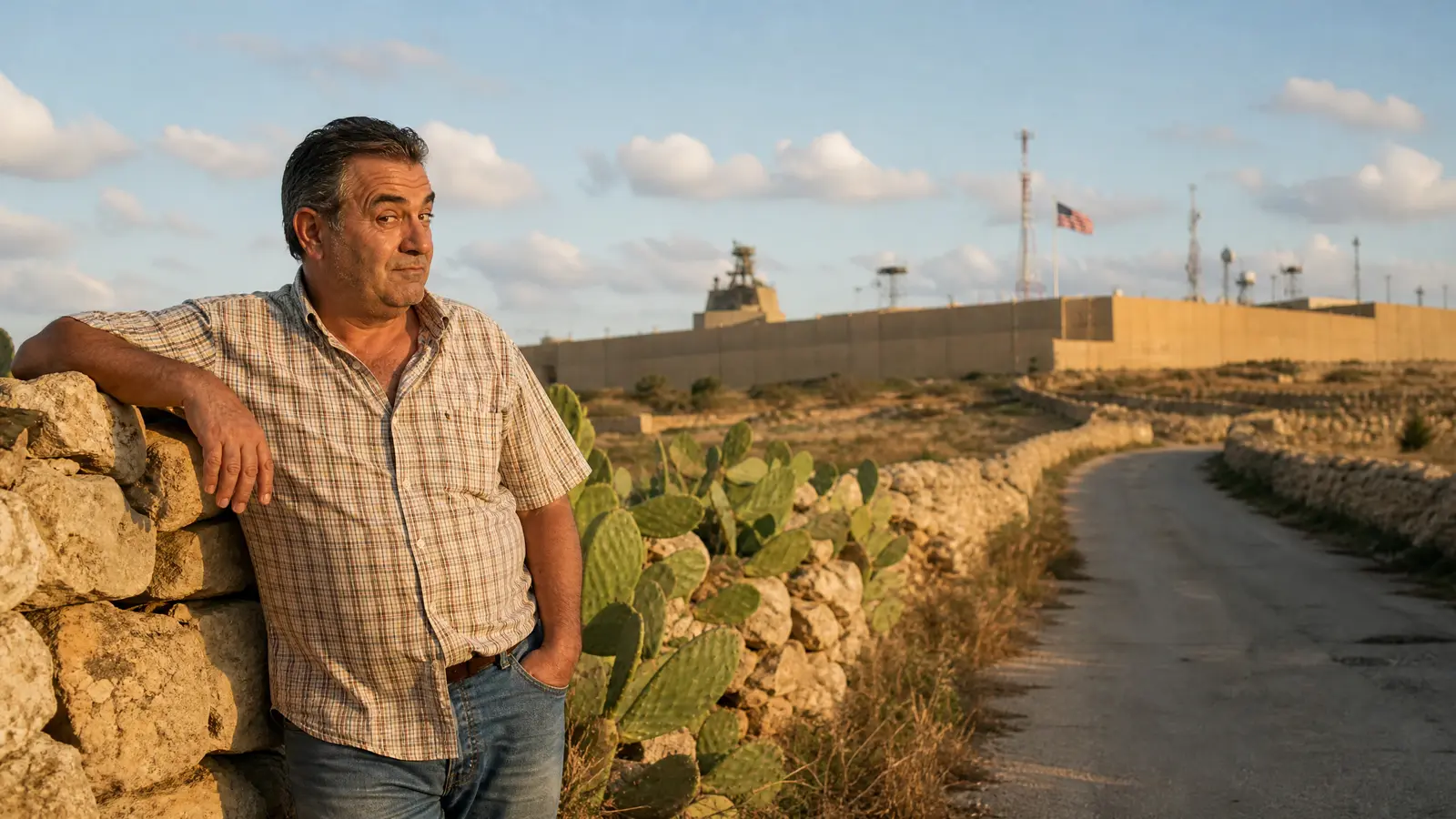
This week, in a walled compound on the edge of a former RAF airfield in the middle of Malta, the champagne came out. US Ambassador Somers Farkas hosted Malta's Prime Minister Robert Abela, President Myriam Spiteri Debono, and half the island's establishment for the Freedom 250 reception, celebrating 250 years of American independence. Flags, anthems, toasts to an old friendship. All perfectly normal diplomatic pageantry.
Except nothing about that compound has ever felt entirely normal to the Maltese. And I say that with affection, because I have been inside it.
A friendship older than almost any other
First, the history, because it is genuinely remarkable. The United States established its first consular presence in Malta in 1796, when the island was still ruled by the Knights of St John. Think about that. The American republic was twenty years old, barely out of its revolutionary cradle, its navy a handful of frigates chasing Barbary corsairs across the Mediterranean, and already it had planted a flag in Valletta's Grand Harbour. Malta was one of the young republic's first windows onto the Old World.
So when the embassy marked America's 250th birthday this week with Malta's political leadership in attendance, it was not some manufactured photo opportunity between strangers. It was a toast between two nations whose story together runs 230 years deep, through the age of sail, through convoys and Cold War summits (Bush and Gorbachev effectively ended the Cold War in a storm-tossed Maltese bay in 1989), right up to today's partnership on maritime security, migration and Mediterranean stability.
Two small navies of history, one now a superpower, still raising glasses in the same harbour town. There is something genuinely moving about that.
And then there is the building
But let's talk about what everyone in Malta actually talks about.
Because when the United States decided, in the 2000s, that it needed a new home on the island, it did not lease a floor in a Sliema office block. It bought ten acres of land at Ta' Qali from the Maltese government, on the site of the old election counting hall, hard against a former World War II fighter airfield where Spitfires and Hurricanes once scrambled against the Luftwaffe. And on that ground, it built a $125 million citadel. More than 800 workers. Blast setbacks. Controlled perimeters. Marine quarters. A multi-building complex for a diplomatic mission of around 125 people.
Ten acres. In a country of 122 square miles. For an island of half a million souls.
To put it in Maltese terms: the American embassy compound is not far off the footprint of a decent village core. You could fit a parish church, a band club, two rival band clubs, a festa and a small political scandal inside those walls, and still have room for the pool. The Knights built Valletta to hold off the Ottoman Empire. The Americans, the Maltese will tell you with a raised eyebrow, appear to have built Ta' Qali to hold off something too. Nobody is quite sure what.
What the taxi drivers know
Ask any Maltese taxi driver about the embassy and you will receive, free of charge, a complete alternative briefing. The antennas, sir. Have you seen the antennas? Why does a friendly island need all those antennas? And the basements. My cousin's friend worked on the construction, and he says the basements go down, and down, and down. Libya is just there, sir, eighty minutes by boat. You think they built all that for visa interviews?
The rumours have been running since the ribbon was cut in 2011. Listening post. Regional nerve centre. The Mediterranean's quietest big ear. When the compound opened, the Americans themselves felt obliged to address the folklore, with the chargé d'affaires assuring the Maltese, deadpan, that there were no missile silos underneath the embassy. Which, as every Maltese will tell you over a Kinnie, is exactly what you would say if there were.
I am joking. Mostly. The boring truth, and there is a boring truth, is that after the 1998 embassy bombings in East Africa, Congress mandated that every new American embassy anywhere on earth be built like a fortress: setbacks, blast walls, hardened everything. The Ta' Qali compound is simply the standard modern American embassy, LEED-certified and art-filled, dropped onto an island so small that the standard model looks like an occupation. Baghdad's embassy sprawls over a hundred acres. By that measure, Ta' Qali is a garden shed.
And yet. Malta sits at the crossroads of everything: Europe's southern gate, Africa's northern doorstep, astride the shipping lanes that carry the world's goods and, in darker seasons, its weapons and its desperate. If you were a great power, and you wanted one quiet, comfortable, English-speaking, EU-member vantage point over the entire central Mediterranean, you could not invent a better one than Malta. The Phoenicians knew it. The Romans knew it. Napoleon knew it, and stopped by to steal the silverware. The Royal Navy knew it for 180 years.
Would it really be so strange if Washington knew it too? I allude. I do not accuse. Draw your own conclusions, preferably over a glass of Marsovin on a Valletta rooftop, which is where all the best Maltese geopolitical analysis is conducted anyway.
My own small pilgrimage to the fortress
Now for full disclosure: I owe that compound a debt.
Years ago, in my American chapter, I made the pilgrimage to Ta' Qali more than once to collect my L1 visa. And I can report the following from personal experience. You do not simply walk into the American embassy in Malta. You surrender your phone, your bag, your dignity and, briefly, your sense of proportion. You pass through layers of security that would flatter a nuclear facility. Somewhere between the third checkpoint and the interview window, you catch yourself thinking: all this... for me? For a work visa?
And then a perfectly friendly consular officer stamps your future into your passport, wishes you a good day, and releases you back into the Maltese sunshine, past the walls, past the cameras, past whatever it is the taxi drivers say is under the lawn. The whole experience is efficient, courteous and faintly cinematic. I half expected to be handed a manila envelope on the way out.
That, incidentally, is the part of the story that matters for readers of this site. Behind the folklore, that building is where real lives change: Maltese students getting Fulbright scholarships, Maltese-American families reuniting, entrepreneurs like my younger self collecting the visa that opens the door to Austin or New York. Strip away the antennas and the mystery, and the fortress in the fields is, day to day, a machine for connecting two peoples. It has been doing it, in one office or another, since 1796.
Two-hundred and fifty years, one raised eyebrow
So happy 250th, America. Malta was there near the very beginning, watching your frigates come and go from the Grand Harbour, and Malta is here now, raising a glass at your reception in Ta' Qali and, in the same breath, speculating cheerfully about what is really behind the third gate.
That is the Maltese way, and honestly, it is the healthiest attitude toward any great power: genuine friendship, zero naivety. Love the ally, count the antennas. The Americans, to their credit, seem to be in on the joke. Two hundred and fifty years in, the relationship is warm enough to celebrate and interesting enough to gossip about, and in the Mediterranean, that is about as good as friendship gets.
As for what is actually under the embassy? I picked up my visa. I asked no questions. Some mysteries make an island more charming, not less.