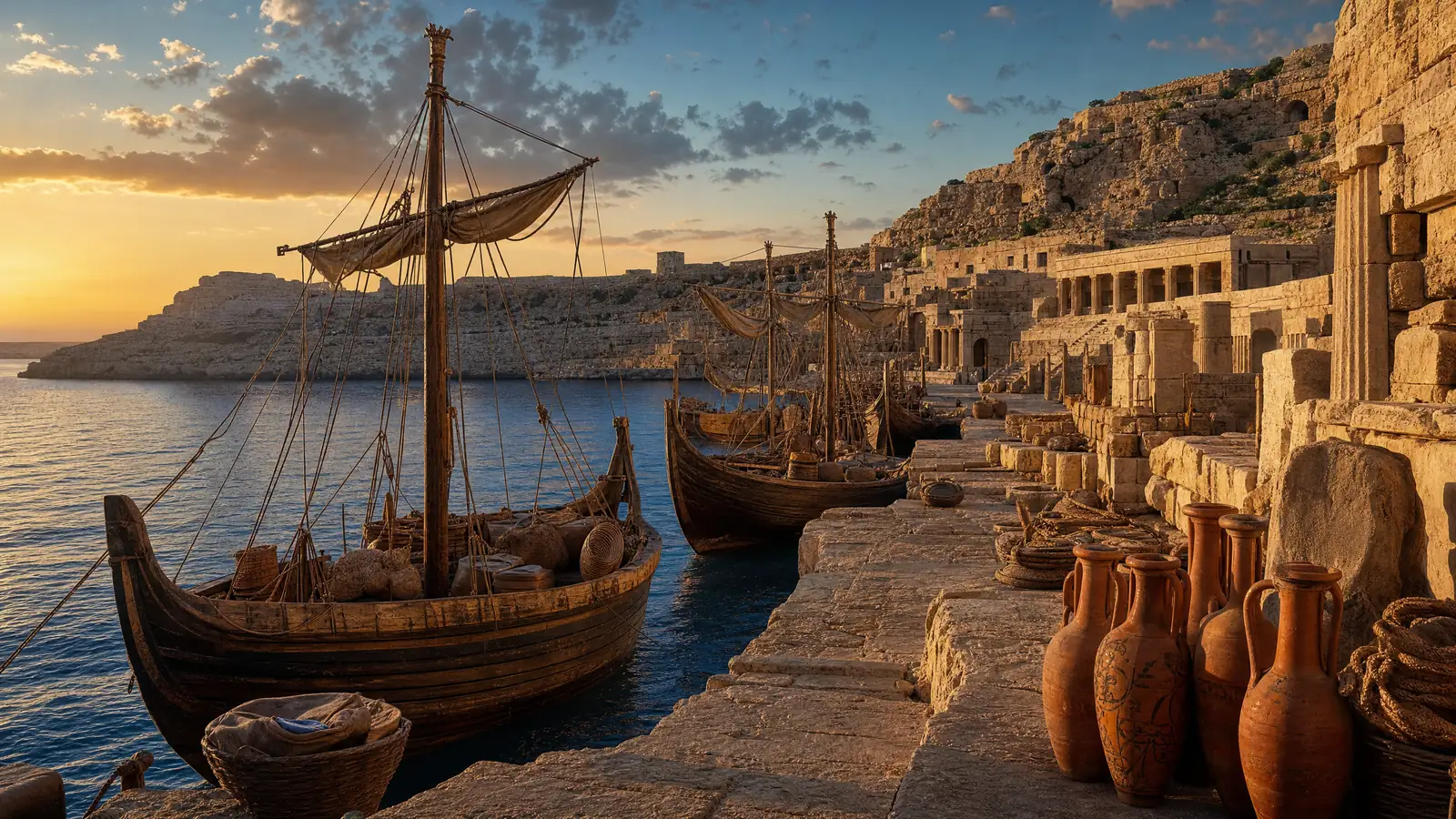
Before Rome. Before the Knights. Before the British, the French, the Arabs, and the Byzantines. Before any of the layered occupations that gave Malta its language and its architecture and its complicated, beautiful DNA, the Phoenicians were here.
They called the island Maleth, meaning shelter or safe harbour. Sailors, they had an eye for these things. The two natural harbours on the north-eastern coast of Malta, one of which would eventually become the Grand Harbour of Valletta, were among the finest anchorage points in the central Mediterranean. A ship running the sea lanes between the Levant and the Atlantic passed close by Malta almost by necessity. The Phoenicians, who built their wealth on exactly those sea lanes, understood the geometry of it. They settled. They traded. They left behind inscriptions, amulets, and a commercial logic that this island has never entirely abandoned.
I think about this when people ask me whether Malta's tax framework is sustainable, whether it is a political accident waiting to be reversed, whether it reflects something real about the place or is simply a small country punching above its weight through regulatory arbitrage. My answer is always the same: go back further than the legislation. The legislation reflects an instinct. The instinct is three thousand years old.
The geography of opportunity
Malta's position on the map is not accidental and not modest. Sit almost exactly at the midpoint of the Mediterranean, equidistant between Gibraltar and the Suez Canal, and you have placed yourself on the fulcrum of everything that has ever moved by sea between Europe, Africa, and the East. The Romans understood this and made Malta a municipium with its own magistrates and civic dignity, unusually generous treatment for a small island. The Romans left coins, mosaics, and a villa at Rabat that speaks to genuine prosperity, not a provincial outpost but a node in a network.
The Arabs who arrived in 870 AD brought with them not just a language but an agricultural sophistication: irrigation, cotton, citrus. Under Norman rule from the twelfth century, Malta sat at the intersection of Christian Europe and the Islamic world and profited from both. The Knights of St John, from 1530, turned the island into the most formidable naval base in the Mediterranean and funded it through the spoils of a sea war that was also, in no small part, a trading war. The British, who took Malta in 1800, made it the strategic centre of their Mediterranean fleet and built a dockyard economy that lasted until 1979.
Every ruler who ever held Malta has used it as a platform for something larger than itself. That is not coincidence. It is geography expressing itself through history.
The commercial DNA in the modern framework
When Malta joined the European Union in 2004, it brought with it a corporate tax refund system that had been engineered over the preceding decades to survive EU state aid scrutiny. The system is not a loophole. It is a carefully constructed statutory mechanism that allows non-resident shareholders to reclaim the majority of tax paid at the corporate level, producing an effective rate of approximately 5% on trading income for qualifying structures. It has been reviewed, scrutinised, and survived because it is legally coherent.
But the deeper point is this: Malta has always competed on access, not size. The Phoenicians offered the harbour. The Knights offered the fortress and the flag. The British offered the dry dock and the sterling. Independent Malta, from 1964 onward, has offered regulatory infrastructure, English common law, EU membership, a 70-plus double tax treaty network, and a personal tax regime built around the remittance basis that is the last of its kind in the EU. The tools change. The logic does not.
What the archaeologists keep finding
There is a detail that I find quietly persuasive. The Phoenician inscription found at Melite, one of the earliest written records from Malta, dating to around the second century BC and using both Phoenician and Greek text, is a bilingual dedication to the god Melqart and to Heracles. Two languages, two religious traditions, one stone. Commercial people learn to speak the language of their counterpart. They do not insist on one register. They find the overlap.
Malta today operates in English and Maltese, within EU law, under common law principles inherited from Britain, with a civil law underlay from the Napoleonic period. It holds a seat at the FATF and at the OECD, participates in every major multilateral tax framework, and has built its financial services sector on regulatory credibility rather than opacity. That is precisely the Phoenician move: speak the language of whoever you need to do business with, and offer them something they cannot easily find elsewhere.
What this means for the HNWI relocator
The practical point is this. Jurisdictions that build their commercial advantage purely on secrecy are fragile, because secrecy erodes under external pressure. Malta has never competed primarily on secrecy. It competes on structure: a tax system that is transparent enough to survive EU and OECD scrutiny, a legal system that is familiar enough for British and Irish and American clients to navigate, and a physical location that puts you inside the EU with access to every benefit that implies.
That is a durable advantage. Not because the legislation cannot change, it can and does, but because the underlying logic is embedded in three thousand years of geography and commercial habit. Malta has always found a way to be useful to the people moving money and goods across the Mediterranean. That has not stopped. It has only become more sophisticated.
If you are considering Malta as a base, the history is not merely decorative. It is evidence.
Learn more about Malta's tax residency programmes or book a consultation to discuss your specific situation.