On the fifteenth of June, in a quiet villa in Rome, a man was welcomed the way you welcome a nation.
His name is Riccardo Paternò di Montecupo, and his title is Grand Chancellor. He came to Villa Europa to sit among the European Union's heads of mission, the ambassadors accredited to the Holy See, and he was received as one of them. A peer. A counterpart. The representative of a sovereign power. The European Union and nineteen of its member states keep formal diplomatic relations with the entity he serves, and the EU's diplomatic service recorded the meeting in the careful, ceremonial language it reserves for real states.
The power he represents has no territory. No coastline, no capital, no patch of the globe coloured in to mark where it begins and ends.
And yet its name is one you have almost certainly typed into a search bar, perhaps while reading this very blog. It is the Order of Malta. The same Order that built the island you may be thinking of calling home.
The island they built
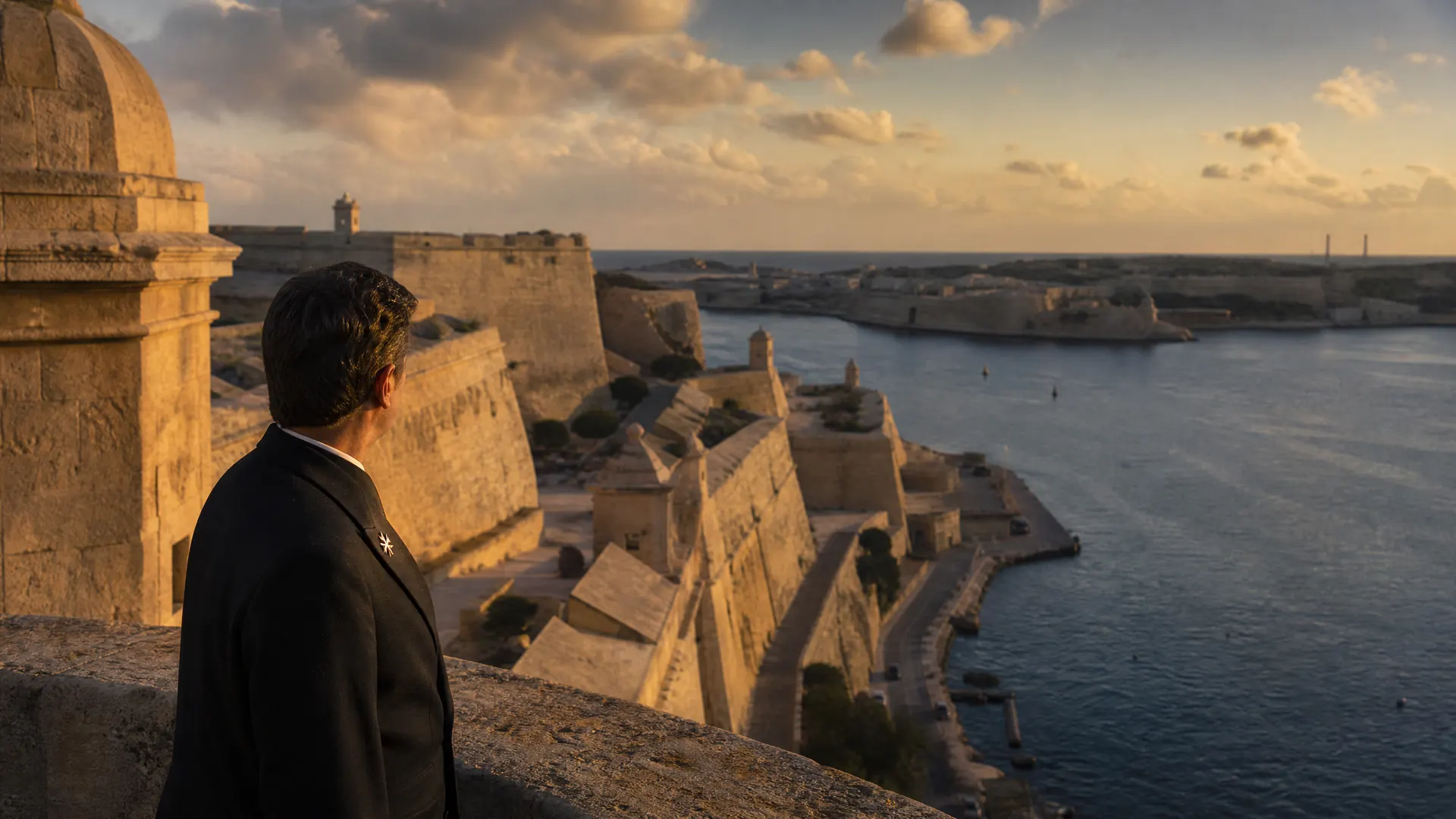
If you have ever stood on the bastions above the Grand Harbour at dusk, gold light bleeding across the honey-coloured stone of Valletta, you were standing inside the Order's masterpiece.
The Knights of Saint John arrived in 1530, gifted the island by an emperor for a token rent of a single falcon a year. They stayed until 1798. In those two and a half centuries they did not merely occupy Malta. They made it. They turned a stark Mediterranean rock into one of the most fortified, most beautiful, most consequential places in Europe.
The defining moment came in 1565, when the Ottoman Empire threw an enormous force at the island in a siege that contemporaries thought would end the Knights forever. It did the opposite. Under Grand Master Jean Parisot de Valette, a few hundred knights and the Maltese people held. When the Turkish sails finally withdrew, de Valette resolved that Malta would never again be caught so exposed, and he laid the foundation stone of a brand new fortified capital on a bare peninsula above the harbour. They named it after him. Valletta. You can read the bones of that story, the Great Siege, the Knights and Napoleon, and feel how completely the island's identity was forged in those decades.
The eight-pointed cross you see today on Maltese coins, on the tails of aircraft, stamped into souvenirs in every Valletta side street, is the Maltese cross. It was theirs first. The Order gave Malta not only its harbours and its baroque skyline but its very emblem. The island wears the Order's symbol the way some nations wear an eagle or a lion.
The country that lost its country
Then, in June 1798, it ended. Napoleon's fleet arrived on the way to Egypt, the Knights surrendered the island almost without a fight, and the Order that had ruled Malta for 268 years sailed away with nothing.
No land. No fortress. No falcon's-rent island. By every ordinary measure, a state that loses all its territory ceases to be a state.
The Order did not get that memo.
It wandered, regrouped, and in 1834 settled permanently in Rome, where it quietly went on being a country anyway. Today, as the Order's own account confirms, it maintains diplomatic relations with more than 110 nations, holds permanent observer status at the United Nations, signs treaties, issues its own passports, and mints its own coins and stamps and even licence plates. Its two seats in Rome, the Magistral Palace on the Via dei Condotti and the Magistral Villa on the Aventine Hill, hold extraterritorial status. They function, in plain terms, like embassies. Italian police cannot simply walk in. Italian law does not run inside them in the usual way. An Italian court ruled as far back as 1974 that the Order is a sovereign subject of international law, equal in standing to a foreign state, despite governing no land at all. You can see how it describes its own strange and stateless sovereignty in its own words.
Sit with that. A country is usually a place. This one is not. It is closer to an idea that has been wearing the costume of a country for nine hundred years, and wearing it so convincingly that the rest of the world still bows.
The shadow of the Templars
There is a darker thread running underneath all of this, and it leads exactly where you think it does.
In the same crusading century that produced the Knights of Saint John, a rival brotherhood rose alongside them: the Knights Templar. Warrior-monks, yes, but also the first great international bankers of Europe, holders of fortresses and fortunes and secrets that frightened kings. And frightened kings act. Under pressure from the French crown, the Templars were destroyed in 1312, their order dissolved by papal bull, their last grand master burned at the stake, their name driven underground into seven centuries of whispered conspiracy.
Their wealth, though, did not vanish into legend. By papal decree, the Templars' property was transferred to the Knights of Saint John. The very Order that would go on to take Malta, build Valletta, and sit among ambassadors in Rome this June.
So the institution at the heart of this story is, in a real and documented sense, the heir to the Templars. If you have ever enjoyed the idea that the Templars never truly disappeared, here is the sober, far stranger truth. A piece of them survived. Not in a cave or a coded manuscript, but in the open, with a flag, a chancellor, a passport office, and a seat at the diplomatic table. And the island where they planted their cross is the one with the sunlit harbour and the easy flights from London.
Why a stateless country should interest anyone choosing Malta
Here is the secret hiding in plain sight, and it matters more to the person weighing up a move to Malta than any keyhole or crusader legend.
Sovereignty was never really about soil. It is about recognition. A state is sovereign because other states agree to treat it as such, and the Order has spent nine centuries collecting that agreement one handshake at a time, until the agreement itself became the country. Lose the land and you keep the country, so long as the recognition holds.
That is not a medieval curiosity. It is the quiet logic underneath every modern decision to build a life across borders. Belonging is chosen, defended and granted. It is not simply inherited from the dirt you happened to be born on. Malta, of all places, understands this in its bones, because its entire identity was chosen and built and defended by an order of men who arrived from somewhere else and made the island theirs.
When you stand on those bastions above the Grand Harbour, you are not just admiring a view. You are standing inside the proof. A country can be made. An identity can be chosen. And the people who understood that best left their cross on every coin in your pocket, then sailed off to become the strangest sovereign nation on earth, a country with no country, still watching, still recognised, still here.