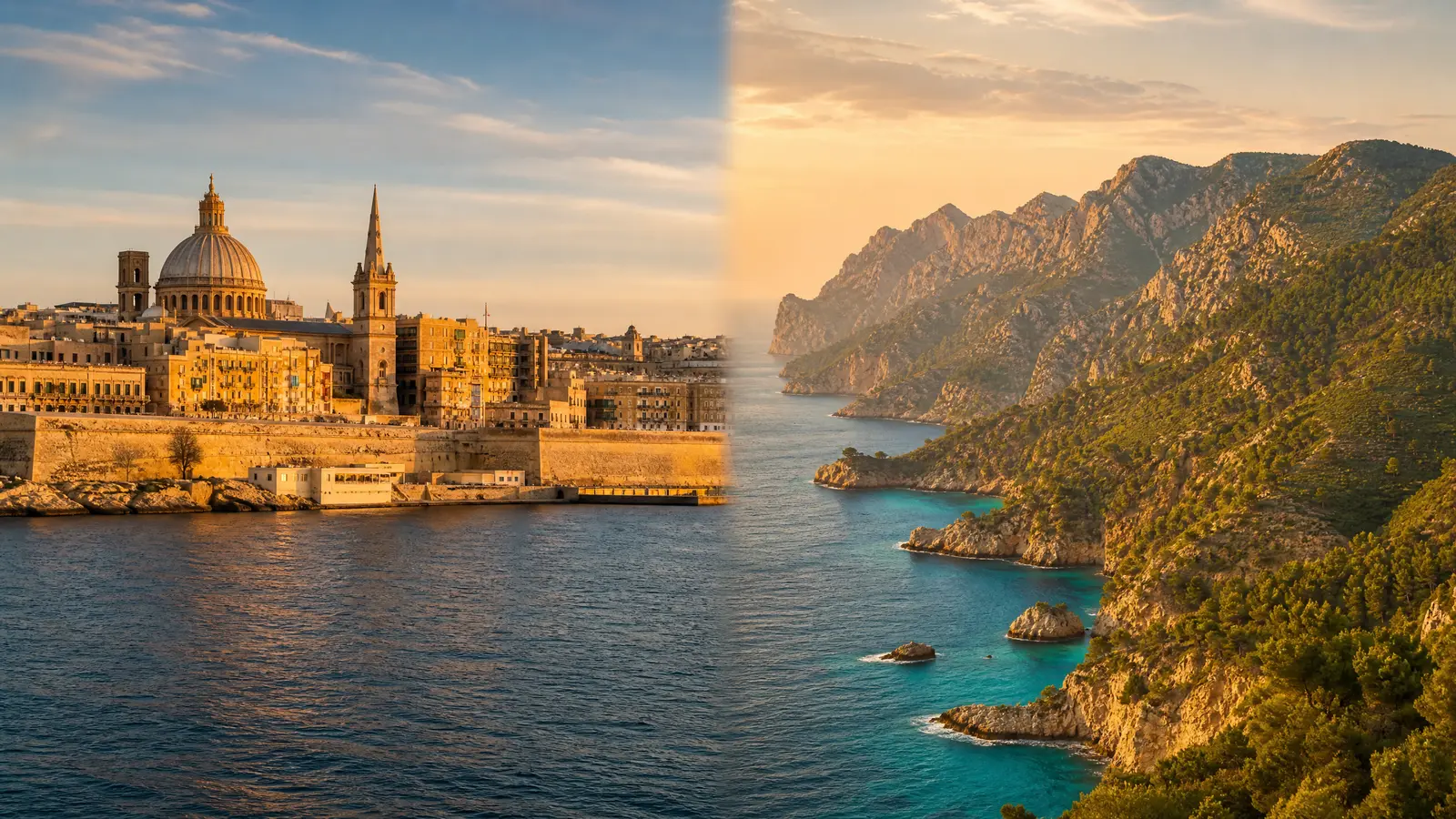
This is Part 1 of Malta vs the Mediterranean, a seven-part series comparing Malta with the islands people actually shortlist against it: Mallorca, Ibiza, Sicily, Corsica, Rhodes, Madeira and Cyprus. Let me settle one thing before we begin, so it never clutters the series: on tax, Malta wins before the whistle blows. Non-dom remittance basis, no wealth tax, no exit tax, no inheritance tax, against Spain's wealth levies, Italy's fee-based regimes, France's everything. That verdict is a given here. This series is for the other voice in your head, the one that says: "I don't care about tax. I want mountains. I want a certain life." Fine. Let's have that conversation, honestly, island by island.
And honesty demands I open Part 1 with a concession: Mallorca is more beautiful than Malta. Not arguably. Decisively. The Serra de Tramuntana is a UNESCO-listed wall of limestone peaks stitched with olive terraces, falling into coves the colour of bottle glass. Deía glows like an unfinished painting. If your heart votes on landscape alone, stop reading and book the flight.
But a life is not a landscape. A life is winters, hospitals, school runs, dinner reservations in February, and the feeling on a Tuesday. So let us compare lives.
The two islands at a glance
Space: Mallorca's crushing victory
Mallorca is more than eleven times Malta's size with less than twice its people. Feel what that means. There are valleys in the Tramuntana where you can walk all day and meet only goats. There are vineyards, forests, an interior of stone villages sleeping in the heat. Professional cycling teams winter there because the roads climb like the Alps and empty like a chapel. Malta cannot give you this. Malta is the most densely populated country in the EU, and the construction cranes I curse in every second article are the proof. If your soul requires wilderness on your doorstep, Mallorca wins, and it is not close.
Health: a genuine draw, with a footnote
Both islands answer the question that quietly decides more relocations than any other: what happens if something goes badly wrong at 2 a.m.? Palma hosts Son Espases, a genuinely first-rate university hospital, plus a deep private sector fattened on German patients. Malta answers with Mater Dei, a full national teaching hospital that is never more than a short drive away, because nothing in Malta is more than a short drive away, traffic permitting, and I say "traffic permitting" through gritted teeth. The footnote is language and access: in Malta the entire system, consent forms to consultants, runs in English by law, and as regular readers know, even a newly registered self-employed resident enters the public system. In Mallorca you will navigate serious illness in Spanish, or pay privately to avoid it. Call it a draw on quality. Malta by a nose on frictionless access.
Cost of living: pain versus politics
Neither island is cheap anymore, and I will not romance you. Sliema and St Julian's prices would have been unthinkable a decade ago. But Mallorca has crossed into something else: prime property inflated by German and Scandinavian money to the point where the housing question has become the island's central political wound. Protest marches, tourist-go-home graffiti, government schemes to restrict foreign buying floated every season. You can dismiss it as noise, but understand what it means: in Mallorca, the foreign resident is the problem; in Malta, the foreign resident is the business model. One island debates how to slow you down. The other builds its economy around welcoming you. Day-to-day costs, groceries, restaurants, help, run broadly similar; the difference is the political weather.
Vibe: province versus capital
Here is the comparison nobody makes and everyone should. Mallorca, for all its glamour, is a province: decisions about your taxes, your residency rules, your rights get made in Madrid by people who have never heard of you. Malta is a sovereign capital the size of a town: the banker, the regulator, the minister and your accountant share a postcode, and the distance between you and every institution is one polite email. Mallorca's international scene is enormous but tribal, famously German-speaking in its southwest strongholds. Malta's is smaller, more mixed, more permanent, and conducted in English. Mallorca has proper seasons, cool wet winters included, and parts of the coast genuinely close from November. Malta never closes; it just grumbles.
Beauty: surrender, then reframe
I conceded the landscape, so let me claim what is mine. Mallorca's beauty is panoramic; it belongs to geology. Malta's beauty is human; it belongs to what people built and still live inside: the Grand Harbour at dawn, temples older than the pyramids, festas detonating over village domes, Mdina silent at midnight. One island moves you the way nature does. The other moves you the way history does. Decide which voice you want narrating your years.
The verdict
Choose Mallorca if the mountains are non-negotiable, if Spanish and Catalan excite rather than exhaust you, and if you can live gracefully as a guest in a place increasingly ambivalent about hosting you.
Choose Malta if you want a twelve-month, English-speaking, one-degree-of-separation country that wants you here, keeps its hospital fifteen minutes away, and never asks you to apologise for arriving. The Tramuntana, after all, is ninety minutes' flight from my front door. Rent the mountains. Own the life.
Next in the series: Malta vs Ibiza, where the world's most photographed summer meets the question of what happens in November.