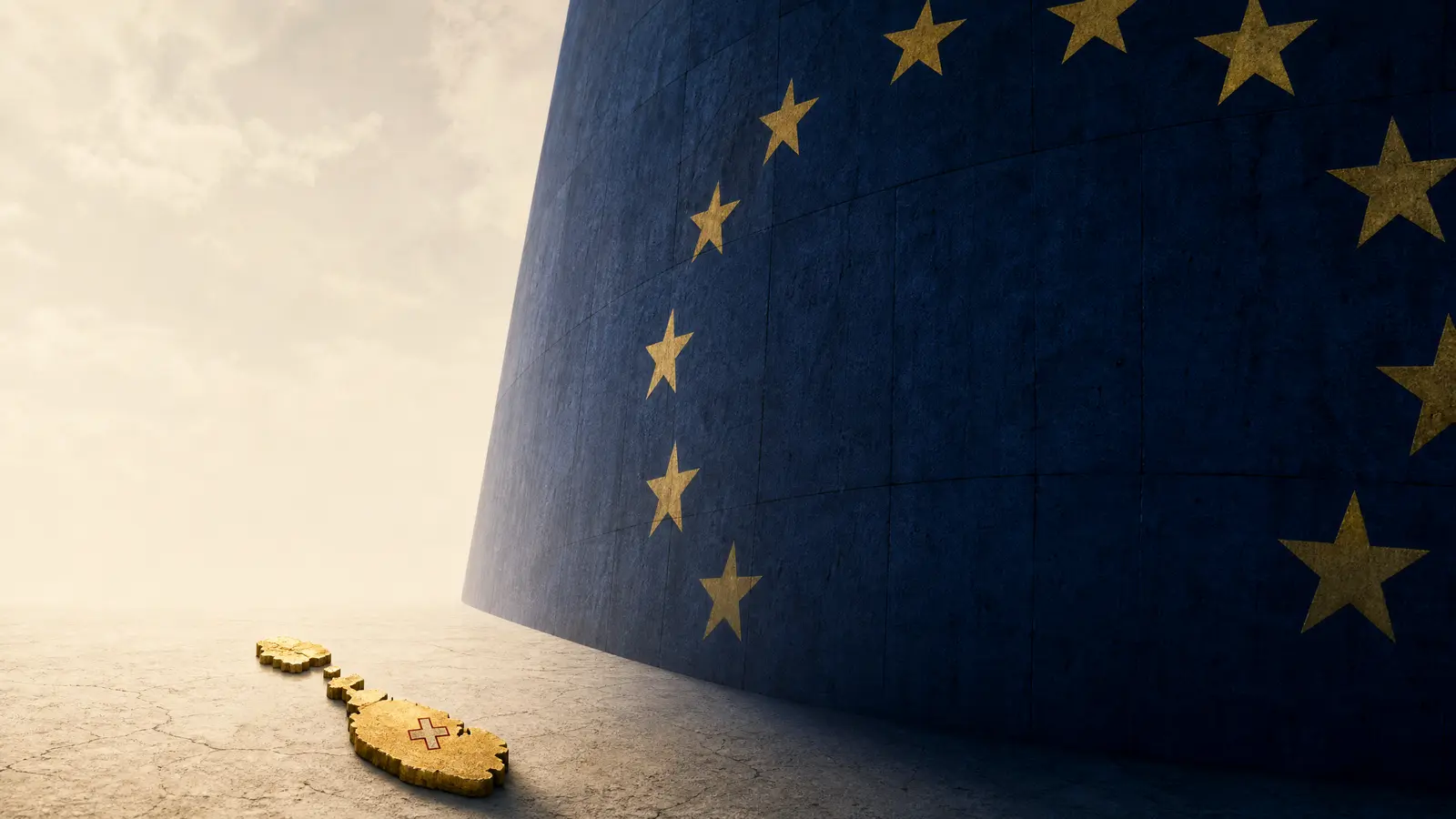
On 22 June 2026, in a parliamentary chamber smaller than some corporate boardrooms, Prime Minister Robert Abela drew a line that would make every finance minister in Brussels look up. Malta, he said, will oppose the introduction of any EU-wide tax designed to fund the bloc's central budget. Not negotiate it down. Not accept it with safeguards. Oppose it, under any circumstances. For the complete picture of how Malta corporate tax works in 2026 — the 35% headline, the 5% effective rate, and the new 15% election — see the Malta corporate tax pillar.
It was the kind of sentence that sounds like courage and arithmetic at the same time. Because the country making it has roughly half a million people, fewer than the suburbs of a mid-sized European city, and it has just told France, Germany, and the entire weight of the European Commission that the answer is no.
This is David and Goliath, recast for the age of spreadsheets. The slingshot is a single word: unanimity.
What Brussels actually wants
To understand why a tiny archipelago is willing to pick this fight, you have to understand what is being proposed and what it would cost the island.
The next EU long-term budget, the Multiannual Financial Framework for 2028 to 2034, has a hole in it. Someone has to repay the pandemic-era borrowing. Someone has to fund the new ambitions. So Brussels is hunting for fresh revenue streams it calls "own resources", money that flows directly to the EU rather than through national treasuries.
One idea on the table is a levy on online gambling. To most member states, that is an abstraction. To Malta, it is a knife held to the throat of the economy. Online gambling contributes more than 10% of Maltese GDP and sits at the centre of the island's entire pitch as a low-cost home for European digital business. A European gambling tax is not a policy footnote here. It is a direct hit on the foundations.
And the prize for everyone else is real. The European Commission has estimated that new tax measures on digital services, gambling, and crypto assets could raise nearly €11 billion a year for the EU budget. When twenty-six countries can see eleven billion euros on the other side of one country's veto, the pressure does not stay polite for long.
Why the critics are sharpening their knives
Malta does not arrive at this fight with clean hands, and pretending otherwise would insult the reader's intelligence.
The island's headline corporate tax rate is 35%, among the highest in the European Union. But a refund mechanism for non-resident shareholders can pull the effective rate down to as little as 5%. That gap, the distance between what Malta says it charges and what it actually collects, is the whole game.
The numbers are stark. In 2022, companies that would have contributed €1.5 billion in tax under standard rates ended up paying €216.6 million. Malta handed out roughly €1.3 billion in tax breaks to foreign companies that year, equivalent to about 8% of its entire GDP. The Tax Justice Network has repeatedly named Malta one of the most aggressive tax regimes in Europe, and economists who dislike the model call it a race to the bottom, a structure that forces larger states to compete on terms that drain their own ability to fund hospitals and schools.
So this is not a simple tale of a brave little nation versus a faceless empire. It is a story about a clever business model, built in plain sight, now meeting the moment when the rest of the club decides it has paid for that cleverness long enough.
The slingshot still works, for now
Here is why David is still standing. Any change to EU tax rules requires the unanimous agreement of all 27 member states. One veto stops everything. As the gambling industry's own trade body has pointed out, a new EU own resource cannot move without every government saying yes.
That single rule has been Malta's shield for a decade, and at home the shield is held with both hands. Abela's position commands cross-party support. The opposition, speaking through deputy leader Alex Perici Calascione, broadly backed the government while urging it to be more assertive in defending Maltese interests, pressing for the principle of insularity and special treatment for Gozo. On this one question, the island is not divided. It is a wall.
For this budget cycle, that wall will most likely hold. The veto is real, the politics are aligned, and the technical obstacles to designing a workable EU gambling tax are genuine. In the short term, David wins.
But could little Malta really win the war?
Probably not. And it is worth being honest about why.
Vetoes are powerful, but they are also lonely, and loneliness has a price. When you are the single obstacle standing between twenty-six governments and eleven billion euros, Brussels does not give up. It looks for another door. The global minimum tax already chipped at the edges of Malta's refund model. Enhanced cooperation lets willing states move without the holdout. Measures get reclassified so they no longer count as "tax" and no longer need unanimity. The pressure does not arrive as one decisive battle. It arrives as erosion, year after year, until the cliff that looked permanent is suddenly a slope.
Add the reputational weight. Every TJN report, every "aggressive regime" headline, every diplomatic cold shoulder is a small tax of its own. A country can win every vote and still lose the argument, and over a long enough horizon the argument is what shapes the rules.
So the realistic forecast is not a Maltese surrender and not a Maltese triumph. It is a slow squeeze. The 5% effective rate is not a law of physics. It is a political settlement, and political settlements get renegotiated.
And "Mexit"? Don't hold your breath
If the squeeze tightens, could Malta simply leave, the way Britain did? The idea has a certain romance to it. It is also almost certainly fantasy.
The cruel paradox of Malta's position is that the gambling and digital industries it is fighting to protect depend on the very club it is fighting. Single market access, EU passporting, the euro, cohesion funds, and the credibility of being inside the tent are not optional extras. They are the product. Leave the EU and the low-tax haven loses the thing that made it valuable in the first place: frictionless access to 450 million European customers. Mexit would not save the model. It would dismantle it.
Malta is therefore locked into a strange and permanent position. It must keep fighting Brussels to preserve its advantage, and it can never walk away from Brussels without destroying that same advantage. It is David who cannot leave Goliath's house, because he lives in it.
What this means if Malta is part of your plan
For the internationally minded individual or business looking at Malta today, the picture is neither panic nor complacency. It is clarity.
Right now, the veto holds, the politics are united, and the structures that make Malta attractive remain intact. That is the good news, and it is real. But the smart reading of Abela's defiance is not that Malta has won. It is that Malta is digging in for a long siege, and sieges are won by patience on both sides.
Build with your eyes open. Treat the current settlement as durable but not eternal. Diversify your assumptions the way you would diversify a portfolio, because the single greatest risk to any structure is believing it can never change. Malta's slingshot is loaded and the stone is in the air. It is a magnificent throw. Just remember that Goliath has twenty-six brothers, and they are all still standing.