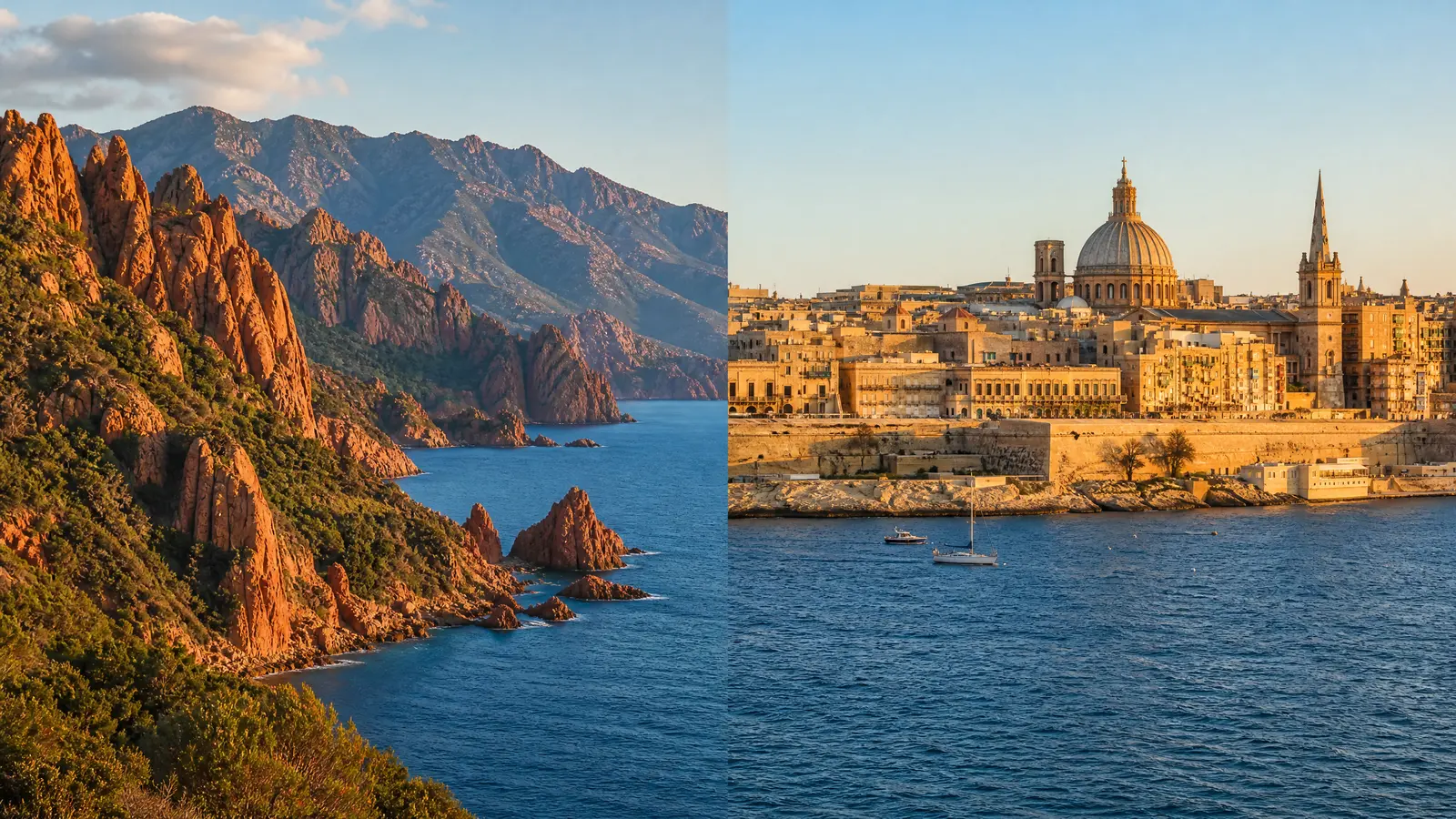
This is Part 4 of Malta vs the Mediterranean, our seven-part series comparing Malta with Mallorca, Ibiza, Sicily, Corsica, Rhodes, Madeira and Cyprus. Tax was ruled on before Part 1 and the ruling stands: Malta wins the fiscal contest outright, and against France, home of the wealth tax on property and some of Europe's heaviest burdens, it is not even a contest; Corsica is the worst tax deal in this entire series and we will leave it at that. This series is about the other question: "I don't care about tax. I want..." And if what you want is raw beauty, Corsica is about to make this very hard for me.
The French call Corsica l'Île de Beauté, the Island of Beauty, and for once official branding undersells. Picture a granite mountain range, peaks near 2,700 metres, snow into June, dropped whole into the sea. Chestnut forests. Gorges of green water. The flame-red cliffs of the Calanques and the Scandola reserve, a UNESCO marine wilderness reachable only by boat. Beaches at Palombaggia and Rondinara that embarrass the Caribbean. And through the middle of it, the GR20, the hardest and most glorious long-distance trail in Europe. The maquis, that dense scrub of myrtle and rosemary, perfumes the whole island; Napoleon, its most famous son, claimed he could recognise Corsica with his eyes closed, by smell alone.
I bow to all of it. And then I ask the question this series exists to ask: what is it like on a Tuesday in November when you need a cardiologist, a school place, or simply a friend?
The two islands at a glance
| | Malta | Corsica | |---|---|---| | Population | ~570,000 in 316 km² | ~355,000 in 8,700 km² | | Density | Highest in the EU | Among the emptiest coastlines in the Med | | Daily language | English (official) | French, with Corsican beneath and beside it | | Serious healthcare | Mater Dei, 15 minutes away | Ajaccio and Bastia hospitals; complex cases fly to Marseille or Nice | | Winter life | Full | Coasts close; interior half-sleeps | | Attitude to newcomers | The national business model | Guarded, historically fierce | | Cost feel | High | High in season, French-mainland-plus | | Tax in one line | Non-dom, wins | France. Enough said. |
Space and wildness: total Corsican victory
Corsica is twenty-seven times Malta's size with two-thirds of its people. Sit with that ratio. It produces a Mediterranean that barely exists anywhere else: empty beaches in July, mountain villages where the loudest sound is water, a coastline so protected that whole stretches look as they did when Genoese watchtowers were news. Malta, the most densely populated country in the EU, concedes this category before the first whistle. If solitude in nature is your definition of wealth, Corsica is the richest island in this series and it is not close.
The island that keeps its distance
But Corsica's wildness is not an accident of geography. It is a policy of the soul. This is an island with a proud, prickly identity, its own language on every road sign (often over the French, with the French shot out), a long nationalist history in which holiday homes of outsiders were, for decades, a legitimate target of protest of the loudest kind, and a standing political demand to restrict property sales to non-residents. Things are calmer now, and the individual welcome in a village bar can be wonderfully warm. But understand the deep grammar: Corsica's beauty survived precisely because Corsica resisted people like us. You will be a guest there for twenty years. Malta, whose entire modern economy is the hosting of the internationally mobile, hands you the keys and asks what took you so long. Neither attitude is wrong. But only one of them is an invitation.
Health, schools, winters: the practical reckoning
French healthcare is superb, and Corsica receives a competent island edition of it: solid hospitals in Ajaccio and Bastia, and for anything complex, a flight to Marseille or Nice, because 355,000 people spread over vast terrain cannot sustain every specialty. Winter thins the flight schedules, closes the coastal towns, and returns the island to itself, which the Corsicans consider the whole point. Schooling is French, full stop; the international offering is negligible. And everything administrative happens in French, at French pace, under French law, with mainland France a sea away.
Malta's rebuttal is the one regular readers can recite: a full national hospital fifteen minutes from every door, in English, inside a public system that admits even the newly self-employed; English-language schools at every level; flights in every direction twelve months a year; and a state whose institutions are one polite email away. Malta will never give you a granite peak. It will always give you a Tuesday that works.
Vibe and beauty: the honest score
Corsica's vibe is fierce and inward: clan-deep villages, polyphonic singing in stone churches, a pace set by mountains rather than markets. It is one of the most atmospheric places on this planet, and it does not perform for you; you adjust to it. Malta's vibe is open and busy: a sociable village-nation, gossipy, safe, occasionally maddening, permanently switched on, where you are inside the society by your third month. On beauty, Corsica wins this series' nature crown outright, taking it even from Mallorca. Malta answers, as always, with the man-made sublime and with geography: Corsica is a short seasonal hop or an easy sail away. Summit the GR20. Then come home to a country that knows your name.
The verdict
Choose Corsica if wilderness is your religion, French your comfortable second skin, self-sufficiency your temperament, and being a respectful permanent guest a role you can play with grace.
Choose Malta if you want to be wanted: a full-time, English-speaking, fifteen-minutes-to-everything country that built its house with a room for you in the plans.
The Island of Beauty keeps its beauty by keeping its distance. Malta keeps its promise by keeping its door open. Both are forms of integrity. Only one of them is a home you can move into.
Next in the series: Malta vs Rhodes, the only comparison here that history has already run once, in 1522, with the same knights on both islands.