Considering a move to French Polynesia?
Book a Strategy SessionContents
- 1. French Polynesia: Country Overview
- 2. Putting French Polynesia on the Map
- 3. What Others Say About Tahiti and French Polynesia
- 4. Tax Benefits: What French Polynesia Has to Offer
- 5. Tax Rates at a Glance
- 6. Tax Residency: What Triggers It
- 7. Double Tax Treaties
- 8. Avoid Remaining Tax Resident at Home
- 9. Tax Considerations When Leaving Your Home Country
- 10. Company Setup & Corporate Tax
- 11. Who Should (and Shouldn't) Move to French Polynesia
- 12. Visas and Residence Permits
- 13. Path to Citizenship
- 14. Banking in French Polynesia
- 15. What Makes French Polynesia Genuinely Attractive
- 16. Cost of Living in French Polynesia
- 17. Buying Real Estate in French Polynesia
- 18. Retiring in French Polynesia
- 19. US Citizens: What You Need to Know
- 20. Correct Preparation
- 21. Automatic Exchange of Information (OECD CRS)
- 22. Further Relocation Formalities
- 23. How We Help With Your Move to French Polynesia
I.
French Polynesia: Country Overview
French Polynesia is an overseas collectivity of France, scattered across the South Pacific in five archipelagos: the Society Islands, the Tuamotus, the Gambiers, the Marquesas, and the Australs. Together they comprise 118 islands and atolls spread across an ocean expanse larger than Western Europe. The capital, Papeete, sits on the island of Tahiti — the commercial and administrative centre, and the point of arrival for almost everyone who comes.
Life here is shaped by the sea, the heat, and a particular Polynesian ease with time. The pace is slower than Europe, the distances are vast, and the beauty — volcanic peaks, turquoise lagoons, black-sand beaches — is not exaggerated by the travel brochures. More than 3,000 hours of sunshine per year is the norm. The people are warm, the French administrative system is familiar to Europeans, and the territory has a functioning healthcare system in Papeete that meets European standards.
On the tax side, French Polynesia is exceptional. There is no personal income tax, no wealth tax, no inheritance tax, and no capital gains tax for private individuals. Companies enjoy a full tax exemption in their first year of operation. The solidarity contribution (CST) — a graduated levy on wages — replaces income tax and reaches a maximum of 25% only at high salary levels. For entrepreneurs, investors, and high-net-worth individuals, the combination of French legal infrastructure and near-zero direct taxation is rare and genuinely valuable.
What to be aware of: French Polynesia is not for everyone. The cost of living is very high — food is expensive because almost everything is imported, and a return flight to Europe costs upwards of €2,000 and takes 20+ hours. Healthcare outside Papeete is limited: on the outer islands, medical facilities are basic and serious conditions require evacuation to Tahiti or France. The internet infrastructure is improving but remains unreliable by European standards on many islands. French Polynesia has no double tax treaties with major European countries, which means foreign-source income must be managed carefully to avoid double taxation. And for those who do not speak French, daily life — dealing with administration, banks, and local services — can be genuinely difficult.
The territory is best suited to people who want to build a life there, not simply register an address. The tax advantages are real, but they require a genuine relocation — and that means accepting the isolation, the distance from family and colleagues in Europe, and the particular rhythms of island life.
Putting French Polynesia on the Map
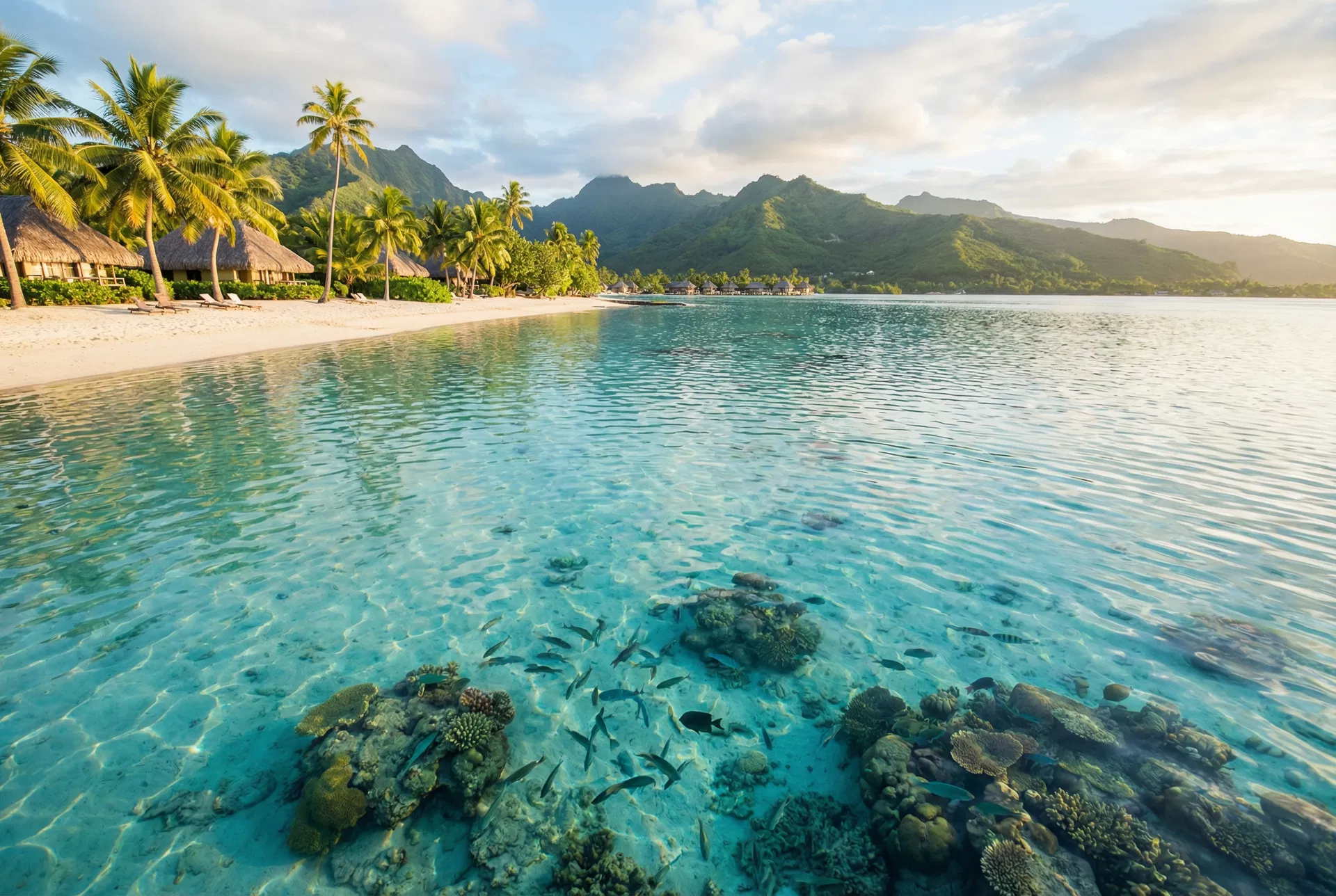
French Polynesia — South Pacific Ocean, approximately 6,000 km south-west of California
French Polynesia does not announce itself. It arrives — in the sudden blue of a lagoon glimpsed from a descending plane, in the warm weight of the air as the cabin door opens, in the scent of tiare blossoms pressed into a garland and placed around your neck by a stranger who smiles as if she has been expecting you. The islands do not perform beauty. They simply are beautiful, with the indifference of something that has always been this way.
Scattered across an ocean expanse larger than Western Europe, the 118 islands and atolls of French Polynesia fall into five archipelagos — the Society Islands, the Tuamotus, the Gambiers, the Marquesas, and the Australs. Each has its own character. Bora Bora is the postcard: the black-tipped peak of Mount Otemanu rising from a lagoon of impossible turquoise, ringed by a necklace of motus where the sand is so fine it squeaks underfoot. The Marquesas are something else entirely — raw, volcanic, brooding, their cliffs plunging straight into a sea that has no reef to tame it. Here Gauguin came to die, and here Herman Melville jumped ship and fell in love with a people he could not forget.
The Polynesian people carry their history lightly. They are the greatest navigators the world has ever known — their ancestors crossed the Pacific in outrigger canoes guided by stars, currents, and the flight of birds, settling islands separated by thousands of miles of open ocean centuries before Europeans had left sight of land. That confidence, that ease with distance and with the sea, is still visible in the way a Tahitian fisherman reads the water, or in the way a dancer moves at a heiva festival, the drumbeat carrying something ancient and unbroken.
Life here moves at a pace that cannot be legislated. The pace of tides. The pace of fruit ripening on a tree you did not plant. Papeete, the capital, has traffic and noise and a covered market where you can buy vanilla pods, black pearls, and raw tuna at six in the morning. But twenty minutes by ferry, Moorea rises from the sea like a cathedral, and the world you left behind becomes genuinely difficult to remember.
II.
What Others Say About Tahiti and French Polynesia
"The South Pacific is memorable because when you are in the islands you simply cannot ignore nature. You cannot avoid looking up at the stars, large as apples. You cannot avoid hearing the surf. You cannot avoid smelling the flowers."
"Tahitians don't chase happiness. Happiness comes naturally to them. You only need to see them in the water, with a beer in their hand, splashing each other or waving to every stranger they see on the road, to know this. Happiness is in the air: in every hibiscus flower that opens early in the morning, in the sweet aroma of the pineapple plantations, in the smile of the people lolling around idly, resting slothfully in the warm breeze that ruffles the surface of the lagoon."
"The narrow coastal road has many twists and turns, each one revealing scenery of incredible beauty. On one side, the mountains rise proud and steep, challenging the sky; on the other, the tropical lagoon sparkles like a zillion twinkling stars."
"Jacques-Yves Cousteau declared Tikehau — an hour's flight from Tahiti — the richest atoll on earth."
IV.
Tax Benefits: What French Polynesia Has to Offer
French Polynesia is one of the most overlooked zero-personal-tax jurisdictions in the world. As a French Overseas Collectivity (Collectivité d'Outre-Mer), it operates a tax system entirely separate from metropolitan France: there is no personal income tax, no wealth tax (the French IFI does NOT apply), no inheritance or gift tax, and no general capital gains tax for individuals. Yet the territory retains full French legal protection, French citizenship pathways, and access to France's extensive double tax treaty network covering over 120 jurisdictions. The combination of European-standard rule of law with Pacific island lifestyle and a genuine zero-personal-tax framework is rare globally.
- ›0% personal income tax — French Polynesia does not levy income tax on individuals. This is confirmed by the International Labour Organization in its statistical methodology for the territory.
- ›0% wealth tax (no IFI) — the French Impôt sur la Fortune Immobilière does NOT apply in French Polynesia.
- ›0% inheritance and gift tax for transfers between residents.
- ›0% capital gains tax for individuals — no general individual CGT regime.
- ›Corporate income tax 25% standard — competitive vs mainland France's 25%; 20% for renewable energy companies; 33% (declining to 25% by 2027) for mining, financial institutions, and leasing companies.
- ›French legal framework and EU customs union benefits — French Polynesia is part of the EU's "Outermost Regions" framework via France, providing customs-free trade with France and the EU on most goods, French citizenship via standard naturalisation (typically 5 years), and access to French/EU legal protections.
- ›Coverage via France's 120+ DTAs — French Polynesia residents benefit from France's extensive double tax treaty network including comprehensive treaties with the US, UK, Germany, Canada, Switzerland, and most major economies.
- ›Not on EU non-cooperative jurisdiction list, not on FATF monitoring list — participates in CRS via France; full international transparency standards.
- ›Pacific island lifestyle with developed-country infrastructure — Tahiti, Bora Bora, Moorea, and the Marquesas archipelago combine pristine natural environment with French healthcare, education, and legal systems. CFP franc (XPF) pegged to the euro at a fixed rate (1 EUR = 119.33 XPF), eliminating euro currency risk.
- ›No formal digital nomad visa, but residency via French immigration — French Polynesia uses the French residency framework. There is no specific digital nomad visa, but the territorial tax system means foreign-source income earned by residents is not subject to local taxation (and there is no personal income tax in any case).
IV.
Tax Rates at a Glance
The most important tax rates in French Polynesia are as follows. Note that these have been simplified and should be used as general guidance only.
Key Tax Rates — French Polynesia
A defining feature of French Polynesia is that no tax is levied on personal income. Income tax does not exist. In its place, a percentage of the solidarity contribution is deducted from wages and salaries, graduated according to monthly income brackets. Because this contribution is deducted directly by the employer, employees have no obligation to file a separate return.
The figures below have been converted from CFP francs to euros for readability.
Solidarity Contribution (CST) — Monthly Salary Brackets
The maximum rate of 25% applies to monthly income above €20,937. Even at this level, the maximum monthly contribution is capped at €5,234. Given that employees pay only the solidarity contribution, French Polynesia qualifies as a low-tax jurisdiction.
Cryptocurrency and Crypto Assets
Whether gains arise from private trading, mining, staking, or commercial crypto trading — French Polynesia currently has no clear regulatory framework for cryptocurrency. The territory has issued only one licensed ICO to date. For crypto investors, this legal uncertainty is a significant drawback. The situation may evolve, but as of now, French Polynesia is not a recommended destination specifically for crypto-focused relocation.
V.
Tax Residency: What Triggers It
French Polynesia has its own tax administration — the Direction des Impôts et des Contributions Publiques (DICP) (impots.pf) — which operates independently from mainland France. Tax residency in French Polynesia is determined by the DICP under local rules, not French metropolitan law.
According to the DICP, a person is considered a tax resident of French Polynesia if they meet any one of the following criteria:
- ›Principal home (foyer): Your habitual place of residence is in French Polynesia — meaning your family home, or the place where you normally live when not absent for professional reasons.
- ›Principal place of stay: You spend more time in French Polynesia than in any other single country during the tax year. The 183-day rule is used as a practical guide: spending more than 183 days in the territory in a calendar year is strong evidence of principal residence.
- ›Centre of economic interests: Your principal investments, business activities, or professional activities are based in French Polynesia.
Because French Polynesia levies no personal income tax, the DICP does not issue formal tax residency certificates in the same way as high-tax jurisdictions. There is no annual income tax return to file for private individuals. However, tax residency still matters for two reasons: it determines your exposure to the solidarity contribution (CST) on wages, and it is the basis on which French Polynesia participates in the OECD Common Reporting Standard (CRS) — meaning your tax residency status will be reported to foreign tax authorities if you hold accounts abroad.
Establishing tax residency in French Polynesia requires more than registering an address. You must be able to demonstrate, if challenged, that your principal home or principal place of stay is genuinely in the territory. Documentation — lease agreements, utility bills, bank statements, travel records — matters.
VI.
Double Tax Treaties
French Polynesia has no double tax treaties of its own with any country. This is one of the most important practical limitations of the territory for internationally mobile individuals and businesses. Unlike metropolitan France — which has an extensive treaty network covering over 120 countries — French Polynesia operates its own tax system and has not concluded any bilateral tax agreements.
The treaties that France has signed with countries such as Germany, the United Kingdom, the United States, Switzerland, and others do not automatically extend to French Polynesia. French Polynesia is an overseas collectivity with its own fiscal administration (the DICP), and its tax laws are entirely separate from those of metropolitan France. Whether any specific French treaty applies to French Polynesia depends on the wording of that treaty and has not been definitively resolved for most bilateral agreements. Do not assume treaty protection applies without specific legal advice.
In practical terms, this means:
- ›Foreign-source income (dividends, interest, royalties, rental income from abroad) is taxed according to the source country's domestic rules — with no treaty reduction available from the French Polynesia side.
- ›No reduced withholding tax rates on dividends or interest paid to French Polynesia residents — source countries apply their full domestic withholding rates.
- ›No tie-breaker rules for dual-residency disputes — if both your home country and French Polynesia claim you as a tax resident, there is no treaty mechanism to resolve it.
- ›Careful structuring is essential — particularly for those with significant investment income, pension income, or business income from abroad. The absence of treaties makes the choice of corporate structure and asset location more important, not less.
The absence of tax treaties is not a dealbreaker — but it does require more sophisticated planning than jurisdictions with broad treaty networks. We help clients structure their affairs to minimise double taxation exposure through legal entity choices, income routing, and timing strategies.

Volcanic interior of Tahiti, French Polynesia
VII.
Avoid Remaining Tax Resident at Home
Relocating to French Polynesia does not automatically end your tax obligations elsewhere. The critical question is whether you have genuinely severed tax residency in your country of origin — and this is determined not by where you have registered an address, but by where you actually live, where your ties are, and how your life is organised.
Most countries use a combination of objective tests to determine tax residency: the number of days you spend on their territory, where your family lives, where your habitual abode is, where your business is managed, and where your social and economic life is centred. If you spend more than 183 days in your home country, maintain a family home there, or continue to manage a business from there, you may remain fully tax resident — regardless of what your passport or registration documents say.
Under OECD model tax treaty rules, when two countries both claim you as a tax resident, the tiebreaker is your centre of vital interests: the country with which your personal and economic ties are closer. This is a factual assessment, not a formal one. Courts and tax authorities look at where your spouse and children live, where your property is, where your professional activity is directed, and where you spend your time in practice.
What a genuine relocation looks like: Your primary residence is in French Polynesia. You spend the majority of the year there. Your family has moved with you. You have deregistered from your previous country of residence and closed or restructured any business ties there. Your economic and social life has genuinely shifted.
A sham relocation — registering an address in French Polynesia while continuing to live, work, and maintain your life elsewhere — does not achieve tax freedom. It creates legal risk. Tax authorities in most countries have the power to challenge a claimed change of residence, and the burden of proof falls on you to demonstrate that the move was genuine.
We only work with clients who are serious about making a real move. Proper planning — including the timing of the departure, the restructuring of business interests, the handling of exit taxes, and the documentation of the new residence — is what distinguishes a clean relocation from a costly mistake.
VIII.
Tax Considerations Before You Leave Your Home Country
Before you relocate, you need to understand what tax consequences arise in your current country of residence at the point of departure. These rules vary significantly by country and must be assessed individually — there is no universal answer.
Many countries impose an exit tax or deemed disposal charge when a tax resident leaves. This typically applies to unrealised capital gains on shares, business interests, real estate, or other assets — taxing you as if you had sold everything on the day you departed. The rules differ widely: some countries apply this to all assets above a threshold, others only to substantial shareholdings or business interests. Some have look-back periods that can catch you even after you have left.
Among the countries that levy a meaningful exit tax or deemed-disposal charge:
- ›Germany — Applies an exit tax on unrealised gains in shareholdings of 1% or more under §6 AStG. A ten-year look-back period can apply even after departure.
- ›United States — The "expatriation tax" under IRC §877A treats long-term residents and citizens as having sold all worldwide assets at fair market value on the day they relinquish citizenship or residency. There is no escape for covered expatriates.
- ›France — Exit tax applies to unrealised gains on securities and company rights above €800,000 when a French tax resident relocates abroad.
- ›Netherlands — Deemed disposal applies to substantial shareholdings (5% or more) at the point of emigration. A deferral mechanism exists for moves within the EU.
- ›Australia — Departing residents are treated as having disposed of most assets at market value on the date they cease to be Australian tax residents.
- ›Canada — The "departure tax" deems most property to have been disposed of at fair market value on the date of emigration, triggering capital gains on unrealised appreciation.
- ›Denmark — Applies exit taxation on shares and other securities held at the time of departure, with deferred payment options for moves to other EU/EEA states.
Beyond exit tax, you may remain subject to limited tax liability in your home country after the move — for example, on rental income from property you continue to own there, on dividends from domestic companies, or on pension payments. Severing tax residency does not necessarily sever all tax obligations.
The timing of your departure, the structure of your assets, and the sequence of any business disposals all have material consequences. In some cases, restructuring assets before departure — or deferring the move by a few months — can make a significant difference to the tax outcome.
A tax consultation before you move is not optional — it is essential. The cost of getting this wrong is almost always greater than the cost of getting proper advice upfront.
IX.
Company Setup & Corporate Tax in French Polynesia
French Polynesia offers several corporate structures, broadly mirroring the French system. The most commonly used are:
- ›SARL (Société à Responsabilité Limitée) — the equivalent of a limited liability company. The most popular structure for small and medium businesses. Minimum capital is 1 XPF (effectively zero).
- ›SA (Société Anonyme) — a joint-stock company suitable for larger operations or where multiple shareholders and a formal board structure are required.
- ›SAS (Société par Actions Simplifiée) — a simplified joint-stock company with flexible governance rules, increasingly popular with entrepreneurs.
- ›Entreprise Individuelle (sole trader) — for individuals operating without a separate legal entity. Simple to set up, but offers no liability protection.
The standard corporate tax rate is 25% from Year 2 onwards. Sustainable-energy companies benefit from a permanent 20% reduction (effective rate: 20%). Financial sector companies pay 35%. In Year 1, all new companies are fully exempt from both corporate tax and transaction tax.
Is a local company always the right answer?
Not necessarily. For many internationally mobile entrepreneurs, it is more tax-efficient to set up a company in a low-tax or zero-tax jurisdiction outside French Polynesia — and simply draw a tax-free or low-taxed salary or dividend from that entity while residing in French Polynesia. Popular structures include:
- ›US LLC (single-member, disregarded entity) — no US corporate tax if the owner is a non-US person; income flows through to the individual. Widely used by non-US residents for international business.
- ›Singapore company — 17% headline corporate rate with extensive exemptions for new companies; strong banking access and international credibility.
- ›UAE company (mainland or free zone) — 0% corporate tax on qualifying income; straightforward setup; no personal income tax on distributions.
Setting up the right offshore structure is something we do regularly for clients relocating to French Polynesia. Learn more about our company setup services →
Careful planning is essential. Using a foreign company while residing in French Polynesia can trigger Permanent Establishment (PE) risk — meaning the foreign company could be deemed to have a taxable presence in French Polynesia if you manage it from there. The right structure depends on your business model, income type, and the specific countries involved. We can help you design a structure that works — legally and practically.

Overwater bungalows, Bora Bora lagoon
XI.
Who Should (and Shouldn't) Move to French Polynesia
Section 11 is where the relocation decision becomes practical. French Polynesia can be an excellent fit for some profiles and a poor fit for others; the decisive question is whether the tax rules, lifestyle, residence requirements, banking, healthcare, and family situation point in the same direction.
Good Fit
- ›International entrepreneurs and investors whose income structure actually benefits from French Polynesia’s tax and residence rules.
- ›Remote professionals and business owners who can move their centre of life genuinely, not merely change an address on paper.
- ›Families or individuals who value French Polynesia’s lifestyle, geography, safety profile, and cost structure as part of the overall decision.
- ›People willing to handle local banking, residency, healthcare, and administration properly rather than improvising after arrival.
- ›Those who understand that relocation is a full tax-residency project, not a holiday with a lower tax rate.
Poor Fit
- ×Those who cannot genuinely spend enough time in French Polynesia to support a defensible tax-residence position.
- ×People who need a zero-friction, Western-European administrative environment from day one.
- ×US citizens who expect the move to eliminate US tax filing, FBAR, FATCA, or citizenship-based taxation.
- ×Those with income, companies, or family ties that keep them clearly taxable in their previous French Polynesia.
- ×Anyone choosing the jurisdiction only because it sounds attractive online, without testing housing, banking, healthcare, and lifestyle fit.
XII.
Path to Citizenship
Because French Polynesia is an overseas collectivity of France, citizenship in French Polynesia is effectively French citizenship. There is no separate Polynesian nationality — residents who naturalise become French citizens, with all the rights and obligations that entails, including an EU passport.
The standard path to French citizenship through naturalisation requires:
- ›5 years of continuous legal residence in French territory (including French Polynesia). This is the general rule; the period may be reduced to 2 years for those who have completed higher education in France or made an exceptional contribution.
- ›Sufficient French language skills — typically B1 level or above. A language test is required as part of the application.
- ›Integration into French society — demonstrated through knowledge of French history, culture, and values (assessed in an interview).
- ›Clean criminal record and no outstanding tax liabilities.
- ›Stable income sufficient to support yourself without recourse to public funds.
Spouses of French citizens may apply after just 4 years of marriage (with 3 years of continuous residence in France or French territory). Children born in French Polynesia to at least one French parent acquire French citizenship at birth.
The practical implication for tax planners: acquiring French citizenship triggers French worldwide tax obligations if you subsequently move to metropolitan France or are deemed a French tax resident. This is an important consideration for those who naturalise and later wish to relocate — French exit tax rules and worldwide income taxation would then apply.
An EU passport via French naturalisation is a significant benefit for non-EU nationals — it provides visa-free access to 186+ countries and the right to live and work anywhere in the EU. For many clients, this is a compelling long-term reason to consider French Polynesia beyond the immediate tax benefits.
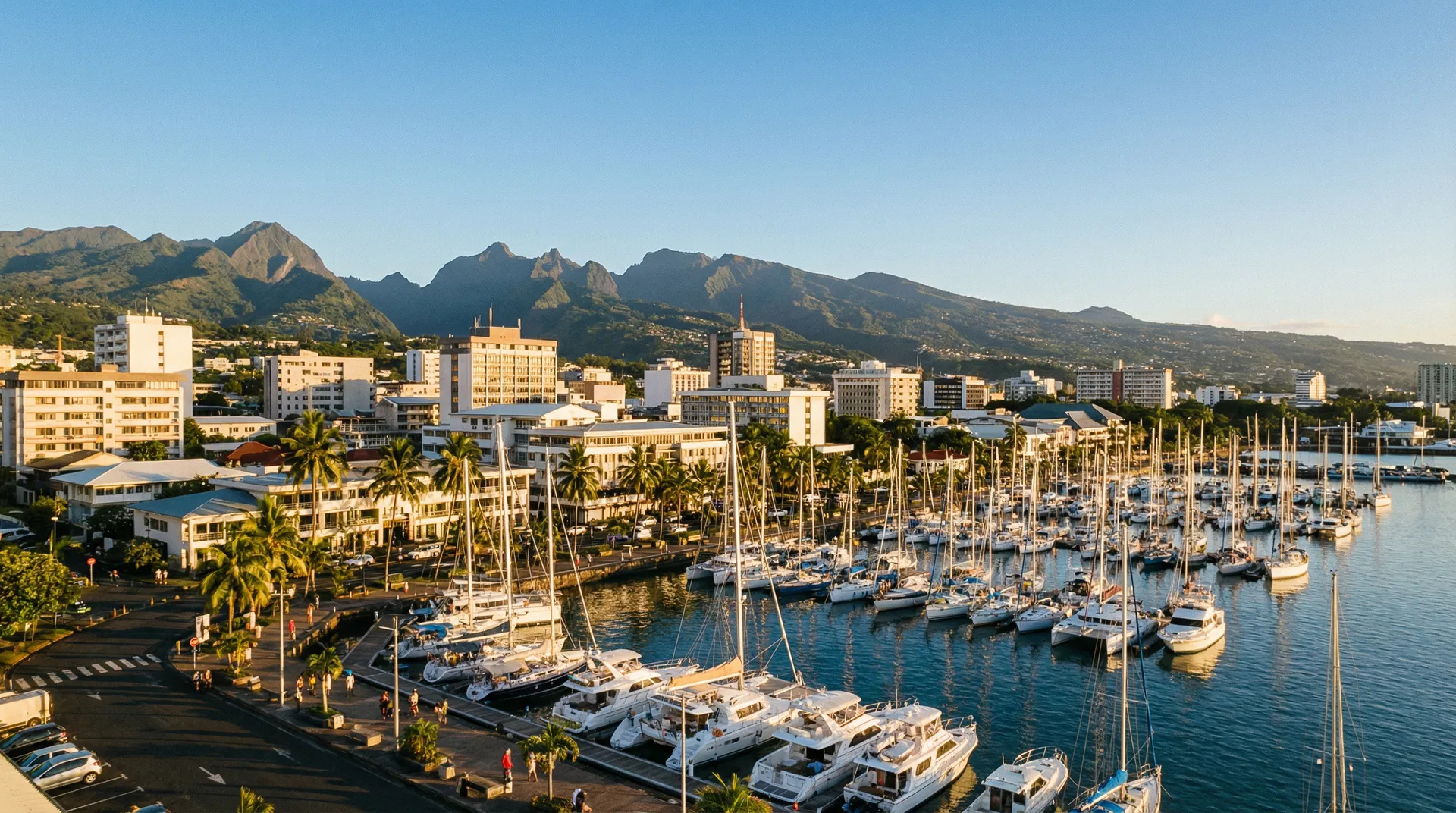
Papeete waterfront and marina, Tahiti
XIII.
Banking in French Polynesia
French Polynesia has a functioning banking system, supervised under French regulatory standards. The main local banks are:
- ›Banque de Polynésie (part of the Société Générale group)
- ›Banque de Tahiti (part of the BPCE group)
- ›Banque Socredo (state-backed development bank, widely used for business accounts)
- ›Caisse d'Épargne (savings bank, part of the BPCE network)
Opening a local account is generally straightforward for residents with a valid address and residence permit. However, local banks are not well-suited as your primary international banking hub. They operate primarily in CFP francs (XPF), have limited international wire transfer capabilities compared to major financial centres, and may not be accepted by all counterparties abroad.
Where to hold your main accounts
For internationally mobile individuals and entrepreneurs, it is generally advisable to maintain your primary banking relationships outside French Polynesia, in a jurisdiction with strong banking infrastructure, broad international acceptance, and ideally some degree of privacy protection. Jurisdictions we frequently recommend include:
- ›Switzerland — private banking tradition, multi-currency accounts, strong asset protection, and high banking secrecy standards within the limits of international law.
- ›Singapore — Asia-Pacific hub, excellent international wire infrastructure, strong regulatory framework, and broad acceptance by global counterparties.
- ›United States — US dollar accounts at major US banks are universally accepted; useful for USD-denominated businesses and investments.
- ›Georgia (Caucasus) — easy account opening for non-residents, low fees, and a surprisingly robust banking system for a jurisdiction of its size. Particularly useful as a secondary account.
We help clients identify the right banking structure for their specific situation. Learn more about our offshore banking services →
Important: not all banks are compatible with all residences. Some Swiss and Singaporean banks have restrictions on clients resident in certain jurisdictions, and compliance requirements vary. We help clients identify the right banking structure for their specific situation — residency, business type, and income profile all affect which banks will accept you and on what terms.
XV.
What Makes French Polynesia Genuinely Attractive
French Polynesia is attractive when it is judged as a complete relocation platform, not as a slogan. The point is not that French Polynesia is perfect for everyone. The point is that, for the right person, the combination of tax position, residence practicality, lifestyle, geography, banking, language, and long-term stability can produce a genuinely coherent base.
- Extraordinary lifestyle with French legal anchor. French Polynesia is attractive because it combines island beauty with a French legal and administrative framework. That combination is rare: remote Pacific lifestyle with a familiar European institutional backbone.
- The lifestyle case is not cosmetic. The lifestyle is the main asset: ocean, climate, sailing, diving, Polynesian culture, and a level of natural beauty that few places can rival. It is not an efficiency play; it is a life-design decision.
- It can function as a real operating base. For remote investors, retirees, and families with independent income, the territory can work if cost, distance, and healthcare logistics are accepted from the beginning.
- It rewards the right profile. It suits those who want remoteness, privacy, and lifestyle quality more than business density or low-cost convenience.
- The attraction has to be handled honestly. The drawbacks are distance, high import costs, limited housing stock, and bureaucratic French procedures. It is attractive only when the isolation is a feature, not a problem.
XVI.
Cost of Living in French Polynesia
French Polynesia is beautiful but expensive. Imported goods, island logistics, limited housing stock and inter-island travel make the cost base closer to a premium island economy than to mainland France.
Typical monthly costs for an internationally mobile professional or family in French Polynesia (2026 planning ranges):
| Category | XPF/month | GBP/month | USD/month |
|---|---|---|---|
| 1-bed apartment, desirable area | XPF 240,240–430,100 | £1,700–3,050 | $2,200–3,900 |
| 2-bed apartment / small house | XPF 448,800–877,800 | £3,200–6,200 | $4,100–8,000 |
| International school (annual per child) | XPF 726,000–2,194,500 | £5,150–15,550 | $6,600–19,950 |
| Private health insurance (annual individual) | XPF 143,000–420,750 | £1,000–3,000 | $1,300–3,800 |
| Restaurant meal, mid-range (per person) | XPF 3,850–9,900 | £50–50 | $50–100 |
| Monthly groceries, single person | XPF 102,960–205,700 | £750–1,450 | $950–1,850 |
| Utilities and internet, apartment | XPF 45,760–112,200 | £300–800 | $400–1,000 |
Comfortable single professional (no children): XPF 572,000–935,000/month (£4,050–6,650 / $5,200–8,500)
Family of four with private schooling: XPF 1,320,000–2,310,000/month (£9,350–16,400 / $12,000–21,000)
These figures are planning ranges, not promises. The actual budget in French Polynesia depends heavily on housing quality, neighbourhood, school choice, healthcare needs, car ownership, travel frequency, and whether you are trying to live like a local or maintain a Western expatriate standard.
XVII.
Buying Real Estate in French Polynesia
Buying real estate in French Polynesia can be useful for lifestyle, residence planning, and long-term anchoring, but it should not be treated as a simple shortcut to tax residence. Property is a factual tie; it can support a relocation story when used properly, but it can also create tax, inheritance, financing, and exit issues if bought before the wider plan is clear.
For internationally mobile buyers, the main points in French Polynesia are:
- ›Ownership rules: Foreigners can buy property, but land tenure, family ownership, customary issues, and administrative approvals require careful local advice.
- ›Transaction costs: Notary costs and registration duties are significant, and high-quality property in Tahiti, Moorea, and Bora Bora is expensive.
- ›Market and rental profile: Rental demand exists in tourism-linked areas, but short-term rental rules, management, maintenance, and cyclone exposure must be considered.
- ›Residence and tax angle: Property can be attractive for lifestyle reasons, but it is not a simple investment market; liquidity is narrow and local legal diligence is essential.
The practical approach is to decide first whether the property is primarily for living, residence support, rental yield, asset protection, or lifestyle. Those are different purchases. A good real estate decision in French Polynesia begins with title due diligence, tax-residence planning, inheritance review, and a realistic exit strategy — not with glossy developer brochures.
Transaction cost table (French Polynesia)
| Cost item | Typical amount | Notes |
|---|---|---|
| Notary fees and transfer taxes | 7–10% | Typical total transaction costs on purchases |
| Legal due diligence | Additional | Important because of land-tenure and family-ownership issues |
| Agency / management | Additional | Varies by island and transaction |
| Typical total buyer costs | 7–10%+ | Before financing, survey, and specialist title work |
XVI.
Retiring in French Polynesia
For retirees, French Polynesia offers a compelling combination of zero tax on pension income, a warm climate, stunning natural beauty, and a French administrative framework that is familiar and reliable. It is not the cheapest retirement destination in the world — but for those with sufficient means, it offers a quality of life that few places can match.
Key considerations for retirees
- ›Tax on pensions: French Polynesia levies no personal income tax. Pension income from abroad is not taxed locally. However, your home country may continue to tax your pension at source — this depends on whether a tax treaty applies and on your home country's domestic rules. Always verify before assuming your pension is tax-free.
- ›Retiree visa: EU citizens need no visa. Non-EU retirees typically apply for a Visa Long Séjour – Visiteur, which requires proof of sufficient passive income (typically €1,500–€2,000/month) and private health insurance. This is the standard route for financially independent retirees.
- ›Healthcare: Papeete has a good public hospital (Centre Hospitalier de la Polynésie Française) and several private clinics. Standards are broadly comparable to metropolitan France. Outside Papeete, medical facilities are limited — serious conditions require evacuation to Tahiti or France. Private health insurance is essential, particularly for those living on the outer islands.
- ›Accessibility: French Polynesia is well-connected by air — direct flights from Paris (20+ hours), Los Angeles (8 hours), and Auckland (5 hours). Domestic inter-island flights are frequent. The territory is genuinely accessible, though long-haul travel is a fact of life.
- ›Cost of living: High by global standards — budget at least €4,000–€6,000/month for a comfortable retirement lifestyle in Papeete, less on quieter islands. The high cost is driven primarily by imported food and goods.
- ›Tax treaties: French Polynesia has no tax treaties of its own. Retirees with pension income from Germany, the UK, the US, or other countries should verify how their pension is taxed in the source country — treaty relief through the France–source country treaty may or may not apply to French Polynesia residents.
For retirees from high-tax countries, French Polynesia's zero income tax environment can represent a substantial saving on pension income — but only if the source country's domestic rules allow it. A pre-move consultation is essential to confirm the tax position on your specific pension type.
XIX.
US Citizens: What You Need to Know
US citizens and long-term green card holders are taxed by the United States on their worldwide income, regardless of where they live. Relocating to French Polynesia does not end US tax obligations — it changes the picture, but does not eliminate it.
Key considerations for US citizens in French Polynesia:
- ›Foreign Earned Income Exclusion (FEIE): US citizens who qualify as bona fide residents of French Polynesia or pass the physical presence test can exclude a significant amount of foreign earned income from US federal income tax. This applies to wages and self-employment income — not passive income such as dividends, interest, capital gains, pensions, or rental income.
- ›Foreign Tax Credit: Income tax paid in French Polynesia can generally be credited against US tax on the same income, reducing or eliminating double taxation. The credit is particularly important for income not covered by the FEIE and for taxpayers whose income exceeds the annual FEIE threshold.
- ›Treaty position: French Polynesia is treated through the French legal framework for many tax-administration purposes; US citizens should obtain advice on whether any France-related treaty position is available for their exact facts. A treaty does not automatically remove US filing obligations, and most treaties contain savings-clause rules that preserve US taxation of citizens.
- ›FBAR: US persons with bank accounts in French Polynesia exceeding $10,000 in aggregate must file FinCEN Form 114 (FBAR) annually. Failure to file can carry severe penalties, even when no tax is due.
- ›FATCA: US citizens may also need to report foreign financial assets on Form 8938. Banks in French Polynesia may separately identify US account holders under FATCA procedures and report account information through the relevant channels.
- ›Social Security and self-employment tax: The FEIE reduces income tax but does not automatically eliminate US self-employment tax. Whether US Social Security tax applies depends on employment status, entity structure, and any applicable totalization agreement.
US citizens considering French Polynesia should work with a qualified US international tax adviser alongside local counsel. The interaction between US tax law and French Polynesia tax law is manageable, but it requires careful planning before the move, not after the first filing deadline arrives.
XVIII.
Correct Preparation
Before your move to the South Pacific, a number of important questions need to be answered. The following section addresses the most common ones.
When is the right time to move?
There is no perfect moment. From a tax perspective, the move can happen at any point during the calendar year. If you intend to start a business, you set the financial year yourself and can benefit from the full 12-month tax exemption from day one.
Do I need a visa?
No. You do not need a visa for yourself or your family. If you intend to stay longer than 3 months, you must register your address at the town hall (Mairie) and formally extend your stay.
What happens to my existing company?
A relocation abroad has consequences for your existing business. A limited company can generally continue to operate, potentially with a new director. If you were self-employed, continuation is not straightforward. Discuss the best structure with your adviser — and if you are considering selling the business, it is better to complete the sale before you leave.
Do I need to set up a new company abroad?
Not necessarily. If you generate income as a private investor, employee, or freelancer, a new local entity is not required. However, given the tax incentives for new incorporations, it is worth considering. We discuss the options in a personal consultation.
What happens to my current home?
To genuinely shift your centre of life to the islands, giving up your home is non-negotiable. This step is essential for your tax liability in your previous country of residence to be extinguished.
Should I rent a place in French Polynesia before the official move?
Yes — it makes sense. If you already know your stay will exceed 6 months, renting in advance is actually less stressful. Various agents and platforms can help you find suitable accommodation remotely before you arrive.
What do I need to prepare for my family?
The move should work for the whole family. Key questions: Which island or neighbourhood suits your lifestyle? Is proximity to Papeete city centre necessary, or are the outer districts fine? How accessible are schools, doctors, and shops? Which areas should be avoided? The answers depend on your specific situation.
How much money should I transfer in advance?
You can transfer unlimited funds to a French Polynesian bank account before you officially relocate. At the time of transfer, your tax domicile is still in your home country — so the transfer itself is not a taxable event in French Polynesia. If you have substantial capital, transferring a larger sum in advance gives you a solid financial foundation from day one.
How much will I need to live on?
Your required income depends entirely on your lifestyle and circumstances. Calculate your costs carefully and compare them against your income. If your existing wealth is sufficient to cover the transition period, no taxes apply — your accumulated capital is exempt from the solidarity contribution.
Deregistering from your home country
The final step is a proper deregistration — both with the residents' register and with the tax authority. If you want to be thorough, you can request a tax clearance certificate after settling all outstanding liabilities. This document confirms that all claims have been settled and provides a clean break.
Homeschooling in French Polynesia
Homeschooling is legal in French Polynesia and follows French national regulations. Parents must notify the local education authority (Direction Générale de l'Éducation et des Enseignements) annually and ensure their child meets the minimum educational requirements. Inspections may be carried out to verify that the child is receiving adequate instruction. For families relocating with school-age children who prefer not to use local French-language schools, homeschooling is a viable and legally recognised option.
XXI.
Automatic Exchange of Information (OECD CRS)
French Polynesia participates in the OECD Common Reporting Standard (CRS) through the French international reporting framework. CRS is the global framework for automatic exchange of financial account information between tax authorities, and French-linked financial institutions exchange information with partner jurisdictions.
In practical terms, this means: if you hold bank accounts or financial assets in French Polynesia, the financial institution in French Polynesia will report your account details — balance, income, and identifying information — through the relevant tax-reporting channel, which can then share this information with the tax authority of your country of tax residence.
The key point is that CRS follows tax residence, not nationality or citizenship. For example, a Swedish citizen who has genuinely become tax resident in French Polynesia is treated, for CRS purposes, as a tax resident of French Polynesia — not as a Swedish reportable person merely because of the passport. The same principle applies to any non-US nationality: the account should be reported to the country of tax residence, not automatically to the country of citizenship.
CRS does not create a tax liability — it creates transparency. If you are properly tax resident in French Polynesia and have correctly severed residency in your home country, CRS reporting simply confirms what should already be declared. The risk arises when individuals attempt to maintain dual residency, leave old tax-residence indicators unresolved, or claim French Polynesia residency without genuinely living there.
US citizens are different. The United States does not participate in CRS in the same way. Americans are affected by FATCA instead: banks outside the United States generally identify US persons and report their account information through FATCA channels to the US authorities, regardless of whether the person is tax resident in French Polynesia or anywhere else.
Key point: CRS is not a problem for those who have relocated correctly. It is a problem for those who have not. Proper tax residency planning — with genuine physical presence and documented ties to French Polynesia — is the only sustainable approach. CRS follows tax residence, not citizenship; FATCA follows US-person status.
XXII.
Further Relocation Formalities
Upon establishing residence in French Polynesia, you will need to obtain a local tax and social registration where required from the competent local authority. This is required for most financial and legal transactions in French Polynesia, including opening bank accounts, signing contracts, registering with tax authorities, and dealing with public offices.
You will also need to obtain or complete the relevant French/French Polynesian residence documentation process once your residence status has been approved. This document or registration record becomes your practical proof of residence in French Polynesia and is usually required for banking, telecom contracts, utilities, leases, property transactions, and day-to-day administrative matters.
- ›Driving licences from most countries are accepted only for a limited period after arrival. Once you become resident in French Polynesia, you should verify whether your licence can be exchanged directly or whether a local medical certificate, translation, theory test, or practical test is required.
- ›Health insurance should be arranged before arrival unless you are immediately covered by a local public system. In many cases, private international cover is the safest bridge solution while residence, employment, or social-security registration is still being completed.
- ›Importing personal effects should be planned before shipping anything to French Polynesia. Household goods may qualify for relief when imported shortly after taking up residence, but customs paperwork, inventory lists, timing rules, and vehicle-import duties can make late or informal shipping expensive.
- ›Proof of address and banking are often linked. Banks, telecom providers, and government offices may require a lease, utility bill, local address certificate, or residence registration before they will open an account or complete onboarding.
- ›Ongoing local compliance should not be treated as an afterthought. Calendar reminders for residence renewals, tax registrations, local filings, health-insurance renewals, and address updates help prevent administrative problems that can later undermine the tax-residency position.
XXI.
How We Help With Your Move to French Polynesia
We offer comprehensive tax and legal support for your relocation to a tax-efficient country. We follow a proven process — and where the country requires it, we involve our local partner firm on the ground, while remaining responsible for overall coordination.
The results speak for themselves: we have helped over 100 entrepreneurs and business owners significantly reduce their tax burden. Careful planning, thorough advice, and comprehensive support are our standard. Legally sound structuring within the framework of international tax law is our highest priority.
Our services typically include one or more of the following:
- → Tax advice on the consequences of relocating abroad: analysis, projections, assessments
- → Clarifying location questions for your business abroad based on factors such as market access, available workforce, and public subsidies — in collaboration with local experts
- → Recommendations for local estate agents experienced with international clients, for both rental and purchase
- → Referrals to specialist immigration lawyers for residency and visa matters
- → Introductions to local tax advisers who handle the opening of bank accounts for both the company and you personally
- → Ongoing tax and administrative management of your company
- → Tax-efficient structuring and restructuring of assets via foreign companies, holding structures, and trusts
Our fees are generally billed on a time basis; fixed prices apply for certain services such as company formation.
As a first step, we recommend booking a consultation to discuss your plans — by phone, Zoom, or Signal. Together we find the best approach and establish contact with our local partner. As project coordinator, we keep all the threads in hand that are necessary for the successful implementation of your plans.
Key Facts
Compare Countries