I have loved Michelin restaurants for as long as I have been able to afford them, and my waistline has kept every receipt. Ask my tailor. Ask my belt. There is a version of me, still lingering in a wine cellar somewhere in Mdina, ordering the cheese course he absolutely did not need.
So let me be honest before I tell you about the little place that changed everything. I am the last man alive who should be criticising fine dining. I adore it. I have chased it across continents. And yet the meal I think about most when I think about Malta was served to me by a man on a side street in Valletta who never once handed me a menu.
Let me start where it started.
Back when Malta had exactly one temple
I lived in Malta twice, a year at a stretch, back in the 2010s, and in those days the island's fine-dining map was almost comically short. There was no Michelin Guide for Malta yet. The inspectors had not arrived. There were no stars to chase and no rankings to argue about over a cold Kinnie. But everyone who cared about food knew exactly where the summit was, and it had one name: De Mondion.
De Mondion sits on the top floor of the Xara Palace, a 17th-century palazzo wedged inside the fortified walls of Mdina, the Silent City. You climb up through those honey-coloured bastions with the swifts screaming overhead, you pass through a hush that feels older than most countries, and you step onto a terrace that looks out across the entire island to the sea. The cooking was classic, precise, and quietly grand, the kind of food that does not shout because it has never once needed to. It felt like the single place on the island that knew exactly what it was. I loved it then, unreservedly. And when the Michelin Guide finally did land in Malta, De Mondion earned its star, and not one person who had ever eaten up there was even mildly surprised.
Back then, that was the whole conversation. One temple. One pilgrimage. Everything else was pizza and a sea view.
Today there is a whole lot more
Now? Now Malta has a fine-dining scene that would have sounded like a fever dream in 2013.
The 2026 Michelin Guide for Malta lists forty-eight restaurants and seven stars, scattered across a cluster of islands you can drive across in under an hour. ION Harbour by Simon Rogan holds two stars, the only two-star kitchen in the country, perched on a bastion high above the Grand Harbour. Around it now orbit a whole galaxy of one-stars: De Mondion still holding court up in Mdina, and Noni, Under Grain, Fernandõ, Rosamì, Le GV. A country the size of a mid-sized city suddenly has a constellation where it once had a single lamp.
I went to ION Harbour recently with my son, who is a chef himself, which is equal parts joy and terror. Watching him read the plates the way I read a balance sheet, catching the technique, the sourcing, the intent behind every element, was worth the entire evening on its own. The food was beautiful. The service was flawless. The farm-to-table philosophy is the real thing here, not a slogan on a chalkboard. It was, by every measure I can name, lovely.
And yet.
Too much of a good thing
Here is the heresy I have arrived at after a lifetime of tasting menus: too much of a good thing eventually stops being a good thing.
There is a point, somewhere around the fourteenth immaculate course, the fourth foam, the third time a serious young man describes a single radish as a journey, where something in me quietly begins to rebel. The rooms go hushed. The tweezers come out. Everyone starts whispering as though they have wandered into church by accident. The plates get smaller and the reverence gets bigger, and slowly I stop feeling like a guest and start feeling like a congregant. It is all genuinely wonderful, and by the end of it I am reverent, dazzled, and faintly starving, wanting more than anything on earth a plate of something my grandmother might actually have made.
Which brings me to the side street.
The tasting menu that is not that kind of tasting menu
Years ago, long before any of the stars arrived, I turned down a narrow lane in Valletta called St Lucia Street, and I found a little place called Legligin.
Now. If you hear the words "tasting menu" and immediately picture tweezers, tablecloths, and a bill that requires a quiet lie down, please throw that picture away. Legligin runs a blind tasting menu, which is an entirely different animal. There is no à la carte. There is no list to fuss over, no agonising between the sea bass and the beef. You sit down, you tell them honestly what you cannot eat, and then you surrender.
They decide. They cook whatever they found fresh at the market that morning, and they bring it to you course after course, five at lunch and seven at dinner, for roughly the price of a starter and a glass of wine at the temples up the hill. Ninety-five percent of what lands in front of you was grown, caught, or raised on the island. The wine is local too, poured with genuine enthusiasm by people who want you to have a good time rather than a spiritual experience. It is generous. It is warm. It is the exact, deliberate opposite of hushed. And it is, in its own gloriously scruffy way, as Maltese as it gets.
Which means, yes, the rabbit
Let me tell you about Maltese food, because it is magnificently strange and I love it without a shred of reservation.
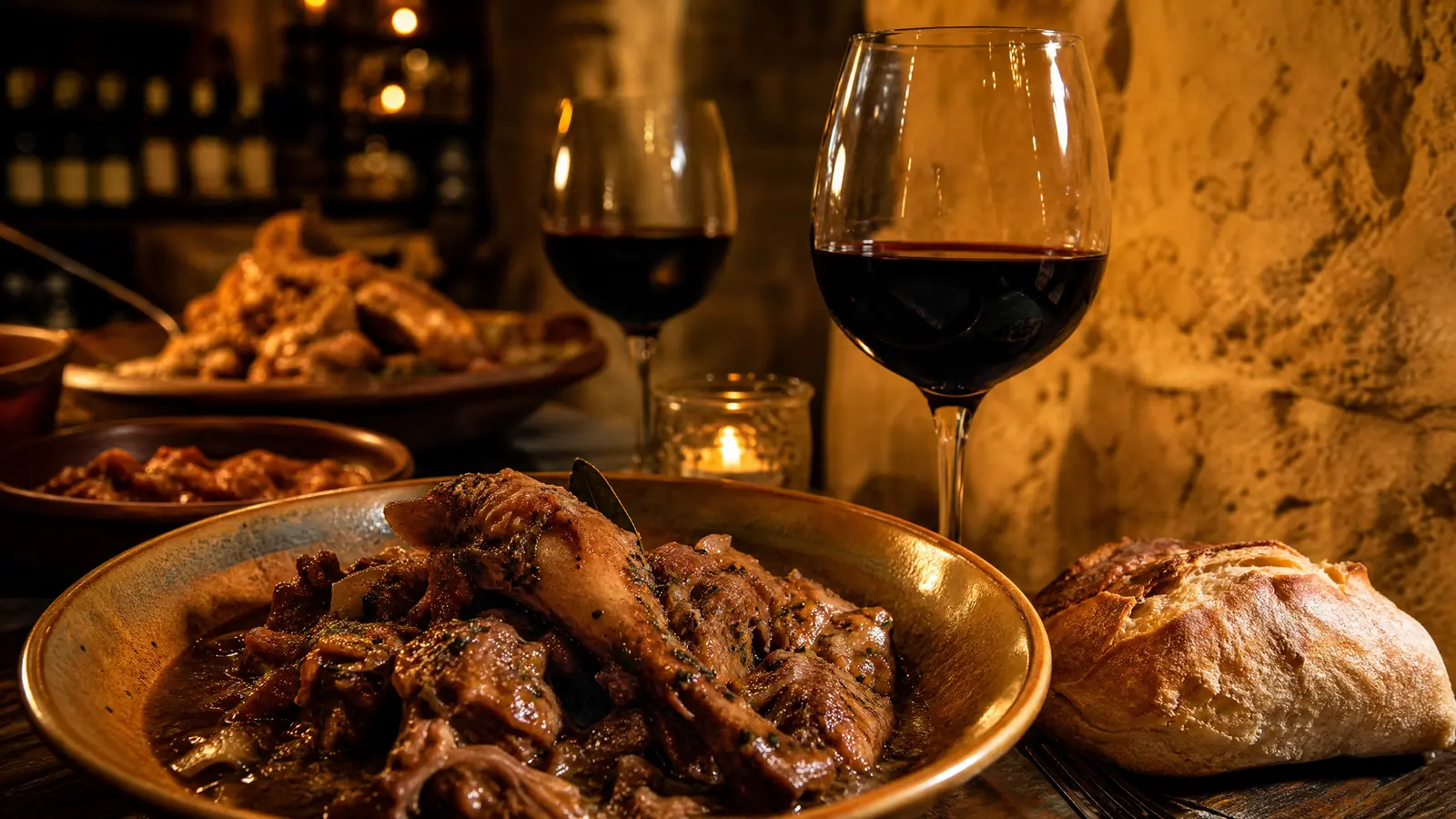
The national dish of Malta is rabbit. Sit with that for a moment. An island nation, ringed by more fish than it knows what to do with, looked around and decided that its flag-bearer at the dinner table would be a bunny. They stew it in wine and garlic until it slides off the bone, they build an entire ceremony around it called a fenkata, and they will serve it to you with the serene, unshakeable confidence of a people who have never once paused to question this decision. And here is the thing. They are completely right. It is delicious.
Then there is the fish, which they treat with the respect it has earned, seasoned simply with local marjoram and dill, pulled from the water that morning, cooked without a scrap of ceremony. And the pork and rabbit stews, thyme and rosemary, slow-cooked to the edge of collapse. Nothing on a Legligin plate is trying to be art. Every plate is trying, very hard and very successfully, to make you happy and full, roughly in that order. That is the whole philosophy, and they execute it beautifully.
The night I broke David
I have made something of a hobby, over the years, of bringing outsiders to Legligin and quietly watching their faces come apart.
The most memorable was David, an American friend who, when I first met him, had never once left the United States. Not once. He arrived in Valletta already faintly bewildered, and then I did the single cruellest thing you can do to a man raised on menus, substitutions, and dressing served on the side. I took him somewhere with no menu at all.
You could watch the panic set in. "What do I order?" You don't. "What are my options?" You have none. "What if I don't like it?" You will. He kept reaching for a menu that did not exist, like a man patting his pockets for keys he left on the other side of the ocean. Then the first plate arrived. Then the second. Somewhere between a glass of Maltese red he could not pronounce and a piece of rabbit he did not yet know he was eating, I watched David finally let go. He stopped trying to manage the meal and started, at last, to have it. By the end he was practically misty-eyed, insisting it was the best food of his entire life, which, given his sample size at the time, was both deeply moving and statistically inevitable.
The Germans and the Swiss, on the other hand
My German and Swiss friends needed no such conversion.
They took one look at the abundance, the local wine, and the honest, groaning plates, and they were home. My friends from Zurich and Munich carry a deep, almost cellular respect for exactly two things: generosity of portion and honesty of value. Legligin delivers both without breaking a sweat. Course after course after course, bottle after bottle, until you arrive at that specific and magnificent condition my Swiss friends describe with quiet reverence as being completely, gloriously, cannot-move full. Eat until you burst. Nobody at that table was counting foams. They were counting blessings.
So do I miss the old Malta?
Here is the harder question, and I am not going to pretend I have a clean answer.
Malta has become sophisticated. The island I first knew was rougher, quirkier, altogether more of a beautiful mess. There were fewer suave rooms and a great many more places like Legligin: a little cellar down a side street, run by people who cooked what they felt like cooking and poured what they happened to love. Today there are bastion-top dining rooms, five-hundred-bottle cellars, valet parking near the Grand Harbour, and Forbes Five-Star hotels standing exactly where there used to be scaffolding, washing lines, and a committee of stray cats. The transformation is real, and in truth it is remarkable. The island grew up. So, I suppose, did I.
Do I miss the old Malta?
It depends entirely on the mood I happen to be in.
Some evenings I want the full theatre. I want the view over the Grand Harbour, the immaculate service, my son beside me silently clocking the technique, a meal engineered to the millimetre. On those nights the new Malta is an outright gift, and I am genuinely grateful it exists.
But on other evenings, the ones that end up mattering more than I care to admit, I want to turn down a narrow lane, push open a plain wooden door, and let a stranger feed me rabbit and pour me wine until I physically cannot move. I want no menu, no reverence, no tweezers. I want to leave full, not merely impressed. I want Malta the way it was when I was younger and the island was too, before either of us had learned quite so much about presentation.
Life is short and fleeting. You get one shot at the table. Some nights, make it two Michelin stars. Other nights, make it a side street, a bottle of Maltese red, and a plate you did not order and will never once forget.
I have learned, slowly, to want both. And I have learned that the best meal is almost never the most expensive one. It is the one where you finally stop reading the menu and start living the evening.
Even if, especially if, there was never a menu to begin with.