I spend a large part of my professional life reading statistics about countries. Tax codes, treaty networks, banking regulations, governance rankings like the World Bank's governance indicators. This is necessary work, and I am not going to pretend otherwise.
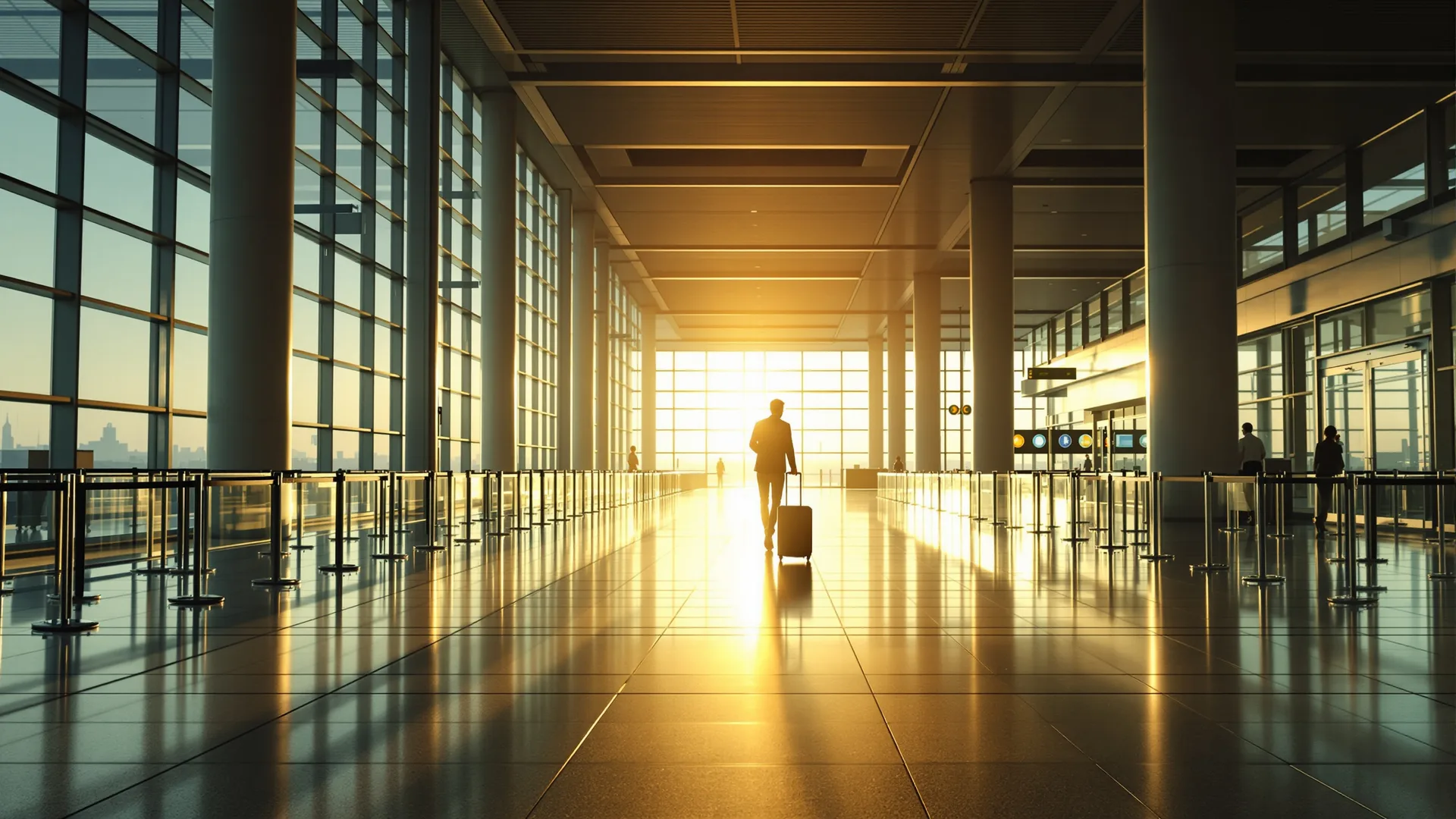
But if you offered me a choice between a country's complete statistical profile and one hour inside its main international airport, arriving as an ordinary passenger with a suitcase and no special treatment, I would take the hour at the airport. Every time.
I call it the airport test. It is not scientific. It is a habit formed over twenty years of landing in places where clients were thinking of moving their lives, their families, and their money. And it has been right far more often than it has been wrong. Let me walk you through what I actually look at, in the order it happens.
The Passport Queue: System or Mood
Immigration is the first conversation you have with a state, and states tell you the truth in that conversation whether they intend to or not.
A functioning passport control looks boring. The channels are clearly marked. The number of open desks bears some relationship to the number of arriving passengers. The officer looks at your documents rather than at you, asks predictable questions, stamps or scans, and moves on. You could film it and nothing would happen in the footage. That is the point.
A dysfunctional one is theatre. One desk open out of twelve while a cluster of officers chats by the wall. A queue that splits, merges, and reforms based on instructions nobody quite hears. A supervisor who wanders the hall pulling individual travellers out of line for reasons that are never explained, while everyone else avoids eye contact and hopes it will not be them.
Here is what that second scene actually tells you: this is a state where discretion outranks procedure. The question is never whether a country has rules. Every country has rules, usually too many. The question is whether the rules govern the officials or the officials govern the rules. You learn the answer within fifteen minutes of leaving the aircraft, and it is the single most important thing the airport will tell you all day.
Who Controls the Taxi Rank
Walk past baggage claim and out into arrivals, and the second institution reveals itself: the taxi queue.
In a well-governed place there is a marked rank, metered cars, perhaps a marshal handing out the next vehicle, and a posted tariff to the city. Nobody speaks to you until it is your turn. In Zurich or Singapore the whole transaction is so uneventful you forget it by the time you reach the hotel.
In a badly governed place, the negotiation starts inside the terminal. Men intercept you at the exit doors with a laminated card of "official" prices. The metered taxis exist, somewhere outside, but a wall of shoulders stands between you and them. And the thing to notice is not the men themselves. It is the uniformed police officer standing ten metres away, watching all of it, doing nothing.
That officer is the data point. If a cartel can capture the taxi rank in the state's own front garden, in full view of its own police, then cartels can capture other interfaces too: the customs clearance, the licensing office, the land registry. The taxi queue is a small market operating under the state's nose. How it is run tells you how markets are run.
How Officials Treat a Stranger
At the moment of arrival you are the weakest version of yourself. You have no status in this country, no connections, possibly no language. Which makes you the perfect instrument for measuring something important: how this administration treats people who have no leverage over it.
Courtesy without servility is the gold standard. The officer who is polite to you because politeness is the standard, not because you look wealthy, works in a system with standards.
Contempt is a data point, and I do not just mean rudeness. I mean the specific contempt of the official who makes you wait an extra beat before acknowledging you, because the wait itself is the message that you need him and he does not need you.
And there is a third mode people rarely talk about: fear. Officers who glance at their supervisor before every decision, who will not answer a simple question because answering is a risk, work inside a system where responsibility is dangerous. Remember that mood, because one day your residence file will sit on the desk of someone exactly like them, and files do not move in systems where nobody dares to own a decision.
Uniforms per Square Metre
Somewhere between the gate and the kerb, count the uniforms.
A confident state polices its airport lightly and effectively. There is security, real security, but you barely register it because it is doing something specific. Singapore's Changi, which sits at or near the top of the Skytrax world airport rankings year after year, is one of the most heavily secured buildings in Asia, and it feels like a garden with a runway attached.
A nervous state performs security instead. Clusters of uniforms at every corridor junction. Long weapons carried in the retail area for no articulable reason. And my personal favourite: the repeated document check, where three different men examine the same stamp at three different points within a hundred metres, each check existing mainly to justify the man performing it.
Presence is not function. When you see a lot of uniform and very little function, you are looking at a state that does not trust its own population, or its own institutions, or both. That distrust will show up later in everything from capital controls to the tone of tax audits.
The ATM and the SIM Counter
Still inside the terminal, run two small transactions. They are the cheapest due diligence you will ever do.
First, the ATM. Does it work? Does it dispense a sensible amount in local currency at something resembling the real exchange rate, or does it offer you a "convenient" conversion that skims eight percent off the top while three of the five machines sit dark? A country's relationship with money crossing its border is visible at the arrivals ATM long before you read a word of central bank regulation. Where cash is rationed, spreads are absurd, or half the machines are dead, you have learned something about the banking system that no brochure will tell you.
Second, the SIM card counter. In a functioning jurisdiction this is a five-minute transaction: posted price, passport scanned once because registration is the law, done. In a dysfunctional one it becomes an odyssey: photocopies, forms in triplicate, a second queue for the stamp that validates the first queue. The requirement is identical in both places. The difference is whether requirements are treated as process or as obstacle. That distinction will define every interaction you ever have with this country's bureaucracy, from opening a bank account to renewing a permit.
The Toilets
I am entirely serious about this one. The airport toilet is the most honest room in the country.
Everything else in the terminal is representation. The marble hall, the duty-free glass, the national airline's flagship lounge: all of it is built to impress visitors and, more importantly, visiting officials. The toilets are different. They are pure maintenance. Nobody wins a ribbon-cutting photo for them. They are cleaned at two in the morning, or they are not, and nobody important will ever know which.
A state, or a concessionaire answerable to that state, that keeps its airport toilets clean when nobody is watching runs on internalised standards. That is close to the textbook definition of institutional quality: behaviour that holds without supervision.
And the inverse is devastatingly informative. A gleaming terminal with broken locks, missing soap, and a mop leaning in a puddle is a whole political philosophy in one room: representation funded, function abandoned. Countries that build marble halls and skip the soap do the same thing with their pension systems. I wish that were a joke.
Why This Predicts Your Life There
Now, why should any of this matter to someone planning a relocation or an international structure? Because of a pattern I have watched repeat for two decades in my own advisory practice.
The jurisdictions that fail the airport test fail later in the administration. Not sometimes. Almost always.
The composite version, with details blurred because these are real people: a client applies for residence in a country whose airport ran on discretion, and discovers that his file also runs on discretion. It moves when a local "facilitator" is engaged and stalls when he is not. Meanwhile another client, in a country whose border ran on rules, receives a letter from the tax office that actually answers the question he asked, within a stated deadline. Neither outcome surprised me. Both were visible in the arrivals hall years earlier.
This is not mysticism. The airport is the state in miniature. Border police, customs, transport regulation, public procurement, maintenance contracts, and the interface between officials and strangers all meet in a single building. It is also, crucially, the building every government knows the world will judge it by.
The airport is the state on its best behaviour. Whatever you see there, the everyday administration behind it is worse.
That asymmetry is what makes the test so useful. A good airport does not guarantee a good country. But a bad airport, honestly observed, is very hard to explain away.
The Limits of the Test
Let me be fair, because a test with no known limits is not a test, it is a prejudice.
Money can buy a terminal. There are gleaming hubs, built and operated by excellent foreign firms, standing above hinterlands that work nothing like the terminal does. If the airport feels like a different country from the taxi ride that follows, believe the taxi ride.
The reverse also exists. Some genuinely well-governed places have scruffy, cramped airports, because their governments spend on schools and courts rather than marble. The test over-weights maintenance and process and under-weights politics, rights, and law. So treat it as a prior, not a verdict: form your hypothesis in the arrivals hall, then check it against the data, the treaties, and the lived experience of people who actually deal with the administration.
One more refinement: run the test twice, once arriving and once leaving. Departure shows you things arrival cannot, above all how a state treats people exiting with their money. Exit is where nervous states drop the mask.
And judge the process, never the person. There are surly officers in Zurich and kind ones in the most chaotic halls on earth. One human being is an anecdote. The system around them is the evidence.
The Checklist
Next time you land somewhere you are considering seriously, as a place to live, a place to bank, or a pillar of a plan B, spend your first hour on this:
- Passport queue: Do open desks match passenger volume? Are travellers pulled aside by rule or by whim?
- Officer behaviour: Procedure or mood? Do officials look at documents or at faces?
- Taxi rank: Metered and marshalled, or negotiated through a wall of middlemen while police watch?
- Treatment of strangers: Courtesy as standard, contempt as message, or fear of responsibility?
- Uniform density: Light and functional, or heavy and theatrical? Count repeated checks of the same document.
- ATM: Working machines, sane exchange rate, cash actually dispensed?
- SIM counter: Five-minute process or photocopy odyssey?
- Toilets: Clean and stocked at odd hours, or marble outside and neglect inside?
- Signage and flow: Can you navigate without asking, or does the building itself require a fixer?
- The departure rerun: Repeat everything on the way out, especially anything touching money.
Score it honestly, then hold your score up against the country's brochure. Where the two disagree, the arrivals hall is usually telling the truth and the brochure is usually selling something. I have built a career on the gap between those two documents.
Work with Sebastian
If a country has passed your airport test and you want to know whether it passes the harder ones, the tax treatment, the banking, the residence rules, the exit questions from your home country, that is what I do every day. Book a consultation.