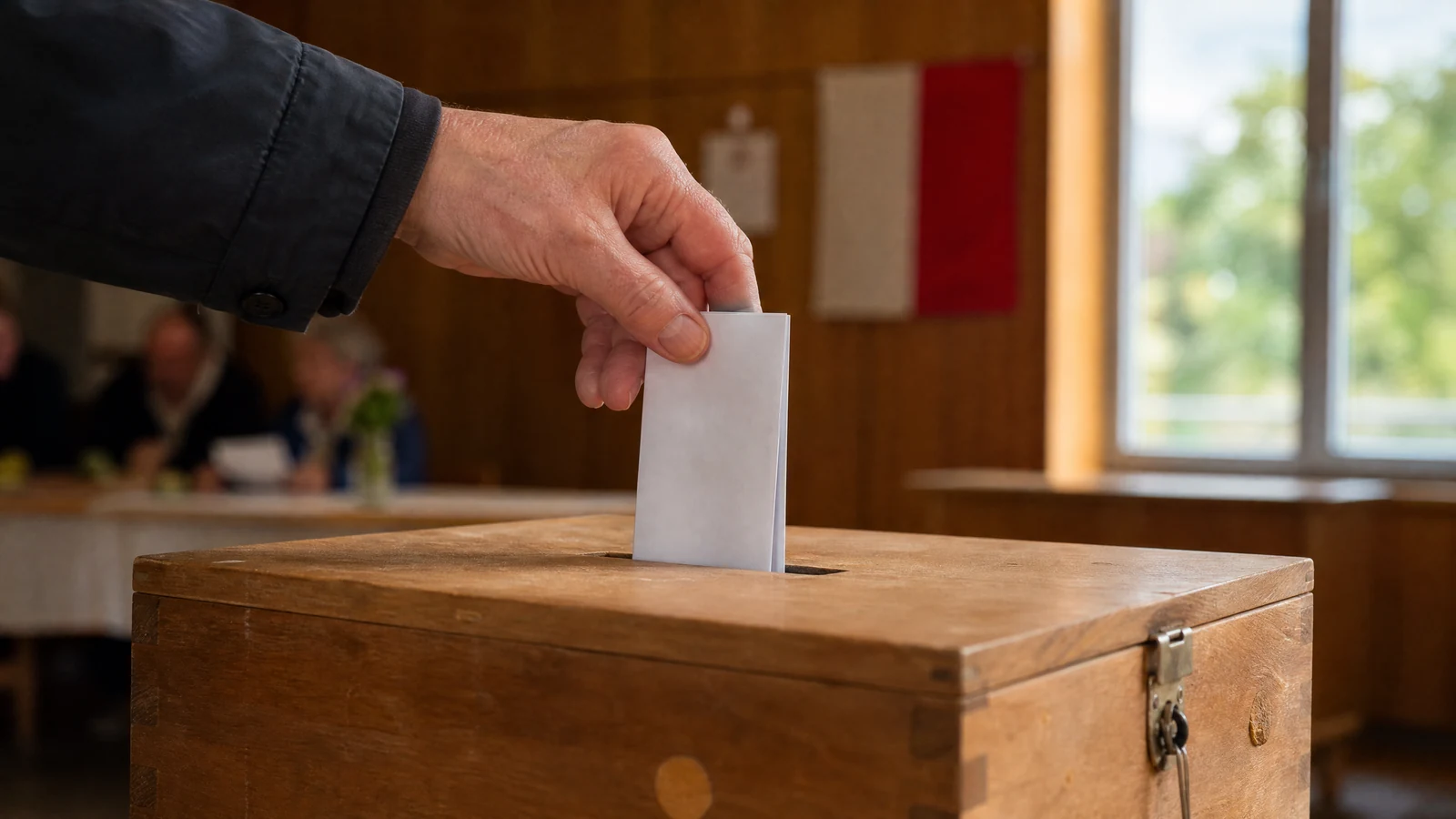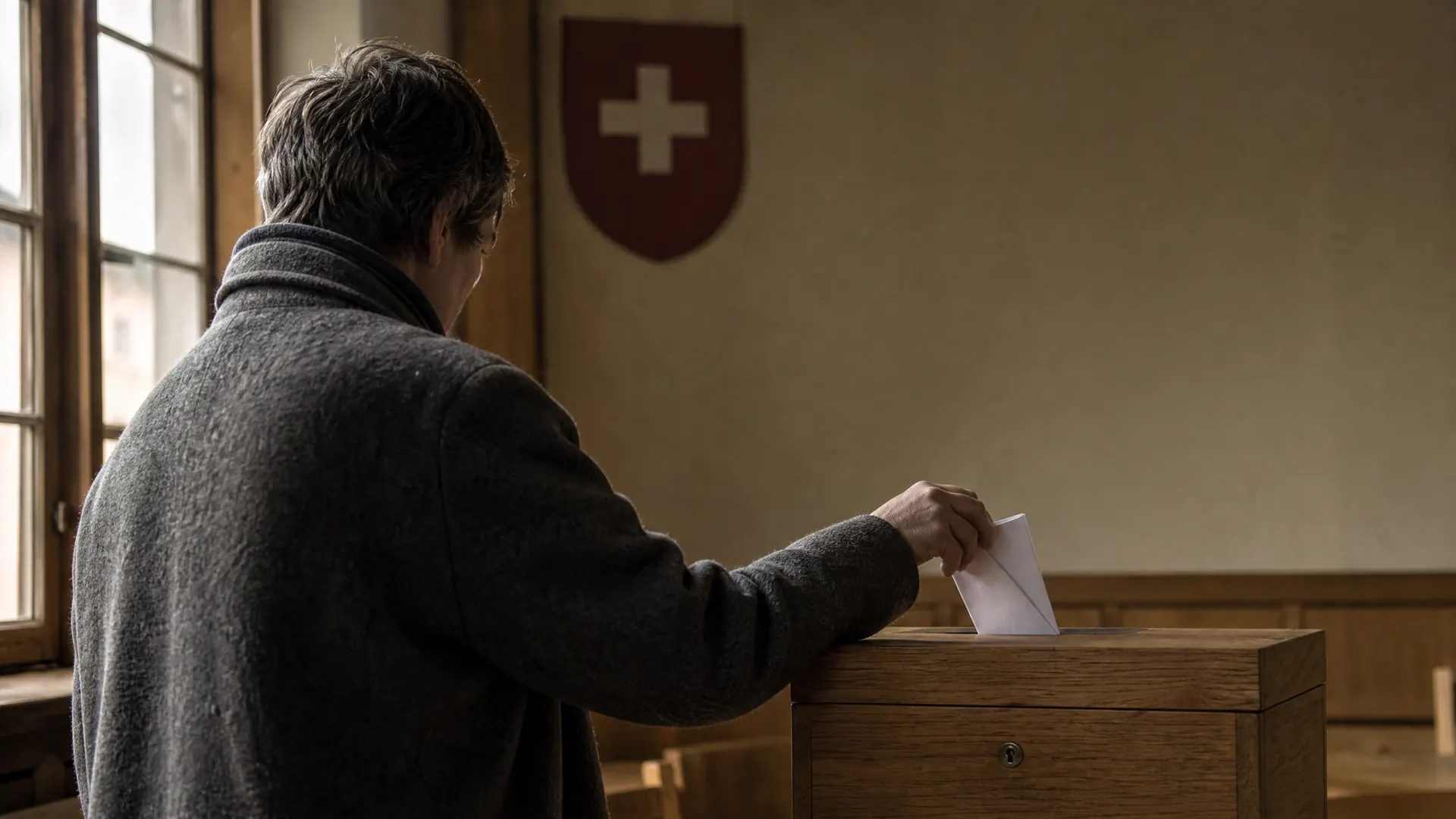
On Sunday, 27 September 2026, Swiss voters and the Swiss cantons decide whether the country's neutrality should be written into the constitution in hard, specific terms. The ballot question is short: do you want to accept the popular initiative "Safeguard Swiss neutrality"? The consequences are not short at all, because the initiative is less about whether Switzerland is neutral (everyone on both sides says it is and should stay so) than about who gets to decide what neutrality allows.
That makes it the second Swiss sovereignty vote the Brief has followed this year. In June the question was population and free movement, and the Brief looked at it before and after the 14 June result. This time the question is foreign policy itself.
If you want the view from outside, meaning what the vote does and does not change for foreigners who live in or bank in Switzerland, our sister site swissplan.plus has already read the ballot from outside. The other route leads inward: into the constitution, the Embargo Act and the question of whose decisions become Swiss law.
What the text on the ballot actually says
The initiative was submitted on 11 April 2024. The Federal Council published its message on 27 November 2024, and Parliament passed its federal decree on 20 March 2026. All three dates come from the voting text in the Federal Council's official explanations, the booklet every Swiss voter receives. There is no counter-proposal.
The initiative would add a new article 54a to the Federal Constitution. In the booklet's German text it has four paragraphs. In plain English (our translation, not an official one):
- Switzerland is neutral. Its neutrality is perpetual and armed.
- Switzerland joins no military or defence alliance. Cooperation with such alliances is reserved for the case of a direct military attack on Switzerland, or acts preparing such an attack.
- Switzerland takes no part in military conflicts between third states and imposes no non-military coercive measures on belligerent states. Obligations to the United Nations are reserved, as are measures to prevent the circumvention of other states' non-military coercive measures.
- Switzerland uses its perpetual neutrality to prevent and resolve conflicts and makes itself available as a mediator.
Parliament recommends rejection. The booklet records the final votes: 124 to 65 in the National Council with 5 abstentions, and 29 to 10 in the Council of States with 5 abstentions. The Federal Council also says no: in its view the neutrality practice followed since 1848 has proven itself, and the constitution already gives it the room for manoeuvre it needs, as its page on the initiative explains.
Because this is a constitutional amendment, it needs a double majority. Under Article 142 of the Federal Constitution, a proposal put to "the People and Cantons" is accepted only if a majority of those voting and a majority of the cantons approve it, with six cantons counting as half a cantonal vote. A narrow national Yes can still fail in the cantons.
Most of it is already the law
Read the four paragraphs against the government's own description of current practice and something striking emerges. The Federal Council's booklet concedes that the initiative's demands correspond in essential points to the legal duties of a neutral state and are already observed in practice. Switzerland is already permanently neutral. It already stays out of NATO and every other alliance with a mutual defence obligation. It already takes no part in wars between other states. It already applies every UN sanction, because as a UN member it must. It already offers its good offices, most visibly through the talks that keep landing in Geneva.
Neutrality is not new to the constitution either. Article 173 instructs the Federal Assembly to take measures to safeguard "the independence and neutrality of Switzerland", and Article 185 gives the Federal Council the same duty. The booklet dates neutrality in the constitution to 1848 and its international recognition to the settlement of 1815. The legal content of neutrality, meaning what a neutral state may and may not do in a war between others, sits in the Hague Conventions of 1907, as the foreign ministry explains.
So if paragraphs 1, 2 (first sentence) and 4 largely describe the status quo, the vote turns on two narrower pieces: the alliance-cooperation clause in paragraph 2, and the sanctions clause in paragraph 3. The second is where the sovereignty question lives.
The real question: whose decisions become Swiss law
Switzerland imposes sanctions through a specific statute, the Federal Act on the Implementation of International Sanctions, usually called the Embargo Act. Its first article is worth reading slowly. The Confederation may enact compulsory measures to implement sanctions "that have been ordered by the United Nations Organisation, by the Organisation for Security and Cooperation in Europe or by Switzerland's most significant trading partners". The measures are enacted by the Federal Council as ordinances.
That clause is the whole debate in miniature. Under current law, sanctions decided in Brussels can become binding in Switzerland by decision of the seven-member Federal Council, which Article 2 of the Act makes the competent authority, and of its departments when the lists change, without a new vote in Parliament and without a popular vote. That is exactly what happened on 28 February 2022, when the Federal Council decided to adopt the EU sanctions packages of 23 and 25 February against Russia, freezing listed assets "with immediate effect". It has continued since. On 22 May 2026, SECO announced that the economics department had decided to adopt changes from the EU's 20th sanctions package, adding 115 individuals and entities to the asset freeze.
Notice that the initiative uses the Embargo Act's own vocabulary. "Non-military coercive measures" is the constitutional twin of the Act's "compulsory measures" (in German both are Zwangsmassnahmen). Paragraph 3 would close that door for belligerent states, leaving open only what the UN obliges and what stops others' sanctions being dodged through Switzerland.
Two definitions of sovereignty on one ballot
Both camps claim to defend Swiss independence. They mean different things by it.
The government's version is sovereignty as freedom of action. The booklet stresses that Switzerland decides independently, case by case, which sanctions it adopts and which it does not, and it offers an example: Switzerland did not adopt the EU's ban on certain Russian media, because the Federal Council prefers to answer false statements with facts rather than prohibitions. On this view, a sovereign state keeps its options open and chooses case by case what serves its interests. Tying its hands in the constitution would be a loss of sovereignty, not a gain.
The initiative committee's version is sovereignty as a fixed rule that outsiders cannot bend. Its text in the booklet says the initiative ensures that Switzerland keeps its neutrality permanently, armed and comprehensively, and does not interpret it «flexibel», flexibly, under pressure from outside. On this view, case-by-case discretion is exactly the channel through which foreign pressure enters, and the only defence is a rule the government cannot trade away.
There is a real paradox here. The initiative moves power away from the executive and into the constitution, which only the people and the cantons can change. The government asks to keep the power in the executive. Which of those is more sovereign depends on whether you locate sovereignty in the state's room to manoeuvre or in the citizens' ability to fix the rules. The ballot does not settle that philosophical question. It simply asks the only people entitled to answer it.
What a Yes would change
The booklet is unusually concrete about the consequences it foresees:
- Sanctions. Switzerland could no longer adopt measures such as the EU's Russia sanctions and might have to lift existing ones. It could only act to prevent circumvention, and the booklet notes that the initiative leaves open which concrete measures would count.
- Security cooperation. Joint exercises, information exchange and coordinated arms procurement with partners, especially neighbouring states, would be permitted only once Switzerland is attacked or an attack is being prepared. The government argues that cooperation cannot be practised for the first time in a crisis.
- Defence industry. The government expects Swiss arms makers to suffer if partners stop seeing Switzerland as a reliable supplier.
- Reputation. The government warns that other states could react negatively in certain cases.
Two details matter for anyone reading the result from abroad. First, the text contains no transitional provision and no deadline for implementation, so the practical sequence after a Yes (which ordinances change, and when) would be for the Federal Council and Parliament to work out. Second, the article's final number would be assigned by the Federal Chancellery after the vote, which is routine but explains why you may see it cited differently later.
What a No would change
Formally, nothing. The Embargo Act stays as it is, the Federal Council keeps deciding sanction by sanction, and the current cooperation with partners continues within the limits of neutrality law. But a No would not end the argument. The foreign ministry's own questions and answers on neutrality acknowledge that closer forms of cooperation with NATO "can and should be examined", while full membership remains incompatible with neutrality. How clear the result is will shape that debate as much as which way it goes.
How to read Sunday's numbers
Three things are worth watching when the results come in on Sunday afternoon.
The gap between people and cantons. Swiss foreign policy has turned on cantonal arithmetic before. When Switzerland decided to join the United Nations in the popular vote of 3 March 2002, the outcome depended on the cantons as well as the national vote. Any initiative needs both majorities, and smaller rural cantons weigh as much as Zurich.
The size of the margin, not only the direction. In Parliament the initiative drew 65 votes in the National Council and 10 in the Council of States. If the popular Yes runs well ahead of that parliamentary share, it tells you that neutrality is one of the issues where Swiss voters and their representatives see things differently. That gap is itself information about how predictable Swiss foreign policy will be over the next decade.
The second item on the ballot. Voters also decide the "Food Initiative" on domestic food production and drinking water, which Parliament rejected without a single Yes vote in either chamber (194 to 0 and 44 to 0). Turnout on Sunday will be shaped by both.
Why this matters beyond Switzerland
For people who hold assets, residence or a Plan B in Switzerland, the country's value has always rested on one quality above others: it changes slowly, visibly, and by rules everybody can read in advance. That is the argument the Brief made for why boring jurisdictions win, and it applies here in an unusual way. Whatever the result, the decision is being made the Swiss way, by a public vote on a published text after two years of parliamentary process.
The substance is a different matter. A Yes would make Switzerland more predictable in one sense (a fixed rule in the constitution) and less predictable in another (the practical fallout for existing sanctions and partnerships, which the text leaves to implementation). A No keeps the executive's discretion, which is predictable in its process and open in its outcomes. For the full country picture, from residence to tax, the Switzerland country page is the place to start.
What 27 September decides, in the end, is not whether Switzerland is neutral. It decides whether neutrality is a policy the government applies or a rule the government obeys. That is a sovereignty question in the purest sense, and on Sunday it goes to the people and the cantons, which is where the Swiss constitution says such questions belong.
Work with Sebastian
If you hold residence, assets or a Plan B in Switzerland and want to know how a change in Swiss foreign policy could touch your own position, book a consultation.