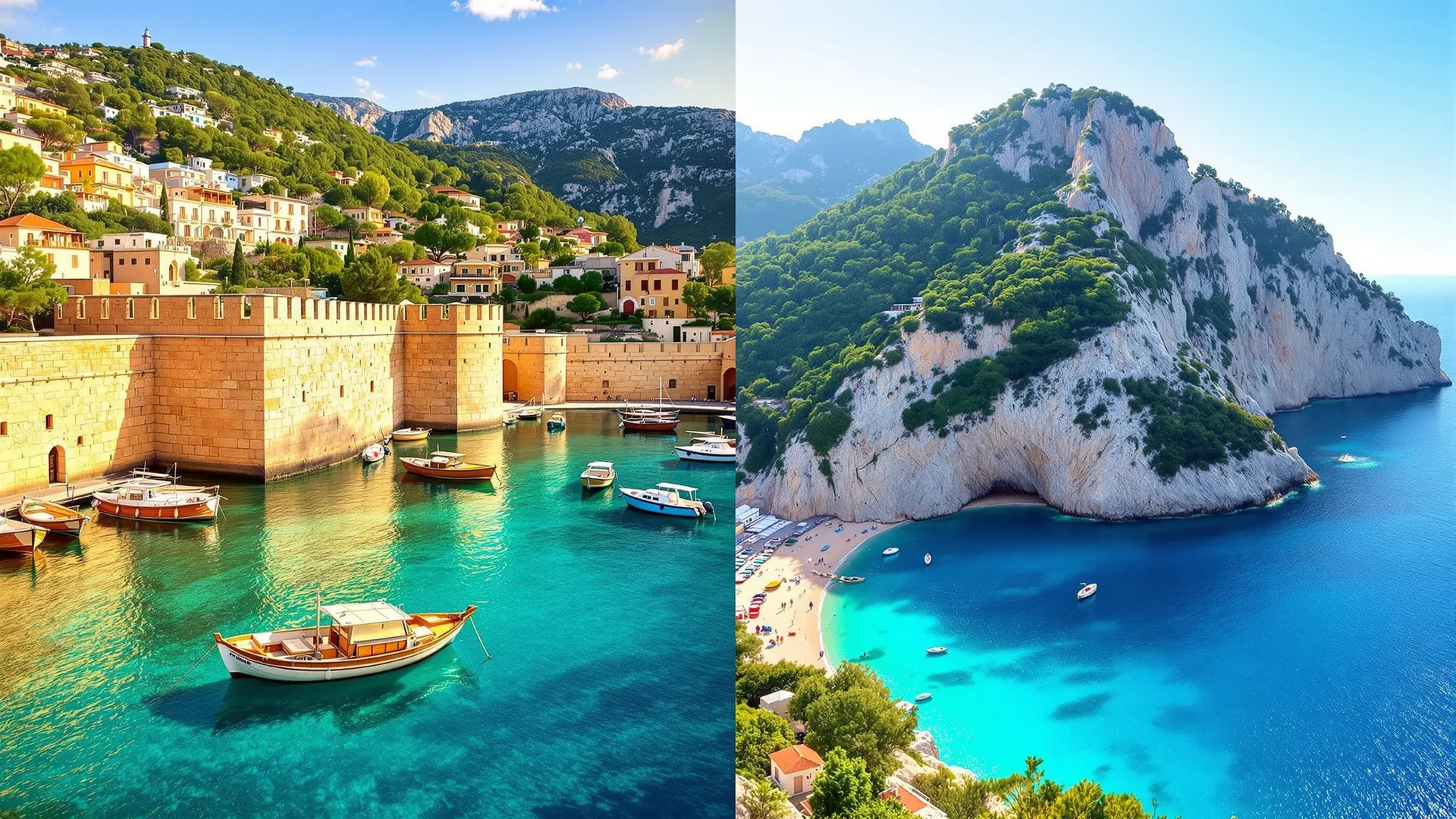
People keep asking me to compare Malta and Mallorca. I understand why. Seen from a desk in Munich or Zurich, they look like the same decision: a sunny Mediterranean island, an international airport, a property with a sea view, a better life. Book the flight, pick the island.
They are not the same decision. They are not even the same category of decision. One is a choice about lifestyle inside a high tax country. The other is a choice about jurisdiction that happens to come with a lifestyle attached.
I should declare my position up front. I have lived in Malta twice, a year at a time, and my sister-in-law Sabrina has been based in Valletta since 2012, looking after our clients on the ground. Mallorca I know the way a frequent visitor knows it: holidays, client meetings, long weekends. That is real familiarity, but it is not residence, and I will not pretend otherwise. What I can do is compare the two the way I compare them for clients in a paid consultation: taxes first, because taxes are where the two islands stop being comparable at all, then residence, then the daily life questions that decide whether you actually stay.
The Tax Question Is Not Close
Start with the part most comparison articles bury in paragraph nine.
Mallorca is Spain. When you become tax resident there, Spain taxes your worldwide income. The general scale is progressive and reaches a combined top rate of 47% on income above 300,000 euros under the state scale, with the exact figures varying by region. Savings income, meaning dividends, interest and capital gains, runs from 19% up to 30% above 300,000 euros, per the current PwC summary for Spain.
Then comes the part that surprises people who have only lived in Germany or the UK: Spain still has a wealth tax. The state scale runs from 0.2% to 3.5% on worldwide net assets above a 700,000 euro allowance, with a further 300,000 euro exemption for the main home. Some regions abate their wealth tax, which is exactly why Madrid became fashionable, but in 2022 the central government invented the solidarity tax on large fortunes to claw that relief back. It applies to net assets of three million euros and up, at rates of 1.7% to 3.5%, and what was announced as temporary has since been made permanent. The details are in the PwC summary of Spanish wealth taxes. The Balearics, where Mallorca sits, are not one of the generous regions.
What about the famous Beckham Law? It is real and I have written about its limits before. If you qualify, you pay a flat 24% on Spanish employment income up to 600,000 euros for up to six years, foreign investment income stays outside the Spanish net, and the wealth and solidarity taxes only touch your Spanish assets during the regime. For a well paid executive relocating on a contract, that is genuinely attractive. But notice what it is built around: employment income. Entrepreneurs living off dividends from their own companies, investors living off a portfolio, people selling a business in the next few years, they mostly do not fit, or they fit badly. And the clock runs out. Year seven, you are an ordinary Spanish resident with worldwide income tax, wealth tax exposure and, if you later want to leave with a large portfolio, a possible exit tax on the way out.
Malta plays a different game entirely. As a resident non-dom you are taxed on Malta source income and on foreign income you remit to Malta. Foreign income you keep outside stays untaxed, and foreign capital gains are exempt even if you bring the money in, a point confirmed in the PwC summary for Malta. The price of admission is modest: a minimum tax of 5,000 euros a year if your unremitted foreign income is 35,000 euros or more. There is no wealth tax. There is no solidarity surcharge on your portfolio. I have covered the regime in detail in the non-dom guide.
On the corporate side, Malta's headline rate is 35%, but the refund system brings the effective rate on trading profits down to around 5% for non-resident shareholders, and since 2025 companies can instead elect a flat 15% final tax without the refund mechanics. Structure matters, substance matters, and none of this is something to copy from a blog post. But the direction of travel is obvious: one island is a place where serious tax planning is possible and legal, the other is a place where you arrange your affairs around a six year exemption and hope.
Residence: One Door Just Closed
For EU citizens, both islands are administratively easy. You register, you prove income and health cover, you get on with life.
For non-EU citizens the picture diverged sharply in 2025.
Spain abolished its golden visa with effect from 3 April 2025. The investor residence route, including the 500,000 euro property option that drove so much Mallorca demand, was terminated by Organic Law 1/2025; existing holders keep their rights, but the door is shut for new applicants, as KPMG's flash alert on the cancellation sets out. Spain still has other routes, the non lucrative visa and a digital nomad visa among them, but the buy your way in option is gone.
Malta went the other way. It still runs functioning residence programmes for non-EU nationals, from permanent residence to the special tax status routes, and I have written an honest assessment of which routes are realistic in 2026 and how the programmes fit together. None of them are cheap. All of them exist, which is more than Spain can now say for its investor route.
Daily Life: Now Mallorca Starts Winning
Here is where I have to be honest against my own island.
Mallorca is simply more beautiful. The Tramuntana mountains are a serious landscape: proper peaks, hairpin roads, hiking and cycling that attract professionals. The beaches are long and sandy. There is countryside, real countryside, with fincas and almond blossom and space between the towns. Malta has none of that. Malta is 316 square kilometres of densely built limestone. The swimming is glorious, some of the clearest water in the Mediterranean, but the beaches are mostly rock, the sandy ones are few and crowded, and the construction is relentless. If your dream is green hills behind the house and a mountain drive on Sunday, Malta will disappoint you every single week.
What does Malta win? Language, community, and convenience.
English is an official language in Malta. Contracts, courts, banks, doctors, schools: everything works in English, natively, not as a courtesy. In Mallorca you are dealing with Spanish and Catalan, and outside the international bubble your paperwork, your notary and your tax office run in Spanish. Plenty of Germans live in Mallorca for years inside a German speaking enclave. That is its own kind of island.
The community point is underrated. Malta's international business community is large relative to the island: financial services, iGaming, funds, crypto, shipping. You meet people who moved for the same reasons you did, and the person next to you at dinner understands what a holding company is. Mallorca's expat scene is bigger in absolute numbers but tilts toward retirees, lifestyle buyers and the seasonal crowd. Both are fine. They are different rooms.
And the seasons: Mallorca has a real winter lull, when resort towns close and flight schedules thin out. Malta runs all year, and even has a direct New York flight these days, though Palma's summer connectivity to German speaking Europe is in a league of its own. On heat, neither island is innocent; I have written about what a Maltese August actually feels like, and Palma in August is not much kinder.
Costs and Healthcare
Neither island is cheap anymore. Palma property has been driven hard by international demand for two decades, and the golden visa abolition was partly a political reaction to exactly that. Malta's rents in the Sliema and St Julian's belt have climbed just as painfully, though the island still offers value once you leave the central strip; the full picture is in my cost of living breakdown. Groceries, restaurants and help around the house are broadly comparable. Anyone who tells you one island is dramatically cheaper is selling something on that island.
Healthcare is a genuine Spanish strength. The Spanish system is excellent by any European standard, and Mallorca has strong public and private provision. Malta is better than its size suggests, with a solid public system and inexpensive private care, and I have written a residents' guide to Maltese healthcare. For routine life both are fine. For rare and complex conditions, a big Spanish university hospital beats anything a nation of half a million people can build. That is arithmetic, not criticism.
Who Should Choose Which Island
Three profiles, the way I actually see them across the desk.
The entrepreneur or investor with international income. Malta, and it is not close. The non-dom regime, the corporate structuring options, no wealth tax, English as the working language, a community that speaks your language commercially as well as literally. Mallorca offers this person a six year Beckham window at best, and usually not even that.
The employed executive or the family optimising for lifestyle. Mallorca, honestly. If your income is employment income, the Beckham regime can work for its six years, and if you have made peace with paying Spanish taxes as the price of the mountains, the beaches, the international schools and the two hour flight home, that is a legitimate trade. Some of my favourite people have made it. They did it with open eyes, which is the part that matters.
The person in between, who wants Mediterranean life and tax sanity and cannot quite have both in one place: base yourself in Malta, take your holidays in Mallorca, and be scrupulously honest about where your tax residence actually sits, because the Spanish tax authority counts days and has seen every clever arrangement twice.
Where Would I Actually Live?
Malta. I have twice, and the reasons have not changed. Not because it is prettier, it is not, but because the whole package works for the life I lead: English, EU membership, a tax system that rewards planning instead of punishing it, and an airport twenty minutes from everything. Mallorca is where I would go to breathe. Malta is where I would build.
Work with Sebastian
If you are weighing Malta against Spain, or against anywhere else, the right answer depends on your income structure, your passport and your family, not on a listicle. I have helped clients through this exact decision since before most of the current programmes existed. Book a consultation.