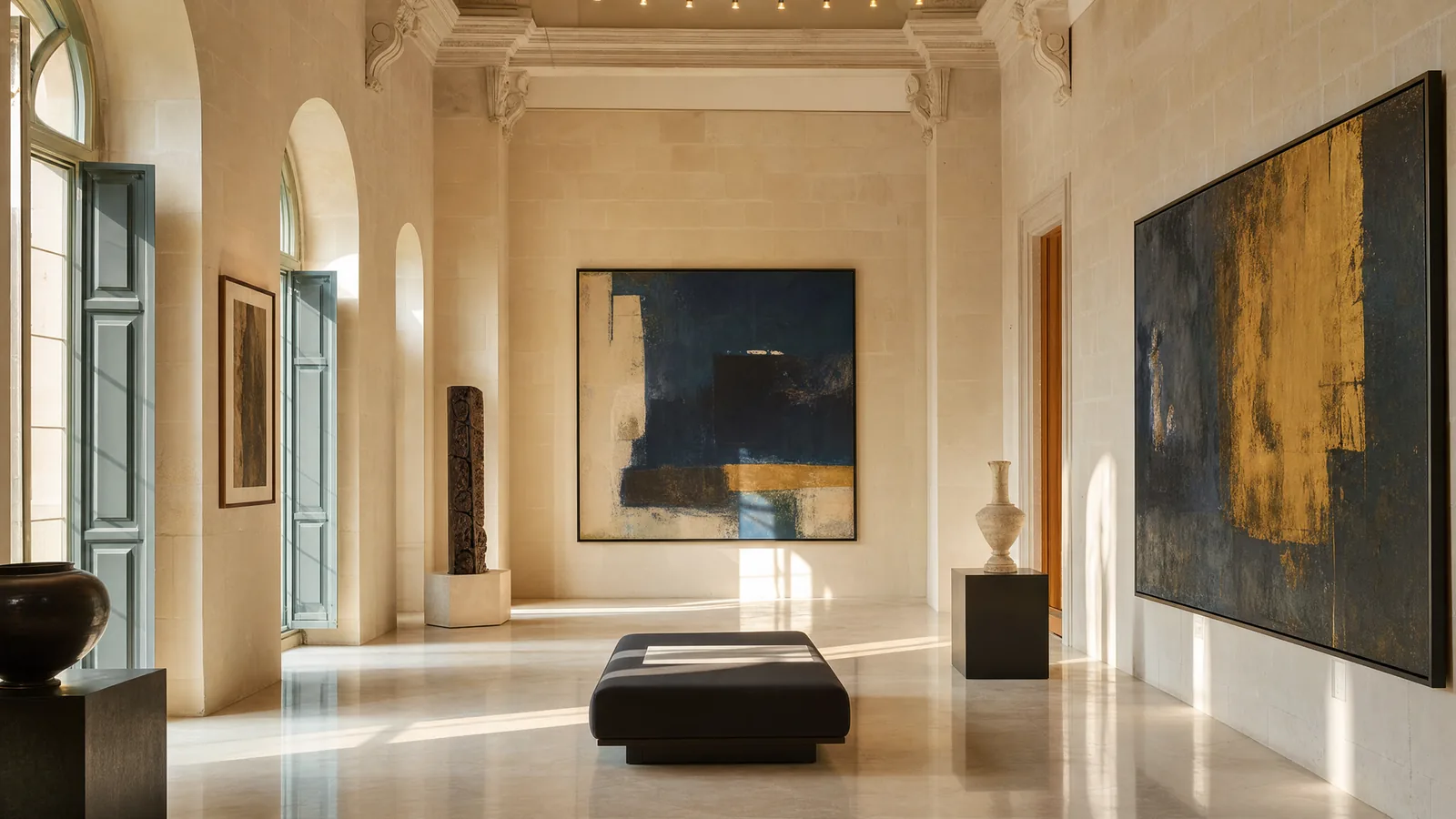
Nobody talks about this in the brochures. The brochures talk about the 15% flat tax and the Grand Harbour at sunset and the ease of opening a company. They do not talk about what happens to the Basquiat in the dining room or the Richter that has been sitting in a Geneva freeport for eleven years appreciating at a rate that would embarrass most equity portfolios.
For high-net-worth individuals with serious collections, the tax treatment of art is not a footnote. It is often one of the more consequential dimensions of a relocation decision. Malta's framework for collectors is genuinely interesting, and genuinely underexplained. This article attempts to correct that.
The baseline: what Malta taxes and what it does not
Malta imposes income tax on individuals at progressive rates up to 35%. It does not impose a wealth tax. It does not impose an inheritance tax. It does not impose a capital gains tax on the disposal of most assets by individuals, with some exceptions that I will come to.
The absence of a capital gains tax on personal asset disposals is the foundational point for collectors. If you are a Malta tax resident and you sell a painting you have owned personally, you are in a different position from a collector resident in Germany, France, the United Kingdom, or Austria, all of which tax gains on art disposals to varying degrees. Malta's Income Tax Act taxes capital gains only in specific circumstances: gains arising from the transfer of immovable property, securities, and certain business assets. Fine art held personally does not fall within those categories.
The Maltese Income Tax Act, specifically Chapter 123 of the Laws of Malta, is the governing statute. Read it, or have your advisor read it carefully. The absence of art from the capital gains provisions is not an oversight. It reflects a legislative choice.
The non-dom remittance basis and its implications for collectors
Most internationally mobile HNWIs who come to Malta do so under one of the formal residence programmes, the Global Residence Programme for non-EU nationals or the Malta Permanent Residence Programme. These programmes carry specific tax treatment, typically a flat 15% on foreign income remitted to Malta, with a minimum annual tax payment.
The critical concept here is the remittance basis. Under Malta's non-dom regime, foreign-source income and gains are only taxable in Malta if, and to the extent that, they are remitted to Malta. Income that arises offshore and remains offshore is outside the Maltese tax net entirely.
For a collector, this has a direct application. If you sell a work through Christie's or Sotheby's and the proceeds land in a non-Maltese account, the gain is not remitted and is not subject to Maltese tax. The proceeds can remain in a freeport account, a Swiss bank, a Liechtenstein structure, or wherever you choose to hold them. You are not taxed on them in Malta unless you choose to bring them in.
This is the same principle that makes Malta attractive for investment portfolios. It is simply less frequently applied, in public discussion, to the art context. The mechanics are identical.
Buying art in Malta: VAT and import considerations
Malta applies VAT at the standard rate of 18% on most goods and services. Works of art imported into Malta from outside the EU are subject to import VAT. However, Malta applies a reduced rate of 5% on the importation of works of art, which is consistent with the EU VAT Directive's provisions for cultural goods.
This matters if you are physically relocating a collection to Malta. The 5% rate applies to importation. Subsequent sale of art within Malta by a private individual is not a VAT-taxable supply, because VAT is a tax on business transactions, not private disposals. A collector selling a personal work is not acting as a taxable person for VAT purposes.
If you are considering holding art in Malta through a company or trust structure, the analysis becomes more complex and you need specific advice. Art held through a trading company is treated differently from art held personally. The personal holding remains the cleanest structure for most collectors.
The Maltese art market itself
Malta is not London or New York or Hong Kong. There is no major international auction house resident on the island, and the domestic art market is modest. Valletta has a small number of commercial galleries, and the Malta Arts Council supports a lively local scene. But if you are buying and selling internationally significant works, the market is not in Malta. The tax treatment is in Malta. Those are different things, and you do not need to be in the same place.
What Malta does offer, for the collector, is a stable legal system (English common law, EU framework), no reporting obligations on offshore assets beyond standard CRS obligations, no annual wealth tax on the collection, no inheritance tax on death, and the remittance basis on offshore gains. For a serious collector who buys, holds, and sells through international auction houses and freeports, that is a meaningful combination.
Practical considerations
A few points worth noting before you act on any of this.
First, your country of departure matters. If you are leaving Germany, the exit tax provisions of section 6 AStG apply to certain assets, and art held in a company structure may be caught. If you are leaving the United Kingdom, the remittance basis rules that applied during your UK residence have their own unwinding implications. Get advice on the exit position before you focus on the Maltese arrival position.
Second, provenance and compliance. The international art market is subject to increasing anti-money-laundering regulation. The EU's 5th Anti-Money Laundering Directive brought high-value art dealers within scope. Malta's FIAU (Financial Intelligence Analysis Unit) implements these rules. This is not a Malta-specific issue, it is a global art market issue. But collectors relocating with significant works should ensure their provenance documentation is complete before the move.
Third, freeport structures. Several of our clients hold major works in Geneva or Luxembourg freeports. Moving Malta tax residence does not require moving the art. The works can stay where they are. The tax residence change affects how gains on eventual disposal are treated, not the physical location of the assets.
If you hold a significant collection and are considering Malta, this is worth a detailed conversation. Book a consultation to discuss the specifics of your situation.