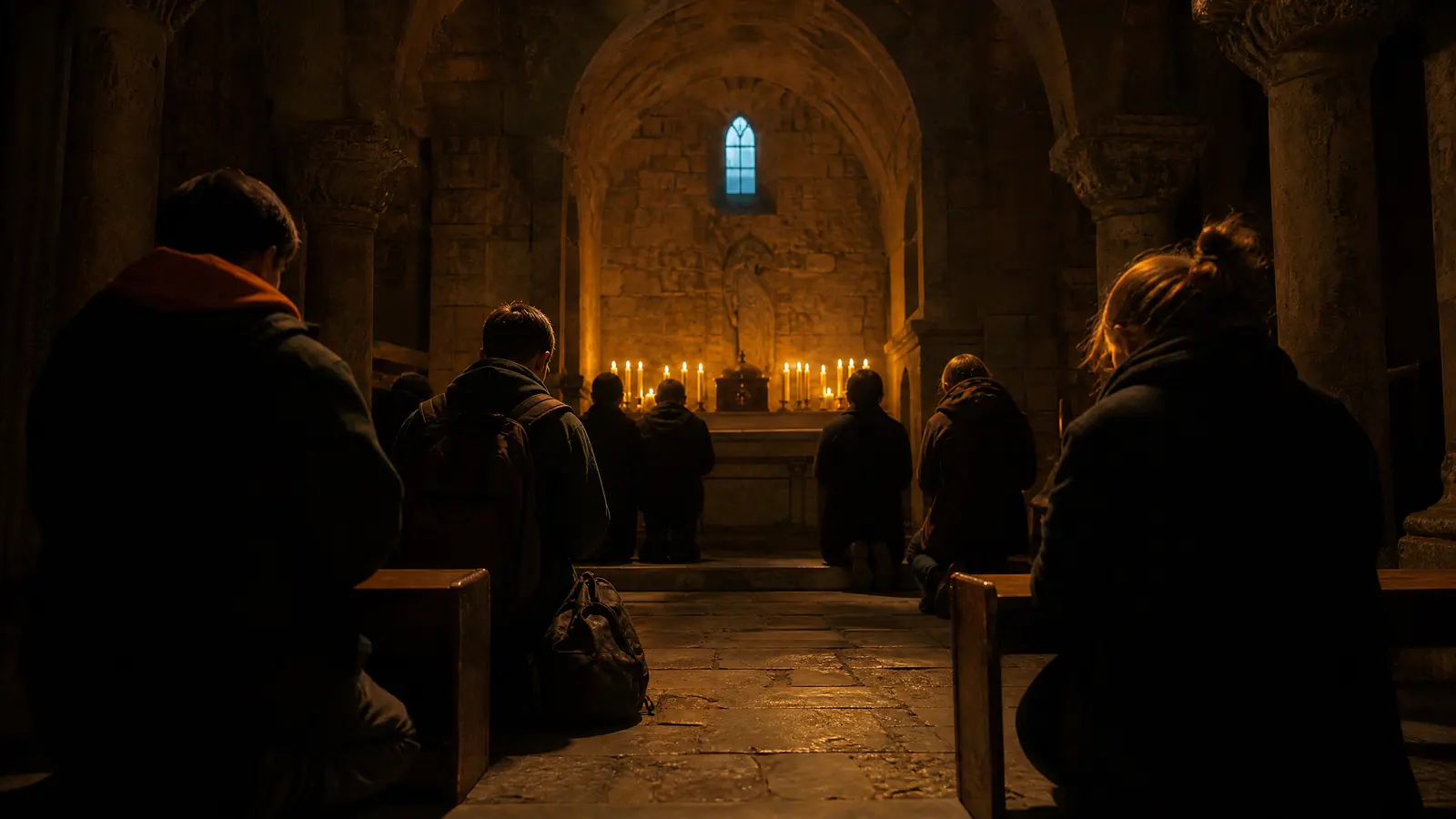
At a quarter past six in the morning, in the stone cold crypt beneath the Liebfrauenkirche in Zurich, I counted the young.
I had come for early Mass half expecting the scene every secular obituary of the faith has trained us to expect: a scattering of grey heads, a weary priest, the smell of spent candles and managed decline. That is not what I found. The lower church was full. Not politely, not comfortably. It was full the way a room is full when people have chosen to be there, in the dark, before work, before the trams were even warm. Students with rucksacks still on their backs. Young professionals in good coats. A girl praying with her forehead nearly touching the pew in front of her. And the priests, when they came in, were young men themselves, unhurried, reverent, treating the altar as though something real were about to happen there. Because it was.
I have written before on The Brief about St Michael's Abbey in Farnborough, and the afternoon I spent with the abbot, who told me almost apologetically that the novitiate was filling up in a way he had not seen in his adult life. At the time I filed it away as a beautiful anomaly. One stone is a stone. But the stones keep coming. In America, in Germany, in Switzerland, across the United Kingdom, I keep having the same conversation, over and over, with people who have no reason to lie to me and every professional reason to be cautious. Something is happening to our young. They are coming home.
The poll they were desperate to be rid of
For a moment, it looked as though the numbers had caught up with the anecdotes. In the spring of 2025 the Bible Society published The Quiet Revival, and the headline was electric: monthly churchgoing in England and Wales rising by half in six years, and among the young a fourfold surge, with young men leading the charge. For the first time in living memory the caricature of the empty church filled with elderly women simply did not hold. Here, at last, was data to match what I was seeing with my own eyes in crypts and abbeys.
Then, this March, the poll was quietly taken out and shot. YouGov withdrew the underlying research, citing fraudulent respondents and failed quality controls, apologised, took full responsibility, and the Bible Society pulled the report. And you could hear it from a mile off: the exhale of relief from the commentariat, the almost gymnastic eagerness with which certain outlets rushed to bury the story. The Guardian and its fellow travellers reported the retraction with barely concealed glee, as they always do when a comforting narrative can be dismantled.
Note the asymmetry. Diversity is sacred when it means a fourteen year old boy in a dress being applauded at a school assembly. Diversity is a threat when it means that same boy, five years later, kneeling in a confessional because he has gone looking for the true, the good and the beautiful and found it waiting for him in the cradle of European civilisation. One is celebrated as liberation. The other is treated as a public health emergency. I know something about the instinct to silence a truth that offends the powerful. My great-grandfather, Nikolaus Ehlen, was handed a Redeverbot by a regime that could not bear what he said out loud. The men who slap the label "misleading" on a young man's faith are gentler than the Gestapo, thank God, but the reflex is the same: some truths must not be allowed to spread.
Take the poll away. The evidence still stands.
So let us do exactly what they want. Let us throw the flawed poll on the fire. Let us grant every objection, concede every methodological sin, and start again from zero. What is left?
France is left. And France is not a survey. France is a count. Every Easter the French bishops tally the adults and teenagers baptised into the Church at the Vigil, name by name, font by font. There is no opt-in sample to game, no priming question to nudge. And that count has been going vertical. Adult baptisms in France have risen roughly 160 percent in a single decade, from under four thousand a year to well over ten thousand. This Easter of 2026, more than twenty thousand adults and teenagers were received into the Catholic Church in a single season, around thirteen thousand of them adults, up by a fifth again on the year before. And the largest single group of these converts, in the most aggressively secular republic in Europe, were young adults between eighteen and twenty-five. Students. Young professionals. The exact demographic the poll was accused of inventing.
That is not a rogue statistic. That is a civilisational fact, recorded by an institution that has every reason to be cautious and no reason to inflate. And it does not stand alone. A separate tracker, not the one that was retracted, found that belief in God among British eighteen to twenty-four year olds had more than doubled in four years. Even the careful sociologists at Theos, no cheerleaders for cheap revival talk, men who have spent thirty years wearily puncturing exactly these hopes, now concede that the ground has shifted, that there is a small but real and measurable stirring that will not be explained away.
Strip out the bad poll, and the abbey at Farnborough is still filling. Strip it out, and my crypt in Zurich is still full at dawn. Strip it out, and thirteen thousand French adults still walked out of the water this Easter with the oil of chrism still wet on their foreheads. You cannot retract a baptism.
The priest in the north
But the moment I keep returning to did not happen in France, or in a headline, or in a spreadsheet. It happened over a cup of tea, a few weeks ago, with a parish priest in the north of England.
I want to describe him carefully, because I have no wish to criticise him. I liked him enormously. He was in his sixties. He had come up in a Church that spent his entire ministry contracting, and he had the scars to prove it. He had buried more parishes than he had built. One priest now doing the work of three, driving between churches on a Sunday like a travelling salesman of grace, arriving slightly out of breath for a Mass, leaving before the tea urn was cold to make the next one. He had come through a serious illness some years back, the kind that leaves a man quietly aware of his own mortality. And there was, I thought, a loneliness about him that he would never have named, the particular solitude of a man who gives everyone else a family and goes home to an empty presbytery.
The realities of the job had hardened him. Who could blame him? He had watched the faith drain out of the culture like water out of a cracked font. He had sat in diocesan meetings about safeguarding software and boiler repairs and parish amalgamations, meetings that had precisely nothing to do with why a boy kneels down at nineteen and asks for God. Somewhere along the way the vocation had quietly become an administration. Not by his choice. By a thousand small subtractions. The mystery had been slowly filed down into a set of tasks.
And here is the thing I noticed, gently, without saying a word. He had become, without ever losing his faith or his loyalty, a little bit blasé about the power of the sacraments. He administered them, of course, faithfully, every week. But he spoke of them the way a good doctor speaks of a routine procedure. Something you do. Something that must be done. Not something that cracks heaven open every single time your hands move over the bread. His convictions ran deep, I never doubted that for a second. But the wonder had gone quiet in him. The job had all but buried it.
And then he said it
And then, almost as an aside, he told me something that changed the whole conversation.
More and more young people were coming back. Young adults. And not casually, not as tourists. They were taking the sacraments deadly seriously. They wanted confession, real confession, the whole examined weight of it. He had found himself, to his own astonishment, spending far more time in the confessional than he had in years, listening to twenty-somethings pour out lives he had assumed his culture had rendered incapable of guilt, or grace, or hunger.
There you are, my friend, I thought, and did not say.
Because look at what was happening in front of me. Here was a man who had grown a little tired of the mystery, and the mystery had come looking for him. He thought his job was to keep the lights on in a dying building. Instead the young were streaming back through his door, and dragging him, whether he had planned it or not, back to the coalface of the supernatural, back to the one place where his whole life actually made sense: the dark of the confessional, the words of absolution, a soul made new.
This is the part the pollsters can never measure and the Guardian will never report, so let me say it plainly. The grace of the sacraments does not only change the one who receives it. It changes the one who channels it. A cynical heart cannot sit in a confessional week after week, hearing the young confess and weep and begin again, and stay cold. It is not possible. Grace runs both ways along the wire. The priest who thinks he is merely dispensing mercy discovers, if he is paying attention, that the mercy is dispensing him, softening the callus that a hard vocation and a hard culture had laid down over decades.
I watched it happen in real time. I watched the crust of a good and weary man begin, ever so slightly, to give. He did not announce a spiritual reawakening. He would have been embarrassed to. But it was there, in the way his voice lifted when he described those queues at the confessional, in the flicker of something that looked a great deal like surprise, and hope, and joy.
What a gift of the Lord for His loyal servant. To labour thirty years in a vineyard everyone told you was dead, to grow tired, to grow a little cynical, to soldier on out of sheer loyalty long after the wonder had gone quiet, and then, in your sixties, with your health behind you and your body aching from the driving between parishes, to have the young come home and hand your own faith back to you. To be reminded, by children young enough to be your grandchildren, that the thing you have been quietly administering all these years was the most powerful force in the universe all along.
That is what is happening. Not in a poll. In a country parish in the north of England, in a crypt in Zurich at dawn, in the overflowing baptisteries of Paris, in an abbey in Farnborough where the novitiate is filling up again. The liberals can retract the survey. They can gloat over the flawed sample and the fraudulent respondents and tell themselves the story is dead.
But they cannot retract the young man on his knees. They cannot retract the water or the oil or the absolution. And they cannot retract the softening of a tired old priest's heart, which no methodology on earth will ever measure, and which is worth more than every survey ever taken.
Life is short and fleeting. One shot. Make it count. More and more of the young have worked that out. And they are counting it toward the only thing that lasts.