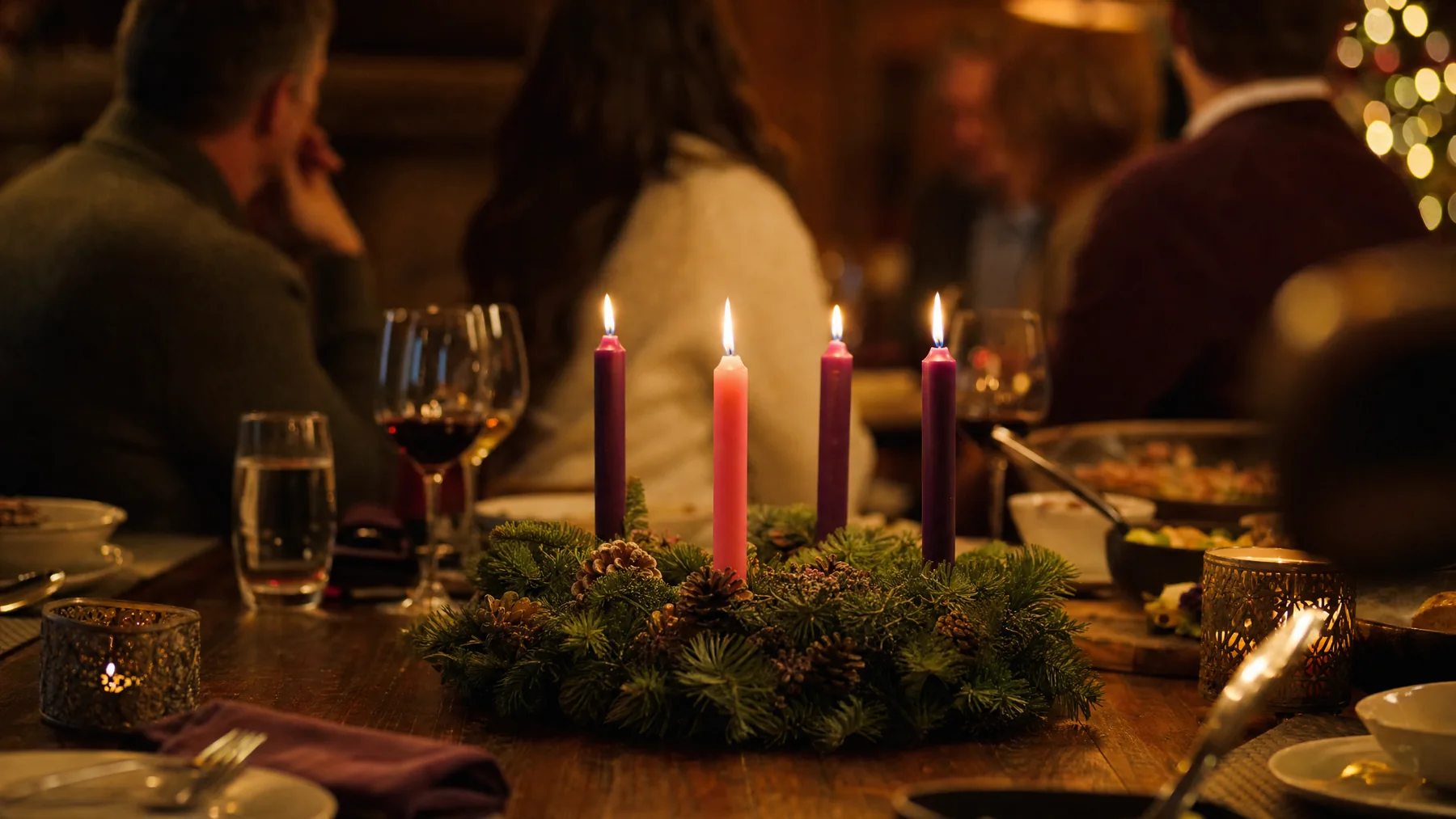
We are in the third week of Advent. Gaudete Sunday — the Sunday of joy — has just passed. The pink candle has been lit.
I am writing this from London, where the shops have been playing Christmas music since the first of November and where the concept of Advent as a season of preparation, of waiting, of deliberate restraint before the feast, is essentially unknown outside Catholic and Anglo-Catholic parishes. The culture has consumed Christmas and discarded the forty days that give it meaning.
This bothers me more than it probably should. Let me try to explain why.
What Advent Actually Is
Advent is not the run-up to Christmas shopping. It is a liturgical season of preparation — four weeks of waiting before the celebration of the Incarnation, the moment when God entered human history as a child in a stable in Bethlehem. It is a penitential season, though less severe than Lent. It is a season of hope — the theological virtue of hope, which is distinct from optimism and survives circumstances that defeat optimism.
The Church's genius has always been the liturgical calendar. Not because religious ritual is magic, but because human beings are creatures who need structure, rhythm, and meaning imposed on time. Without it, we drift. We consume. We are swept along by whatever the commercial culture decides to do with each month of the year.
Advent says: wait. Not because waiting is pleasant but because the thing worth waiting for deserves preparation.
What We Have Lost
I grew up in Freiburg, in a Catholic household, in a Germany where Advent still had texture. The Adventskranz on the kitchen table. The O Antiphons in the last week before Christmas. The restraint — real restraint, not performative — before the Feast.
I am raising my children across two continents, in a culture that has replaced the liturgical year with the commercial year, in which Christmas begins in October and ends on December 26th when the shops start the sales.
What has been lost is not primarily religious. It is anthropological. The rhythm of waiting, of preparation, of making space for something before it arrives, is a human need that secular culture has simply abolished.
The consequences are visible everywhere. We have no patience. We cannot defer gratification. We scroll endlessly, seeking the next stimulus before the current one has registered. We have built an entire economy around the elimination of waiting — same-day delivery, instant streaming, on-demand everything.
And then we wonder why nothing satisfies.
The Deeper Point
I want to say something that might surprise people who know my work primarily through its tax and emigration content.
The case for freedom — financial freedom, jurisdictional freedom, freedom from the overreaching state — is not purely economic. It rests on a prior conviction about what human beings are and what they are for.
I believe human beings are made for more than consumption. I believe we have a nature — a specific, knowable nature — that orients us toward truth, beauty, goodness, and ultimately toward God. I believe the institutions that embody this understanding — the family, the Church, the community, the nation at its best — are worth defending, not merely tolerating.
The secularisation of Advent is, in this frame, not a trivial cultural shift. It is one symptom of a broader disenchantment — the progressive elimination of meaning from the structures that used to give human life its shape.
A culture that cannot wait for Christmas cannot wait for anything. And a civilisation that cannot wait is a civilisation that cannot plan, cannot build, and cannot endure.
A Personal Note
This is the season I take most seriously. Not because I am particularly devout by the standards of my grandparents' generation — I am not. But because the liturgical rhythm of Advent and Christmas is one of the anchors that gives the year its shape, that reminds me what matters beyond the deal flow and the tax structures and the geopolitical noise.
I will be at Mass on Christmas morning. My children will be there. The candles will be lit, the readings will be read, and for an hour we will participate in something that has been continuous for two thousand years and will, God willing, continue long after all of us are gone.
That continuity is itself a form of freedom. One the state cannot tax and no government can abolish.
A blessed Advent to all who observe it.
Work with Sebastian
No consultation pitch this week. Enjoy the season. If you want to talk in January about building genuine freedom for 2026 and beyond, I am here. Book a consultation.