Keir Starmer fell today, and the man who follows him will be the seventh prime minister Britain has installed in a single decade. I am no Labour man. Yet for the life of me, I cannot name the crime that earned his execution.
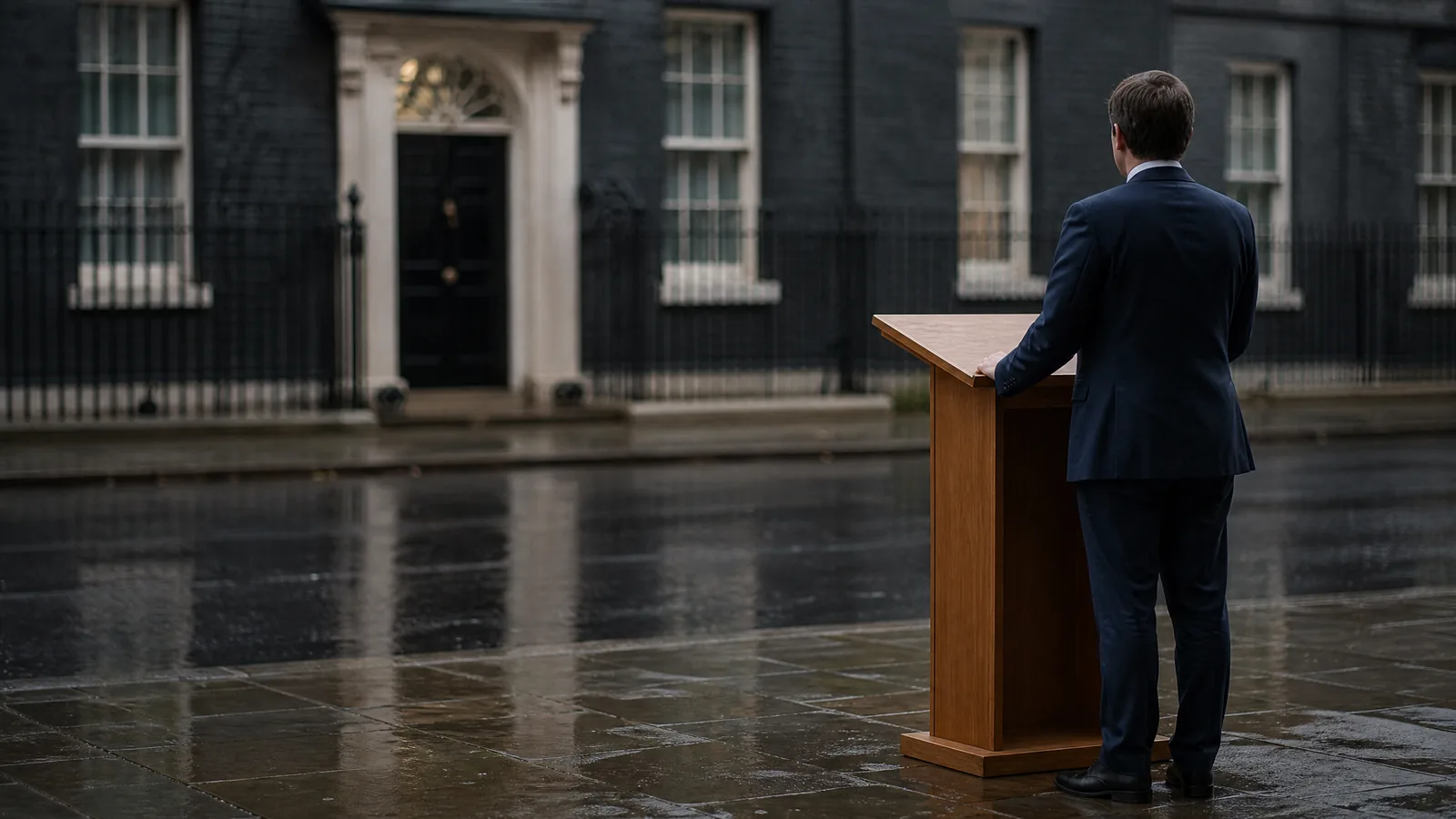
This morning the staff carried a lectern onto the most photographed pavement in the world, set it down on the worn stone outside Number Ten, and stepped back into the shadow of the great black door. A man walked out to meet it. His voice held until he spoke of his wife and his children, and then it broke, the way a voice breaks when a man is saying goodbye to something he believed would last longer than it did. Somewhere down the street, protesters played Beethoven. The Ode to Joy, the anthem of the union Britain voted to leave ten years ago this week. And with the music still in the air, Keir Starmer resigned, with what he called good grace, less than two years after his party swept the country.
I want to be precise about my position before I go further, because it matters. I am not a British voter. Indeed, I am not a voter anywhere. I am a confessed abstainer, a man who casts no ballot in any of the countries he has lived in, and I have lived in many. My reason is simple and unfashionable. I cannot bring myself to endorse a system whose final offer is always the lesser of two evils, and I will not lend my name to that choice. So understand what follows for what it is. I have no tribe in this fight, no candidate, no party, no flag to wave or to defend. What follows is not a defence of Keir Starmer the politician, a man whose project I find no more congenial than the next. It is something more disinterested than that, and more uncomfortable. It is a defence of the principle he was denied, a principle that protects men I would despise and men I would admire in exactly equal measure, which is the only kind of principle worth having.
The Body Count
Cameron. May. Johnson. Truss. Sunak. Starmer. And now, in all likelihood, Andy Burnham, freshly returned to Parliament by a by-election engineered for precisely this purpose. Seven prime ministers in ten years. Seven men handed the keys to a nuclear power, the fifth or sixth largest economy on earth, a permanent seat at the table of nations, and seven times the lock was changed before the tenant had unpacked.
There are republics that have survived coups with more continuity than this. There are family businesses with more succession planning. And the strange thing, the thing that should stop us cold, is that almost none of these men were removed by the people who hired them. They were removed by the people who worked for them.
In Search of the Sackable Offence
So I went looking for the offence. I genuinely tried. I asked myself what Starmer had done that would justify the most violent act available in a parliamentary democracy short of an election, the defenestration of a sitting head of government.
Here is what I found. He lost a round of local elections, badly. His poll numbers sagged into the cellar. A populist insurgency on his right kept rising, and his own backbenchers, smelling their seats slipping away, decided he was the reason. More than eighty of them turned. Ministers walked. A rival maneuvered himself back into a Commons seat, and the moment that door opened, the knives came out into the daylight.
Read that list again and tell me where the crime is. Unpopularity is not a crime. A bad night at the council elections is not a crime. Failing to reverse fourteen years of accumulated national decline inside twenty-four months is not a crime. These are the ordinary weather of governing. He was not sacked for wrongdoing. He was sacked for being temporarily unloved.
The Ghost of Boris
I felt this same unease once before, and I felt it about a man from the opposite tribe.
In July of 2022, Boris Johnson won the largest Conservative majority since Thatcher and was driven from office not by that electorate but by a cascade of his own people. Sixty-two ministers, aides, and envoys resigned in the space of days, the largest such walkout in the recorded history of British government, until the position became, in the favored word of the commentariat, untenable. The trigger was a tangle of scandals: the parties during lockdown, the clumsy handling of a colleague's misconduct, the sense that the man's word had come loose from its moorings.
And I will say now what I said then, and I will say it knowing it costs me something with readers who loathe him. Boris Johnson's conduct did not clear the bar either. It was unedifying. It was at times dishonest. It was the behaviour of a man too clever by half who believed the rules bent around him. But a politician being a disappointment, even a vivid and theatrical disappointment, is not the same as a politician committing the kind of grave offence that should override the verdict of millions. The cure his own party administered was wildly out of proportion to the disease.
Two men. Opposite parties. The same fate. Both won landslides. Both were buried mid-term by their own benches. When the same machine produces the same result regardless of which tribe feeds it, you are no longer looking at a series of scandals. You are looking at a structural defect.
The Honest Objection
Now, an honest writer has to make the strongest case against himself, so let me make it.
You will say, correctly, that Britain does not elect a prime minister at all. The British voter marks a ballot for a local Member of Parliament. The party that commands the Commons chooses its leader, and that leader walks into Downing Street on the confidence of his colleagues, not on a personal coronation by the public. By that strict reading, the moment Starmer lost the confidence of his MPs, the constitution worked exactly as designed. There is no betrayal. There is only the machine doing what the machine does.
I concede every word of the legal description. And I think it misses the truth entirely.
Because we both know how a modern campaign is actually fought. We know whose face fills the poster, whose name sits in the headline, whose character is litigated for six weeks on every screen in the country. The voter in the booth is not weighing the merits of an obscure local candidate. The voter is choosing a leader and a programme, and the parties know this, and the parties build their entire war machine around it. The campaign is presidential in everything but the textbook. Johnson understood this in his bones, which is why, even as the ministers fled, he kept insisting on his "colossal mandate" from the people. He was constitutionally wrong and morally right. The legal mandate may live in Parliament. The moral mandate lives with the millions who put the cross down believing it meant something.
What Accountability Forgets
There is a second objection, and it is serious, so I will not wave it away. One could argue, and scholars have argued, that there is a genuine moral case for ministers resigning to bring down a leader who has failed the standards of his office. Accountability, the argument runs, cannot be made to wait five long years. Collective responsibility is a real check. A prime minister who has lost his entire cabinet cannot, in any functional sense, govern. The mass resignation is the constitution's immune system, killing the infection before it kills the host.
I find this case respectable. I simply find it dangerous when it is left without limits.
Because where, precisely, does it stop? If a bad poll at the two-year mark is grounds for removal, then no leader on earth can ever do anything hard. Every reform that matters, every painful restructuring, every long and unglamorous investment in a country's future, follows the same brutal curve. It costs you now and rewards you later, often far later, often after you are gone. The pain arrives first and the benefit arrives last. A leader who knows he will be guillotined the instant the pain arrives will simply never reach for the medicine. He will reach for the sugar. He will govern for the next eighteen months and let the next decade rot.
This is the great derangement at the heart of it. We accuse our politicians of thinking too short term, and then we sack them the moment they ask us to think long term. We demand statesmen and we breed weathervanes. We complain that nobody plans for the future, in a system that executes anyone who tries.
The Covenant of the Term
Here is what I believe, stripped of ornament.
A term is a covenant. Four years, five years, whatever the constitution provides. It is not a long time. It is barely time enough to turn a battleship, let alone a nation. When the electorate confers it, Parliament owes the recipient the whole of it, the full road, to succeed or to fail on his own programme and be judged at the ballot box when the music stops. That is the deal. That is the entire dignity of the arrangement.
Resignation, and the forced resignation that is merely murder wearing better clothes, should be reserved for grave matters and grave matters alone. Genuine corruption. Criminality that strikes at the office itself. The betrayal of the constitution, the selling of the country, the breaking of the deepest trust. Treason, not tactlessness. Not a sour by-election. Not a panicked backbench. Not the ordinary, survivable unpopularity that visits every leader who has ever lived long enough to make a real decision.
By that standard, the honest one, neither Starmer nor Johnson should have fallen. One was dull and one was reckless. Neither was a criminal. Neither had betrayed the realm. They were chased from office for the sin of becoming temporarily inconvenient to the careers of the people who serve beneath them, and we dressed it up as accountability and told ourselves it was democracy at work.
It is not democracy at work. It is democracy eating itself, one landslide at a time.
Back to the People
And here is the part that compounds the disappointment, because a clean exit was available this morning and he declined to take it.
If a prime minister truly concludes that he can no longer command the confidence to govern, then there is exactly one response that honours the people rather than the party. Hand the mandate back to its owners. Not sideways, to a successor crowned by a few tens of thousands of party members in a summer ballot, but outward and downward, to the millions who conferred it in the first place. Since the Fixed-term Parliaments Act was swept away in 2022, the prime minister has once again held the power to request a dissolution and put the question to the country. Starmer had that power in his hand this morning. He could have walked to that lectern and called a general election.
He did not. He chose instead a managed succession, an orderly handover of the keys to whichever colleague the party machinery prefers, with the public left to watch from the pavement. The country that elected Labour will now be governed by a prime minister no voter chose for the office, installed through an internal contest most of them cannot even enter, and it may be years before anyone is asked to ratify the arrangement at a ballot box.
If the original mandate was broken, and the entire logic of his resignation insists that it was, then the only democratic repair is a fresh one. Everything else is the political class passing the crown quietly among themselves and calling it continuity. That was the real choice on the stone this morning. The honest road was the harder one, the road back to the people, and he did not take it.
The Door Closes
The lectern goes back inside now. The carpet rolls up. Within weeks another figure will walk out to that same patch of stone, and the cameras will pretend, as they always do, that this time the keys will sit in the same hand long enough to mean something.
I am not naive about why this happens. I understand the panic, the polls, the cold arithmetic of men trying to save their seats. But a country that cannot keep a promise even to the people it elected with a landslide has taught the watching public a quiet and corrosive lesson. It has taught them that the vote is provisional. That the mandate is on loan. That the will of millions can be overruled in a fortnight by a few dozen frightened insiders in a wood-panelled room.
People are not stupid. They learn that lesson. And when enough of them learn it, they stop believing the cross they draw will ever change anything at all. That is not a small thing to lose. That is the foundation, and it does not come back when you need it.
I will confess my own hand in this, since I have been honest about everything else. I stopped drawing that cross long ago, in every country I have called home, precisely because I could no longer believe the menu was worth ordering from. I am, perhaps, an early symptom of the very disease I am diagnosing. When a system spends a decade teaching even its landslide winners that the mandate is only ever on loan, it should not wonder why men like me stopped queuing at the booth at all.
Carpe Diem. Life is short and fleeting, for nations and for the men who briefly lead them. We keep handing them a single shot, and then we shatter the rifle before they can take aim. We should not be surprised when, one day, the people we have taught to distrust the vote go looking for something other than the vote.
Sebastian