Search for "countries with no property tax" and you will find long lists, most of them copied from each other and many of them wrong. The problem is not that nobody knows the answer. It is that the lists mix up two very different taxes and rarely check who actually pays.
So start with the distinction, because everything else depends on it.
A recurring property tax is the bill that arrives every year simply because you own a house or a flat: council tax and business rates in the UK, municipal property tax in the United States and Canada, taxe foncière in France. You pay it whether you live in the property, rent it out or leave it empty.
A transfer tax is paid once, when the property changes hands: stamp duty, registration duty, transfer tax. It can be large, but it is a cost of buying, not of holding.
A country with no recurring property tax can still take 5 percent or more of the price on the day you buy. A country with a low transfer tax can still send you an invoice every year for as long as you own the place. When people say "no property tax", they almost always mean the first. This list is built on that meaning, and it treats the second as a separate bill.
How big the annual bill is elsewhere
To see why the question matters, look at what recurring property taxes raise in countries that rely on them. The OECD's Global Revenue Statistics record revenue from recurrent taxes on immovable property (category 4100) for more than 120 jurisdictions. For 2023, the OECD data show:
| Country | Recurrent taxes on immovable property, % of GDP (2023) |
|---|---|
| United Kingdom | 2.78 |
| Canada | 2.69 |
| United States | 2.63 |
| France | 1.90 |
| Greece | 1.40 |
| Italy | 1.09 |
| Spain | 0.93 |
| Portugal | 0.61 |
| Germany | 0.37 |
| Switzerland | 0.18 |
| Malta | 0 |
In the English-speaking world, the annual tax on owning property is one of the larger items in the public accounts. Across the full dataset, 23 of the 124 jurisdictions report zero revenue in that category for every year from 2021 to 2023.
That number is a starting point, not an answer. As you will see below, a zero in the statistics does not always mean a zero on your invoice.
The verified short list
These are the jurisdictions where the official sources confirm that owning a home does not trigger an annual tax. The list is deliberately short. Each entry rests on a government source, not on another list.
Monaco
The Principality's own public-service portal is unambiguous: "There is no wealth tax, annual property tax or council tax" (MonServicePublic, Tax in Monaco). The same page confirms that residents, with the exception of French nationals covered by the 1963 Franco-Monegasque convention, pay no income tax.
The cost comes at the door. The portal lists registration duties on registered transactions, usually at proportional rates between 0.5 and 7.5 percent. And the price per square metre is the real barrier: Monaco is a holding-cost paradise with an entry ticket few can afford. The Brief's Monaco country page covers residency and the rest of the tax picture.
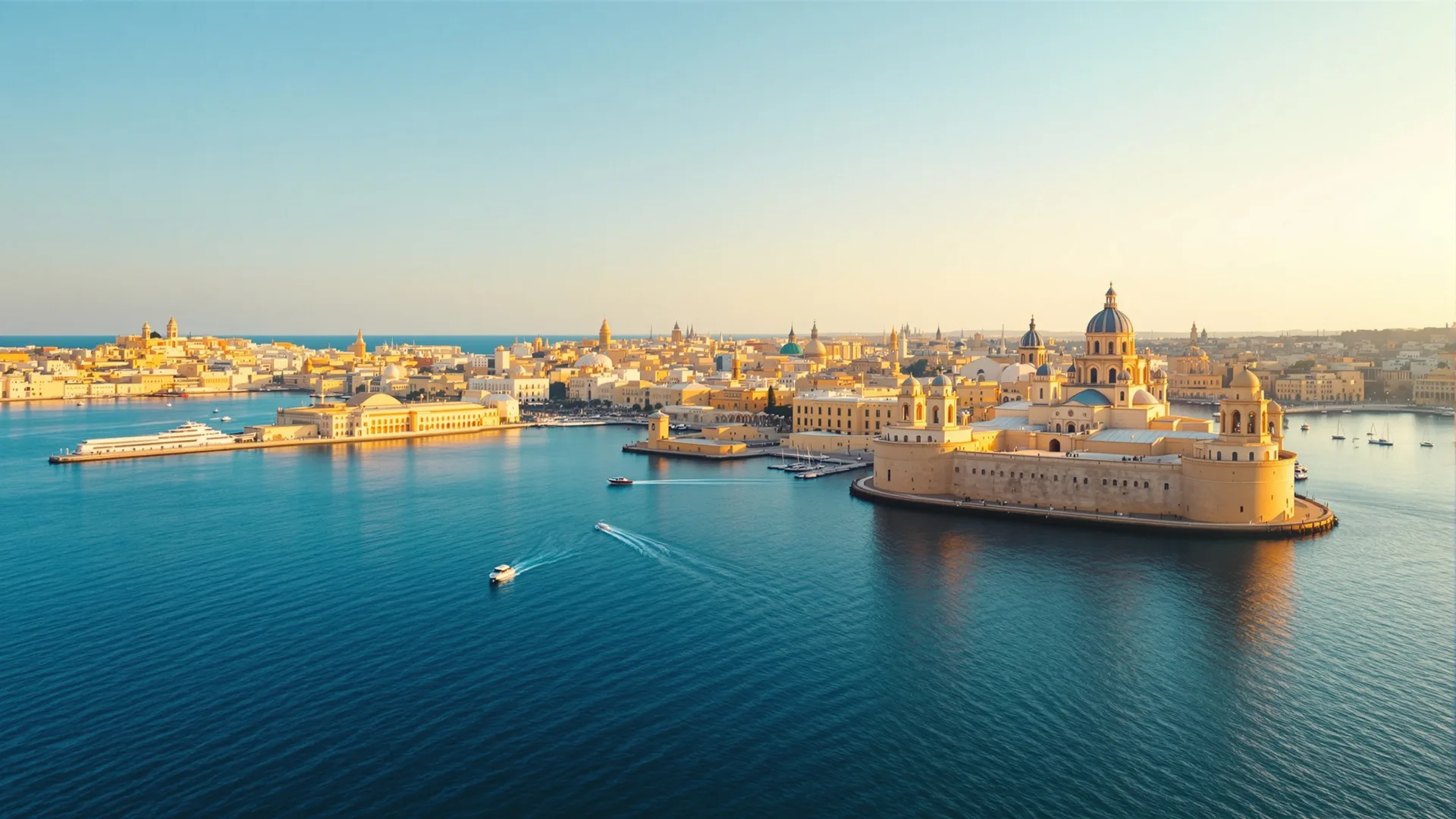
Malta
Malta charges no annual tax for owning a home. The OECD's revenue data record zero recurrent taxes on immovable property for Malta in 2021, 2022 and 2023, and the property tax that Maltese law does levy falls on the transfer.
Under article 32(1) of the Duty on Documents and Transfers Act, a transfer of immovable property carries duty of five euro for every hundred euro of the price or the value, whichever is higher, which means 5 percent. The Act contains reliefs, including reduced rates on part of the price for certain qualifying buyers of a residence, so the effective rate depends on your situation. But the structure is clear: pay once, then hold for free.
That makes Malta one of the few EU members where the holding cost of a home is essentially insurance, maintenance and utilities. For the wider tax picture, the Brief asked whether Malta is a tax haven, and the Malta country page covers residence routes.
Qatar
Qatar's General Tax Authority sets out the country's main taxes in its investors' guide: income tax on income generated in Qatar, withholding tax on certain payments to non-residents, capital gains tax, and excise tax on specified goods. An annual tax on owning property is not among them.
The GTA's tax information page adds a detail that matters to private owners: capital gains from the disposal of real estate by natural persons are exempt, provided the property is not part of a taxable business. The tax code is only half the question: whether and where a foreigner may buy is governed by separate property rules, which need checking before any purchase.
The traps: places that look like zero and are not
Seychelles: zero for citizens, not for you
The Seychelles is regularly listed as a country without property tax, and the OECD's revenue statistics show zero for 2023. Read the law and the picture changes.
According to the Seychelles Revenue Commission, the Immovable Property Tax Act 2019, "applicable to all non-Seychellois owning an immovable property", came into effect in January 2020. Non-Seychellois owners must register their property. For property used for residential purposes, the tax rate is 0.50 percent of the property's market value, payable every year by 31 December. Exemptions exist, among them commercial and industrial property and a residential property owned by someone married to a Seychellois, and a first-time non-Seychellois owner can apply for a one-year exemption.
In other words, a tax that does not exist for locals exists for foreign buyers, and it is charged on market value, not on some historic assessment. This is exactly the case that list-makers miss, and it is why a statistic is never a substitute for the statute.
Croatia: a local tax per square metre
Croatia is another country that older lists describe as property-tax free. The Croatian Tax Administration now lists a porez na nekretnine, a property tax payable by domestic and foreign owners, individuals and companies alike. The base is the usable floor area, and the amount is set by each town or municipality within a range of €0.60 to €8.00 per square metre a year, under the Local Taxes Act as last amended in Narodne novine 152/24.
For a 100-square-metre flat, that means somewhere between €60 and €800 a year depending on the municipality. Not ruinous, but not zero either. Check the local decision, not the national headline.
Switzerland: a famous reform, not a tax holiday
Switzerland comes up in this debate because of the imputed rental value on owner-occupied homes, which the Brief covered in its piece on the reform. The imputed rental value is a notional income taxed under income tax, not a property tax, and the OECD's 2023 figures still record recurrent taxes on immovable property in Switzerland at 0.18 percent of GDP. Swiss property owners are not in a holding-tax-free world. The debate over one income-tax line does not change that.
Transfer taxes: the bill at the door
If you choose a country with no annual property tax, the transfer tax becomes the main tax cost of owning there, and it can move quickly.
Greece is the clearest example this month. At the Thessaloniki International Fair on 5 September 2026, the Greek Prime Minister announced that the transfer tax for buyers from third countries outside the European Union would rise from 3 percent to 15 percent, according to the text of his speech published by his office. For British and American buyers, who are now third-country buyers, that would be a fivefold increase on the day of purchase. It is an announcement, not law: until a bill is published and passed, the details and the start date are open.
The Greek case illustrates a broader point. Holding taxes are politically hard to raise, because they hit every existing owner who votes. Transfer taxes on foreign buyers are politically easy, because the people who pay them do not vote. If you are buying abroad, the transfer tax is the tax most likely to change against you, and it is paid before you have the keys.
What "costs nothing to hold" really means
Even in Monaco, Malta or Qatar, a home is not free to own. The tax line is zero. The other lines are not:
- Service charges in apartment buildings, which can be substantial in premium developments.
- Insurance, which in coastal and island locations reflects storm and flood risk.
- Maintenance, which in salt air and strong sun is not optional.
- Utilities and connection charges, sometimes billed through the same municipal systems that levy property tax elsewhere.
- The cost of the capital itself, which is the largest holding cost of all when prices are high.
This is the argument the Brief made in A Second Home Is Not a Second Life: the purchase price is only the first cheque. A country with no annual property tax removes one line from the budget. It does not remove the budget.
How to check any country yourself
Before you rely on any list, including this one, ask four questions and answer them from the law or the tax authority, not from a blog:
- Is there an annual tax on owning residential property, at national or local level? Many countries leave it to municipalities, so the national tax authority's list may not show it.
- Does it apply to foreigners differently? The Seychelles shows that a country can be tax-free for citizens and not for you.
- What does it cost to buy and to sell? Transfer duty on the way in, and any tax on gains on the way out. The Brief's list of countries with no capital gains tax covers the second half of that question.
- Is anything announced? A published bill or a government announcement, like the Greek one, can change the arithmetic before you complete.
Answer those four and you will know whether a home really costs nothing to hold, or only looks that way on a list.
Work with Sebastian
If you are weighing a home abroad and want the holding costs, transfer duties and residence rules of your shortlist checked against your own situation, book a consultation.