Contents
- 1. Monaco: Country Overview
- 2. Putting Monaco on the Map
- 3. What Others Say About Monaco
- 4. Tax Benefits: What Monaco Has to Offer
- 5. Tax Rates at a Glance
- 6. Tax Residency: What Triggers It
- 7. Double Tax Treaties
- 8. Avoid Remaining Tax Resident at Home
- 9. Tax Considerations When Leaving Your Home Country
- 10. Company Setup & Corporate Tax
- 11. Who Should (and Shouldn't) Move to Monaco
- 12. Visas and Residence Permits
- 13. Path to Citizenship
- 14. Banking in Monaco
- 15. What Makes Monaco Genuinely Attractive
- 16. Cost of Living in Monaco
- 17. Buying Real Estate in Monaco
- 18. Retiring in Monaco
- 19. US Citizens: What You Need to Know
- 20. Correct Preparation
- 21. Automatic Exchange of Information (OECD CRS)
- 22. Further Relocation Formalities
- 23. How We Help With Your Move to Monaco
I.
Monaco: Country Overview
Monaco is a sovereign principality of 2.02 square kilometres — the second-smallest country in the world — on the French Riviera, bordered on three sides by France and on the south by the Mediterranean Sea. Population: approximately 39,000, of whom roughly 10,500 are Monégasque nationals. The remainder — 28,500 people of over 130 nationalities — are foreign residents who have chosen Monaco as their home. The country has been governed by the Grimaldi family since 1297, making it the world's oldest ruling dynasty. The current sovereign is Prince Albert II.
Monaco is not a member of the European Union, but it participates in the Schengen Area through a bilateral agreement with France. It uses the Euro, and its customs union with France means French VAT rates (20%) apply. English is widely spoken; French is the official language.
The foundational tax fact: Monaco levies no personal income tax on individual residents — except French nationals, who remain subject to French income tax under the Franco-Monégasque Convention of 1963, regardless of where they live within Monaco. For all other nationalities, personal income — from any source, of any amount — is completely exempt from Monégasque tax. This applies to: employment income, dividends, interest, capital gains, rental income, director's fees, pension income, and every other category of personal income. There are no controlled foreign corporation (CFC) rules — income received indirectly through offshore companies is not attributed to the Monaco-resident shareholder.
- ›Corporate tax: Companies that conduct commercial or industrial activities and derive more than 25% of their revenue from outside Monaco are subject to a 25% corporate income tax. Companies deriving 75% or more of their revenue from within Monaco pay no corporate income tax. This makes Monaco efficient for businesses primarily serving local or Monaco-domiciled clients; less so for globally-oriented businesses whose customers are outside the Principality.
- ›Inheritance tax: 0% between spouses and in direct parent-child relationships. For other relationships, 8–16% applies. No property tax on annual property ownership. No wealth tax. No local tax.
What to be aware of: Monaco is the most expensive real estate market in the world — average prices exceed €50,000 per square metre, with many properties well above that. The €500,000 minimum bank deposit required by most Monaco banks for residency is a genuine cost of entry. Physical presence is required to maintain Monaco tax residency — residents must spend a meaningful portion of their year in Monaco; the authorities scrutinise residency claims where home-country tax authorities challenge the Monaco position. French nationals cannot benefit from the zero income tax — the 1963 convention is not negotiable. And for US citizens, US worldwide taxation applies regardless of Monaco residency.
2026 qualification: Monaco is a 0% personal-income-tax jurisdiction for non-French residents with a residency permit and tax residency certificate, but French nationals remain subject to French tax under the 1963 treaty. Corporate tax is 25% for companies with more than 25% extraterritorial turnover or IP/copyright income; inheritance/gift tax up to 16% applies to Monaco-situate assets outside the direct line; CRS 2.0 reporting applies from 1 January 2026.
II.
Putting Monaco on the Map
Monaco — French Riviera; 2 km²; bordered by France; Mediterranean coast; Schengen Area
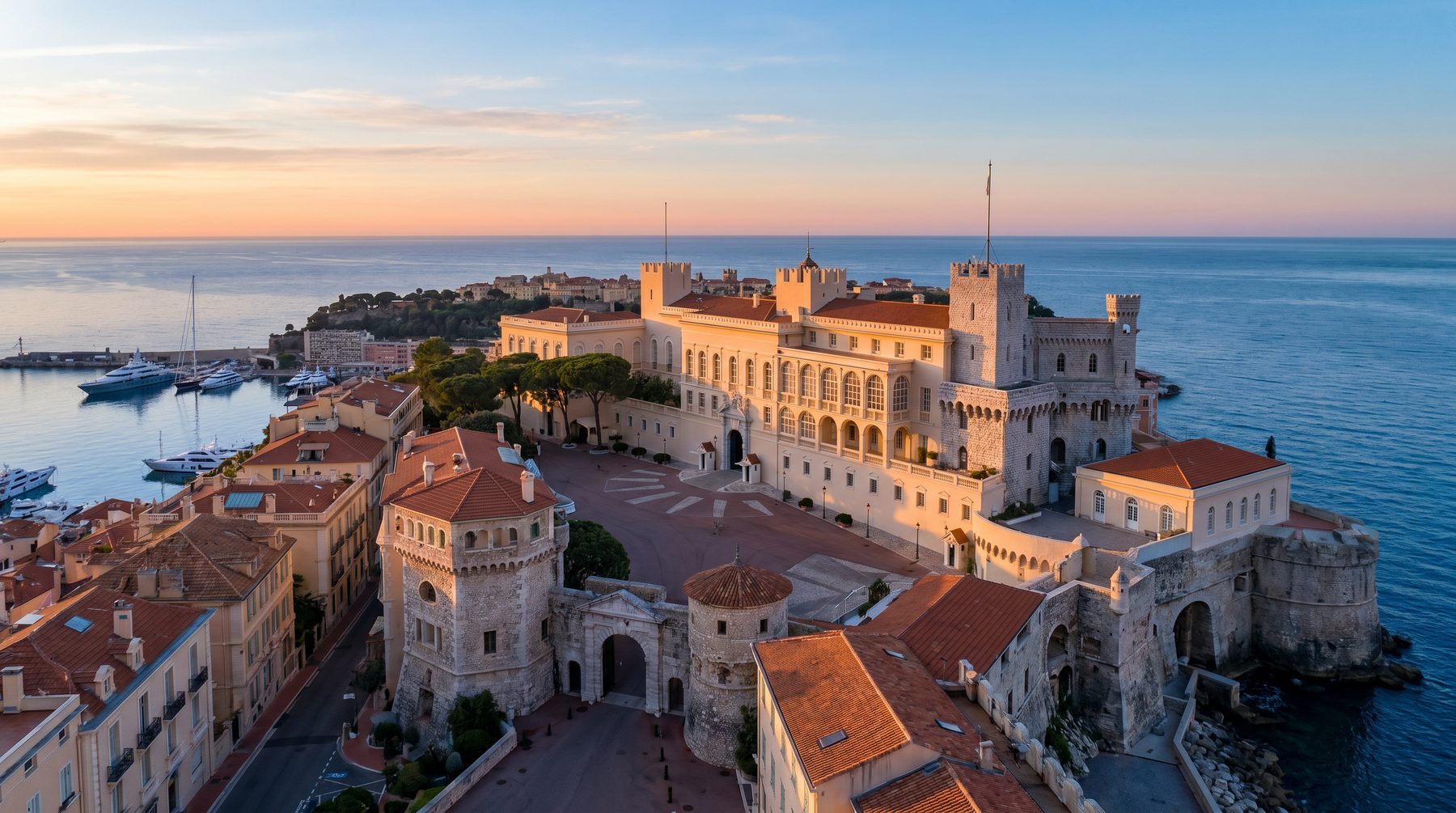
Monaco is a principality built on a cliff, which means that almost everything in it involves either an ascent or a descent. The Monaco-Ville — the old city, the original medieval settlement on the headland — sits at the top, with the Prince's Palace, the Cathédrale de Monaco (where the Grimaldis are buried, including Grace Kelly, interred as Princesse Grace), and a square from which the view extends over the harbour and the Mediterranean in one direction and over the Principality in the other. Below the cliff, the Port Hercule — the yacht harbour — is where the mega-yachts tie up during the Grand Prix and the Monaco Yacht Show and, to a lesser extent, throughout the rest of the year, because this is where people keep their yachts when they live in Monaco.
The Casino de Monte-Carlo is the most famous building in Monaco and arguably the most imitated building in the world: its Belle Époque facade, its gaming rooms, its association with Ian Fleming's Bond — all have been reproduced in Las Vegas and Macau and everywhere that gambling and luxury intersect in architecture. The casino itself is still a working casino, and on a Tuesday evening in October, when the Grand Prix crowds are gone and the summer tourists have dispersed, it retains a specific atmosphere that the reproductions cannot quite capture.
The Grand Prix de Monaco in May is when the Principality becomes something else entirely: the barriers go up, the grandstands are assembled against the buildings above the harbour, and for one weekend the streets that residents normally drive to collect groceries become the most famous circuit in Formula 1. Fairmont Hairpin, the slowest corner in F1 at the point where the road turns back on itself above the tunnel, is one of the most photographed sites in motorsport. The race is no longer the fastest or most technically challenging on the calendar, but it remains the most atmospheric, because the track is real streets and the drivers are passing within centimetres of the barriers and the city simultaneously.
Cap-d'Ail and Beausoleil in France are immediately adjacent to Monaco's borders — residents of these French towns are within walking distance of the Principality and can cross into Monaco in minutes. Nice is 20 kilometres east. Cannes is 50 kilometres west. Milan is 195 kilometres northeast. The location on the French Riviera is genuinely central to the European wealthy lifestyle circuit.
III.
What Others Say About Monaco
"Monaco is not a country. It is a yacht that has run aground and been very successfully converted into real estate."
— P.J. O'Rourke, Holidays in Hell, 1988
"The Principality of Monaco is a sunny place for shady people."
— W. Somerset Maugham, attributed, circa 1920s (Maugham lived at the Villa Mauresque in nearby Cap Ferrat)
"I understand why people live in Monaco. The tax is zero, the weather is reliably warm, and every view is of the sea. The inconvenience is that you have to live in Monaco."
— A.A. Gill, restaurant critic and travel writer, Sunday Times, 2015

IV.
Tax Benefits: What Monaco Has to Offer
Monaco's tax architecture has been the model for European 0% PIT jurisdictions since 1869 — Prince Charles III abolished income tax after Casino de Monte Carlo revenue made it unnecessary. Non-French residents (with the carte de séjour + tax residency certificate) pay 0% on personal income, capital gains, dividends, interest, wealth, and annual property tax. Inheritance and gift tax is territorial — applying only to Monaco-situate assets — at 0% in direct line, scaling up to 16% for unrelated heirs. Corporate income tax (ISB) is 25% (reduced from 33.33% in 2022) but applies only to companies generating more than 25% of turnover outside Monaco. Critical caveats: French nationals are subject to French tax law under the 1963 bilateral treaty; Monaco has only 10 active DTAs (one of Europe's narrowest networks), which can increase tax leakage on foreign-source income; CRS 2.0 reporting protocol is in force from 1 January 2026 covering digital currencies. Monaco has NO Golden Visa programme — residency requires substantive financial means and (for non-EEA) a French long-stay visa.
- ›0% personal income tax for non-French residents — since 1869, applies to salaries, dividends, interest, capital gains, structured products, cryptocurrency gains. NOTE: French nationals resident in Monaco remain subject to French tax law on worldwide income under the 1963 Franco-Monégasque convention (with narrow exemptions for those resident pre-October 1957).
- ›0% wealth tax, 0% annual property tax, 0% housing tax — Monaco does not levy any annual taxes on wealth or real estate ownership. Real estate transfer fees apply on purchase: 2.5% for new builds, 6.25% for resales, 11.5% for purchases via offshore/foreign entities.
- ›Inheritance and gift tax — territorial only, 0% in direct line — Monaco taxes only assets situated in Monaco (regardless of decedent/donor's domicile). 0% spouse and direct descendants/ascendants; 8% siblings; 13% uncles/aunts/nephews/nieces; 16% other relatives and unrelated. Worldwide assets held outside Monaco fall outside the Monaco inheritance tax net.
- ›Choice of inheritance law (Law No. 1.448, June 2017) — Monaco residents may choose the applicable inheritance law for their will, providing flexibility for international residents to adapt estate planning to specific needs.
- ›Corporate income tax (ISB) only on >25% extraterritorial revenue / IP-derived income — 25% rate (reduced from 33.33% in 2022) applies to industrial/commercial companies generating more than 25% of turnover from outside Monaco, and to companies receiving patent/literary/artistic copyright income. Local-only companies are tax-exempt. New companies benefit from a graduated relief scheme: 0% in years 1–2, scaling to 100% by year 6.
- ›0% withholding tax on dividends, interest, royalties to non-residents — clean repatriation of profits from Monaco-resident companies.
- ›Pillar Two QDMTT NOT implemented — Monaco has not enacted GloBE rules as of 2026; standard 25% (or 0%) corporate tax preserved for all companies.
- ›Narrow DTA network — only 10 active treaties — France (1963), Guernsey, Liechtenstein, Luxembourg, Mali, Malta, Mauritius, Qatar, Saint Kitts and Nevis, Seychelles. UAE and Montenegro signed but not yet in force. 35+ TIEAs (information exchange only) including US, UK, Germany, Italy, Australia. The narrow treaty network can paradoxically increase tax leakage on foreign-source dividends/interest (e.g. 30%–35% US dividend WHT for Monaco residents vs reduced rates for residents of treaty countries).
- ›CRS 2.0 in force from 1 January 2026 — Monaco signed updated protocol with EU October 2025; extends automatic exchange to digital currencies and electronic money products; reinforces financial institution due diligence. Monaco is NOT on OECD or EU tax-haven blacklists.
- ›Residency requires substantive financial means; NO Golden Visa — carte de séjour + 183+ days/year + bank deposit (typically ~€500K) + property (purchase or rental) + clean criminal record. Non-EEA nationals must first obtain a French long-stay visa. Tax residency certificate issued ~1 year after arrival, subject to demonstrating economic and personal ties to Monaco.
V.
Tax Rates at a Glance
| Tax | Rate (2026) | Notes |
|---|---|---|
| Personal Income Tax (non-French residents) | 0% | Since 1869 |
| Personal Income Tax (French nationals) | French tax law applies | 1963 bilateral treaty |
| Capital Gains Tax | 0% | Securities, real estate (residents); separate transfer fees on real estate |
| Wealth Tax | 0% | None |
| Annual Property Tax | 0% | None |
| Annual Housing Tax | 0% | None |
| Inheritance Tax — direct line | 0% | Spouse, parents, children |
| Inheritance Tax — siblings | 8% | |
| Inheritance Tax — uncles/aunts/nephews/nieces | 13% | |
| Inheritance Tax — other / unrelated | 16% | |
| Inheritance Tax scope | Monaco-situate assets only | Territorial |
| Choice of inheritance law (Law 1.448) | Available | Will may select applicable law |
| Corporate Income Tax (ISB) | 25% | Reduced from 33.33% as of 1 Jan 2022 |
| Corporate Income Tax — local-only companies | Exempt | If turnover within Monaco only |
| Corporate Income Tax — IP/copyright income | 25% | Regardless of source |
| Corporate Income Tax — graduated new-company relief | 0%/0%/25%/50%/75%/100% | Years 1, 2, 3, 4, 5, 6+ |
| Withholding Tax — dividends, interest, royalties | 0% | To non-residents |
| Pillar Two QDMTT | Not implemented | As of 2026 |
| VAT — standard | 20% | French VAT system via 1963 customs union |
| VAT — intermediate | 10% | |
| VAT — reduced | 5.5% | Food, books |
| VAT — super-reduced | 2.1% | Medicines, certain print |
| Real estate transfer — new build | 2.5% | 1.5% notary + 1% registration |
| Real estate transfer — resale (individuals/Monaco companies) | 6.25% | 1.5% notary + 4.75% registration |
| Real estate transfer — via foreign companies | 11.5% | 10% + 1.5% notary |
| Leasehold tax | 1% of total rent | Plus service charges |
| Real estate VAT — first sale of new build (within 5 years) | 20% | Real estate value-added tax |
| Tax residency | Carte de séjour + 183+ days + most days in Monaco | Tax residency certificate ~1 year after arrival |
| CRS 2.0 protocol | In force 1 Jan 2026 | Includes digital currencies |
| Currency | EUR | Eurozone-pegged via 2002 monetary agreement |
| DTAs (in force) | 10 | FR, GG, LI, LU, ML, MT, MU, QA, KN, SC |
| DTAs (signed, awaiting implementation) | 2 | UAE, Montenegro |
| TIEAs | 35+ | Information exchange only — including US, UK, DE, IT, AU |
VI.
Tax Residency: What Triggers It
Monaco residency consists of two components that must both be satisfied: administrative residency (the carte de séjour) and tax residency (the certificat à des fins de formalités fiscales).
- ›Administrative residency (carte de séjour): Requires: Monaco accommodation (owned or rented under a minimum 1-year lease, appropriate size for family); financial sufficiency demonstrated by bank reference letter (minimum €500,000 deposit at a Monaco bank); clean criminal record; for non-EU nationals, a French long-stay visa obtained before arrival. The carte de séjour is initially issued for 1 year, extended to 3 years, then 10 years, as the resident demonstrates genuine connection to Monaco.
- ›Tax residency certificate: Issued by the Monégasque tax authority approximately 12 months after establishing administrative residency, once the resident has demonstrated genuine physical presence in Monaco. This is the document that certifies you as a Monaco tax resident for the purposes of presenting to your home country's tax authority.
- ›Genuine physical presence is required. Monaco does not enforce a rigid 183-day rule, but it does expect residents to spend a meaningful portion of their time in Monaco — typically more months in Monaco than in any other single jurisdiction. Home-country tax authorities (particularly Germany, France, and increasingly the UK) actively scrutinise Monaco residency claims. Evidence of genuine Monaco life — Monaco property, Monaco children's school, Monaco social life, Monaco bank accounts, Monaco doctor — all strengthen the tax residency claim.
Key point: Having a Monaco apartment and a Monaco bank account does not make you a Monaco tax resident. You must spend genuine time in Monaco, demonstrate that Monaco is your primary home, and obtain the tax residency certificate before your home country will accept your Monaco non-residency. The Principality is aware of this and scrutinises arrangements where applicants appear to be using Monaco as a tax address while primarily living elsewhere.
VII.
Double Tax Treaties
Monaco has a deliberately limited DTA network — agreements with France, Luxembourg, Portugal, Seychelles, and a small number of others. There are no Monaco DTAs with Germany, the UK, Switzerland, the United States, Australia, Canada, or most major source-country economies.
- ›The Monaco-France Convention (1963) is the most important bilateral instrument, and not for a reason that benefits most Monaco residents: it subjects French nationals resident in Monaco to French income tax. This is not a standard DTA — it is a specific bilateral arrangement that eliminates Monaco's primary tax benefit for one entire nationality.
- ›The absence of DTAs with major economies is the defining feature of Monaco's treaty position. A German national in Monaco receives German dividends subject to full German domestic withholding at 26.375% — the Germany-Monaco DTA does not exist to reduce this. A British national in Monaco receives UK dividends subject to full UK domestic withholding — no UK-Monaco DTA applies.
This matters less than it might appear, because Monaco's zero income tax means income arrives in Monaco already subject to source-country withholding and is then received tax-free. The total effective tax burden is the source-country withholding rate alone — not source-country rate plus Monaco income tax, because Monaco levies none. For a German national with €1M in German dividends, the effective combined burden is 26.375% German withholding — far less than the 26.375% German withholding plus German progressive income tax that would apply if they remained in Germany.
2026 treaty update: Monaco has only 10 full DTAs in force — France, Guernsey, Liechtenstein, Luxembourg, Mali, Malta, Mauritius, Qatar, Saint Kitts and Nevis, and Seychelles. UAE and Montenegro are signed but not yet in force. Monaco has 35+ TIEAs, but these provide information exchange only, not treaty-rate relief.

VIII.
Avoid Remaining Tax Resident at Home
Monaco's zero income tax is only available to those who have genuinely made Monaco their primary home. The Principality does not enforce a rigid 183-day rule, but it expects residents to spend a meaningful portion of the year in Monaco and to demonstrate that Monaco is genuinely where their life is based. Home-country tax authorities — particularly Germany, Austria, and the UK — are sophisticated about Monaco residency claims and will challenge those not supported by evidence of genuine Monaco life.
For German nationals, the §6 AStG exit tax on shareholdings of 1% or more is the primary departure cost. There is no Germany-Monaco DTA — the German tax authority applies its full domestic non-residency criteria, including examining days spent in Germany, German property available for personal use, family and economic ties to Germany, and German-managed business interests. For British nationals, the SRT exit date must be precisely established. There is no UK-Monaco DTA — UK domestic rules determine non-residency entirely, without treaty support. For Swiss nationals, Swiss domestic departure provisions apply. There is no Switzerland-Monaco DTA — Swiss withholding on Swiss-source income paid to Monaco residents applies at full domestic rates.
IX.
Tax Considerations When Leaving Your Home Country
Before you relocate, you need to understand what tax consequences arise in your current country of residence at the point of departure. These rules vary significantly by country and must be assessed individually — there is no universal answer.
Many countries impose an exit tax or deemed disposal charge when a tax resident leaves. This typically applies to unrealised capital gains on shares, business interests, real estate, or other assets — taxing you as if you had sold everything on the day you departed. The rules differ widely: some countries apply this to all assets above a threshold, others only to substantial shareholdings or business interests. Some have look-back periods that can catch you even after you have left.
The timing of your departure, the structure of your assets, and the sequence of any business disposals all have material consequences. In some cases, restructuring assets before departure — or deferring the move by a few months — can make a significant difference to the tax outcome.
- ›Germany. The §6 AStG exit tax on shareholdings of 1% or more is triggered at the moment of departure from German tax residency. There is no Germany-Monaco DTA — German-source income paid to Monaco residents, including German dividends and German interest, is subject to full German domestic withholding without treaty reduction. This is a significant cost that must be factored into the overall Monaco planning calculation.
- ›United Kingdom. SRT exit date. CGT on departure. No UK-Monaco DTA. UK-source income flowing to Monaco residents — dividends, interest, pension income — is subject to full UK domestic withholding rates without treaty reduction. The five-year temporary non-residence rules mean that gains crystallised on UK-sited assets during a period of Monaco residence of fewer than five years can be clawed back into UK CGT on return.
- ›Switzerland. Swiss domestic departure provisions apply. No Switzerland-Monaco DTA. Swiss-source income paid to Monaco residents is subject to Swiss domestic withholding at full rates — 35% on dividends and interest — without treaty reduction.
- ›France. French nationals cannot benefit from Monaco's zero income tax regardless of genuine Monaco residence — the 1963 Franco-Monégasque Convention subjects French nationals to French income tax in Monaco. This is the single most important caveat for the Monaco planning profile and it is non-negotiable.
- ›United States. US worldwide taxation applies regardless of Monaco residency. Monaco's zero personal income tax means there is no Monaco tax to credit against the US liability on foreign income that Monaco does not tax. US citizens in Monaco receive Foreign Tax Credit relief only on Monaco-source income that Monaco actually taxes — which, for personal income, is nothing.
⚠ Obtain Local Tax Advice in Your Home Country The information above provides a general overview of the departure tax rules that commonly apply when leaving high-tax jurisdictions. It is not legal or tax advice. The rules in your specific home country — Germany, Austria, Switzerland, the UK, the US, or any other jurisdiction — are complex, change frequently, and depend entirely on your personal circumstances: your nationality, the nature and location of your assets, your business structure, your family situation, and the timing of your departure. Before you take any steps to relocate, obtain written advice from a qualified tax adviser who is licensed in your home country and experienced in international relocations. A consultation with us is a good starting point — but it does not substitute for country-specific legal advice from a practitioner in your jurisdiction of departure. The cost of getting this wrong is almost always greater than the cost of getting proper advice upfront.
X.
Company Setup & Corporate Tax
Monaco's corporate tax structure is designed to favour businesses primarily serving Monaco's local market. A Monaco company deriving 75% or more of its revenue from within Monaco pays zero corporate income tax. A company deriving more than 25% of revenue from outside Monaco pays 25% corporate income tax on worldwide profits.
This makes Monaco efficient as a corporate structure for: local professional services (lawyers, accountants, wealth managers serving Monaco resident clients); companies where the Monaco resident owner provides services personally (consulting, investment management for Monaco resident clients); and companies whose clients are the Monaco resident base.
For businesses with global clients, Monaco corporate structures are typically less efficient than alternatives — a holding company in a lower-tax jurisdiction (Liechtenstein, Switzerland, Malta) may be more appropriate alongside Monaco personal residency.
Is a local company always the right answer? Not necessarily.
For Monaco residents with global businesses or investment portfolios, maintaining income at the personal level (through foreign company dividends or personal service income) and receiving it in Monaco as personal income — tax-free — is often simpler and more efficient than structuring through a Monaco corporate entity.
- ›Liechtenstein company: 12.5% corporate rate, zero withholding on dividends — efficient holding structure for Monaco-resident shareholders
- ›UAE company: 0% on qualifying income. UAE operating company + Monaco personal residency = very efficient combined structure
- ›Malta company: ~5% effective rate through refund system. For globally trading businesses
Learn more about our company setup services →
Permanent establishment risk: A foreign company is not a magical solution. If the company is effectively managed from your country of residence, or if staff, sales activity, or day-to-day control are located there, local tax authorities may still tax the profits locally. Structure follows substance. Genuine management, banking, contracts, and operational substance in the foreign jurisdiction are essential.
2026 corporate update: Monaco’s ISB corporate tax rate is 25% for industrial/commercial companies with more than 25% extraterritorial turnover and IP/copyright-income companies. Local-only companies are exempt; new-company relief starts at 0% for years 1–2 and scales to full taxation by year 6. Monaco has no Pillar Two QDMTT as of 2026 and levies 0% withholding tax on outbound dividends, interest, and royalties.
XI.
Who Should (and Shouldn't) Move to Monaco
Section 11 is where the relocation decision becomes practical. Monaco can be an excellent fit for some profiles and a poor fit for others; the decisive question is whether the tax rules, lifestyle, residence requirements, banking, healthcare, and family situation point in the same direction.
Good Fit
- › International entrepreneurs and investors whose income structure actually benefits from Monaco’s tax and residence rules.
- › Remote professionals and business owners who can move their centre of life genuinely, not merely change an address on paper.
- › Families or individuals who value Monaco’s lifestyle, geography, safety profile, and cost structure as part of the overall decision.
- › People willing to handle local banking, residency, healthcare, and administration properly rather than improvising after arrival.
- › Those who understand that relocation is a full tax-residency project, not a holiday with a lower tax rate.
Poor Fit
- × Those who cannot genuinely spend enough time in Monaco to support a defensible tax-residence position.
- × People who need a zero-friction, Western-European administrative environment from day one.
- × US citizens who expect the move to eliminate US tax filing, FBAR, FATCA, or citizenship-based taxation.
- × Those with income, companies, or family ties that keep them clearly taxable in their previous Monaco.
- × Anyone choosing the jurisdiction only because it sounds attractive online, without testing housing, banking, healthcare, and lifestyle fit.

XII.
Visas and Residence Permits
- ›EU/EEA nationals: Can apply directly for Monaco residency. No French visa required. Application to the Monaco Direction de la Sûreté Publique (DSP). Requirements: Monaco accommodation; financial sufficiency (Monaco bank reference letter, minimum €500,000 deposit); clean criminal record.
- ›Non-EU nationals: Must first obtain a French long-stay visa (Type D) from the French consulate/embassy in their country of origin — Monaco does not issue its own visas. The French long-stay visa for Monaco is a specific category, distinct from general French visas. After obtaining the French long-stay visa, apply to the Monaco DSP for the residence permit (carte de séjour).
- ›Timeline: French visa approval: typically 2–4 months from application. Monaco residency permit: typically 4–6 weeks after arrival with French visa. Total timeline for non-EU nationals: 3–6 months from initiating the process.
- ›Carte de séjour stages: 1-year temporary residence card → 3-year renewable card (after 3 years of residence) → 10-year renewable card (after further qualifying residence). Permanent residency (with indefinite card) available after approximately 9 years.
2026 residence update: Monaco has no Golden Visa or Residency by Investment programme. Residence requires a carte de séjour, accommodation in Monaco, a clean criminal record, financial means often evidenced by around €500,000 in a Monegasque bank, and for non-EEA nationals a French long-stay visa first.
XIII.
Path to Citizenship
Monégasque citizenship is among the most difficult in the world to obtain and is outside the realistic scope of most internationally mobile individuals. Naturalisation requires 10 years of permanent residency status and is subject to approval by the Prince. The Monégasque nationality is held by approximately 10,500 people — less than 30% of the Principality's population. The Monaco passport provides Schengen travel access but is not an EU passport.
XIV.
Banking in Monaco
Monaco has a sophisticated private banking sector precisely calibrated to HNW individuals: BNP Paribas Monaco, HSBC Private Bank Monaco, Credit Suisse Monaco (now UBS), Société Générale Monaco, Julius Baer Monaco, Edmond de Rothschild Monaco, and several others. The minimum deposit requirement of €500,000 at a Monaco bank is a condition of the residency application process — this is a bank requirement, not a Monaco government requirement, but it is universal in practice.
For a relocation to Monaco, the local account is normally the operational account: rent, utilities, cards, domestic transfers, local tax or residence registrations, and evidence that the move is real. It should not automatically become the main wealth-management account unless the local banking system offers the depth, multi-currency capability, private-banking service level, and long-term stability required for the client's assets.
Account opening in Monaco should be treated as a compliance exercise, not as an administrative formality. Expect passport checks, proof of address, residence or visa documentation where applicable, tax-identification details, source-of-funds evidence, and sometimes in-person attendance or a local phone number. The easiest applications are those where the residence story, income source, and banking purpose are consistent before the first form is submitted.
Where to hold your main accounts
Monaco's own private banking sector is genuinely excellent and provides the bank reference letter necessary for residency. Many Monaco residents maintain their primary wealth management within Monaco for the convenience and credibility it provides. For additional diversification:
- ›Switzerland — Zurich and Geneva private banks for additional depth; Swiss-law asset protection; different regulatory jurisdiction from France
- ›Liechtenstein — LGT and other Liechtenstein private banks; additional privacy and asset protection layer
- ›Singapore — Asia-Pacific exposure for clients with significant Asian investment or business
Learn more about our offshore banking services →
Important: not all banks are compatible with all residencies. Some Swiss and Singaporean private banks have restrictions on clients resident in certain jurisdictions, and compliance requirements vary. Residency status, income profile, source of wealth, and business type all affect which institutions will accept you and on what terms. We help clients navigate this before they commit to any banking structure.
XV.
What Makes Monaco Genuinely Attractive
- ›The zero income tax. At high income levels, the financial mathematics of Monaco become compelling in a way that has no equal in Europe. A person with €5 million in annual income — dividends, distributions, carried interest — pays zero Monaco personal income tax on all of it. The same person in Germany would pay approximately €2.2 million; in the UK approximately €2.25 million; in France approximately €2.25 million. The annual saving is €2+ million. Over 10 years, compounded, the difference is transformative.
- ›The safety. Monaco has one of the lowest crime rates in the world. The country is covered by CCTV cameras at high density; the police presence is substantial; the community is small enough that residents know one another. For ultra-HNW individuals who have concerns about personal security, Monaco offers a level of protection that no other urban lifestyle environment provides at comparable cost.
- ›The Formula 1 race. This is a genuine lifestyle point, not incidental. Many of Monaco's residents are there specifically because of their connection to motorsport — drivers, team principals, sponsors, and the broader ecosystem of people for whom the Monaco lifestyle and the F1 calendar are aligned.
- ›The Mediterranean. 300 days of sunshine per year. Warm sea from May to October. The landscape of the Riviera behind the coast. The proximity to Nice, Cannes, Antibes, and the Ligurian coast of Italy. Monaco's geographic environment is genuinely extraordinary.
XVI.
Cost of Living in Monaco
Monaco is one of the most expensive places in the world to live. The budget is not driven by groceries or restaurants but by qualifying accommodation and the wealth level required to make residence practical.
Typical monthly costs for an internationally mobile professional or family in Monaco (2026 planning ranges):
| Category | EUR/month | GBP/month | USD/month |
|---|---|---|---|
| 1-bed apartment, desirable area | €4,650–9,300 | £3,950–7,900 | $5,050–10,100 |
| 2-bed apartment / small house | €8,750–17,500 | £7,450–14,800 | $9,500–19,000 |
| International school (annual per child) | €14,150–43,700 | £12,000–37,050 | $15,400–47,500 |
| Private health insurance (annual individual) | €2,750–9,100 | £2,350–7,700 | $3,000–9,900 |
| Restaurant meal, mid-range (per person) | €50–100 | £50–50 | $50–100 |
| Monthly groceries, single person | €2,000–4,450 | £1,700–3,800 | $2,150–4,850 |
| Utilities and internet, apartment | €900–2,450 | £750–2,050 | $950–2,650 |
- ›Comfortable single professional (no children): €11,050–20,250/month (£9,350–17,150 / $12,000–22,000)
- ›Family of four with private schooling: €25,750–46,000/month (£21,850–39,000 / $28,000–50,000)
These figures are planning ranges, not promises. The actual budget in Monaco depends heavily on housing quality, neighbourhood, school choice, healthcare needs, car ownership, travel frequency, and whether you are trying to live like a local or maintain a Western expatriate standard.
XVII.
Buying Real Estate in Monaco
Buying real estate in Monaco can be useful for lifestyle, residence planning, and long-term anchoring, but it should not be treated as a simple shortcut to tax residence. Property is a factual tie; it can support a relocation story when used properly, but it can also create tax, inheritance, financing, and exit issues if bought before the wider plan is clear.
For internationally mobile buyers, the main points in Monaco are:
- ›Ownership rules: Foreigners can buy property freely, but prices are among the highest in the world and supply is extremely limited.
- ›Transaction costs: Transaction costs, notary fees, agency fees, service charges, and financing costs are material even for wealthy buyers.
- ›Market and rental profile: Property is central to residence because applicants need suitable accommodation, either owned or rented.
- ›Residence and tax angle: The market is prestigious and resilient but not risk-free; buyers should focus on residence suitability, building quality, succession planning, and liquidity at the very top end.
The practical approach is to decide first whether the property is primarily for living, residence support, rental yield, asset protection, or lifestyle. Those are different purchases. A good real estate decision in Monaco begins with title due diligence, tax-residence planning, inheritance review, and a realistic exit strategy — not with glossy developer brochures.
Transaction cost table (Monaco):
| Cost item | Typical amount | Notes |
|---|---|---|
| Registration duty | 4.5–6% | Approximate range |
| Notary fees | 1–1.5% | Approximate |
| Agency commission | 3–5% | Market convention |
| Typical total buyer costs | 8–12% | Before financing and structuring costs |

XVIII.
Retiring in Monaco
Retiring in Monaco can make sense for the right profile, but it should not be reduced to a simple tax headline. The real question is whether the country gives you the right combination of residence security, pension treatment, healthcare access, cost of living, climate, and day-to-day comfort. A retirement move is harder to reverse than a business relocation, so practical quality of life matters as much as tax.
For retirees considering Monaco, the main points are:
- ›Residence route: The practical route is usually the residence requires accommodation, financial resources, bank onboarding, and genuine presence. This should be confirmed before making property commitments or moving assets, because a pleasant destination is not useful if the residence basis is weak.
- ›Pension income: Monaco generally has no personal income tax for most residents, but french citizens and source-country pension rules require special care. The decisive point is often not only local tax, but whether the pension-paying country continues to tax the pension at source.
- ›Healthcare: Excellent private and public healthcare access, with france nearby for specialist care. Retirees should arrange private insurance or a clear local healthcare pathway before arrival, especially where pre-existing conditions are involved.
- ›Cost of living and lifestyle: Luxury, safety, mediterranean setting, and strong wealth-management infrastructure. The country can work well where the retiree’s lifestyle expectations match the local rhythm rather than an imagined expatriate brochure.
- ›Climate and practical fit: Mild mediterranean climate, but very high cost and limited space. Climate, language, bureaucracy, transport, and access to family often decide whether the move remains attractive after the first year.
Monaco should therefore be assessed as a full retirement platform, not merely as a tax jurisdiction. The best candidates are retirees who have stable foreign income, good health coverage, a realistic view of local bureaucracy, and a clear plan for where they will live, how they will receive care, and how their pension will be taxed both locally and at source.
XIX.
US Citizens: What You Need to Know
US citizens and long-term green card holders are taxed by the United States on their worldwide income, regardless of where they live. Relocating to Monaco does not end US tax obligations — it changes the picture, but does not eliminate it.
Key considerations for US citizens in Monaco:
- ›Foreign Earned Income Exclusion (FEIE): US citizens who qualify as bona fide residents of Monaco or pass the physical presence test can exclude a significant amount of foreign earned income from US federal income tax. This applies to wages and self-employment income — not passive income such as dividends, interest, capital gains, pensions, or rental income.
- ›Foreign Tax Credit: Income tax paid in Monaco can generally be credited against US tax on the same income, reducing or eliminating double taxation. The credit is particularly important for income not covered by the FEIE and for taxpayers whose income exceeds the annual FEIE threshold.
- ›Treaty position: Treaty relief between the United States and Monaco is limited or fact-dependent. Before relying on any treaty position, US citizens should confirm the current treaty status and the exact income category with a qualified US international tax adviser. A treaty does not automatically remove US filing obligations, and most treaties contain savings-clause rules that preserve US taxation of citizens.
- ›FBAR: US persons with bank accounts in Monaco exceeding $10,000 in aggregate must file FinCEN Form 114 (FBAR) annually. Failure to file can carry severe penalties, even when no tax is due.
- ›FATCA: US citizens may also need to report foreign financial assets on Form 8938. Banks in Monaco may separately identify US account holders under FATCA procedures and report account information through the relevant channels.
- ›Social Security and self-employment tax: The FEIE reduces income tax but does not automatically eliminate US self-employment tax. Whether US Social Security tax applies depends on employment status, entity structure, and any applicable totalization agreement.
US citizens considering Monaco should work with a qualified US international tax adviser alongside local counsel. The interaction between US tax law and Monaco tax law is manageable, but it requires careful planning before the move, not after the first filing deadline arrives.
XX.
Correct Preparation
- ›The residency application process. Non-EU nationals begin with the French long-stay visa — obtain this before taking any other action. Without the French visa, you cannot enter Monaco for the purpose of establishing residence. The French consulate/embassy in your home country handles Monaco-specific French visa applications. Allow 2–4 months for this step.
- ›The bank relationship. Open a Monaco bank account and deposit a minimum of €500,000 — this provides the bank reference letter required for the residency application. This process takes 1–3 months, as Monaco banks conduct thorough due diligence on new clients. Begin the bank relationship early and in parallel with the visa process.
- ›The home-country exit. Home-country departure tax analysis is essential before committing to Monaco. The exit tax on departure from Germany (§6 AStG), the UK SRT exit date, the Swiss departure provisions — all must be planned precisely. The Monaco residency start date and the home-country non-residency date must be coordinated.
What is the recommended order of steps?
- 1.Engage a Monaco-qualified lawyer and a home-country tax adviser simultaneously — both are required from the outset.
- 2.Home-country departure tax analysis — exit taxes, departure date, and the interaction with your Monaco arrival date.
- 3.Identify Monaco accommodation — lease a Monaco apartment for a minimum of 1 year (purchase is not required for initial residency, though it strengthens the claim).
- 4.Apply to open a Monaco bank account — begin due diligence process immediately; allow 1–3 months.
- 5.Non-EU nationals: apply for French long-stay visa for Monaco at French consulate in home country.
- 6.Deposit minimum €500,000 at Monaco bank and obtain bank reference letter.
- 7.Submit Monaco residency application to the Direction de la Sûreté Publique.
- 8.Take up genuine residence in Monaco — spend meaningful time there, enrol children in Monaco schools if applicable, establish Monaco social and medical life.
- 9.After approximately 12 months, apply for Monaco tax residency certificate.
- 10.Present Monaco tax residency certificate to home-country tax authority as formal notification of departure.
XXI.
Automatic Exchange of Information (OECD CRS)
Monaco participates in the OECD Common Reporting Standard (CRS), the global framework for automatic exchange of financial account information between tax authorities. Monaco has been exchanging information with partner jurisdictions since 2018.
In practical terms, this means: if you hold bank accounts or financial assets in Monaco, the financial institution in Monaco will report your account details — balance, income, and identifying information — to the local tax authority, which will then automatically share this information with the tax authority of your country of tax residence.
The key point is that CRS follows tax residence, not nationality or citizenship. For example, a Swedish citizen who has genuinely become tax resident in Monaco is treated, for CRS purposes, as a tax resident of Monaco — not as a Swedish reportable person merely because of the passport. The same principle applies to any non-US nationality: the account should be reported to the country of tax residence, not automatically to the country of citizenship.
CRS does not create a tax liability — it creates transparency. If you are properly tax resident in Monaco and have correctly severed residency in your home country, CRS reporting simply confirms what should already be declared. The risk arises when individuals attempt to maintain dual residency, leave old tax-residence indicators unresolved, or claim Monaco residency without genuinely living there.
US citizens are different. The United States does not participate in CRS in the same way. Americans are affected by FATCA instead: banks outside the United States generally identify US persons and report their account information through FATCA channels to the US authorities, regardless of whether the person is tax resident in Monaco or anywhere else.
Key point: CRS is not a problem for those who have relocated correctly. It is a problem for those who have not. Proper tax residency planning — with genuine physical presence and documented ties to Monaco — is the only sustainable approach. CRS follows tax residence, not citizenship; FATCA follows US-person status.
XXII.
Further Relocation Formalities
Upon establishing residence in Monaco, you will need to obtain a Monaco tax or administrative registration where required from the competent local authority. This is required for most financial and legal transactions in Monaco, including opening bank accounts, signing contracts, registering with tax authorities, and dealing with public offices.
You will also need to obtain or complete the relevant carte de résident process once your residence status has been approved. This document or registration record becomes your practical proof of residence in Monaco and is usually required for banking, telecom contracts, utilities, leases, property transactions, and day-to-day administrative matters.
- ›Driving licences from most countries are accepted only for a limited period after arrival. Once you become resident in Monaco, you should verify whether your licence can be exchanged directly or whether a local medical certificate, translation, theory test, or practical test is required.
- ›Health insurance should be arranged before arrival unless you are immediately covered by a local public system. In many cases, private international cover is the safest bridge solution while residence, employment, or social-security registration is still being completed.
- ›Importing personal effects should be planned before shipping anything to Monaco. Household goods may qualify for relief when imported shortly after taking up residence, but customs paperwork, inventory lists, timing rules, and vehicle-import duties can make late or informal shipping expensive.
- ›Proof of address and banking are often linked. Banks, telecom providers, and government offices may require a lease, utility bill, local address certificate, or residence registration before they will open an account or complete onboarding.
- ›Ongoing local compliance should not be treated as an afterthought. Calendar reminders for residence renewals, tax registrations, local filings, health-insurance renewals, and address updates help prevent administrative problems that can later undermine the tax-residency position.
XXIII.
How We Help With Your Move to Monaco
We offer comprehensive tax and legal support for your relocation to Monaco. We follow a proven process — and where Monaco requires specialist local input, we involve appropriately qualified local tax, legal, immigration, and banking advisers on the ground, while remaining responsible for overall coordination.
The results speak for themselves: we have helped over 100 entrepreneurs and business owners significantly reduce their tax burden through carefully planned relocations. Careful planning, thorough advice, and comprehensive support are our standard. Legally sound structuring within the framework of international tax law is our highest priority.
Our services typically include one or more of the following:
- →Tax advice on the consequences of relocating abroad: analysis, projections, assessments
- →Assessment of Monaco residency viability and home-country exit tax planning (Germany, UK, Switzerland, Austria — all primary source countries for Monaco residents)
- →Coordination between Monaco lawyer and home-country tax adviser
- →Bank introductions — Monaco private banks and the due diligence process
- →French long-stay visa strategy for non-EU nationals
- →Accommodation search coordination
- →Timeline planning to align Monaco arrival with home-country departure
- →Ongoing coordination between Monaco and home-country advisers
Our fees are generally billed on a time basis; fixed prices apply for certain services such as company formation.
As a first step, we recommend booking a consultation to discuss your plans — by phone, Zoom, or Signal. Together we find the best approach and establish contact with our local partner. As project coordinator, we keep all the threads in hand that are necessary for the successful implementation of your plans.