This is Part 7, the finale, of Malta vs the Mediterranean, our series comparing Malta with Mallorca, Ibiza, Sicily, Corsica, Rhodes, Madeira and Cyprus. Six times I have opened by declaring the tax question settled in Malta's favour, and six times it was true. This time I must be more careful. Cyprus is the one island in this series that fights Malta to a respectable draw on tax: its own non-dom regime, no tax on dividends for non-doms, no inheritance tax, a 60-day residency route. On pure fiscal arithmetic, some profiles genuinely do better in Limassol, and a series that promised honesty says so in the first paragraph. Which is exactly why this finale, more than any other part, must be decided by everything else: size, vibe, geography, health, and the shape of a life.**
Because here is the strange truth about Cyprus and Malta: they are siblings. Both raised by the British Empire and released in the same decade. Both drive on the left, draft their contracts in English, run their law on a common-law chassis, joined the EU together on the same day in 2004, and built national industries out of hosting the internationally mobile. When my clients shortlist two islands, these are almost always the two. So what actually separates the twins?
The two islands at a glance
| | Malta | Cyprus | |---|---|---| | Population | ~570,000 in 316 km² | ~950,000 (government-controlled areas) in a 9,250 km² island | | Scale | One dense city-state | Real geography: mountains, plains, four cities | | Daily language | English (official) | Greek official; English fluent everywhere in business | | Serious healthcare | Mater Dei, public system, 15 minutes | GESY national system plus strong private sector | | Schengen | Yes, since 2007 | Not yet; working toward it | | Geography | Centre of the Med, 90 minutes to Rome | Far east: 4 to 5 hours to western Europe, next door to the Levant | | Vibe capital | Valletta, baroque and human-scale | Limassol, towers and new money | | Tax in one line | Non-dom, permanent architecture | The one genuine rival |
Space and seasons: Cyprus lives larger
Cyprus is nearly thirty times Malta's size, and it spends the space well. The Troodos Mountains rise almost two thousand metres from the island's heart: pine forests, Byzantine painted churches, waterfalls, and, in a good January, actual skiing, a sentence no one will ever write about Malta. Vineyards, a wild northwest at Akamas, real agricultural plains, and long sand at Ayia Napa that Malta's rocky lidos can only envy. Cyprus also has seasons Malta lacks: crisper winters, mountain snow, spring meadows. A Cypriot can drive from beach to alpine forest in an hour. A Maltese can drive from coast to coast in forty minutes and see cranes the whole way. On land, nature and elbow room, Cyprus wins clearly.
Vibe: the twins diverge
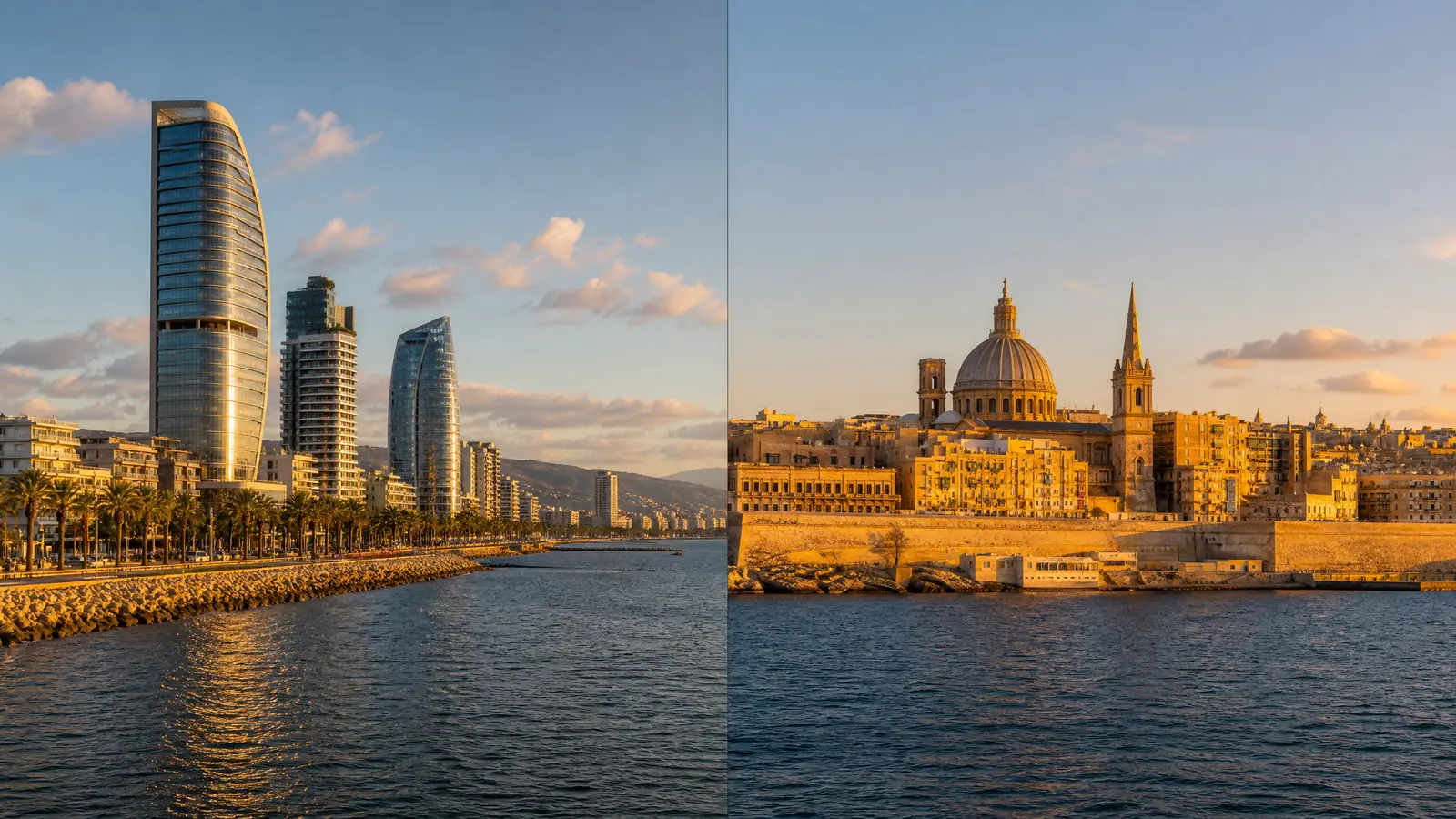
Here the islands stop rhyming. Cyprus's international life concentrates in Limassol, and Limassol has become a specific thing: a vertical city of towers, funds and new money, shaped by two decades of Russian capital, a more recent wave of Israeli and Lebanese arrivals, and a forex-and-fintech cluster with the sensibility that implies. It is dynamic, expensive by Cypriot standards, and, depending on your taste, either thrilling or charmless. Around it, the older Cyprus endures: Nicosia's divided-city gravity, Paphos's retiree calm, mountain villages of long lunches.
Malta's vibe is smaller-boned and more blended: one continuous village-nation where the gaming professional, the Maltese grandmother, the finance lawyer and the festa band committee share the same hundred square metres of pavement. No single quarter of new towers holds the international life; it is dissolved into the whole. Valletta against Limassol is baroque stone against glass: choose your century. And hovering over Cyprus always, politely unmentioned in the brochures, is the Green Line: a divided capital, a frozen conflict, the last partitioned country in Europe. Daily life ignores it successfully. A finale about honesty cannot.
Geography: the centre versus the edge
Open the map. Malta sits in the dead centre of the Mediterranean: ninety minutes to Rome, two hours to Nice or Athens, three to London, Sicily visible from my cliff. Cyprus sits at the sea's far eastern end: four to five hours from western Europe, but next door to Tel Aviv, Beirut, Cairo and the Gulf. This is not a flaw; it is an orientation. Cyprus is Europe's balcony onto the Levant, and for anyone whose business faces Israel, the Gulf or the eastern Mediterranean, that adjacency is priceless, though it also means regional turbulence is felt closer. And one hard practical line: Malta is in Schengen; Cyprus, for now, is not, which for a frequent European traveller means passport queues Malta abolished in 2007.
Health and daily machinery: honours even, almost
Both islands answer the 2 a.m. question well. Cyprus runs GESY, a young but genuinely functioning national health system, alongside a private sector that medical tourists cross seas for. Malta runs Mater Dei and a public system that, as this magazine has detailed, opens even to the newly self-employed arrival. Both operate in English at every level that matters. Both suffer traffic beyond their size and construction beyond their taste; neither may cast the first stone. Costs run close, with Limassol property now Maltese-priced while the rest of Cyprus remains gentler than the rest of Malta. Call the daily machinery a draw between well-run siblings, which after six one-sided instalments is its own kind of drama.
The verdict, and the series verdict
Choose Cyprus if you want the same Anglo-Mediterranean operating system with geography attached: mountains, seasons, space, the Levant next door, and a tax regime that, for dividend-heavy profiles especially, genuinely rivals anything in Europe.
Choose Malta if you want the centre rather than the edge: Schengen, ninety minutes to the European mainland, a single blended society instead of a towered enclave, no frozen conflict on the horizon, and the non-dom architecture this series took as settled from Part 1.
And the series verdict, after seven islands? Every rival beat Malta at something, and I printed every defeat: Mallorca's mountains, Ibiza's summer, Sicily's food and romance, Corsica's wilderness, Rhodes' sun and softness, Madeira's climate, Cyprus's space and its genuinely rival tax deal. Malta won only one category, and it happens to be the one a life is actually made of: the whole. The hospital fifteen minutes away, in English, twelve months a year, ninety minutes from Europe, in a country that wants you there. Islands are easy to fall in love with. Malta is the one that loves you back on a Tuesday in February. That is why I live here. Carpe Diem.
This concludes Malta vs the Mediterranean. The full series: Mallorca, Ibiza, Sicily, Corsica, Rhodes, Madeira, Cyprus.