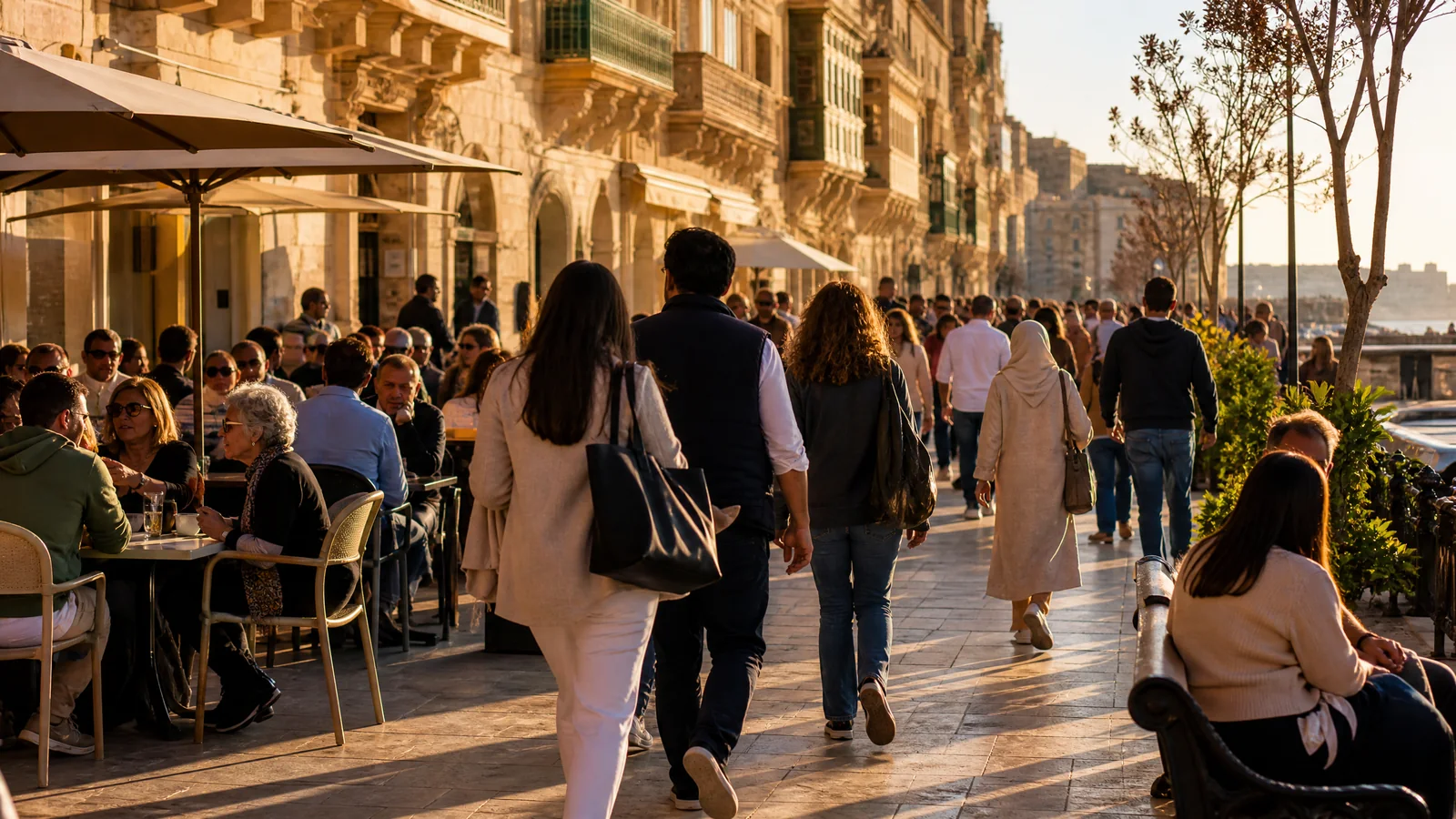
Malta's economy kept up its pace in the spring. According to the National Statistics Office's first estimate for the second quarter of 2026, published on 27 August, gross domestic product rose by 4.5% in volume terms compared with the same quarter of 2025. In money terms, the economy produced €6.5 billion in the three months from April to June, €417.1 million or 6.8% more than a year earlier.
The first thing worth understanding is that this is a continuation, not a spike: the first quarter had already grown strongly. The second is what sits underneath the headline: who is spending, which sectors are growing, and where the money ends up. Those are the parts that shape daily life on the island, from job offers to restaurant bills.
The Headline in Four Numbers
The release, NR 151/2026, gives four figures that matter most:
- Real growth of 4.5%. This is the change after stripping out price increases, and it is the number usually quoted as "growth".
- Nominal growth of 6.8%. This is the change in the euro value of everything produced.
- A GDP deflator of 2.2%. The deflator measures how much the prices of everything produced in Malta rose. The NSO notes this is 0.5 percentage points lower than the rate for the first quarter.
- Domestic demand contributed 5.3 percentage points, and foreign trade took away 0.7 points.
The quarter also looks stronger than the one before it. In May, the NSO's first estimate for Q1 2026 put real growth at 3.9%. First estimates are revised as more data arrive, so the comparison is indicative, but the direction is clear: growth picked up in the spring rather than slowing.
Who Did the Spending
The expenditure side of the accounts shows where the growth came from. Final consumption rose by 6.7% in volume terms. Within that:
- household spending rose by 3.5%;
- government consumption rose by 14.7%;
- spending by non-profit institutions serving households rose by 9.1%.
Measured as contributions to GDP growth, government consumption added 2.5 percentage points and private consumption 1.7 points. In other words, in this quarter the state added more to growth than all households together.
The NSO's contribution table shows this is not a one-off. In the first quarter of 2026, government consumption had already added 1.8 points against 1.4 points from households. Across the five quarters shown in the release, the government's contribution rose from 0.7 points in the second quarter of 2025 to 2.5 points now, while the household contribution fell from 2.4 points to 1.7. For people living on the island, that means a growing part of the economy's momentum depends on public budgets rather than on private demand alone.
The trade figures are best read in gross terms. Exports of goods and services added 4.0 points to growth in the second quarter, and imports subtracted 4.7 points. Malta sold more abroad, but bought even more, much of it to meet the demand that households, the government and investors created at home.
Investment helped too. Gross fixed capital formation, which covers construction, machinery and other long-lived assets, rose by 5.1% and contributed 1.0 point. Exports grew by 3.0% and imports by 4.1%. Because Malta imports much of what it consumes and invests, strong domestic demand pulls imports up, and that is why trade shows as a small negative.
For residents, the government figure deserves a second look. A quarter in which public consumption grows almost 15% in real terms is a quarter of more public-sector wages, more purchases and more services. It supports incomes and demand now. It also sits alongside the question every budget has to answer about how that spending is paid for, which is outside what NR 151 covers.
Which Sectors Drove It
The production side tells a similar story from a different angle. Gross value added, the output of all industries, rose by 5.0% in volume terms. Services contributed 4.7 percentage points of that, industry 0.4 points and agriculture and fishing nothing.
The NSO names three service sectors as the main drivers:
- financial and insurance activities, up 12.2%;
- information and communication, up 9.2%;
- professional, scientific and technical activities, up 7.5%.
In the statistical classification, financial and insurance activities cover banks, funds, insurers and payment firms; information and communication covers software, telecoms and data services; professional activities cover law, accounting, consultancy and similar firms. Online gaming itself is classified elsewhere, under arts, entertainment and recreation, but the payments and technology businesses that grew up around it, described in the piece on Malta's iGaming and fintech hub, sit largely in the fast-growing sectors. The figures suggest the service economy is still the engine, rather than tourism, construction or manufacturing on their own.
Where the Money Went
The income approach shows how the extra €417.1 million of nominal GDP was shared out compared with the second quarter of 2025:
| Component | Increase |
|---|---|
| Compensation of employees | €253.8 million |
| Gross operating surplus and mixed income | €136.6 million |
| Taxes on production and imports, less subsidies | €26.7 million |
Roughly three fifths of the increase went to employees as wages, salaries and employer contributions. That matters for anyone who lives on a Maltese salary, and it fits the labour market picture from the spring. The NSO's Labour Force Survey for Q1 2026, published in June, counted 333,682 people in employment, 3.3% more than a year before, with an unemployment rate of 3.5%. The same survey put average basic monthly salaries at between €1,410 in elementary occupations and €3,628 for managers. The wider context is in the overview of Malta's labour market.
Growth Per Head Is Slower
One line in the release is easy to miss. Nominal GDP per capita in the second quarter was €10,976, against €10,547 a year earlier. That is an increase of about 4.1%, well below the 6.8% rise in total nominal GDP.
The gap between the two is arithmetic, and it points to population. If the economy grows by 6.8% in euro terms but output per person grows by about 4.1%, the population used in the calculation must have grown by roughly 2.6% over the year. Much of Malta's growth comes from more people working here, not only from each person producing more. Anyone who has tried to find parking in Sliema or a quiet beach in August has felt this. The argument that a crowded island is also a dynamic one is made in the piece on Malta's population density; these figures are its economic side.
For residents, it has two consequences. Demand for housing, roads, schools and health services grows with headcount, whatever happens to productivity. And average incomes rise more slowly than the headline figure suggests.
GDP Is Not the Same as Income Kept in Malta
The release also reports gross national income of €5.7 billion for the quarter, against GDP of €6.5 billion. GNI adds income that residents earn abroad and subtracts income earned in Malta by non-residents, such as profits of foreign-owned companies and wages of cross-border workers.
In the second quarter the difference was about €0.8 billion. On a net basis, that much of the income generated in Malta accrued to people and companies outside the country. That is typical for a small, open economy with many foreign-owned firms, and it is one reason headline GDP overstates how much richer the resident population becomes when the economy grows.
Prices: What Residents Actually Pay
The GDP deflator of 2.2% measures prices of everything produced in Malta, including exports. The figure closer to a household budget is the consumer price index. The NSO's HICP release for July 2026, published on 19 August, put annual inflation at 2.1%, up from 2.0% in June, with a 12-month average of 2.3%.
The detail matters more than the headline. The largest upward contribution came from restaurants and accommodation services, 0.49 percentage points, with annual price growth in that category of 3.3%. Clothing and footwear fell by 3.6%, and information and communication by 1.6%. In other words, the prices that rise fastest are the ones driven by local demand and tourism: eating out, hotels, services. The things Malta imports and sells in competitive markets are getting cheaper.
If you are budgeting a move, the cost of living guide has the real numbers for rent, food and schooling. The Q2 data suggest that a 4.5% growing economy has so far not turned into runaway inflation, but that services and hospitality remain the pressure point.
What It Means if You Live Here, or Plan To
Put together, the second quarter data give a fairly clear picture of daily life on the island in 2026.
Jobs remain plentiful. Employment is growing by more than 3% a year and most of the extra income is going to employees. For skilled professionals in finance, technology and professional services, the sectors that grew fastest, the market is on their side.
The state is spending heavily. Government consumption grew faster than any other part of demand. That supports incomes and services now, and it makes the next budget worth watching for anyone whose plans depend on tax rates and public services.
Growth is extensive, not just intensive. Per-head output grew about 4.1% in nominal terms, well below the total. More people are sharing the same roads, beaches and housing stock, and that is visible in where people choose to live on the island.
Inflation is moderate, but uneven. Around 2% overall, with services and hospitality rising faster than goods.
The first estimate is not the last word. The NSO revises GDP estimates as fuller data arrive. The Q1 deflator, first published at 3.0% in May, is now implied at 2.7% by the Q2 release. The direction of travel in NR 151 is clear. The exact decimals may still move.
For Malta, a 4.5% growth rate is not an outlier. It is the continuation of a model built on services, inward migration and a state that spends heavily. Whether you find that model attractive depends on what you are looking for from the island. The numbers suggest it is still working.
Work with Sebastian
If you are weighing a move to Malta and want the practical, legal and tax picture on one plan, book a consultation.