Contents
- 1. Dominican Republic: Country Overview
- 2. Putting the Dominican Republic on the Map
- 3. What Others Say About the Dominican Republic
- 4. Tax Benefits: What the Dominican Republic Has to Offer
- 5. Tax Rates at a Glance
- 6. Tax Residency: What Triggers It
- 7. Double Tax Treaties
- 8. Avoid Remaining Tax Resident at Home
- 9. Tax Considerations When Leaving Your Home Country
- 10. Company Setup & Corporate Tax
- 11. Who Should (and Shouldn't) Move to Dominican Republic
- 12. Visas and Residence Permits
- 13. Path to Citizenship
- 14. Banking in the Dominican Republic
- 15. What Makes Dominican Republic Genuinely Attractive
- 16. Cost of Living in Dominican Republic
- 17. Buying Real Estate in the Dominican Republic
- 18. Retiring in the Dominican Republic
- 19. US Citizens: What You Need to Know
- 20. Correct Preparation
- 21. Automatic Exchange of Information (OECD CRS)
- 22. Further Relocation Formalities
- 23. How We Help With Your Move to the Dominican Republic
I.
Dominican Republic: Country Overview
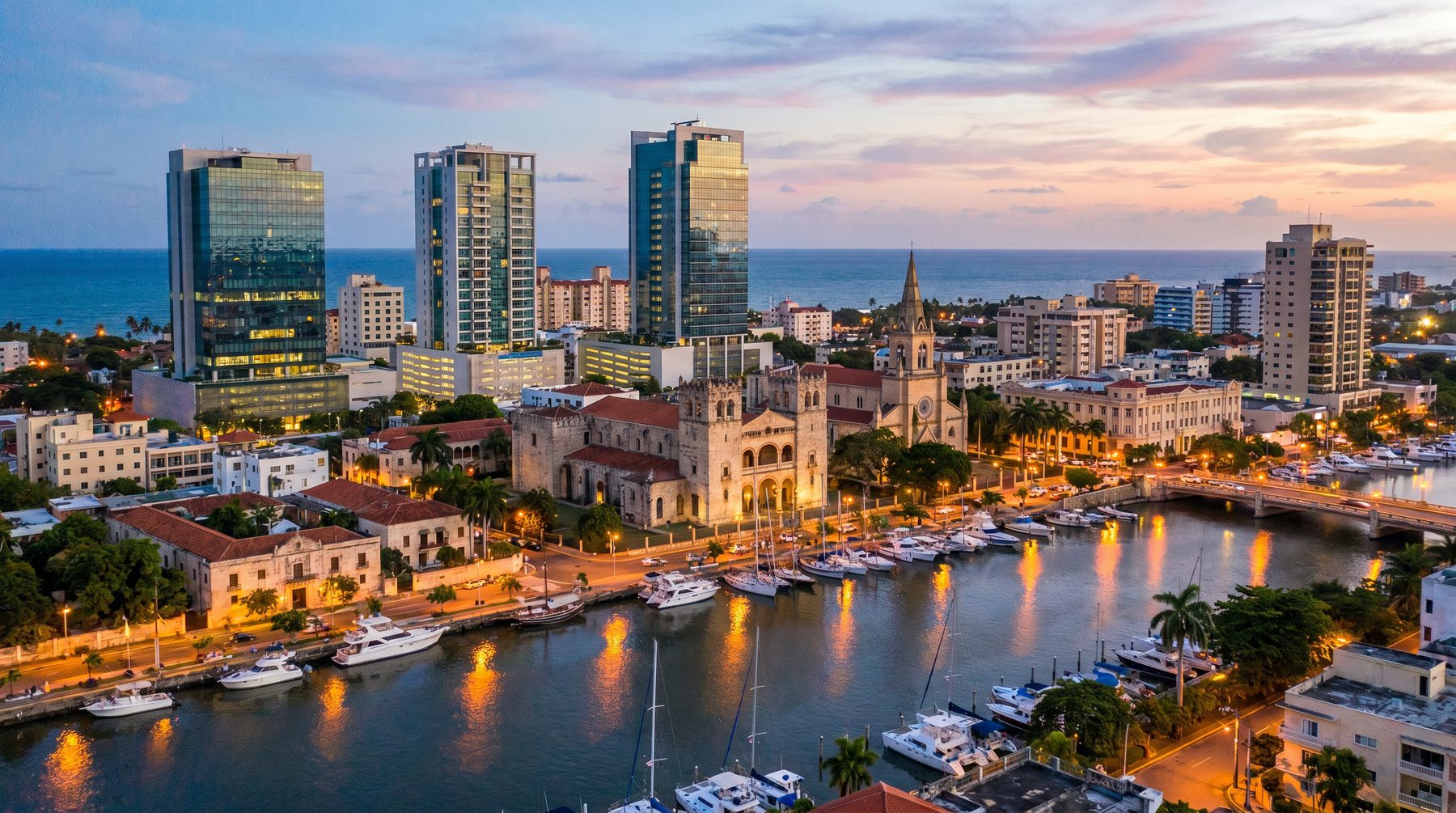
The Dominican Republic occupies the eastern two-thirds of Hispaniola — the island in the Caribbean Sea that it shares with Haiti. It is the second-largest country in the Caribbean by area (48,671 km²) and the most visited, receiving over 10 million tourists per year before the COVID disruption and recovering strongly since. The capital is Santo Domingo, founded by Bartholomew Columbus in 1496 — the oldest continuously inhabited European settlement in the Americas. Population: approximately 11 million.
The tax system is purely territorial: Dominican residents pay Dominican income tax only on income sourced in the Dominican Republic. All income derived from foreign sources — dividends from foreign shares, interest from foreign accounts, capital gains from foreign investments, foreign business profits, foreign rental income, foreign pensions — is permanently and unconditionally exempt from Dominican income tax. There is no time limit on this exemption, no special application required, and no qualifying investment threshold. It applies by default to any person who becomes a Dominican tax resident.
One point that is frequently and harmfully misrepresented: the territorial exemption for foreign-source income is permanent. There is a separate, limited three-year exemption that applies to certain Dominican-source investment income for new residents — but this has no bearing on foreign income, which is simply never taxed.
The Dominican Republic is not a zero-tax jurisdiction — income earned locally (from Dominican businesses, property, employment) is subject to progressive income tax at 0%–25%. But for internationally mobile individuals whose income is primarily foreign-source, Dominican residency creates a very clean tax position.
What to be aware of: The Dominican Republic is attractive because of its permanent territorial approach, but banking, documentation, immigration processing, and home-country exit planning need discipline. The local system rewards clean paperwork and punishes improvisation.
The Dominican Republic operates a territorial tax system. Foreign-source work income, business income, and pensions are permanently exempt for every tax resident. Only foreign-source financial and investment income (foreign dividends, interest, capital gains, and foreign rental income) is treated differently: for general residents this becomes taxable from the third year of residency. Holders of a Law 171-07 visa (pensionados, rentistas, investors) are exempt from Dominican tax on all foreign-source income, including foreign financial and investment income, permanently.
II.
Putting the Dominican Republic on the Map
The Dominican Republic occupies the eastern two-thirds of Hispaniola — the second island Columbus found in 1492, the one he described in his journals as the most beautiful thing he had ever seen. Four hundred years of colonialism, sugar, slaves, revolution, dictatorship, and eventual democracy have not been gentle with that original beauty. But the island's landscape has an obstinate quality: it insists on being extraordinary even under unfavourable conditions.
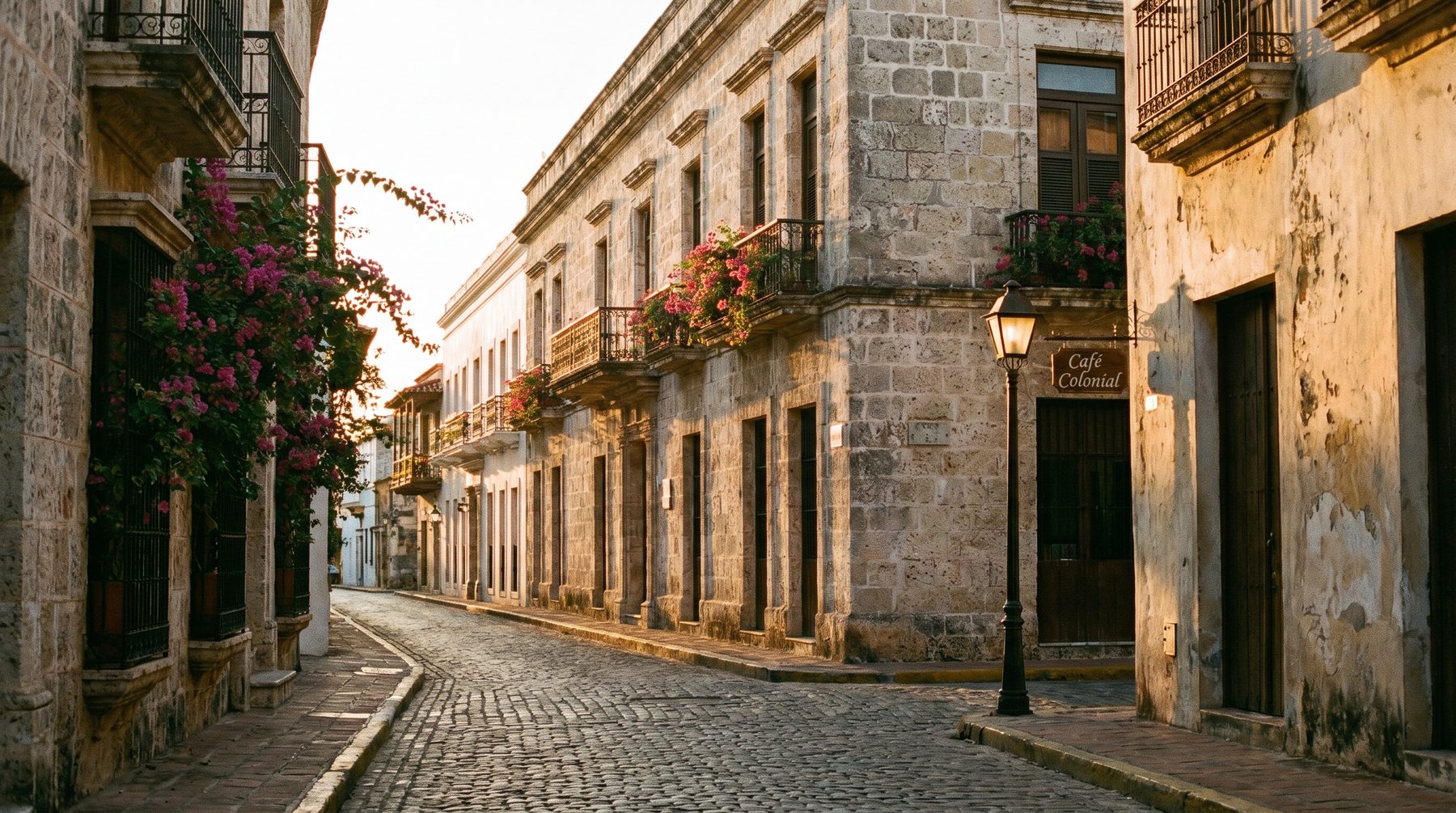
Santo Domingo is the oldest continuously inhabited European settlement in the Americas — founded 1496, nine years before anyone landed in what is now the United States. The Zona Colonial, the old city, is a UNESCO World Heritage Site with the first cathedral, the first hospital, the first university, and the first paved street in the New World. Cobblestones, fortress walls, colonial palaces, and Caribbean bougainvillea. It is not a museum; it is a living neighbourhood where people eat dinner and hang laundry and play dominoes in the evening heat.
The north coast — the Amber Coast around Cabarete and Las Terrenas on the Samaná Peninsula — is where internationally mobile residents tend to settle. Cabarete has become one of the world's serious windsurfing and kitesurfing destinations, with consistent trade winds and a long reef-sheltered bay. Las Terrenas on the Samaná Peninsula is more European in character — significant French and Italian populations, excellent restaurants, a slower pace, and beaches that still have the quality of something not entirely discovered. The waterfalls of El Limón in the Samaná interior are among the finest in the Caribbean.
The Pico Duarte — at 3,098 metres the highest mountain in the Caribbean — sits in the Cordillera Central. Most people arriving in the Dominican Republic do not imagine they are arriving in a country with a mountain taller than anything in the British Isles. The country's geographic variety is consistently underestimated: within four hours of Santo Domingo, you can be in desert, cloud forest, mountain plateau, and white-sand bay.
III.
What Others Say About the Dominican Republic
“Dominicans are Caribbean and therefore have an extraordinary tolerance for extreme phenomena.”
— Junot Díaz, The Brief Wondrous Life of Oscar Wao, 2007 (Pulitzer Prize for Fiction)
“The capital city of the Dominican Republic is Santo Domingo, the oldest city in the Americas. Among all the Caribbean islands, none presents so complex and fascinating a history.”
— Lonely Planet, Dominican Republic
"The most beautiful land that human eyes have ever seen."
— Christopher Columbus, ship's log, 5 December 1492, on first sighting Hispaniola

IV.
Tax Benefits: What the Dominican Republic Has to Offer
The Dominican Republic operates a territorial tax system under Law 11-92 (the Tax Code). Foreign-source work income, foreign-source business income, and foreign pensions are PERMANENTLY EXEMPT for every Dominican tax resident — no time limit. Only foreign-source FINANCIAL and INVESTMENT income (foreign dividends, foreign interest, foreign capital gains, foreign rental income) is treated differently: for general tax residents, this category becomes taxable from the third year of residency onwards. Holders of a Law 171-07 visa — pensionados ($1,500/month pension), rentistas ($2,000/month income), or investors ($200,000+) — are exempt from Dominican tax on ALL foreign-source income, including foreign financial and investment income, permanently. Combined with no wealth tax, no exit tax, no CFC rules, the Dominican Republic remains one of the most accessible territorial-tax jurisdictions in the Americas.
- ›Foreign work income, foreign business income, and foreign pensions — permanently exempt for ALL residents — Dominican Republic's territorial system never taxes these categories of foreign-source income, regardless of how many years you have been resident. This is the headline benefit and applies to every tax resident, not just visa-programme participants.
- ›Foreign financial and investment income — exempt for the first two years for general residents; permanently exempt under Law 171-07 — for general residents (no special visa), foreign dividends, interest, capital gains, and foreign rental income become taxable from the third year of residency onwards. Holders of a Law 171-07 visa are exempt from this rule and pay 0% on foreign financial income for as long as they hold the status.
- ›Law 171-07 visa programme — three qualifying categories — pensionados (pensioners with $1,500/month qualifying foreign pension), rentistas (annuitants with $2,000/month stable income for 5+ years), and investors ($200,000+ in approved investment). All three confer permanent exemption from Dominican tax on foreign-source income (including financial/investment income), 50% reduction in IPI property tax, partial vehicle import duty exemption, and an accelerated path to permanent residency and citizenship.
- ›No annual wealth tax, no exit tax, no CFC rules — the Dominican Republic has no net wealth tax, no Wegzugsbesteuerung-style departure tax on unrealised gains, and no controlled foreign company regime taxing offshore corporate structures of residents.
- ›Personal income tax progressive 0%–25%; corporate tax 27% flat — Dominican-source income taxed at 0%–25% for individuals (top bracket above ~DOP 867,000); Dominican corporations taxed at flat 27% on Dominican-source profits.
- ›Inheritance tax 3% on net estate value — modest by international standards but not zero; payable on the net value of the estate after deductions.
- ›IPI Property Tax 1% above DOP 9.85M threshold (50% off for Law 171-07 holders) — the IPI is the annual real estate tax, applying only to property valued above approximately DOP 9.85M (~$168,000); Law 171-07 beneficiaries pay only half.
- ›Caribbean location, USD-flexible economy — Las Terrenas, Cabarete, Punta Cana, and other expat hubs are USD-friendly; cost of living substantially below the US/Canada/Western Europe; CONFOTUR (Law 158-01) provides additional tax incentives for qualifying tourism-zone real estate developments.
- ›NEW 2026: cryptocurrency explicitly taxable as ordinary income — DGII guidance issued in 2025–2026 confirms crypto gains fall within the standard 0%–25% personal income tax brackets and must be reported. The territorial rule still governs source: Dominican-source crypto activity is taxable; foreign-source crypto activity follows the work-vs-financial-income split above.
V.
Tax Rates at a Glance
| Tax | Rate (2026) | Notes |
|---|---|---|
| Personal Income Tax | 0%–25% progressive | 0% to DOP 416,220; 25% above ~DOP 867,000 |
| Foreign work / business / pension income (all residents) | 0% | Permanently exempt — no time limit |
| Foreign financial / investment income — general residents | 0% (years 1–2), then taxable from year 3 | Article 269 Tax Code; KPMG TaxNewsFlash 14 Jan 2026 |
| Foreign financial / investment income — Law 171-07 holders | 0% | Permanently exempt while status maintained |
| Corporate Income Tax | 27% flat | On Dominican-source corporate income |
| Capital Gains (corporate) | 27% | Included in CIT base |
| Capital Gains (individuals, Dominican-source) | 0%–25% | As ordinary income |
| Cryptocurrency gains | 0%–25% | Now explicitly taxable as ordinary income; territorial rule governs source |
| Dividend Withholding Tax | 10% | Residents and non-residents |
| Interest Withholding Tax | 10% | Standard; exemptions for some savings/government bonds |
| Inheritance Tax | 3% | On net value of estate after deductions |
| Gift Tax | 0% | None |
| Asset Tax (corporations) | 1% | Of total corporate assets — alternative minimum |
| IPI Property Tax | 1% | Annual; on property value above DOP ~9.85M; 50% reduction for Law 171-07 |
| VAT (ITBIS) — standard | 18% | |
| VAT (ITBIS) — reduced | 16% | On selected items |
| Wealth Tax | 0% | None |
| Exit Tax | 0% | None |
| CFC rules | None | |
| Social Security — employee | ~10% | AFP, SFS, SRL combined |
| Social Security — employer | ~7.1% | Combined |
VI.
Tax Residency: What Triggers It
Dominican tax residency is established by spending 182 or more days in the Dominican Republic in a calendar year. The Dominican Republic does not have a 60-day rule or a centre-of-vital-interests test — day count is the primary mechanism.
Once tax resident, you file a Dominican income tax return covering only your Dominican-source income (foreign income is exempt and excluded from the return). The Dominican income tax authority (DGII — Dirección General de Impuestos Internos) issues a tax residency certificate (Certificate of Tax Residence) on application by residents who meet the 182-day threshold.
Immigration residency vs. tax residency: Legal immigration residency (a Dominican residence card) and tax residency are separate. You can be a legal resident with a Dominican residence card without spending 182 days per year in the country, and you can spend 182+ days without holding legal residency. Both are useful — immigration residency for the practical benefits (driving licence, banking, property purchase simplicity); tax residency for the certificate that evidences your tax position to home-country authorities.
VII.
Double Tax Treaties
The Dominican Republic has only two DTAs in force: Canada (1976) and Spain (2011). This is a deliberately narrow treaty position and should not be presented as a broad treaty network.
There is no US-Dominican Republic tax treaty, which is materially relevant for US expats because there is no treaty-based reduction of US withholding rates on Dominican-source income and no treaty tie-breaker for dual-residency cases. There is also no DTA with the United Kingdom, Australia, or any Scandinavian country.
For most international residents, the core planning point is therefore not treaty access, but the Dominican Republic's territorial-tax rules and, where relevant, Law 171-07 status for permanent exemption on all foreign-source income.

VIII.
Avoid Remaining Tax Resident at Home
The Dominican Republic’s attraction is its territorial system, not a zero-tax environment with no enforcement. Home-country tax authorities treat a Dominican Republic relocation the same way they treat any other relocation — and the absence of a DTA between most countries and the Dominican Republic means home-country domestic rules apply without modification.
- ›For UK nationals: The SRT applies. Fewer than 183 days in the UK with minimal UK ties creates UK non-residency — the Dominican Republic connection is not itself determinative, but it demonstrates where you are instead. Manage UK days, retain no UK property for personal use, and comply with split-year rules in the year of departure.
- ›For Australian nationals: ATO domicile and 183-day tests apply. Establishing genuine Dominican Republic residency (property, physical presence, social connections) supports a claim of ceased Australian tax residency.
- ›For Canadian nationals: Residential ties analysis. Canada Revenue Agency looks at whether you have a spouse/partner remaining in Canada, whether you maintain a Canadian dwelling available for your return, and other secondary ties. The Dominican Republic residency must be genuine and demonstrable.
- ›The physical presence requirement (182 days) is actually helpful for establishing a clean break from home-country residency — most home countries require 183+ days elsewhere anyway, and the Dominican 182-day rule aligns with this.
IX.
Tax Considerations When Leaving Your Home Country
Before you relocate to Dominican Republic, you need to understand what tax consequences arise in your current country of residence at the point of departure. These rules vary significantly by country and must be assessed individually. Many countries impose an exit tax, deemed disposal charge, temporary non-residence rule, or continuing reporting obligation when a tax resident leaves.
- ›United Kingdom. SRT governs departure date. CGT on gains realised while UK-resident. Temporary non-residence rules apply for five years. No UK-Dominican DTA — domestic rules apply throughout.
- ›Australia. CGT Event I1 at departure. ATO assesses domicile and 183-day test. No Australia-Dominican DTA.
- ›Canada. Departure tax on deemed disposition of property at fair market value. Canadian-source income taxed in the Dominican Republic? No — exempt under territorial system. Canadian non-resident withholding applies to Canadian-source income paid to Dominican residents. The Canada-Dominican DTA exists and may reduce applicable rates.
- ›United States. See Section XIX. No treaty to reduce US tax obligations.
A tax consultation before you move is not optional — it is essential. The cost of getting this wrong is almost always greater than the cost of getting proper advice upfront. We help clients assess home-country exit taxes, treaty position, reporting obligations, and the correct order of steps before relocating to Dominican Republic.
X.
Company Setup & Corporate Tax
The Dominican Republic offers straightforward company formation for foreign entrepreneurs:
- ›Sociedad de Responsabilidad Limitada (S.R.L.): Equivalent to a limited liability company. Minimum capital: DOP 100,000 (~$1,700). Corporate tax: 27%. Registration through the Chamber of Commerce — straightforward process.
- ›Sociedad Anónima (S.A.): Standard corporate vehicle; more formalities than the S.R.L.; used for larger businesses requiring formal share structure.
- ›Free Trade Zones (Zonas Francas): Significant incentives for export-oriented businesses — typically 0% income tax for 20 years, 0% import duties, 0% sales tax. Over 700 companies operate in Dominican Free Trade Zones.
Is a local company always the right answer?
Not necessarily. For internationally mobile individuals residing in the Dominican Republic whose income is primarily foreign-source, there is often no need to establish a Dominican entity at all. The territorial exemption applies to personal income from foreign sources whether or not it flows through a local company. A local Dominican S.R.L. at 27% corporate tax is appropriate for businesses with Dominican-source revenue — but for income generated outside the Dominican Republic, structuring through a lower-tax international vehicle and receiving distributions in the Dominican Republic tax-free (under the territorial system) is typically more efficient.
Popular international structures for Dominican-resident entrepreneurs include:
- ›US LLC (single-member, disregarded entity): No US corporate tax if the owner is a non-US person. Income flows through to the individual. The LLC is widely used by Dominican-based entrepreneurs operating online businesses, consulting practices, and digital services — the income originates in the US or internationally, the individual receives it in the Dominican Republic free of Dominican personal tax.
- ›Singapore company: 17% headline rate with significant new company exemptions. Strong banking access and international credibility. Well-suited for clients whose business has a global or Asian dimension and who need a jurisdiction with broad acceptance by international banks and counterparties.
- ›UAE company (mainland or free zone): 0% on qualifying income. Distributions to a Dominican-resident individual as dividends from a UAE company are received free of Dominican personal tax under the territorial system, and at 0% UAE corporate tax (subject to Small Business Relief thresholds or Free Zone substance requirements). This combination — UAE company, Dominican Republic personal residency — is used by clients who want to minimise tax at both the corporate and personal level simultaneously.
We help clients design the right international structure for their specific situation. Learn more about our company setup services →
Careful planning is essential. Using a foreign company while residing in the Dominican Republic can trigger Permanent Establishment (PE) risk — if the company's management and control is exercised from the Dominican Republic, local tax authorities may treat it as Dominican-tax-resident. The right structure depends on your business model and income profile. We help clients design structures that work legally and practically.
XI.
Who Should (and Shouldn't) Move to Dominican Republic
Section 11 is where the relocation decision becomes practical. Dominican Republic can be an excellent fit for some profiles and a poor fit for others; the decisive question is whether the tax rules, lifestyle, residence requirements, banking, healthcare, and family situation point in the same direction.
Good Fit
- › Remote workers and digital entrepreneurs with entirely foreign-source income. The territorial system is most powerful for those whose income comes entirely from outside the Dominican Republic. Zero tax on that income, clean setup, no complex regime to navigate
- › Retirees with foreign pension and investment income. Foreign pension: 0% Dominican tax. Foreign investment income: 0% Dominican tax. Healthcare at private hospitals is good quality and affordable. Cost of living is manageable. The lifestyle â warm climate, beach access, active expat community â is genuinely pleasant for those who enjoy the Caribbean
- › Those seeking warm-weather Caribbean residency without the cost of the British Virgin Islands, Cayman, or Bahamas. The Dominican Republic is significantly less expensive than other Caribbean zero-tax jurisdictions, with a much larger country, more geographic variety, and better physical infrastructure
Poor Fit
- × Those who need high-quality infrastructure comparable to Europe or North America. Power cuts are common outside tourist areas; water quality is inconsistent; roads outside major tourist corridors are poor
- × US citizens expecting to eliminate US tax. No US-DR DTA, and US citizenship-based taxation applies in full. Dominican residency reduces the Dominican tax to zero â but the US obligation remains
- × Those who will struggle with the lifestyle. This is a Caribbean country with Caribbean pace, Caribbean noise levels, Caribbean bureaucracy, and a Caribbean gap between what is advertised and what exists. If that sounds exhausting rather than energising, reconsider

XII.
Visas and Residence Permits
- ›Tourist entry: Citizens of the US, UK, Canada, Australia, and most European countries enter the Dominican Republic visa-free for up to 30 days (extendable). A tourist card (included in the airfare or purchasable on arrival) is required.
- ›Temporary Residency: Categories include:
- ›Rentista: Documented passive income from foreign sources — typically $2,000/month minimum demonstrated
- ›Inversionista (Investor): Minimum $200,000 investment in a Dominican business or real estate
- ›Retirement (Pensionado): Foreign pension income; minimum levels vary; apply to MIGRACION
- ›Permanent Residency: After two years of temporary residency, apply for permanent residency. Processing is notoriously slow (12–18+ months) and requires persistence and a good local lawyer.
- ›Practical shortcut: The Dominican Republic has a strong attorney-facilitated residency process — engaging a Dominican immigration lawyer from the outset significantly reduces frustration. Budget $2,500–5,000 for immigration legal fees.
2026 Law 171-07 residence update: the standard temporary-residence route is separate from the Law 171-07 fast-track. Pensionados qualify with a $1,500/month foreign pension, rentistas with $2,000/month stable income for at least five years, and investors with $200,000+ in approved investment. Law 171-07 status confers permanent exemption from Dominican tax on all foreign-source income, including foreign financial and investment income, plus a 50% IPI property-tax reduction, vehicle-import benefits, and an accelerated path to permanent residency and citizenship.
XIII.
Path to Citizenship
Dominican citizenship by naturalisation requires two years of permanent residency (after two years of temporary residency — four years total) plus a Spanish language demonstration and good conduct record. The Dominican Republic does permit dual citizenship.
Dominican passport: access to approximately 90 countries visa-free — more limited than European or most Anglosphere passports. The citizenship is valued primarily for practical Dominican Republic access rather than travel document utility.
The fastest route for foreign nationals is through the Inversionista residency: a minimum investment of $200,000 in Dominican real estate or a registered business grants temporary residency immediately. After two years of temporary residency, permanent residency becomes available. After two further years of permanent residency, citizenship eligibility begins — four years total from the date of initial investment. This is significantly faster than most Caribbean citizenship routes and makes the Dominican Republic one of the more accessible investment-linked citizenship destinations in the region, at a lower investment threshold than formal citizenship-by-investment programmes such as St Kitts and Nevis or Dominica.
XIV.
Banking in the Dominican Republic
The Dominican banking sector is supervised by the Superintendencia de Bancos. The main institutions are Banco Popular Dominicano (the largest by assets), Banco BHD León (well-regarded with expats), Scotiabank Dominican Republic, and Banreservas (the state bank). Both Dominican Peso (DOP) and US Dollar accounts are available — and USD accounts are widely used by expats given that the DOP depreciates gradually against the dollar and most major transactions are quoted in USD.
Opening an account requires Dominican residency documentation or a pending residency application, passport, proof of Dominican address, and source-of-funds documentation. Scotiabank and BHD León are generally the most accessible for foreign nationals. Process completion takes longer than in North America or Europe — allow multiple visits and considerable patience.
Where to hold your main accounts
For internationally mobile individuals and entrepreneurs, it is generally advisable to maintain your primary banking relationships outside the Dominican Republic, in a jurisdiction with stronger international banking infrastructure and a broader range of investment services. Dominican banks are adequate for local day-to-day life, but they are not well-suited as the primary hub for internationally mobile clients managing significant assets or international business flows. The Dominican financial sector, while regulated, does not offer the depth of private banking, investment management, or multi-currency functionality available in the major financial centres.
Jurisdictions we frequently recommend for primary international banking include:
- ›Switzerland — private banking tradition, multi-currency accounts, strong asset protection, and extensive experience managing internationally mobile clients' affairs. Switzerland is a natural complement to Dominican residency for clients with significant investment portfolios — the Dominican Republic provides the territorial tax base, Switzerland provides the investment infrastructure.
- ›Singapore — Asia-Pacific hub, excellent international wire infrastructure, and broad acceptance by global counterparties. Particularly useful for clients with business or investment exposure to Asian markets.
- ›United States — US dollar accounts at major US banks are universally accepted. Particularly relevant for Dominican-based clients given the country's deep economic ties to the US and the widespread use of USD in everyday Dominican transactions.
- ›Georgia (Caucasus) — straightforward account opening for non-residents, low fees, and a robust banking system for its size. Useful as a secondary account for transaction flexibility and as an accessible alternative when other jurisdictions present compliance barriers.
We help clients identify the right banking structure for their specific situation. Learn more about our offshore banking services →
Important: not all banks are compatible with all residencies. Some Swiss and Singaporean private banks have restrictions on clients resident in certain jurisdictions, and compliance requirements vary. Residency status, income profile, source of wealth, and business type all affect which institutions will accept you and on what terms. We help clients navigate this before they commit to any banking structure.
XV.
What Makes Dominican Republic Genuinely Attractive
Dominican Republic is attractive when it is judged as a complete relocation platform, not as a slogan. The point is not that Dominican Republic is perfect for everyone. The point is that, for the right person, the combination of tax position, residence practicality, lifestyle, geography, banking, language, and long-term stability can produce a genuinely coherent base.
- ›Caribbean accessibility with real urban depth. The Dominican Republic is attractive because it is one of the few Caribbean jurisdictions with a large domestic economy, developed tourism infrastructure, and relatively accessible residence options.
- ›The lifestyle case is not cosmetic. The lifestyle ranges from Santo Domingo’s urban energy to Punta Cana, Las Terrenas, and Casa de Campo. It offers beaches, Spanish culture, direct flights, and a warmer, more social daily life than many sterile tax havens.
- ›It can function as a real operating base. It can function as a base for entrepreneurs, real estate investors, hospitality operators, and people who need Caribbean residence without disappearing into a microstate.
- ›It rewards the right profile. It suits investors and independent operators who want lifestyle, accessibility, and cost advantages while still accepting the realities of a developing country.
- ›The attraction has to be handled honestly. The weak points are bureaucracy, infrastructure, security variance, and the need to structure tax residence properly. The Dominican Republic rewards people who choose carefully and operate with local guidance.
XVI.
Cost of Living in Dominican Republic
The Dominican Republic can be inexpensive, but the internationally comfortable version of life — secure housing, private healthcare, reliable transport and good areas — costs materially more than local averages suggest.
Typical monthly costs for an internationally mobile professional or family in the Dominican Republic (2026 planning ranges):
| Category | DOP/month | GBP/month | USD/month |
|---|---|---|---|
| 1-bed apartment, desirable area | DOP 54,520–113,990 | £700–1,500 | $900–1,950 |
| 2-bed apartment / small house | DOP 110,330–224,200 | £1,450–2,950 | $1,850–3,800 |
| International school (annual per child) | DOP 178,480–560,500 | £2,350–7,400 | $3,050–9,500 |
| Private health insurance (annual individual) | DOP 32,450–111,510 | £450–1,450 | $550–1,900 |
| Restaurant meal, mid-range (per person) | DOP 1,180–3,240 | £0–50 | $0–50 |
| Monthly groceries, single person | DOP 23,360–54,520 | £300–700 | $400–900 |
| Utilities and internet, apartment | DOP 10,380–29,740 | £150–400 | $200–500 |
- ›Comfortable single professional (no children): DOP 129,800–247,800/month (£1,700–3,300 / $2,200–4,200)
- ›Family of four with private schooling: DOP 324,500–590,000/month (£4,300–7,800 / $5,500–10,000)
These figures are planning ranges, not promises. The actual budget in the Dominican Republic depends heavily on housing quality, neighbourhood, school choice, healthcare needs, car ownership, travel frequency, and whether you are trying to live like a local or maintain a Western expatriate standard.
XVII.
Buying Real Estate in the Dominican Republic
Foreigners have the same property rights as Dominican citizens — full freehold ownership, no restrictions on foreign ownership. Property can be purchased and titled directly in the name of a foreign national.
Price ranges (2026):
| Location | Property type | Price range |
|---|---|---|
| Santo Domingo (Piantini / Naco) | 2-bed apartment | $150,000–400,000 |
| Santiago | 2-bed apartment | $90,000–220,000 |
| Puerto Plata / Sosúa | 2-bed condo | $120,000–300,000 |
| Cabarete | Ocean-view villa | $300,000–1,000,000 |
| Punta Cana | Resort condo | $200,000–700,000 |
| Casa de Campo / La Romana | Villa | $500,000–5,000,000+ |
Transaction costs:
- ›Transfer tax: 3% of declared value
- ›Legal fees: 1–1.5%
- ›Notary and registry fees: approximately 0.5%
- ›Total buyer costs: approximately 4–5%
- ›Title due diligence is critical. The Dominican property registry (Registro de Títulos) has historically had title clarity issues — duplicate titles, missing surveys, and disputed coastal property boundaries are real risks. Engage a Dominican property lawyer (not the seller’s lawyer) and require a full title search before completing any purchase.
- ›Rental yields: Yields vary significantly. Non-resort apartments in Santo Domingo or Santiago: 5–8% gross. Punta Cana resort properties let on short-term platforms: 8–12% gross in season, lower off-season.
XVIII.
Retiring in the Dominican Republic
The Dominican Republic is among the top five retirement destinations for American retirees in Latin America — driven by the clean territorial tax system, the low cost of living, the warm climate, and the accessibility from the US east coast (Miami to Santo Domingo: 2.5 hours).
Retirement residency: The Pensionado category requires demonstrated foreign pension income; minimum amounts are set by MIGRACION and should be verified at the time of application. The Pensionado status entitles the holder to various import exemptions on personal goods and a vehicle.
Foreign pension tax:
- ›All nationalities: Foreign pension income is 0% Dominican tax, permanently. This is the cleanest pension tax position of any jurisdiction in this hub.
- ›UK: UK private pension income paid to a Dominican resident may still face UK income tax at source depending on the treaty position (no UK-DR DTA). Specific UK pension advice required.
- ›Canada: CPP/OAS withholding at non-resident rates; Canada-Dominican DTA may reduce rates.
- ›US: US pension income is part of worldwide income subject to US tax. See Section XIX.
- ›Australia: Super pension phase rules apply independently; take ATO advice.
Healthcare: Private healthcare in Santo Domingo and Santiago is of reasonable quality for routine and specialist care. Top facilities include Clínica Abreu, Centro Médico Nacional (CMN), and Hospital Metropolitano de Santiago. Medical costs are a fraction of US levels. US retirees frequently maintain US Medicare and access it during visits home.
XIX.
US Citizens: What You Need to Know
US citizens and long-term green card holders are taxed by the United States on their worldwide income, regardless of where they live. Relocating to the Dominican Republic does not end US tax obligations — it changes the picture, but does not eliminate it.
Key considerations for US citizens in the Dominican Republic:
- ›Foreign Earned Income Exclusion (FEIE): US citizens who qualify as bona fide residents of the Dominican Republic or pass the physical presence test can exclude a significant amount of foreign earned income from US federal income tax. This applies to wages and self-employment income — not passive income such as dividends, interest, capital gains, pensions, or rental income.
- ›Foreign Tax Credit: Income tax paid in the Dominican Republic can generally be credited against US tax on the same income, reducing or eliminating double taxation. The credit is particularly important for income not covered by the FEIE and for taxpayers whose income exceeds the annual FEIE threshold.
- ›Treaty position: The United States and the Dominican Republic do not have a comprehensive income tax treaty. Planning usually relies on domestic US rules, the FEIE where available, and careful classification of income. A treaty does not automatically remove US filing obligations, and most treaties contain savings-clause rules that preserve US taxation of citizens.
- ›FBAR: US persons with bank accounts in the Dominican Republic exceeding $10,000 in aggregate must file FinCEN Form 114 (FBAR) annually. Failure to file can carry severe penalties, even when no tax is due.
- ›FATCA: US citizens may also need to report foreign financial assets on Form 8938. Banks in the Dominican Republic may separately identify US account holders under FATCA procedures and report account information through the relevant channels.
- ›Social Security and self-employment tax: The FEIE reduces income tax but does not automatically eliminate US self-employment tax. Whether US Social Security tax applies depends on employment status, entity structure, and any applicable totalization agreement.
US citizens considering the Dominican Republic should work with a qualified US international tax adviser alongside local counsel. The interaction between US tax law and Dominican Republic tax law is manageable, but it requires careful planning before the move, not after the first filing deadline arrives.
XX.
Correct Preparation
- ›How do I prove I have 0% Dominican tax on my foreign income? Apply to the DGII (Dominican tax authority) for a Certificado de Residencia Fiscal — a tax residency certificate confirming you are a Dominican tax resident. Present this to your home-country tax authority as part of your departure documentation. The DGII issues this after you have established 182+ days of physical presence.
- ›Must I incorporate a Dominican company? No — for foreign-source income, there is no need. The territorial exemption applies to personal income regardless of corporate structures.
- ›What is the minimum viable Dominican Republic setup? A signed rental agreement in your name, 182+ days of physical presence per year, a Dominican bank account, and (eventually) the tax residency certificate from the DGII.
What residency category should I apply for?
- ›Pension income as primary source: Pensionado
- ›Investment income / passive income: Rentista ($2,000+/month)
- ›Investment of $200,000+: Inversionista
- ›Straightforward long-stay: Rentista is the most commonly used for internationally mobile individuals
Recommended order of steps:
- 1.Home-country departure tax analysis
- 2.Explore the country (extended tourist stay) — verify lifestyle works
- 3.Engage Dominican immigration lawyer
- 4.Secure rental accommodation
- 5.Begin residency application
- 6.Open Dominican bank account
- 7.Formally notify home-country tax authority of departure
- 8.Establish 182+ days presence in first full year
- 9.Apply for tax residency certificate from DGII
XXI.
Automatic Exchange of Information (OECD CRS)
The Dominican Republic does not appear as a participating jurisdiction in the OECD's CRS-by-jurisdiction implementation table. A Dominican bank holding your accounts is therefore not reporting under the standard OECD automatic exchange framework that applies in CRS jurisdictions. This is a factual observation, not a marketing point. The Dominican Republic is not a secrecy jurisdiction, and the absence of CRS reporting does not extinguish tax obligations anywhere else. It simply means CRS is not the relevant transparency channel for accounts held there.
This is the moment most people draw the wrong conclusion — because most people misunderstand how CRS works in the first place.
The common assumption is that CRS follows nationality. It does not. CRS follows tax residence. A Swedish passport does not trigger Swedish reporting. A German passport does not trigger German reporting. What matters is where you are tax resident at the moment your bank performs its due diligence — not the country on your passport, not the country you used to live in, not the country where your family still pays tax.
Once you understand that, the Dominican picture becomes clear. A Swedish citizen who has genuinely become tax resident in the Dominican Republic is not reportable to Sweden through Dominican channels for two independent reasons: CRS would not point to Sweden anyway, because Sweden is not the country of tax residence; and the Dominican Republic is not operating as a CRS reporting jurisdiction in the first place. The real question is upstream of both points: does Sweden, or any other prior country, still regard the individual as tax resident under its own domestic rules? That is what determines tax exposure.
CRS creates transparency, not tax liability. The two are routinely confused. Even in a non-CRS jurisdiction, an unfinished or sloppy departure leaves your previous country in a position to tax your worldwide income — regardless of whether information is being exchanged automatically. The genuine risk is not the data flow. The genuine risk is a badly executed exit.
US citizens sit outside this framework entirely. Americans are not principally affected by CRS. They are affected by FATCA and by US citizenship-based taxation. Banks outside the United States — including in the Dominican Republic — generally identify US persons and report account information through FATCA channels to the IRS, regardless of where the individual is tax resident. For Americans, the passport really does follow you. For everyone else, it does not.
Key point: Neither CRS nor the Dominican Republic's non-participating status is a substitute for proper tax-residency planning. The decisive question is upstream: have you genuinely exited your previous tax residence, and have you built a defensible Dominican position? CRS follows tax residence where it applies. FATCA follows US-person status. Domestic tax-residency rules still decide who is allowed to tax you.
XXII.
Further Relocation Formalities
Upon establishing residence in the Dominican Republic, you will need to obtain a RNC / tax identification registration where required from the competent local authority. This is required for most financial and legal transactions in the Dominican Republic, including opening bank accounts, signing contracts, registering with tax authorities, and dealing with public offices.
You will also need to obtain or complete the relevant Dominican cédula once residence is approved process once your residence status has been approved. This document or registration record becomes your practical proof of residence in the Dominican Republic and is usually required for banking, telecom contracts, utilities, leases, property transactions, and day-to-day administrative matters.
- ›Driving licences from most countries are accepted only for a limited period after arrival. Once you become resident in the Dominican Republic, you should verify whether your licence can be exchanged directly or whether a local medical certificate, translation, theory test, or practical test is required.
- ›Health insurance should be arranged before arrival unless you are immediately covered by a local public system. In many cases, private international cover is the safest bridge solution while residence, employment, or social-security registration is still being completed.
- ›Importing personal effects should be planned before shipping anything to the Dominican Republic. Household goods may qualify for relief when imported shortly after taking up residence, but customs paperwork, inventory lists, timing rules, and vehicle-import duties can make late or informal shipping expensive.
- ›Proof of address and banking are often linked. Banks, telecom providers, and government offices may require a lease, utility bill, local address certificate, or residence registration before they will open an account or complete onboarding.
- ›Ongoing local compliance should not be treated as an afterthought. Calendar reminders for residence renewals, tax registrations, local filings, health-insurance renewals, and address updates help prevent administrative problems that can later undermine the tax-residency position.
XXIII.
How We Help With Your Move to the Dominican Republic
We offer comprehensive tax and legal support for your relocation to the Dominican Republic. We follow a proven process — and where the Dominican Republic requires specialist local input, we involve appropriately qualified local tax, legal, immigration, and banking advisers on the ground, while remaining responsible for overall coordination.
The results speak for themselves: we have helped over 100 entrepreneurs and business owners significantly reduce their tax burden through carefully planned relocations. Careful planning, thorough advice, and comprehensive support are our standard. Legally sound structuring within the framework of international tax law is our highest priority.
Our services typically include one or more of the following:
- →Tax advice on the consequences of relocating abroad: analysis, projections, assessments
- →Home-country departure tax analysis (UK, Australian, Canadian, or other nationality)
- →Dominican tax position assessment and DGII certificate planning
- →Introduction to Dominican immigration lawyers, tax advisers, and local accountants
- →Property search support and legal due diligence coordination
- →Banking introduction
- →Coordination between your home-country adviser and your Dominican team
Our fees are generally billed on a time basis; fixed prices apply for certain services such as company formation.
As a first step, we recommend booking a consultation to discuss your plans — by phone, Zoom, or Signal. Together we find the best approach and establish contact with our local partner. As project coordinator, we keep all the threads in hand that are necessary for the successful implementation of your plans.