Contents
- 1. Fiji: Country Overview
- 2. Putting Fiji on the Map
- 3. What Others Say About Fiji
- 4. Tax Benefits: What Fiji Has to Offer
- 5. Tax Rates at a Glance
- 6. Tax Residency: What Triggers It
- 7. Double Tax Treaties
- 8. Avoid Remaining Tax Resident at Home
- 9. Tax Considerations When Leaving Your Home Country
- 10. Company Setup & Corporate Tax
- 11. Who Should (and Shouldn't) Move to Fiji
- 12. Visas and Residence Permits
- 13. Path to Citizenship
- 14. Banking in Fiji
- 15. What Makes Fiji Genuinely Attractive
- 16. Cost of Living in Fiji
- 17. Buying Real Estate in Fiji
- 18. Retiring in Fiji
- 19. US Citizens: What You Need to Know
- 20. Correct Preparation
- 21. Automatic Exchange of Information (OECD CRS)
- 22. Further Relocation Formalities
- 23. How We Help With Your Move to Fiji
I.
Fiji: Country Overview
Fiji is a sovereign Commonwealth nation in the South Pacific, comprising more than 330 islands stretching across the Melanesian region southwest of Samoa and east of Vanuatu. It covers approximately 18,300 km² of land area across a vast 1.3 million km² maritime exclusive economic zone, with a population of approximately 925,000. The capital, Suva, sits on the southeast coast of Viti Levu (the largest island) and is the largest urban centre in the Pacific Islands region (excluding Hawaii and New Zealand). Nadi on the western coast is the principal international airport and tourist gateway.
The country recognises English, Fijian (iTaukei), and Hindi (Fiji Hindi) as official languages — reflecting Fiji's unique demographic mix of indigenous Melanesian iTaukei and the descendants of indentured Indian labourers brought during British colonial rule. English is the lingua franca of business, banking, government, the courts, and inter-community communication. The legal system is a Commonwealth common law jurisdiction based on English common law, with the High Court, Court of Appeal, and Supreme Court of Fiji providing the principal jurisdiction. The currency is the Fiji Dollar (FJD), a managed float against a basket of currencies.
Fiji is a member of the Commonwealth of Nations, the United Nations, the Pacific Islands Forum, and various regional bodies. The country has been politically stable since the December 2022 general election and the peaceful transfer of power to the coalition government — significant context given Fiji's earlier history of military coups (1987, 2000, 2006).
On the tax side, Fiji operates a residence-based worldwide taxation model. Tax residents (those with permanent or habitual residence in Fiji) are taxed on worldwide income at progressive rates from 0% to 39%. Non-residents are taxed only on Fiji-source income. A key feature is the "temporary resident" status — individuals who are in Fiji mainly for employment purposes under a contract that will not exceed 3 years are taxed as temporary residents, with foreign-source income and foreign capital gains exempt from Fiji taxation. This framework is the central planning angle for HNW clients seeking medium-term Pacific residence without full worldwide-income exposure.
There is no inheritance tax, no estate tax, no gift tax, and no annual wealth tax in Fiji. Capital gains tax is applied at 10% on certain Fijian capital assets (Fijian real estate, Fijian private shares); foreign capital gains for full residents are within the worldwide income framework (exempt for temporary residents). Corporate tax is 20% standard. VAT is 15%.
- ›Three main residence pathways for foreign nationals: 1. Investor Permit (FJD 50,000 — 3 years; or FJD 250,000 — 7 years; or FJD 500,000 alternative) — for foreign investors operating businesses in Fiji 2. Residence on Assured Income Permit — for retirees aged 45+ with sufficient foreign income/assets to support themselves 3. Employment Permit — for foreign professionals employed by Fiji employers
- ›There is no formal Citizenship by Investment programme. Fijian citizenship requires 5 cumulative years of residence within any 10-year period, plus standard naturalisation criteria. Dual citizenship has been permitted since 2009.
What to be aware of. Fiji is not a tax haven — the worldwide-taxation regime for full residents and the 39% top personal rate mean Fiji works for HNW clients only under specific structural circumstances: (a) the temporary-resident exemption (employment ≤3 years); (b) significant foreign income kept structurally outside Fiji's residence framework; or (c) lifestyle-prioritised relocation where the tax treatment is acceptable rather than primary. The Fiji passport ranks approximately 100th globally — far weaker than Caribbean CBI alternatives and not a meaningful Plan-B mobility tool. Foreign property ownership is restricted under the Land Sales Act 2014 (no freehold residential land within municipal boundaries; strata title, integrated tourism developments, and commercial property allowed). Fiji participates in OECD CRS since 2023.
II.
Putting Fiji on the Map
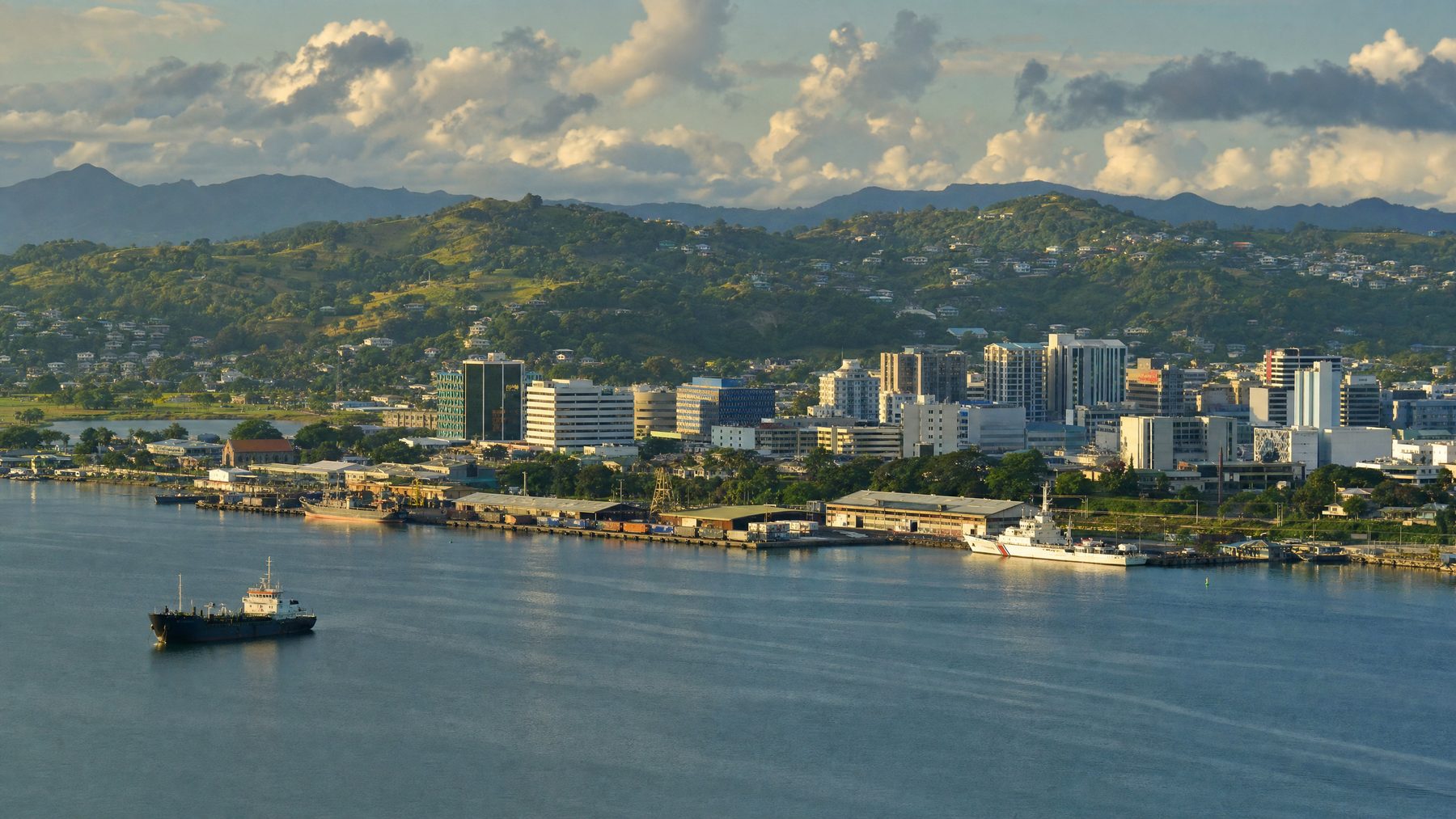
Fiji — South Pacific archipelago of 330+ islands
Fiji arrives in the colours of the South Pacific — the brilliant turquoise of the lagoon at Mamanuca, the deep green of the rainforest in the highlands of Viti Levu, the smell of grilled fish on the beach at Yasawa, and the universal greeting "Bula!" that you hear a hundred times a day. The country is an archipelago of more than 330 islands, of which only about 110 are permanently inhabited. The two main islands — Viti Levu (10,400 km², the largest) and Vanua Levu (5,500 km², the second-largest) — contain the bulk of the population, infrastructure, and economic activity.
Suva, on the southeast coast of Viti Levu, is the capital and largest city — a relatively cosmopolitan Pacific Islands metropolis with the University of the South Pacific, the Pacific Islands Forum Secretariat, the Reserve Bank of Fiji, and a real urban infrastructure missing from most of the rest of the Pacific. The city itself is humid and tropical (Suva sits in the wetter southern half of Viti Levu), with the Albert Park, the Fiji Museum, and the Suva Municipal Market as the central landmarks. Most diplomatic missions, government ministries, and major corporate headquarters are in Suva.
Nadi, on the drier western coast of Viti Levu, is the principal international gateway — Nadi International Airport (NAN) is the largest in the South Pacific. The Denarau Island resort area near Nadi is the country's main tourism hub, with the Hilton, Sheraton, Sofitel, Westin, Radisson, and Marriott. Coral Coast along the south of Viti Levu is the older traditional resort coast. Pacific Harbour is the diving and adventure-tourism centre.
The Mamanuca Islands (just off Nadi) and the Yasawa Islands (further northwest) are the iconic island chains — the white-sand beaches, the over-water bures, the diving and snorkelling. The Mamanucas are mostly developed with resorts at every price point; the Yasawas are wilder, with smaller resorts and traditional villages. Vanua Levu, the second-largest island, is home to Savusavu (one of Fiji's prettier small towns), the Cousteau Resort, and significant copra and sugarcane agriculture.
Taveuni, the third-largest island ("the Garden Island"), is a hiker's and diver's paradise — the Bouma National Heritage Park, the Lavena Coastal Walk, the Rainbow Reef. Kadavu, south of Viti Levu, has the Astrolabe Reef. Rotuma, far to the north, is a Polynesian outlier with its own distinct language and culture.
The Fiji highlands of Viti Levu — Nausori Highlands, Namosi, Naitasiri — are densely forested, home to traditional Fijian villages where indigenous land tenure (vanua/qoliqoli rights) remains strong. River trips on the Navua River, hikes to traditional waterfalls, and bilibili (bamboo raft) journeys are still genuine experiences.
Connectivity is moderate for a Pacific destination. Nadi International handles direct flights to Sydney (4 hours), Brisbane (4 hours), Auckland (3 hours), Los Angeles (10 hours, twice weekly), Hong Kong (10 hours), Tokyo (8 hours), Singapore (10 hours), and the rest of the Pacific (Vanuatu, Tonga, Samoa, Solomon Islands, Cook Islands, Tuvalu). There are no direct flights to Europe — reaching Fiji from London or Frankfurt requires connections via Sydney, Hong Kong, or Singapore (typically 24–28 hours total). Fiji Airways (the national carrier), Air New Zealand, Qantas, Virgin Australia, Cathay Pacific, Korean Air, and other major Asia-Pacific carriers operate to Nadi.
The geographic remoteness from Europe and North America is real. For HNW clients with frequent global business commitments, Fiji's travel-time and cost burden is meaningful — and a significant disadvantage compared to Caribbean alternatives that are 8 hours from London or 3 hours from Miami.
III.
What Others Say About Fiji
"Fiji is the country in the world that is most visibly happy. The greeting 'Bula!' is shouted at you with such authentic warmth that within 24 hours of arrival you find yourself doing the same to strangers. There are very few places left where this is true."
— Travel writer, Yasawa Islands, 2023
"What I value about Fiji after seven years on an Investor Permit is the seriousness of the legal and banking framework — Commonwealth common law, English-language professional services, and a regulatory environment that genuinely works. The Pacific lifestyle is real, but the institutional backbone behind it is what makes long-term residence viable."
— British investor, Suva, 2024
"The Yasawas are what Hawaii looked like in 1950 — simple resorts, traditional villages, the bilibili rafts on the river, the lovo feast in the evening, the kava ceremony with the chief. Tourism has not yet stripped these islands of their authenticity. That is the rarest thing in the South Pacific in 2026."
— Diving guide, Yasawa, 2025

IV.
Tax Benefits: What Fiji Has to Offer
Fiji is not a tax haven, but offers specific structural advantages for HNW clients seeking a Pacific residence base under particular profiles. The principal value propositions are the temporary-resident exemption, the absence of inheritance/wealth/gift tax, the English-language Commonwealth institutional framework, and the 5-year path to naturalisation.
- ›Temporary resident exemption — individuals in Fiji for employment under a fixed-term contract not exceeding 3 years are taxed as temporary residents. Under this status, foreign-source income and foreign capital gains are exempt from Fiji taxation. This is the key planning angle for HNW clients structuring medium-term Fiji residence.
- ›No inheritance tax, estate tax, gift tax, or wealth tax — Fiji imposes no inheritance tax, no estate tax, no gift tax, and no annual wealth tax. Wealth transfers between generations are entirely outside the Fiji tax net.
- ›No general capital gains tax for individuals on most asset categories — Fiji's capital gains tax is limited to 10% on gains from the disposal of certain Fijian capital assets (Fijian real estate, Fijian shares in private companies). Foreign capital gains (for full residents) are within the worldwide income framework — but exempt for temporary residents.
- ›Investor Permit pathway — three tiers for foreign investors operating businesses in Fiji:
- ›FJD 50,000 minimum (~USD 22,500) in approved projects — 3-year permit (Section 9(2)(c) Immigration Act 2003)
- ›FJD 250,000 minimum (~USD 112,000) — 7-year permit (Section 39 Immigration Regulation 2007)
- ›FJD 500,000 minimum (~USD 240,000) — 7-year permit alternative
- ›Residence on Assured Income Permit — for retirees aged 45+. Requires demonstrating sufficient foreign income or assets to support oneself in Fiji. Indefinite renewal subject to continuing meeting the requirements. One of the easier-to-qualify Pacific retirement permits.
- ›Naturalisation possible after 5 years — 5 cumulative years of residence within any 10-year period plus good character, English/Fijian/Hindi language knowledge. Fijian citizenship has been compatible with dual citizenship since 2009.
- ›Commonwealth common law institutional framework — Fiji operates under English common law tradition, with the Supreme Court of Fiji as final appellate authority. English-language banking, professional services, courts, and government make Fiji significantly more accessible to internationally mobile clients than most other Pacific jurisdictions.
- ›Corporate tax — 20% standard, with extensive incentives for tourism, agriculture, and approved investment projects — competitive Pacific rate. Specific tax holidays available for qualifying export-oriented and tourism-related businesses.
- ›Limited DTA network — DTAs in force with several major partners, useful for treaty-based planning.
- ›English language framework — the most accessible Pacific jurisdiction for English-speaking HNW clients. All government, banking, legal, and business operations conducted in English.
V.
Tax Rates at a Glance
The most important tax rates in Fiji are as follows. Note that these have been simplified and should be used as general guidance only.
| Tax | Rate | Notes |
|---|---|---|
| Personal Income Tax — bottom rate | 0% | First FJD 30,000 (2026 thresholds) |
| Personal Income Tax — middle rates | 18%–32% | Tiered thresholds |
| Personal Income Tax — top rate | 39% | Above FJD 270,000+ |
| Tax basis — full residents | Worldwide income | Worldwide income at progressive rates |
| Tax basis — temporary residents (≤3-year employment) | Fiji-source only | Foreign income and CG EXEMPT |
| Tax basis — non-residents | Fiji-source only | At applicable rates |
| Capital Gains Tax — Fijian assets | 10% | On Fijian real estate, Fijian private shares |
| Capital Gains Tax — foreign assets (resident) | Income tax rates | Within worldwide income framework |
| Capital Gains Tax — foreign assets (temporary resident) | 0% | EXEMPT |
| Inheritance Tax | 0% | None |
| Estate Tax | 0% | None |
| Gift Tax | 0% | None |
| Wealth Tax | 0% | None |
| Corporate Income Tax — standard | 20% | Resident companies |
| Corporate Income Tax — non-residents | 20% | On Fiji-source income |
| Corporate Tax incentives | 0%–17% | Tourism, agriculture, export-oriented |
| Withholding Tax — dividends | 0% (resident shareholder) / 9% non-resident | Treaty-reduced rates apply |
| Withholding Tax — interest | 10% | Reduced by DTA |
| Withholding Tax — royalties | 15% | Reduced by DTA |
| VAT (Value Added Tax) | 15% | Standard rate |
| Stamp Duty — share transfers | 1.75% | Of consideration |
| Property Transfer Tax | 3%–10% | Depending on category and ownership |
| Annual Property Tax | Modest | Local council rates |
| Tax residency threshold | Permanent home or 183+ days | Plus habitual residence test |
| Investor Permit (3-year) | FJD 50,000 | Section 9(2)(c) Immigration Act |
| Investor Permit (7-year) | FJD 250,000 | Section 39 Immigration Regulation |
| Investor Permit (alternative) | FJD 500,000 | Higher commitment, longer residence rights |
| Residence on Assured Income Permit | 45+ | Foreign income/assets sufficiency |
| DTAs | ~10 | Includes UK, Australia, NZ, Singapore, Japan |
| CRS exchange | Since 2023 | Annual automatic exchange |
Cryptocurrency and Crypto Assets
Fiji has no specific cryptocurrency taxation regime for individuals. Personal crypto disposals fall under general Fiji income/capital gains tax rules: for full residents, foreign-source crypto gains are within the worldwide income framework; for temporary residents (≤3-year employment), foreign-source crypto gains are EXEMPT. Active crypto trading may be reclassified as business activity. The country has been progressing crypto regulatory frameworks under AML/CFT international best practices but does not yet have a dedicated crypto-asset licensing regime comparable to Singapore, Switzerland, or the UAE. For HNW crypto holders, Fiji is most useful as a Pacific lifestyle base under the temporary-resident framework or with offshore-held positions, not as a primary crypto-tax planning jurisdiction.
VI.
Tax Residency: What Triggers It
Under Fiji tax law, an individual is considered a tax resident if they meet either of the following criteria:
- ›Permanent home in Fiji: Maintaining a home in Fiji with the intention to reside there.
- ›Physical presence: Present in Fiji for more than 183 days in a 12-month period that begins or ends in the relevant tax year.
Tax residents are subject to Fiji taxation on worldwide income at progressive rates 0%–39%. Non-residents are taxed only on Fiji-source income.
The critical sub-category for HNW planning is "temporary resident" status:
- ›Temporary residents: Individuals present in Fiji mainly for employment purposes under a contract that will not exceed 3 years. Temporary residents are taxed only on Fiji-source income; foreign-source income and foreign capital gains are exempt from Fiji taxation. This treatment applies for the duration of the qualifying employment contract (up to 3 years).
This temporary-resident exemption is the principal HNW planning angle for Fiji. Examples of profiles that fit:
- ›Senior expat executives on 2–3 year Pacific assignments
- ›Foreign professionals on consultancy or project-based contracts of fixed duration
- ›HNW individuals using Fiji as a 2–3 year Pacific base while structuring international assets without remitting to Fiji
Beyond 3 years, full-resident status applies, with worldwide income taxation at progressive rates up to 39%. This is why Fiji works best for HNW clients in the medium-term temporary-resident framework or for retirees whose foreign income is sufficiently small relative to thresholds that 39% on the margin remains acceptable.
- ›Documentation matters. Establishing and maintaining Fiji tax residency requires evidence: a registered lease or property title, residence permit (Investor / Assured Income / Employment), passport stamps demonstrating physical presence, utility bills, banking, and a Fiji Tax Identification Number (TIN) issued by the Fiji Revenue and Customs Service (FRCS).
- ›The Residence on Assured Income Permit pathway is for retirees aged 45+ with sufficient foreign income/assets — but this is a residence permit, not a tax exemption. Assured Income Permit holders who become full Fiji tax residents (via 183+ days or permanent home) are subject to worldwide income taxation. Many Assured Income holders structure to remain non-residents for tax purposes (under 183 days/year in Fiji) — making Fiji a part-time base rather than a full-time residence.
VII.
Double Tax Treaties
Fiji has concluded approximately 10 double tax agreements (DTAs) that are currently in force — a moderate Pacific network.
Active DTA partners include:
- ›Australia
- ›India
- ›Japan
- ›Korea (South)
- ›Malaysia
- ›New Zealand
- ›Papua New Guinea
- ›Qatar
- ›Singapore
- ›United Arab Emirates
- ›United Kingdom
The Australia–Fiji DTA is the most important treaty for the largest expat community (Australians remain the largest source of Fiji's foreign retirees and investors). It provides standard residence tie-breaker rules under Article 4 and reduced withholding rates on cross-border dividends, interest, and royalties.
The New Zealand–Fiji DTA is the second most significant — for the substantial NZ expat presence and for Pacific-region business flows.
The UK–Fiji DTA is in force and provides for standard residence tie-breaker rules — useful for British retirees and investors moving to Fiji.
There is no comprehensive DTA between Fiji and the United States, Germany, France, or Canada. This is a structural limitation for non-Australian/non-British HNW clients. For these clients, source-country withholding on income flowing to Fiji is at standard non-treaty rates without treaty relief.
Fiji is a signatory to the OECD Multilateral Convention on Mutual Administrative Assistance in Tax Matters (joined 2023) and has implemented OECD CRS automatic exchange. The country joined the Global Forum on Transparency and Exchange of Information for Tax Purposes in 2023.
The existence of a DTA does not automatically resolve all tax conflicts. The treaty must be invoked correctly, residency must be properly established, and the specific provisions of each treaty must be reviewed for the income type and circumstances.

VIII.
Avoid Remaining Tax Resident at Home
Relocating to Fiji does not automatically end your tax obligations elsewhere. The critical question is whether you have genuinely severed tax residency in your country of origin — and this is determined not by where you have registered an address, but by where you actually live, where your ties are, and how your life is organised.
The most common triggers that can keep you tax-resident at home:
- ›Available dwelling: Any long-term residence that remains available for your use is sufficient to maintain a taxable domicile in many countries. Surrendering it before departure is a precondition of a clean exit in Germany (§1 EStG Wohnsitz), Austria, Switzerland, and many other jurisdictions.
- ›Centre of vital interests: If your family, your business, your social connections, and your financial affairs remain in your home country, most tax authorities will argue that your centre of life has not genuinely moved.
- ›183-day rule (home country): Spending more than 183 days in your home country in a calendar year will typically trigger residency there.
- ›Extended unlimited tax liability (Germany — §2 AStG): Germany's erweiterte unbeschränkte Steuerpflicht under §2 AStG can keep German nationals taxable in Germany for up to ten years after departure if they move to a low-tax country and retain significant ties. Fiji is generally not classified as a low-tax country under §2 AStG for full residents (because the standard regime taxes at 39% top rate on worldwide income), but the temporary-resident framework with foreign-income exemption could potentially qualify under specific analyses. For German nationals, the §2 AStG analysis is fact-specific and should be confirmed before relying on it.
A genuine relocation to Fiji requires that you actually live there — that your home is there, your daily life is there, and that you can demonstrate this with documentation.
The test is not where you are registered. The test is where you live. Tax authorities in Australia, New Zealand, Germany, the UK, and the US are experienced at identifying sham relocations and have the legal tools to challenge them. Proper advice before you move — not after — is essential.
IX.
Tax Considerations When Leaving Your Home Country
Before you relocate, you need to understand what tax consequences arise in your current country of residence at the point of departure. These rules vary significantly by country.
Among the countries that levy a meaningful exit tax or deemed-disposal charge:
- ›Australia. Departing residents are treated as having disposed of most assets at market value on the date they cease to be Australian tax residents. CGT Event I1 applies. The Australia-Fiji DTA provides standard tie-breaker rules. Particularly relevant for the substantial Australian expat presence in Fiji.
- ›New Zealand. No general exit tax for individuals, but specific anti-avoidance rules may apply. NZ-Fiji DTA in force.
- ›United Kingdom. Statutory Residence Test (SRT) exit-date analysis required. UK-Fiji DTA provides tie-breaker rules. UK pensioners moving to Fiji face UK-source pension taxation under domestic rules.
- ›Germany. Applies an exit tax on unrealised gains in shareholdings of 1% or more under §6 AStG. Germany-Fiji has no comprehensive DTA (as of 2026). §2 AStG analysis is fact-specific.
- ›United States. The "expatriation tax" under IRC §877A treats long-term residents and citizens as having sold all worldwide assets at fair market value on the day they relinquish citizenship or residency. No comprehensive US-Fiji DTA.
- ›France. Exit tax applies to unrealised gains on securities and company rights above €800,000. Fiji is non-EU/EEA, so the deferral mechanism for EU moves does not apply.
- ›Netherlands. Deemed disposal applies to substantial shareholdings (5% or more) at the point of emigration.
- ›Canada. The "departure tax" deems most property to have been disposed of at fair market value on the date of emigration. No comprehensive Canada-Fiji DTA.
Beyond exit tax, you may remain subject to limited tax liability in your home country after the move — for example, on rental income, dividends, or pension payments. Severing tax residency does not necessarily sever all tax obligations.
⚠ Obtain Local Tax Advice in Your Home Country. The information above provides a general overview of the departure tax rules that commonly apply when leaving high-tax jurisdictions. It is not legal or tax advice. The rules in your specific home country are complex, change frequently, and depend entirely on your personal circumstances. Before you take any steps to relocate, obtain written advice from a qualified tax adviser who is licensed in your home country and experienced in international relocations. A consultation with us is a good starting point — but it does not substitute for country-specific legal advice from a practitioner in your jurisdiction of departure. The cost of getting this wrong is almost always greater than the cost of getting proper advice upfront.
X.
Company Setup & Corporate Tax
Fiji's corporate framework operates under the Companies Act 2015. The standard corporate tax rate is 20%, with extensive incentives for qualifying activities.
The most common structures:
- ›Limited Liability Company (Ltd): Standard Fijian private company. Corporate tax 20% on worldwide profits for residents, on Fiji-source profits for non-residents. Used for businesses operating in Fiji.
- ›Public Limited Company: For businesses listed on the South Pacific Stock Exchange (SPX) or seeking public investment.
- ›Branch / Permanent Establishment: Foreign companies can register a branch in Fiji.
- ›Approved Investment Companies: Investment Fiji-approved companies may qualify for tax incentives, depreciation acceleration, and other benefits.
Fiji offers extensive corporate tax incentives:
- ›Tourism investment incentives: Tax holidays for new tourism developments (resort, hotel, integrated tourism resort), depending on investment size and location
- ›Agriculture incentives: Tax exemptions for qualifying agriculture and agro-processing
- ›Export incentives: Reduced rates for export-oriented businesses
- ›Tax-Free Region (TFR) regime: Specific designated areas with full or partial tax holidays
- ›Hotel Aid Act: Specific framework for hotel investments
- ›Foreign investment is encouraged through Investment Fiji (the country's investment promotion agency). HNW clients pursuing the Investor Permit pathway typically establish Fiji limited companies as the operational vehicle for their FJD 50,000 / 250,000 / 500,000 investment.
- ›Foreign investment restrictions apply to specific reserved sectors (under the Foreign Investment Act 2004) — primarily traditional iTaukei activities, some agriculture, and certain professional services. Most modern business sectors (tourism, manufacturing, services, IT) are open to foreign investment.
Permanent establishment risk is the central warning. A Fiji company that is effectively managed from another country may be treated as resident there for tax purposes. Genuine substance — directors meeting in Fiji, key decisions taken locally, accounting and operations conducted in Fiji — is essential. Fiji has implemented OECD BEPS minimum standards.
XI.
Who Should (and Shouldn't) Move to Fiji
Section 11 is where the relocation decision becomes practical.
Good Fit
- › Senior expatriate professionals on 2–3 year Pacific assignments who can use the temporary-resident exemption to keep foreign income tax-free during their Fiji stay.
- › Australian, New Zealand, and British retirees aged 45+ pursuing the Residence on Assured Income Permit for a Pacific lifestyle base — particularly those with sufficient flexibility to remain non-tax-resident (under 183 days/year) while enjoying the Fiji residence privilege.
- › HNW investors establishing genuine business operations in Fiji's tourism, agriculture, manufacturing, or services sectors via the Investor Permit framework.
- › Pacific-region entrepreneurs needing a hub between Australia/New Zealand and the rest of the South Pacific — Fiji is the natural Pacific Islands business centre.
- › Lifestyle-prioritised relocations where the tax treatment is acceptable rather than primary — clients valuing the natural beauty, cultural depth, English language framework, and Pacific lifestyle over pure tax efficiency.
- › Long-term expats willing to pursue Fiji naturalisation after 5 years (path to dual Fiji-original citizenship is permitted since 2009).
Poor Fit
- × Anyone seeking a 0% personal tax jurisdiction — Fiji's worldwide-taxation regime for full residents at 39% top rate is not competitive with Caribbean CBI alternatives or genuine 0% jurisdictions like Vanuatu or the UAE.
- × Anyone seeking a strong Plan-B passport — the Fiji passport ranks approximately 100th globally; Caribbean CBI passports (Saint Kitts 148, Antigua 144) are far more useful for international mobility.
- × Clients planning to spend significant time in Fiji long-term beyond 3 years without the ability to keep foreign income offshore — the worldwide-taxation regime applies.
- × Anyone who cannot accept the geographic remoteness — Fiji is 24–28 hours from Europe via connections; no direct flights to Europe; limited direct access to North America (twice-weekly LA flights).
- × Clients seeking absolute privacy — Fiji is fully CRS-compliant since 2023, FATCA-cooperative, and beneficial-ownership-transparent.
- × US citizens expecting Fiji status to eliminate US tax filing — the US taxes citizens on worldwide income regardless of residence; no comprehensive US-Fiji DTA.
- × Clients seeking treaty-network access — Fiji's DTA network is limited to ~10 partners.
- × Clients seeking sophisticated international banking — Fiji's banking sector is functional but not deep; HNW clients typically maintain primary banking in Singapore, Hong Kong, Australia, or other major centres.

XII.
Visas and Residence Permits
Fiji offers three principal residence pathways for HNW clients:
- ›Visitor Visa (Tourist Visa): Citizens of EU/EEA, UK, US, Canada, Australia, New Zealand, Japan, and many other countries can enter Fiji visa-free for stays of up to 4 months (extendable up to 6 months in country). Sufficient for short-term visits and initial reconnaissance. Note: NOT a residence permit.
- ›Investor Permit (Three Tiers):
- ›FJD 50,000 in approved projects (Section 9(2)(c) Immigration Act 2003): 3-year multi-entry permit. For smaller-scale investors.
- ›FJD 250,000 in approved trade or business (Section 39 Immigration Regulation 2007): 7-year multi-entry permit. For mid-scale investors.
- ›FJD 500,000 alternative: 7-year permit with broader business scope.
All Investor Permits require: Investment Fiji approval, registered Fiji business entity, evidence of capital transferred from offshore (RBF letter), genuine business operations, and ongoing annual reporting to Investment Fiji.
- ›Residence on Assured Income Permit: For foreign nationals aged 45+ with sufficient foreign income/assets to support themselves in Fiji without becoming a charge on public funds. Indicative threshold: minimum income approximately €1,167/month (~USD 1,250/month) plus minimum savings ~€42,000 (~USD 45,000). Indefinite renewal subject to continued meeting requirements. Spouse and dependent children can be included.
- ›Employment Permit: For foreign nationals employed by Fiji-based employers. Tied to specific employer; renewable. Subject to labour market test.
- ›Spouse Permit: For foreign spouses of Fiji citizens or permanent residents.
Family inclusion: Investor Permit and Assured Income Permit applications can include spouse and dependent children in the same application.
- ›Permit processing: Investor Permit applications typically process in 3–6 months once Investment Fiji approval is obtained. Residence on Assured Income Permits process in 2–4 months. Applications made through licensed agents accelerate the process.
- ›The clean planning order is: 1. Define the goal — Pacific business presence (Investor Permit), retirement (Assured Income), employment, or naturalisation pathway 2. Match financial capacity to the appropriate permit tier 3. Register the Fiji entity (for Investor Permit) and establish initial documentation 4. Submit application through Investment Fiji and the Department of Immigration 5. Plan for ongoing compliance and naturalisation timeline (5 years cumulative within 10 years)
Visa and permit rules can change. Always verify current requirements with the Fiji Ministry of Immigration or the Fiji High Commission in your country of residence before making any plans.
XIII.
Path to Citizenship
Fijian citizenship requires 5 cumulative years of residence within any 10-year period under a valid residence permit, plus standard naturalisation criteria. There is no formal Citizenship by Investment programme.
Standard naturalisation requires:
- ›5 cumulative years of legal residence within any 10-year period under a valid residence permit (Investor / Employment / Assured Income / Spouse)
- ›Adequate knowledge of English, Fijian (iTaukei), or Hindi
- ›Good character (clean criminal record)
- ›Knowledge of Fijian civic and constitutional matters
- ›Renunciation of previous citizenship is NOT required since 2009 — Fiji permits dual citizenship
- ›Approval at the discretion of the Citizenship Commission
- ›There is no Citizenship by Investment programme. Fiji has explicitly rejected the CBI model, with government officials stating that citizenship should be earned through genuine connection to the country rather than purchased.
- ›For most HNW clients, Fijian naturalisation after 5 years is not the principal motivation — the Fiji passport ranks approximately 100th globally (visa-free or visa-on-arrival access to ~85 countries), significantly weaker than Caribbean CBI passports (Saint Kitts 148, Antigua 144). For Plan-B passport purposes, Caribbean CBI alternatives are typically more useful.
However, for clients genuinely relocating to Fiji long-term, naturalisation provides:
- ›Permanent right to reside without permit renewal
- ›Right to vote
- ›Access to all government services and public benefits
- ›Right to own freehold residential land in city boundaries (currently restricted for foreigners)
- ›Path for descendants (Fijian citizenship can be transmitted to children born to Fijian citizens)
Dual citizenship is permitted since 2009 — meaning naturalised Fijian citizens can retain their original passport.
The Fiji passport provides visa-free or visa-on-arrival access to approximately 85 countries, including the UK (with ETA), the EU Schengen Area (visa-free under specific arrangements), Singapore, Hong Kong, and most Pacific Islands. The US, Canada, and Australia require visas for Fiji citizens.
XIV.
Banking in Fiji
Fiji's banking sector is functional and sufficient for normal HNW retail purposes but lacks the deep private-banking infrastructure of Singapore, Hong Kong, or major Western centres. The country has a mix of local and international banks under the supervision of the Reserve Bank of Fiji (RBF).
Major banks operating in Fiji:
- ›Australia and New Zealand Banking Group (ANZ) Fiji: International ANZ presence, full retail and commercial services, HNW services available
- ›Westpac Fiji: Australian Westpac presence
- ›Bank of South Pacific (BSP) Fiji: Pacific regional bank, full retail and commercial services
- ›HFC Bank: Local Fijian bank, retail focus
- ›Bred Bank Fiji: French BRED Banque Populaire group
Account opening for non-residents is accessible. Standard requirements: passport, residence permit (Investor / Assured Income / Employment), proof of address, source-of-funds documentation. Multi-currency accounts (FJD, USD, AUD, NZD, EUR) are standard at major banks.
The banking sector is CRS-compliant since 2023 and FATCA-cooperative. Reserve Bank of Fiji (RBF) approval is required for certain large foreign-investment capital movements; processing is typically 3 working days.
RBF foreign exchange controls apply to certain transactions — capital movements above prescribed thresholds, profit repatriation by foreign investors, and large foreign-currency settlements all require RBF clearance. This adds a layer of administrative friction not present in many comparable jurisdictions but is generally well-managed in practice.
For Fiji residents (whether under Investor Permit, Assured Income, or other), the typical banking architecture is:
- ›Local Fiji account — for residence administration, daily expenses, property maintenance, and Investor Permit compliance (capital deposit confirmation).
- ›Primary international booking centre — Australia (ANZ Sydney, Westpac), New Zealand (ANZ Auckland), Singapore, Hong Kong, the UAE, Switzerland, the UK, or the US — for the bulk of investment portfolios. Australia is the natural complement for most Fiji residents given the geographic proximity (4-hour direct flight) and the integrated regional banking system.
Important: not all banks are compatible with all residencies. Some Swiss and Singaporean private banks have restrictions on or enhanced due diligence for Pacific Islands residents. Source of wealth documentation must be impeccable. Several private banks impose minimum asset thresholds (typically USD/AUD 1–5 million) for HNW Pacific-resident clients.
Important: not all banks are compatible with all residencies. Some Swiss and Singaporean private banks have restrictions on clients resident in certain jurisdictions, and compliance requirements vary. Residency status, income profile, source of wealth, and business type all affect which institutions will accept you and on what terms. We help clients navigate this before they commit to any banking structure.
XV.
What Makes Fiji Genuinely Attractive
Fiji is attractive when judged as a complete relocation platform for specific profiles — not as a slogan, and certainly not as a tax haven.
- ›The most accessible Pacific Islands jurisdiction with serious institutional infrastructure. English official language, Commonwealth common law, Fiji High Court with appeals to Court of Appeal and Supreme Court of Fiji, Investment Fiji as established investment-promotion authority, a real banking system, and a legitimate regulatory framework. For HNW clients seeking Pacific lifestyle without sacrificing institutional quality, Fiji is genuinely the best choice in the region.
- ›The temporary-resident exemption is the structural tax benefit. For clients on 2–3 year Pacific assignments or with planning windows that fit the framework, the foreign-income/CG exemption is real and useful. Combined with no inheritance/wealth/gift tax, this can be efficient for medium-term relocations.
- ›Genuine Pacific lifestyle. The Mamanuca and Yasawa islands, the Coral Coast, the Pacific Harbour adventure-tourism scene, the highlands of Viti Levu — these are real Pacific destinations at a scale that delivers genuine experience. Diving and snorkelling are world-class.
- ›Path to naturalisation after 5 years with dual citizenship permitted. For clients genuinely committing to Fiji long-term, the route is clear and not unduly burdensome.
- ›Connectivity within the Asia-Pacific region. While European and North American direct flights are limited, the connectivity to Australia, New Zealand, Singapore, Hong Kong, Tokyo, and other Asia-Pacific hubs is excellent. For HNW clients with Asia-Pacific business orientation, Fiji works as a regional base.
- ›Stable democratic governance since 2022. The peaceful transfer of power following the December 2022 election established Fiji's modern democratic baseline. The institutional environment is now more predictable than at any point in the country's recent history.
- ›The attraction has to be handled honestly. Fiji is not a tax haven — the worldwide-taxation regime for full residents at 39% top rate is significant. The Fiji passport is weak by international comparison (approximately 100th globally). The DTA network is limited. The geographic remoteness from Europe and the Americas is real (24–28 hours from Europe via connections). Foreign property ownership is restricted under the Land Sales Act 2014. Fiji rewards clients who fit the profile carefully — Pacific business, medium-term temporary residence, retirement lifestyle, or genuine long-term commitment — and is structurally suboptimal for those expecting Caribbean-CBI tax efficiency or strong Plan-B mobility.
XVI.
Cost of Living in Fiji
Fiji is moderately priced for a Pacific destination — significantly cheaper than Australia or New Zealand, comparable to other developing Pacific countries, but materially more expensive than Southeast Asian alternatives like Thailand or Vietnam.
Typical monthly costs for an internationally mobile professional or family in Fiji (2026 planning ranges):
| Category | FJD/month | GBP/month | USD/month |
|---|---|---|---|
| 1-bed apartment, Suva/Nadi/Denarau | FJD 1,800–4,500 | £620–1,540 | $810–2,030 |
| 2-bed villa / townhouse, prime areas | FJD 4,000–9,000 | £1,370–3,080 | $1,800–4,050 |
| Premium villa, Pacific Harbour / Denarau | FJD 8,000–22,000 | £2,740–7,540 | $3,610–9,920 |
| International school (annual per child) | FJD 18,000–55,000 | £6,170–18,840 | $8,110–24,790 |
| Private health insurance (annual individual) | FJD 5,500–18,000 | £1,880–6,170 | $2,480–8,110 |
| Restaurant meal, mid-range (per person) | FJD 30–100 | £10–34 | $14–45 |
| Monthly groceries, single person | FJD 1,000–2,500 | £340–860 | $450–1,130 |
| Utilities and internet, apartment | FJD 350–800 | £120–270 | $160–360 |
- ›Comfortable single professional (no children): FJD 5,500–10,500/month (£1,880–3,600 / $2,480–4,730)
- ›Family of four with private schooling: FJD 14,000–32,000/month (£4,800–10,970 / $6,310–14,420)
These figures are planning ranges, not promises. Actual budget depends heavily on housing quality, neighbourhood (Denarau/Pacific Harbour are most expensive; suburban Suva is significantly cheaper), school choice, and travel frequency.
- ›Travel costs are a real factor. Most Fiji-based families travel internationally regularly. Flights to Sydney USD 400–1,200; to Auckland USD 350–900; to Los Angeles USD 1,200–3,000; to London USD 2,500–6,000+ (with one stop). Fiji Airways is the national carrier; competition with Qantas, Virgin Australia, and Air New Zealand keeps Pacific routes reasonably priced.
- ›Healthcare: Routine and primary care available in Suva (Suva Private Hospital, Pacific Specialist Healthcare) and Nadi (Lautoka Hospital, Sigatoka Hospital). For complex specialist treatment, residents typically travel to Australia or New Zealand (3-4 hour flights). Comprehensive international health insurance with medical evacuation is essential — Bupa Global, Cigna Global, with premiums USD 2,500–8,000+ per individual annually.
XVII.
Buying Real Estate in Fiji
Buying real estate in Fiji is subject to significant restrictions under the Land Sales Act 2014 — the legislation that governs foreign acquisition of Fijian land.
For internationally mobile buyers, the main points are:
- ›Ownership restrictions for foreigners: Under the Land Sales Act 2014, foreigners CANNOT own freehold residential land within municipal boundaries (i.e. inside the cities of Suva, Lautoka, Nadi, Labasa, Ba, Sigatoka, etc.). This is the central restriction. Foreigners CAN own:
- ›Strata title properties (apartments, condominiums, subdivisions)
- ›Commercial and industrial land
- ›Properties within Integrated Tourism Developments (ITDs) — designated tourism resort developments where freehold ownership is permitted for foreigners
- ›Land outside municipal boundaries (rural and peri-urban land) under specific conditions
- ›Most Fijian land is iTaukei (indigenous Fijian) communal land — held under the iTaukei Land Trust Board (TLTB). This land cannot be alienated to foreigners but can be leased on long-term lease (up to 99 years, typically 50–75 years for residential/commercial purposes). Many tourism developments operate on TLTB leases.
- ›Transaction costs: Stamp duty 3%–10% (graduated by property value); property transfer tax (where applicable); legal fees 1.5–2.5%; agent commission 3–5%. Total buyer-side cost typically 5–10% of purchase price.
- ›Market and rental profile: Denarau Island, Pacific Harbour, Suva (Tamavua, Domain), and Coral Coast are the prime markets for foreign buyers. Rental yields run 5–8% gross in the long-term rental market; the short-term tourism rental market is regulated.
- ›Cyclone exposure: Fiji sits in the Pacific cyclone belt. Properties must be built to modern cyclone codes and insured comprehensively. Cyclone Winston (2016) caused significant damage to specific areas; the country has generally recovered.
The practical approach is to rent rather than buy in the first phase. The Land Sales Act restrictions, the complexity of TLTB land tenure, and the cyclone risk make property purchase a significant commitment that should be undertaken only after extended in-country experience and clear understanding of the legal framework.
Transaction cost table (Fiji):
| Cost item | Typical amount | Notes |
|---|---|---|
| Stamp duty | 3–10% | Tiered by purchase price |
| Property transfer tax | Variable | Depends on property category |
| Legal fees | 1.5–2.5% | Buyer's solicitor |
| Real estate agent | 3–5% | Typically split |
| Annual property tax | Modest | Local council rates |
| Cyclone insurance | 1.5–3% | Annually, of replacement cost |
| TLTB lease registration | 1–2% | Where applicable |

XVIII.
Retiring in Fiji
Fiji is a credible retirement destination for HNW retirees aged 45+ who value Pacific lifestyle, English-language framework, and Commonwealth common-law institutions.
The principal retirement pathway is the Residence on Assured Income Permit:
- ›Aged 45+ at application
- ›Sufficient foreign income/assets to support oneself in Fiji — indicative threshold approximately USD 1,250+/month income and USD 45,000+ savings (subject to Department of Immigration assessment)
- ›Cannot become a charge on public funds — the underlying principle
- ›Indefinite renewal subject to continuing meeting the requirements
- ›Spouse and dependent children can be included
The Assured Income Permit is NOT a tax exemption — it is a residence permit only. Tax treatment for Assured Income Permit holders depends on residence status:
- ›If physically present in Fiji 183+ days/year (full resident): Worldwide income taxed at progressive rates 0%–39%. This is generally NOT favourable for HNW retirees with significant foreign-source income.
- ›If physically present <183 days/year (non-resident or part-time resident): Only Fiji-source income taxed; foreign income outside Fiji's tax base.
Many Assured Income Permit retirees structure to remain non-tax-resident — spending under 183 days/year in Fiji, with the remainder in their original country, in Australia/New Zealand, or in regional alternatives. This allows enjoyment of Fiji as a Pacific lifestyle base without triggering full Fiji worldwide-taxation exposure.
For retirees who choose to become full Fiji tax residents, the tax treatment of foreign pension income depends on the source country and DTA position:
- ›Australian superannuation pensions: Australia-Fiji DTA standard tie-breaker; subject to Fiji full-resident worldwide-income exposure (potentially 39% top rate). Generally less favourable than Caribbean alternatives.
- ›UK state pension and most UK private pensions: UK-Fiji DTA standard rules; subject to UK tax under domestic rules + Fiji worldwide-income exposure.
- ›US Social Security: US citizens taxed on worldwide income regardless; FEIE not applicable to pensions; no US-Fiji DTA.
- ›New Zealand pensions: NZ-Fiji DTA standard rules.
- ›Climate: Tropical — Suva and the southeast (wetter side) average 22–30°C with 3,000+ mm rainfall annually. Nadi and the western/Coral Coast (drier side) 20–32°C with 2,000 mm rainfall. Cyclone season November–April. Generally pleasant for retirees who tolerate humidity.
- ›Healthcare: Limited specialist care locally. Most complex medical issues require evacuation to Australia (3 hours) or New Zealand (3 hours). Comprehensive international health insurance with medical evacuation cover is essential — minimum USD 2,500–8,000+ per individual annually given the medical-evacuation cost exposure.
- ›Cost of living: see Section XVI. Comfortable single retiree budget USD 2,500–4,500/month; couple USD 4,000–8,000/month including private healthcare and travel. Cheaper than Australia or New Zealand; comparable to other Pacific destinations.
- ›Community: Substantial Australian, New Zealand, British, and increasingly North American retirement communities, particularly around Denarau Island, Pacific Harbour, and Savusavu (on Vanua Levu). The expat community is active and integrated; English-language services and clubs are well-developed.
XIX.
US Citizens: What You Need to Know
US citizens and long-term green card holders are taxed by the United States on their worldwide income, regardless of where they live. Relocating to Fiji does not end US tax obligations.
Key considerations for US citizens in Fiji:
- ›Foreign Earned Income Exclusion (FEIE): US citizens who qualify as bona fide residents of Fiji can exclude up to US$132,900 of foreign earned income from US federal income tax for 2026. Applies to wages and self-employment — not passive income.
- ›Foreign Tax Credit: Fiji income tax paid (up to 39% under the standard regime) can generally be credited against US tax on the same income, often eliminating double taxation for full Fiji tax residents. For US citizens who are full Fiji residents, the FTC essentially makes Fiji's higher tax rate the operative rate — meaning Fiji is not a tax-saving jurisdiction for US citizens.
- ›No comprehensive US-Fiji DTA: The two countries do not have a comprehensive double tax agreement.
- ›FBAR (FinCEN Form 114): US persons with Fiji bank accounts exceeding US$10,000 must file FBAR annually.
- ›FATCA (Form 8938): Fiji has FATCA cooperation. US persons must file Form 8938.
- ›PFIC: US citizens holding non-US mutual funds, ETFs, or pooled investments face the punitive PFIC regime.
- ›CFC and Subpart F: US citizens holding majority stakes in Fiji companies face CFC reporting and Subpart F passive-income inclusion. Form 5471 required.
- ›Self-Employment Tax: No US-Fiji totalization agreement. US self-employment tax applies regardless.
- ݤ877A Expatriation: US citizens who renounce citizenship and meet "covered expatriate" tests face mark-to-market deemed sale of worldwide assets.
- ›OBBBA (One Big Beautiful Bill Act, July 2025): Made TCJA brackets permanent; raised QSBS Section 1202 cap to US$15M; raised federal estate tax exemption permanently to US$15M from 2026.
For US citizens, Fiji is a lifestyle destination, not a tax-planning jurisdiction. The Fiji tax system imposes worldwide taxation at potentially higher rates than many comparable alternatives, providing FTC offset against US tax but no overall US tax saving. The US-Fiji DTA absence further limits planning options. US citizens should compare Fiji against alternatives like Puerto Rico Act 60 (US-territory tax benefits without expatriation) before committing.
US citizens considering Fiji should work with a qualified US international tax adviser alongside local Fiji counsel.
XX.
Correct Preparation
Before your move to Fiji, a number of important questions need to be answered.
Do I need to give up my home country property?
To genuinely shift your centre of life to Fiji, surrendering your principal residence in your home country is generally non-negotiable for tax-residence purposes. UK departers must clear the SRT sufficient-ties analysis. Australian departers face CGT Event I1.
Should I pursue Investor Permit, Assured Income, or Employment route?
This depends on your goals. Investor Permit (FJD 50K, 250K, or 500K) is for clients establishing genuine business operations in Fiji — tourism, agriculture, manufacturing, services. Residence on Assured Income (45+ with sufficient foreign income/assets) is for retirees seeking a lifestyle base. Employment Permit is tied to a specific Fiji employer. We assess fit and recommend the specific pathway based on your profile.
Should I structure as temporary resident or full resident?
The temporary-resident framework (employment ≤3 years, foreign income/CG exempt) is favourable for 2–3 year Pacific assignments. Full residency (worldwide taxation at 0%–39%) is the default for longer commitments — and generally NOT a tax-saving jurisdiction. For HNW retirees, structuring to remain non-tax-resident (under 183 days/year in Fiji while holding Assured Income Permit) is often the optimal approach, allowing Fiji lifestyle access without full worldwide-taxation exposure.
How quickly can I open a bank account?
Account opening at major Fiji banks (ANZ, Westpac, BSP) typically takes 2–6 weeks. Multi-currency accounts (FJD, USD, AUD, NZD, EUR) are standard. Have lease agreement, residence permit, source-of-funds documentation, and bank reference ready.
What happens to my existing company?
A relocation abroad has consequences for your existing business. Australian departers face CGT Event I1; UK departers face SRT framework; German nationals face §6 AStG. Discuss with your adviser before moving.
Do I need to set up a Fiji company?
For Investor Permit holders, YES — the residence permit is conditional on operating an approved Fiji business entity. For Assured Income retirees, NO — no Fiji company is required. For pure tax-residence purposes (working-age relocations), the standard Fiji regime offers no advantage.
How much money should I transfer in advance?
You can transfer funds to a Fiji bank account, subject to RBF approval for amounts above prescribed thresholds and bank source-of-funds documentation. Investor Permit holders must transfer the qualifying capital (FJD 50K/250K/500K) via RBF-approved channels and obtain confirmation letters as part of the permit application.
What is the language situation?
Three official languages: English, Fijian (iTaukei), and Hindi (Fiji Hindi). English is universal in business, banking, government, and the courts. There is no language test for any residence permit. For Fijian naturalisation after 5 years, knowledge of any of the three is required.
What about long-term plans?
Naturalisation after 5 cumulative years (within 10) is realistic and dual citizenship is permitted. However, the Fiji passport is weak by international comparison — for Plan-B passport purposes, Caribbean CBI alternatives are more useful. Fijian citizenship is principally relevant for genuine long-term Fiji-resident clients.
Deregistering from your home country
Standard deregistration with the residents' register and tax authority. Australian ATO emigration declaration. UK SA109 Self Assessment Residence form. German Abmeldung at the Bürgeramt. For US citizens, no deregistration is possible — citizenship-based taxation continues.
XXI.
Automatic Exchange of Information (OECD CRS)
Fiji participates in the OECD Common Reporting Standard (CRS), having joined the framework in 2023. Automatic exchange of financial account information with partner jurisdictions began that year.
In practical terms: Fiji financial institutions identify account holders and report account details to the Fiji Revenue and Customs Service (FRCS), which automatically shares this information with the tax authority of the account holder's country of tax residence on an annual basis.
The key point is that CRS follows tax residence, not nationality or citizenship. A Fiji resident who is also tax-resident in another jurisdiction is reported under both. CRS reporting confirms the actual tax-residence position.
Fiji is also a signatory to the OECD Multilateral Convention on Mutual Administrative Assistance in Tax Matters and joined the Global Forum on Transparency and Exchange of Information for Tax Purposes in 2023. The country has implemented BEPS minimum standards.
US citizens are different. Affected by FATCA instead. Fiji financial institutions identify US persons under FATCA procedures and report through a Model 1 IGA framework. US citizens with Fiji accounts must additionally file FBAR and Form 8938 directly with US authorities.
Key point: CRS and FATCA are not problems for those who have relocated correctly. They are problems for those who have not.
XXII.
Further Relocation Formalities
Upon establishing residence in Fiji:
- ›Immigration registration: Standard registration with the Department of Immigration on arrival. Investor Permit, Assured Income, and Employment Permit holders complete registration as part of permit issuance.
- ›Tax registration: Tax Identification Number (TIN) issued by the Fiji Revenue and Customs Service (FRCS). Required for any tax filings, banking, and Investor Permit ongoing reporting.
- ›Driving licences: International driving permits valid for short stays. After residence is established, exchange for a Fiji licence (subject to country-specific exchange agreements). Fiji drives on the left (Commonwealth tradition).
- ›Health insurance: Comprehensive international cover with medical evacuation essential. Bupa Global, Cigna Global, AXA Global Healthcare, and others — premiums USD 2,500–8,000+ per individual annually.
- ›Importing personal effects: Household goods imported within 6 months of taking up residence may qualify for relief from import duty under specific frameworks. Cars typically imported with care for cyclone-zone build quality.
- ›Schools: International school options in Suva (International School Suva, Suva Grammar School) and Nadi (International School Nadi, Yatu Lay International School). Annual fees USD 8,000–25,000+ per child.
- ›Annual compliance calendar: Calendar reminders for the annual tax return (typically by 31 March), Investor Permit annual reporting to Investment Fiji, residence permit renewals (where applicable), health insurance renewals, and property tax payments.
XXIII.
How We Help With Your Move to Fiji
We offer comprehensive tax and legal support for your relocation to Fiji. We follow a proven process — and where Fiji requires specialist local input, we coordinate with our network of Fiji-licensed lawyers, accountants, real estate professionals, and bankers.
The results speak for themselves: we have helped over 100 entrepreneurs and business owners significantly reduce their tax burden through carefully planned relocations. Legally sound structuring within the framework of international tax law is our highest priority.
Our services typically include:
- →Tax advice on the consequences of relocating abroad: analysis, projections, assessments
- →Honest assessment of whether Fiji is the right choice — given that Fiji is not a tax haven and the Pacific Island context may or may not fit specific HNW objectives
- →Permit pathway selection: Investor Permit (FJD 50K/250K/500K) vs Residence on Assured Income (45+) vs Employment Permit
- →Temporary-resident vs full-resident structural analysis — particularly for clients on 2–3 year Pacific assignments
- →Fiji business setup for Investor Permit holders: company registration, Investment Fiji approval, capital transfer via RBF channels
- →Home-country departure tax analysis BEFORE relying on Fiji residence — particularly for Australian (CGT Event I1), UK (SRT), and US citizens
- →Banking strategy: local Fiji accounts (ANZ, Westpac, BSP) plus primary international private banking; source-of-wealth documentation file
- →Coordination with home-country tax adviser, US international tax counsel (where relevant), and the Fiji Revenue and Customs Service for ongoing annual compliance
- →Schooling, healthcare, insurance coordination for relocating families
- →Annual compliance management
Our fees are generally billed on a time basis; fixed prices apply for certain services such as company formation and standard permit applications. As a first step, we recommend booking a consultation to discuss your plans — by phone, Zoom, or Signal. We will be honest about whether Fiji fits your specific objectives or whether a Caribbean or Asian alternative would serve you better.