Contents
- 1.Antigua and Barbuda: Country Overview
- 2.Putting Antigua and Barbuda on the Map
- 3.What Others Say About Antigua and Barbuda
- 4.Tax Benefits: What Antigua and Barbuda Has to Offer
- 5.Tax Rates at a Glance
- 6.Tax Residency: What Triggers It
- 7.Double Tax Treaties
- 8.Avoid Remaining Tax Resident at Home
- 9.Tax Considerations When Leaving Your Home Country
- 10.Company Setup & Corporate Tax
- 11.Who Should (and Shouldn't) Move to Antigua and Barbuda
- 12.Visas and Residence Permits
- 13.Path to Citizenship
- 14.Banking in Antigua and Barbuda
- 15.What Makes Antigua and Barbuda Genuinely Attractive
- 16.Cost of Living in Antigua and Barbuda
- 17.Buying Real Estate in Antigua and Barbuda
- 18.Retiring in Antigua and Barbuda
- 19.US Citizens: What You Need to Know
- 20.Correct Preparation
- 21.Automatic Exchange of Information (OECD CRS)
- 22.Further Relocation Formalities
- 23.How We Help With Your Move to Antigua and Barbuda
I.
Antigua and Barbuda: Country Overview
Antigua and Barbuda is a sovereign Commonwealth nation in the Eastern Caribbean, comprising two main islands and several smaller ones lying between the Caribbean Sea and the Atlantic. It covers 442 km² and has a population of approximately 100,000. The capital, St. John's, sits on Antigua's northwestern coast and is home to roughly a third of the population — its colourful colonial architecture, the wooden-shingled St. John's Cathedral with its twin baroque towers, and the bustling Heritage Quay cruise terminal define its commercial centre.
The country is strikingly developed for its size: a working international airport (V. C. Bird International, ANU) with direct flights to London, New York, Miami, Toronto, Frankfurt (seasonal), and most major Caribbean and South American hubs; one of the most established offshore financial centres in the Eastern Caribbean; and the famous English Harbour and Nelson's Dockyard — the only continuously working Georgian-era dockyard in the world, a UNESCO World Heritage Site, and a centre of the regional sailing community. The climate is tropical with year-round temperatures of 24–30°C, consistent trade winds, and a hurricane season from June to November.
On the tax side, Antigua and Barbuda is one of the most clearly structured zero-personal-tax jurisdictions in the Caribbean. Personal income tax was abolished in April 2016 and has not been reintroduced. There is no capital gains tax, no inheritance tax, no estate tax, no wealth tax, and no gift tax (other than on real estate transfers). Corporate tax is 25% on net profits for ordinary companies; International Business Companies (IBCs) operating exclusively offshore enjoy a 50-year tax holiday. The Antigua and Barbuda Sales Tax (ABST) — the country's VAT equivalent — runs at 17% standard, 12.5% on hotel accommodation, and 10.5% on certain reduced-rate goods and services.
The country offers two distinct planning routes that work side by side: the Citizenship by Investment (CBI) programme, which grants a Commonwealth passport (visa-free access to 150+ countries including the EU Schengen Area and the UK) for a one-time qualifying investment from US$230,000; and the Permanent Residency Programme, a separate scheme that grants tax-residence status to applicants who maintain a place of abode in Antigua, spend at least 30 days per year on the islands, can demonstrate annual income of at least US$100,000, and pay a flat US$20,000 annual tax in lieu of all other personal taxation.
What to be aware of: Antigua and Barbuda is not a treaty-network jurisdiction. The country has only 12 active double tax treaties — 9 with CARICOM neighbours plus Sweden, Switzerland, and the UAE — and no comprehensive DTAs with the US, UK, Germany, Canada, France, or any other major OECD economy. There are 17 Tax Information Exchange Agreements (TIEAs) covering most major economies, but TIEAs do not provide treaty relief on source-country withholding. The country participates in the OECD's Common Reporting Standard (CRS) and has been exchanging financial account information automatically since September 2018. The CBI programme is government-regulated through the Citizenship by Investment Unit (CIU); applicants must use a licensed agent and must visit Antigua for at least 5 days within the first 5 years to maintain citizenship. These are practical considerations that must be weighed against the genuine zero-personal-tax position.
II.
Putting Antigua and Barbuda on the Map
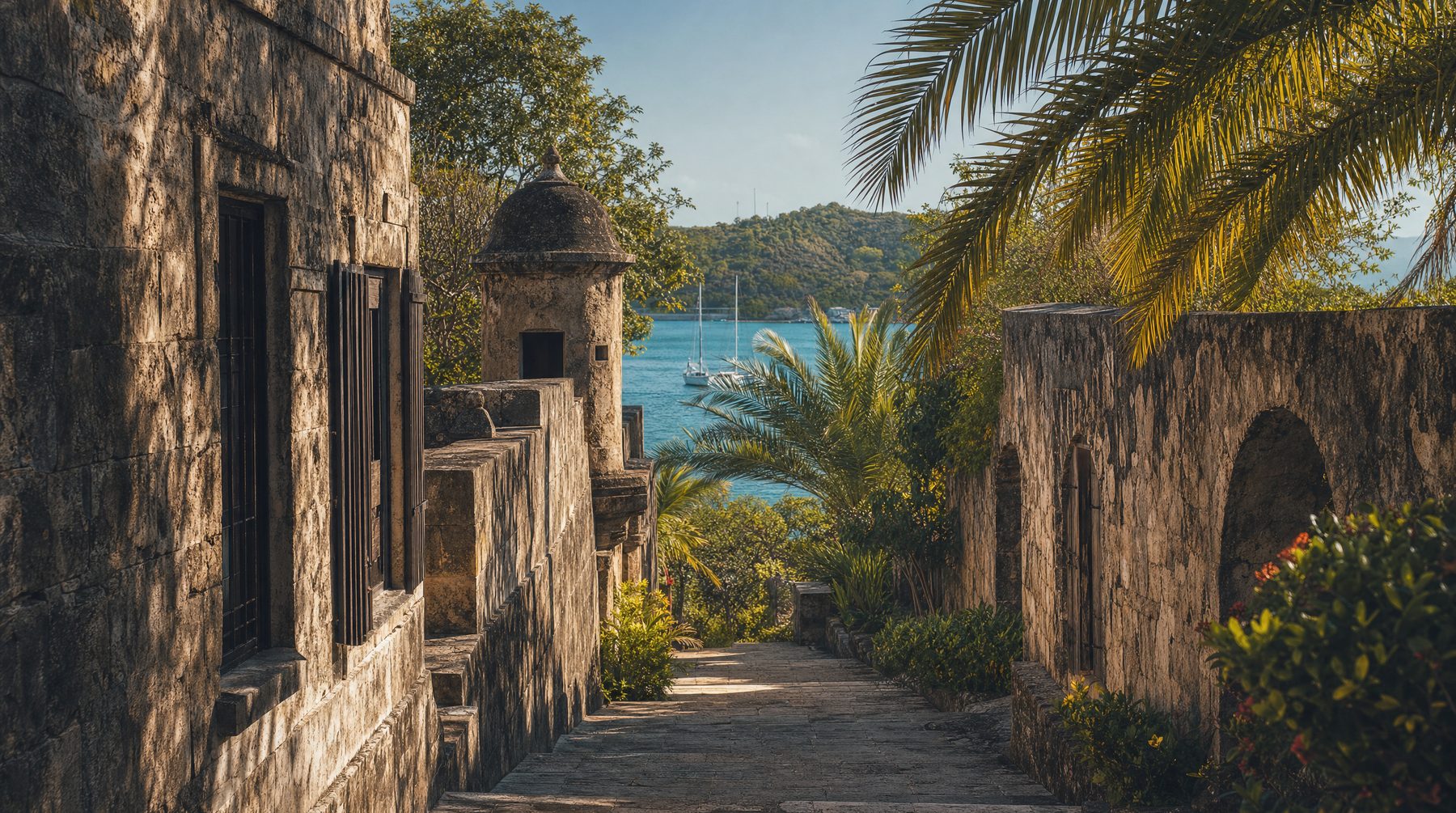
Antigua and Barbuda arrives in the salt smell of English Harbour at first light, in the colour of a Heineken at the Mad Mongoose bar in Falmouth, in the geometry of the Pillars of Hercules — a wall of basalt columns rising from the sea at the entrance to the harbour where Nelson's fleet once sheltered. This is one of those rare Caribbean places where the colonial history is not a museum exhibit but an operating business: Nelson's Dockyard has been continuously open since 1745, and on a Friday night the wooden-floored Copper and Lumber Store is full of yachties, bankers, sailors, and writers who live on boats that are themselves older than most of the houses on the island.
Antigua is famous for its 365 beaches — one for every day of the year, the tourist board claims, and the count is not far off. Half Moon Bay on the east coast, with its perfect crescent of pink sand and blue water, is one of the great underrated beaches in the Caribbean. Dickenson Bay in the north is the resort heartland — the Sandals, the Royalton, the strip of bars and restaurants that runs along the sand. Jolly Harbour on the west coast is the practical centre of expat life: a marina, a golf course, a supermarket, restaurants, banks, and a community that runs from retired British colonels to French sailors to American hedge fund partners on tax-residency status.
The country's most serious historical and visual anchor is English Harbour and the Nelson's Dockyard National Park on the south coast — a UNESCO World Heritage Site that includes Shirley Heights (the eighteenth-century military lookout, where the Sunday-night steel-band party is the social event of the week), Fort Berkeley, and the dockyard itself. Nelson commanded here in the 1780s; the buildings are Georgian, the ironmongery is original, and the harbour is full of superyachts that have come from Saint Barths, the BVIs, or Newport for the winter season.
Barbuda, the smaller sister island, is forty kilometres north of Antigua. It is reached by ferry (90 minutes) or by the small Cessna flights from St. John's. It is genuinely undeveloped — a fifteen-mile beach of pure pink sand on the western coast (one of the longest uninterrupted beaches in the world), the Frigate Bird Sanctuary in Codrington Lagoon (the largest such colony in the western hemisphere), and the Princess Diana Beach — named for her favourite Caribbean swimming spot. Hurricane Irma damaged Barbuda severely in 2017; reconstruction has been slow, and the island remains far less developed than Antigua, which is part of its appeal for those seeking absolute privacy.
The country sits at the crossroads of Caribbean travel: V. C. Bird International Airport handles direct flights to London (8 hours), New York (4 hours), Miami (3 hours), Toronto (5 hours), Frankfurt (10 hours, seasonal), and most major regional hubs. American Airlines, British Airways, Delta, Air Canada, Virgin Atlantic, KLM, and Lufthansa Condor all serve the country. From Antigua, you can be in San Juan in 90 minutes, Saint Lucia in 75 minutes, Saint Barths in 45 minutes, Miami in 3 hours, or London for breakfast. That connectivity is one of the country's unsung practical advantages.
III.
What Others Say About Antigua and Barbuda
"Antigua is the most natural sailing harbour on the planet. The wind comes from the same direction every day, the temperature never drops below seventy-two degrees, and the rum is excellent. If you can't be happy here, you can't be happy."
"What I love about Antigua is that it works. The flights work. The banking works. The lawyers work. The internet works. After ten years on tax-residency status, I have never had to chase anyone. That is more than I can say for half the European countries I have lived in."
"The view from Shirley Heights at sunset on a Sunday in January, with the steel band playing and the harbour full of boats, is one of the great sights in the Caribbean. It is also the moment when the right kind of client decides this is where they want to spend February."
IV.
Tax Benefits: What Antigua and Barbuda Has to Offer
Antigua and Barbuda is one of the few jurisdictions in the world that combines a clean 0% personal income tax position with a government-regulated Citizenship by Investment programme and a separate, formal Tax Residency programme requiring just 30 days of presence per year. The combination — passport optionality, residence flexibility, and zero personal taxation — is unusual, and it is the reason Antigua sits alongside Saint Kitts and Monaco in the higher tier of HNW Caribbean planning options.
- ›0% personal income tax — abolished in April 2016 and not reintroduced. No tax on salary, dividends, interest, capital gains, foreign pensions, foreign rental income, or any other personal earnings. Applies to both citizens and tax residents.
- ›0% capital gains tax — no tax on the sale of shares, bonds, funds, businesses, or other investments. Real estate disposals are subject to stamp duty (7.5% seller / 2.5% buyer) but no income tax on the gain.
- ›0% inheritance, estate, and wealth tax — no inheritance tax, no estate tax, no wealth or net-worth tax. Real estate transfers between family members are subject to stamp duty under standard rules.
- ›Tax Residency Programme — US$20,000 annual flat tax + 30 days presence + US$100,000 minimum income — applicants who maintain a place of abode in Antigua, spend at least 30 days per year on the islands, demonstrate annual income of at least US$100,000, and pay a flat US$20,000 annual tax receive a Permanent Residency Certificate, a Tax Identification Number, and a tax-residency certificate that can be used for international banking and treaty purposes. The flat tax is in lieu of all other personal income tax, and the programme expressly excludes worldwide income from local taxation.
- ›Citizenship by Investment from US$230,000 — government-regulated through the Citizenship by Investment Unit (CIU). Four investment routes: National Development Fund donation US$230,000 (covers up to 4 family members); University of the West Indies Fund US$260,000 (for families of 6+); approved real estate US$300,000 minimum (held 5 years); business investment US$1.5M individual or US$5M joint.
- ›Visa-free travel to 150+ countries — including the EU Schengen Area, the UK (with ETA), Singapore, Hong Kong, and most of the Commonwealth.
- ›Family inclusion is unusually broad — main applicant, spouse, dependent children up to age 30, dependent parents and grandparents over 55, and unmarried siblings can all be included. This makes the per-person cost of CBI for large families exceptionally competitive.
- ›English language, Commonwealth common-law system, USD-pegged currency — Eastern Caribbean Dollar (XCD) pegged at US$1 = XCD 2.70 since 1976. English is the official language and the language of business, banking, government, and the courts. The legal system is based on English common law.
V.
Tax Rates at a Glance
The most important tax rates in Antigua and Barbuda are as follows. Note that these have been simplified and should be used as general guidance only.
| Tax | Rate | Notes |
|---|---|---|
| Personal Income Tax | 0% | Abolished April 2016; no tax on local or worldwide income |
| Capital Gains Tax | 0% | No CGT on shares, bonds, funds, businesses, real estate gains |
| Inheritance / Estate Tax | 0% | None |
| Wealth Tax | 0% | None |
| Gift Tax | 0% | None on personal gifts (real estate transfers subject to stamp duty) |
| Tax Residency Programme | US$20,000 flat annual tax | + 30 days presence + US$100K min income |
| Permanent Residency Certificate | Issued by IRD | Valid annually; renewable |
| Corporate Income Tax | 25% | Standard rate on net profits |
| Corporate Income Tax — banks | 22.5% | Qualifying commercial banks |
| Corporate Income Tax — insurance/oil/telecoms | 10% | Reduced sectoral rate |
| International Business Company (IBC) | 0% | 50-year tax exemption on offshore activities |
| Free Trade and Processing Zone | 0% | 25-year tax holiday for qualifying exporters |
| ABST (Sales Tax) | 17% | Standard rate; 12.5% hotels; 10.5% reduced goods |
| ABST registration threshold | EC$300,000 | (~US$111,000) annual taxable activity |
| Withholding Tax — non-residents | 25% | On dividends, interest, royalties, management fees |
| Property Tax | 0.1%–0.5% | Of assessed market value, by category |
| Stamp Duty — property sale (seller) | 7.5% | Of property value |
| Stamp Duty — property sale (buyer) | 2.5% | Of property value |
| Alien Landholding License | 5% (one-off) | For non-citizens buying real estate |
| Undeveloped Land Tax (non-residents) | 10–20% | Annually, depending on holding period |
| Social Security (employee) | 5.75% | On gross salary up to XCD 78,000 |
| Social Security (employer) | 7.75% | On gross salary up to XCD 78,000 |
| Medical Benefits — employee/employer | 3.5% / 3.5% | Standard health contributions |
| CBI — National Development Fund | US$230,000 | Minimum donation, up to 4 family members |
| CBI — Real Estate | US$300,000 | Minimum approved property; held 5 years |
| CBI — University of the West Indies Fund | US$260,000 | Family of 6+ |
| CBI — Business Investment | US$1.5M / US$5M | Individual / joint |
| Currency | EC$ (XCD) | Pegged at US$1 = XCD 2.70 since 1976 |
Cryptocurrency and Crypto Assets
Antigua and Barbuda has no specific cryptocurrency taxation regime for individuals. Personal crypto gains fall under the general 0% capital gains framework — meaning capital gains from crypto trading by individuals are not taxed in Antigua. The country has positioned itself as a friendly jurisdiction for digital assets: it accepts Bitcoin payments for CBI applications via the Antigua Digital Currency Programme, and has signed memoranda with crypto firms exploring blockchain-based residency and digital identity. For individual crypto investors with substantial unrealised gains, Antigua's 0% framework combined with CBI status and the Tax Residency Programme makes it one of the cleanest Caribbean options for a long-term crypto base.
VI.
Tax Residency: What Triggers It
Antigua and Barbuda offers two parallel routes to tax residency: the standard 183-day rule (which applies in most jurisdictions worldwide) and the Permanent Residency / Tax Residency Programme specifically designed for internationally mobile clients. The latter is unusual in that it requires only 30 days of physical presence per year, making it one of the most flexible tax-residency frameworks in the world.
Under Antigua and Barbuda tax law, an individual is considered a tax resident under one of the following pathways:
- ›183-day rule: Spending 183 or more days physically present in Antigua and Barbuda during a calendar year. Day of arrival and day of departure are both counted. This is the default residency trigger for ordinary residents.
- ›Permanent Residency Programme (30-day route): Maintaining a place of abode in Antigua (leased or owned), spending at least 30 days per calendar year in the country, demonstrating annual income of at least US$100,000, and paying the flat US$20,000 annual tax. Applicants receive a Permanent Residency Certificate, a Tax Identification Number, and a Tax Residency Certificate from the Inland Revenue Department.
- ›Citizenship through CBI does NOT automatically confer tax residency. The Antigua and Barbuda passport gives citizenship and travel rights but does not by itself create tax-residence status. CBI passport holders who wish to become Antigua tax residents must additionally apply for the 30-day Tax Residency Programme or meet the 183-day rule.
Antigua and Barbuda tax residents under either pathway pay 0% personal income tax on local or worldwide income (under the standard regime) or the flat US$20,000 annual tax (under the Permanent Residency Programme). Non-residents are taxed only on Antigua-source income (which, given the absence of personal income tax, is effectively limited to withholding on certain payments and indirect taxes).
The Permanent Residency Programme requires annual renewal. The applicant must continue to maintain the place of abode, spend at least 30 days per year on the islands, pay the US$20,000 flat tax on time, and submit a renewal application to the Inland Revenue Department. Failure to meet any of these conditions terminates the programme status, though the standard 183-day rule remains available as an alternative.
Documentation matters. Establishing and maintaining Antigua tax residency requires evidence: a registered lease agreement or property title, utility bills in your name, travel records demonstrating the 30-day presence, bank account opening, social registration, and the annual flat-tax payment receipt. The Inland Revenue Department can request any of this on review. The programme is real, but it must be operated as a real residence — not as a paper transaction.
VII.
Double Tax Treaties
Antigua and Barbuda has 12 active double tax agreements (DTAs) and 17 Tax Information Exchange Agreements (TIEAs). The DTA network is concentrated in CARICOM neighbours plus a small number of European partners — significantly narrower than larger jurisdictions like Mauritius, Cyprus, or the UAE. This is a structural consideration that must be factored into any Antigua-based planning that involves source-country income.
Active DTA partners include:
- ›Barbados
- ›Belize
- ›Dominica
- ›Grenada
- ›Guyana
- ›Jamaica
- ›Saint Kitts and Nevis
- ›Saint Lucia
- ›Saint Vincent and the Grenadines
- ›Sweden
- ›Switzerland
- ›Trinidad and Tobago
- ›United Arab Emirates
Tax Information Exchange Agreements (TIEAs) — which provide for exchange of information but NOT for relief from source-country withholding — have been signed with: Aruba, Australia, Belgium, Canada, Denmark, Faroe Islands, Finland, France, Germany, Greenland, Iceland, Ireland, Liechtenstein, Netherlands, Netherlands Antilles, Norway, Portugal, Sweden, the United Kingdom, and the United States.
There are no comprehensive DTAs with the United States, the United Kingdom, Germany, France, or Canada. This is the single biggest structural limitation of Antigua-based planning for HNW clients with significant income flowing from these jurisdictions. US citizens in Antigua continue to rely on the Foreign Earned Income Exclusion (US$132,900 for 2026) and the Foreign Tax Credit. UK pensioners face UK-source pension taxation under domestic UK rules without treaty relief. German nationals face full Germany-side withholding on Germany-source income with no treaty reduction.
The CARICOM Intra-Regional Double Taxation Agreement provides a coordinated framework for the Caribbean Community member states, eliminating double taxation on most categories of income flowing between member states. For DACH and US clients, Antigua's DTA limitations are real — but the absence of personal income tax in Antigua means that for most types of foreign-sourced income, there is no Antigua-side tax to offset. The structural challenge is source-country withholding, not double taxation.
On 18 June 2025, Antigua and Barbuda signed the Multilateral Convention to Implement Tax Treaty-Related Measures to Prevent Base Erosion and Profit Shifting (MLI), though the convention is not yet in force locally. The country signed the CRS Multilateral Competent Authority Agreement on 29 October 2015, with automatic exchange beginning in September 2018. Country-by-Country Reporting via the CbC MCAA has been in effect since 28 January 2024.
VIII.
Avoid Remaining Tax Resident at Home
Relocating to Antigua and Barbuda — whether through citizenship by investment, the Permanent Residency Programme, or both — does not automatically end your tax obligations elsewhere. The critical question is whether you have genuinely severed tax residency in your country of origin — and this is determined not by where you have registered an address, but by where you actually live, where your ties are, and how your life is organised.
This is particularly important for Antigua, because the 30-day presence requirement under the Permanent Residency Programme leaves significant room for clients to spend the majority of their time elsewhere. If "elsewhere" happens to be a high-tax country where the client retains a home, family, and business interests, the home-country tax authority will likely conclude that tax residency was never severed — regardless of the Antigua certificate.
The most common triggers that keep clients tax-resident at home:
- ›Available dwelling: Any long-term residence that remains available for your use — a flat you own, a property you rent on an ongoing basis, even a room in a family home — is sufficient to maintain a taxable domicile in many countries. The dwelling does not need to be your primary home; it only needs to be available. Surrendering it before departure is a precondition of a clean exit in Germany, Austria, Switzerland, and many other jurisdictions.
- ›Centre of vital interests: If your family, your business, your social connections, and your financial affairs remain in your home country, most tax authorities will argue that your centre of life has not genuinely moved — regardless of where you have registered. Spouse and minor children remaining in the home country are particularly powerful indicators.
- ›183-day rule (home country): Spending more than 183 days in your home country in a calendar year will typically trigger residency there, overriding any claim to Antigua residency for that year. Antigua's 30-day requirement leaves up to 335 days per year potentially spent elsewhere — and some of that "elsewhere" must NOT be your previous home country.
- ›Extended unlimited tax liability (Germany): Germany's *erweiterte unbeschränkte Steuerpflicht* under §2 AStG can keep you taxable in Germany for up to ten years after departure if you move to a low-tax country (Antigua qualifies as low-tax under the §2 AStG framework) and retain significant ties. This applies to ongoing income, not just exit-year gains.
A genuine relocation requires that you actually live somewhere other than your previous country — that your home is there, your daily life is there, and that you can demonstrate this with documentation. An Antigua passport, an Antigua residency certificate, and a registered Antigua lease are necessary but not sufficient. The remaining 335 days of the year must be lived somewhere defensible: in Antigua itself, in another tax-favourable jurisdiction, or in a pattern of genuine international mobility that does not re-establish tax residence in the high-tax origin country.
The test is not where you are registered. The test is where you live, where your family lives, where your business is run from, and where your significant ties exist. Tax authorities in Germany, Austria, the UK, Switzerland, and the US are experienced at identifying paper relocations and have the legal tools to challenge them. Proper advice before you move — not after — is essential.
IX.
Tax Considerations When Leaving Your Home Country
Before you relocate, you need to understand what tax consequences arise in your current country of residence at the point of departure. These rules vary significantly by country and must be assessed individually — there is no universal answer.
Many countries impose an exit tax or deemed disposal charge when a tax resident leaves. This typically applies to unrealised capital gains on shares, business interests, real estate, or other assets — taxing you as if you had sold everything on the day you departed. The rules differ widely: some countries apply this to all assets above a threshold, others only to substantial shareholdings or business interests. Some have look-back periods that can catch you even after you have left.
Among the countries that levy a meaningful exit tax or deemed-disposal charge:
- ›Germany. The §6 AStG exit tax on unrealised gains in shareholdings of 1% or more applies at departure. Crucially, because Antigua is treated as a low-tax jurisdiction under §2 AStG, Germany's "extended unlimited tax liability" can apply for up to 10 years after departure — taxing ongoing German-source income and certain foreign-source income flows. This makes Antigua a more complex German exit destination than EU jurisdictions where §2 AStG does not apply. There is no Germany-Antigua DTA, so no treaty relief is available. Pre-departure planning is essential.
- ›United States. The "expatriation tax" under IRC §877A treats long-term residents and citizens as having sold all worldwide assets at fair market value on the day they relinquish citizenship or residency. The exemption for 2026 is approximately US$890,000. There is no escape for covered expatriates. Recipients of gifts or bequests from covered expatriates may face up to 40% recipient tax under §2801. There is no US-Antigua income tax treaty.
- ›United Kingdom. Statutory Residence Test (SRT) exit date must be precisely established. The new FIG regime (in force since 6 April 2025) is irrelevant to Antigua-bound clients — it is a regime for new UK arrivals, not departures. UK pensioners moving to Antigua face UK-source pension taxation under domestic rules with no Antigua treaty relief. There is no comprehensive UK-Antigua DTA (only a TIEA signed in 2010).
- ›France. Exit tax applies to unrealised gains on securities and company rights above €800,000 when a French tax resident relocates to a non-EU/EEA country. Antigua is non-EU/EEA, so the deferral mechanism available for moves within the EU does not apply.
- ›Netherlands. Deemed disposal applies to substantial shareholdings (5% or more) at the point of emigration. Conservation assessment may apply.
- ›Australia. Departing residents are treated as having disposed of most assets at market value on the date they cease to be Australian tax residents.
- ›Canada. The "departure tax" deems most property to have been disposed of at fair market value on the date of emigration, triggering capital gains on unrealised appreciation.
Beyond exit tax, you may remain subject to limited tax liability in your home country after the move — for example, on rental income from property you continue to own there, on dividends from domestic companies, or on pension payments. Severing tax residency does not necessarily sever all tax obligations.
The timing of your departure, the structure of your assets, and the sequence of any business disposals all have material consequences. In some cases, restructuring assets before departure — or deferring the move by a few months — can make a significant difference to the tax outcome.
⚠ Obtain Local Tax Advice in Your Home Country. The information above provides a general overview of the departure tax rules that commonly apply when leaving high-tax jurisdictions. It is not legal or tax advice. The rules in your specific home country — Germany, Austria, Switzerland, the UK, the US, or any other jurisdiction — are complex, change frequently, and depend entirely on your personal circumstances: your nationality, the nature and location of your assets, your business structure, your family situation, and the timing of your departure. Before you take any steps to relocate, obtain written advice from a qualified tax adviser who is licensed in your home country and experienced in international relocations. A consultation with us is a good starting point — but it does not substitute for country-specific legal advice from a practitioner in your jurisdiction of departure. The cost of getting this wrong is almost always greater than the cost of getting proper advice upfront.

X.
Company Setup & Corporate Tax
Antigua and Barbuda offers several corporate structures, each with distinct tax implications. The personal 0% income tax position must not be confused with corporate taxation — which, for ordinary domestic companies, runs at 25% on net profits.
- ›Antigua Limited Company (Domestic): Standard vehicle for businesses operating in Antigua. Minimum share capital is XCD 1,000 (~US$370). Corporate tax is 25% on net profits, with reduced rates of 22.5% for qualifying commercial banks and 10% for insurance, oil, and telecommunications companies. Companies operating in the country must register for ABST if turnover exceeds EC$300,000 (~US$111,000) and pay 17% sales tax on goods and services.
- ›International Business Company (IBC): The flagship offshore vehicle. IBCs are tax-exempt for 50 years from incorporation on most categories of income — including business profits, dividends, interest, royalties, and capital gains — provided the IBC operates exclusively outside Antigua and does not derive income from Antigua sources. IBCs require one shareholder and one director (can be the same person or legal entity, of any nationality), filing of audited accounts is not mandatory, and beneficial ownership reporting requirements apply under the December 2024 Guidance Note. Annual licence fees apply. The IBC is a serious instrument when structured with genuine substance — it is not a paper wrapper for onshore activities.
- ›Free Trade and Processing Zone (FTPZ) Company: The Antigua Free Trade and Processing Zone in the northeastern part of Antigua offers a 25-year tax holiday on corporate income, import duties, sales tax, and property tax for qualifying export-oriented businesses. Suitable for genuine offshore manufacturing, processing, and services with international clients.
- ›Unincorporated Business (Sole Trader / Partnership): Subject to Unincorporated Business Tax (UBT) on a sliding scale from 0% to 25% of gross income (less certain deductions). Filed quarterly. Suitable for small consulting practices, professional services, and family-run operations.
Dividends paid by Antigua companies to resident shareholders are not subject to additional personal income tax (since personal income tax is 0%). Dividends paid to non-residents are subject to 25% withholding tax, which can be reduced under the limited DTA network where applicable.
Antigua and Barbuda has implemented economic substance requirements in line with OECD and EU standards. IBCs and other relevant entities must maintain adequate substance — premises, qualified employees, and operating expenses — proportionate to the scale and nature of their business. The Inland Revenue Department reviews substance compliance, and non-compliance can result in loss of tax-favoured status.
For most HNW relocation clients, the decision is not "Antigua company vs home-country company" — it is whether the client's personal tax position changes when they relocate. The Antigua company option becomes relevant only when there is a genuine business reason to operate from Antigua: an active investment fund, a family office, an offshore consulting practice with international clients, or a marine/aviation/yachting business that benefits from Antigua's regional expertise.
Is a local company always the right answer?
Not necessarily. For many internationally mobile entrepreneurs, the local Antigua company is not the most efficient operating vehicle. A local company is useful when you have local staff, local premises, local customers, or regulated local activity. If your business earns income internationally, an international structure may be cleaner.
- ›US LLC — often suitable for non-US owners with non-US income who need simple administration and good payment access.
- ›Singapore company — useful where banking reputation, Asian counterparties, and strong legal infrastructure matter.
- ›UAE company — useful for zero-tax or low-tax operating structures when substance, management, and banking can be handled properly.
Permanent establishment risk is the central warning. A foreign company that is effectively managed from a high-tax country, or that has staff, sales activity, or day-to-day control located there, may still be taxed locally regardless of where it is incorporated. Genuine management, banking, contracts, and operational substance in Antigua are essential for the IBC and FTPZ structures to deliver their intended tax treatment.
XI.
Who Should (and Shouldn't) Move to Antigua and Barbuda
Section 11 is where the relocation decision becomes practical. Antigua and Barbuda can be an excellent fit for some profiles and a poor fit for others; the decisive question is whether the tax rules, lifestyle, residence requirements, banking, healthcare, and family situation point in the same direction.
Good Fit
- ›HNW entrepreneurs, investors, and families seeking a government-regulated second citizenship with broad family inclusion (spouse, children to 30, parents/grandparents 55+, unmarried siblings).
- ›Internationally mobile clients who genuinely want a Caribbean base with the flexibility of 30 days/year minimum presence — typically retirees, sailors, and remote-working entrepreneurs.
- ›HNW retirees with portable foreign income (foreign pensions, investment portfolios, foreign rental property) and no significant Germany-, US-, or UK-source income that requires DTA relief.
- ›Clients seeking a passport upgrade for travel mobility — Antigua's Commonwealth passport gives visa-free or visa-on-arrival access to 150+ countries including the Schengen Area, the UK (with ETA), Singapore, and Hong Kong.
- ›Sailors, yachtsmen, and the global yachting community — Antigua is the regional capital of Caribbean sailing and one of the most established yachting registries.
- ›Individuals willing to handle banking documentation, CRS/FATCA reporting, source-of-wealth files, and a clean home-country exit properly rather than improvising after arrival.
Poor Fit
- ×Those who cannot genuinely spend 30+ days per year in Antigua AND avoid re-establishing tax residence in their previous high-tax country for the remaining 335 days.
- ×German nationals with significant German-source income who require DTA protection — there is no Germany-Antigua DTA, and Germany's §2 AStG extended-liability framework can apply for up to 10 years.
- ×US clients expecting Antigua status to eliminate US tax filing — the US taxes citizens on worldwide income regardless of residence, and there is no US-Antigua DTA.
- ×Clients seeking to base operating businesses with EU/US clients in Antigua — the limited DTA network creates source-country withholding inefficiencies that make the structure uneconomic vs alternatives like Cyprus, Malta, or the UAE.
- ×Anyone choosing the jurisdiction only because of CBI marketing, without testing housing, banking, healthcare, schooling, and lifestyle fit.
- ×Clients who need a year-round metropolitan or institutional environment — Antigua is small, insular, and operates at island pace; it is not Singapore, Geneva, or Dubai.
XII.
Visas and Residence Permits
Antigua and Barbuda offers several distinct routes for foreign nationals, each suiting different profiles. The key planning point is that short-stay entry, work permits, the Permanent Residency Programme, and citizenship by investment are four separate frameworks — and they should not be blurred.
- ›Visa-free / visa-on-arrival entry: Citizens of over 130 countries — including the EU, UK, US, Canada, Australia, and most Commonwealth states — can enter visa-free for stays up to 1 month (extendable to 6 months). This is sufficient for the 30-day Permanent Residency Programme presence requirement without any additional immigration formality.
- ›Permanent Residency Programme (Tax Residency): The flagship route for HNW relocation. Maintain a place of abode in Antigua (leased or owned), spend at least 30 days per year on the islands, demonstrate annual income of at least US$100,000, and pay the flat US$20,000 annual tax. Applicants receive a Permanent Residency Certificate, a Tax Identification Number, and a Tax Residency Certificate. Renewable annually. Does not by itself confer citizenship rights but is a defensible tax-residence position for international purposes.
- ›Nomad Digital Residence (NDR) — discontinued: Antigua's 2-year remote-work visa was officially terminated with effect from 15 November 2025 and no longer accepts applications. Remote workers now rely on visa-free short stays or the Standard Residence Permit route below.
- ›Standard Residence Permit (4-year route to Permanent Residence): Available through employment, business establishment, family reunification, or property ownership. Initial permit valid for 1 year, renewable; permanent residence available after 4 years of legal residence. Requires meaningful presence and integration.
- ›Citizenship by Investment (CBI): The flagship product. Granted by the CBI Unit (CIU) under the Citizenship by Investment Act. Four investment routes:
- ›National Development Fund (NDF): US$230,000 minimum donation, covering main applicant + up to 3 dependents. Most popular route. Non-refundable.
- ›Approved Real Estate: US$300,000 minimum in a CIU-approved development, held for at least 5 years. Property may be sold to another CBI applicant after 5 years.
- ›University of the West Indies Fund: US$260,000 contribution for families of 6 or more — most cost-effective for large families.
- ›Business Investment: US$1.5M individual investment OR US$5M joint investment in a CIU-approved business venture.
- ›CBI minimum stay: Visit Antigua for at least 5 days within the first 5 years of citizenship to maintain status. The government has indicated future plans to raise this to 30 days, but as of 2026, 5 days remains the rule.
- ›Work Permits: Required for employment in Antigua. Tied to specific employer; renewable annually. Not relevant for most HNW relocation clients who derive income from foreign sources or who establish their own offshore companies.
The clean planning order is: (1) define the goal — passport, residence, tax residence, business base, lifestyle base, or some combination; (2) select the appropriate framework — CBI for passport, Permanent Residency Programme for tax residence, both together for full coverage; (3) handle the application through the appropriate authority with a licensed local agent or lawyer.
Visa and permit rules can change. Always verify current requirements with the Antigua and Barbuda High Commission or Embassy in your country of residence before making any plans. We can assist with the preparation of documentation and coordination with local authorities as part of our relocation service.
XIII.
Path to Citizenship
Antigua and Barbuda offers two parallel paths to citizenship: standard naturalisation through long-term legal residence, and the Citizenship by Investment (CBI) Programme — the route that has put Antigua on the international HNW map.
Standard Naturalisation requires:
- ›7 years of continuous legal residence in Antigua and Barbuda
- ›Good character and clean criminal record
- ›Knowledge of basic English (the official language) and reasonable knowledge of Antigua and Barbuda
- ›Demonstrable lawful means of support
- ›Oath of Allegiance to the Sovereign of Antigua and Barbuda
Citizenship by Investment (CBI) Programme is the route most relevant for international clients. Established by the Citizenship by Investment Act 2013 and administered by the Citizenship by Investment Unit (CIU) under the Prime Minister's Office, it grants full Antigua and Barbuda citizenship and a Commonwealth passport in exchange for a qualifying economic contribution.
Four investment routes:
- ›National Development Fund (NDF) — US$230,000 minimum: A non-refundable donation to the NDF. Covers main applicant plus up to 3 dependents. Most popular route. Government processing fees apply on top: approximately US$30,000 main applicant + US$15,000 spouse + US$10,000 per dependent. Due diligence fees: US$7,500 main applicant + US$7,500 spouse + US$2,000 per dependent.
- ›Approved Real Estate — US$300,000 minimum: Investment in a CIU-approved real estate project, held for at least 5 years. Property may be resold to another CBI applicant after the 5-year period. Government and processing fees apply on top.
- ›University of the West Indies Fund — US$260,000: A single donation route designed specifically for large families (6 or more members). Covers main applicant plus 5 dependents and includes a one-year tuition-only scholarship at UWI. Most cost-effective for families.
- ›Business Investment — US$1.5M individual / US$5M joint: Investment in a CIU-approved business venture. Less commonly used.
Family inclusion is unusually broad:
- ›Main applicant
- ›Spouse
- ›Dependent children up to age 18 (or up to 30 if full-time students)
- ›Dependent children over 18 with disabilities
- ›Dependent parents and grandparents over 55
- ›Unmarried siblings of the main applicant or spouse
Processing time: Officially 3–6 months. Backlogs have been reported in 2025–2026, with current processing closer to 5–7 months. Applications must be submitted by a CIU-licensed agent.
Minimum stay requirement: Citizens by investment must visit Antigua and Barbuda for at least 5 days within the first 5 years of citizenship to maintain status. The government has indicated plans to raise this requirement to 30 days, but as of 2026 the 5-day rule is in force. CBI citizens are NOT required to live in Antigua, take a language test, or renounce their existing citizenship.
Dual citizenship is permitted. Antigua and Barbuda imposes no restriction on holding multiple citizenships.
Restricted nationalities: Citizens of certain countries (the list is updated periodically by the CIU) cannot apply directly through the standard CBI route. Applicants from these countries must demonstrate they migrated before age of majority and have lived outside the restricted country for at least 10 years, with no remaining ties.
The CIU is rigorous on due diligence: criminal background checks, financial verification, source-of-funds documentation, health checks, and biometric data are all required. Discounted or unofficial offers should be treated as red flags — the official CIU warns against them publicly. The correct approach is to engage a CIU-licensed agent or law firm, prepare a complete and honest source-of-funds file, and budget for the official fees in full. Antigua's CBI programme is well-regulated, and applications that pass due diligence are processed reliably.
The Antigua and Barbuda passport provides visa-free or visa-on-arrival access to 150+ countries, including the EU Schengen Area, the UK (with ETA), Singapore, Hong Kong, and most Commonwealth countries. It does not provide US visa-free access — Antigua passport holders require a B1/B2 visa for the US.

XIV.
Banking in Antigua and Barbuda
Antigua and Barbuda has a functional local banking sector with a mix of regional Caribbean and international banks. The country is a member of the Eastern Caribbean Currency Union, sharing the EC$ (XCD) which is pegged to the US dollar at 2.70:1 — meaning effective USD-denominated banking with a Caribbean institutional layer.
The major banks operating in Antigua and Barbuda are:
- ›CIBC FirstCaribbean International Bank — the largest regional bank, full retail and commercial services, strong for international clients with Canadian banking ties
- ›Antigua Commercial Bank (ACB) — local institution, broad retail services, the operational bank of choice for many local residents
- ›Eastern Caribbean Amalgamated Bank (ECAB) — local commercial bank with strong service for HNW clients
- ›Global Bank of Commerce (GBC) — Antigua-licensed international bank specialising in offshore corporate banking, IBC services, and HNW private banking
- ›RBC Royal Bank — regional presence; full-service retail and commercial
- ›FNB Antigua Limited — local institution
Account opening for non-residents is possible at most institutions with a passport, proof of address, source-of-funds documentation, and a bank reference. Multi-currency accounts (USD, EUR, GBP, XCD) are widely available. Online banking is standard. SWIFT transfers are available at all major banks.
The banking sector has been subject to correspondent-banking pressure since 2015 — like much of the Caribbean. Major US correspondent banks have reduced their direct relationships with smaller Caribbean institutions, which can occasionally affect international wire-transfer processing times and costs. Antigua's banks have generally adapted by maintaining multi-tier correspondent relationships, but this is a structural feature of regional banking that clients should be aware of.
For Antigua tax residents and CBI passport holders, the typical banking architecture is:
- ›Local Antigua account — for living expenses, real estate, residence administration, the annual flat tax payment, and the proof of operational presence required for the Permanent Residency Programme.
- ›Primary international booking centre — Singapore, Switzerland, the UAE, Luxembourg, the UK (under FIG), or the US (for US clients) — for the bulk of investment portfolios, where private banking depth, custody quality, and multi-currency capability are stronger than the regional Caribbean banks can provide.
Where to hold your main accounts
For most internationally mobile clients, the primary banking relationship should not automatically sit in Antigua. Local accounts are useful for rent, utilities, residence administration, real estate, and domestic spending, but your main wealth and operating accounts should usually remain in stronger international banking centres.
- ›Switzerland — private banking, wealth custody, and long-term capital preservation.
- ›Singapore — strong Asian banking, excellent reputation, and robust multi-currency infrastructure.
- ›United States — practical for USD payments, brokerage access, cards, and global business counterparties.
- ›UAE / Luxembourg — useful complementary booking centres for internationally mobile HNW families.
Important: not all international banks are compatible with all residencies. Some Swiss and Singaporean private banks have explicit restrictions on clients resident in CBI jurisdictions, and many require enhanced due diligence on Antigua residents. Source of wealth documentation must be impeccable. Several private banks impose minimum asset thresholds (typically USD 1–5 million) and will not accept Antigua-resident clients below those thresholds. Decide the banking architecture before relying on the relocation — the worst outcome is acquiring CBI status and then discovering that the major private banks will not open accounts for the new resident.
XV.
What Makes Antigua and Barbuda Genuinely Attractive
Antigua and Barbuda is attractive when it is judged as a complete relocation platform, not as a slogan. The point is not that Antigua is perfect for everyone. The point is that, for the right person, the combination of tax position, residence practicality, lifestyle, geography, banking, language, and long-term stability can produce a genuinely coherent base.
- ›The planning architecture is unusually clean. Passport optionality through CBI from US$230,000, tax residence through a separate annual programme (30 days + US$20,000 + US$100,000 income), and 0% personal income tax across all categories. Few jurisdictions combine all three so transparently.
- ›The lifestyle case is real and specific. English Harbour and Nelson's Dockyard are the great Georgian sailing stations of the Caribbean — working harbours, not stage sets. The 365 beaches are real. The food is improving rapidly (the Caribbean culinary scene of the 2020s is something genuinely new). And Antigua Sailing Week in late April is one of the great regattas in the world.
- ›It is not secrecy-based. The attraction survives transparency. CRS, FATCA-equivalent reporting, due diligence on CBI applicants — Antigua has signed and implemented the OECD frameworks. The reason Antigua works is that the local personal-tax system is genuinely favourable, not because it hides anything.
- ›It can function as a genuine operating base. Direct flights to London, New York, Miami, Toronto, and Frankfurt; functional internet; English language; Commonwealth common-law courts; regional banking; superyacht infrastructure. For a sailor, an investor, an offshore consulting professional, or an internationally mobile family, the practical infrastructure is real.
- ›It rewards the right profile. It suits clients who want a clean second base in a Caribbean setting with English language and Commonwealth institutions — not clients trying to improvise a fake offshore life, not clients who require a major-city lifestyle, and not clients who need a treaty-network jurisdiction for source-country withholding relief.
- ›The attraction has to be handled honestly. The DTA network is narrow — no comprehensive treaties with the US, UK, Germany, France, or Canada. The 30-day presence requirement is real and must be met. Banking architecture must be planned in advance. And the home-country exit must be done properly, particularly for German nationals where §2 AStG can apply for up to 10 years.
XVI.
Cost of Living in Antigua and Barbuda
Antigua and Barbuda is not a cheap emerging-market base. It is an import-dependent Caribbean jurisdiction where most consumer goods, cars, fuel, food, and household supplies are imported and priced accordingly. For internationally mobile clients, the question is not survival cost but the budget required for Western-level housing, private healthcare, schooling, and lifestyle in a Caribbean setting.
Typical monthly costs for an internationally mobile professional or family in Antigua and Barbuda (2026 planning ranges):
| Category | EC$/month | GBP/month | USD/month |
|---|---|---|---|
| 1-bed apartment, desirable area | EC$4,860–8,100 | £1,400–2,400 | $1,800–3,000 |
| 2-bed villa / townhouse | EC$8,100–16,200 | £2,400–4,800 | $3,000–6,000 |
| Premium villa, Jolly Harbour / Falmouth | EC$13,500–32,400 | £4,000–9,600 | $5,000–12,000 |
| International school (annual per child) | EC$40,500–94,500 | £12,000–28,000 | $15,000–35,000 |
| Private health insurance (annual individual) | EC$8,100–24,300 | £2,400–7,200 | $3,000–9,000 |
| Restaurant meal, mid-range (per person) | EC$135–270 | £40–80 | $50–100 |
| Monthly groceries, single person | EC$1,890–3,510 | £550–1,050 | $700–1,300 |
| Utilities and internet, apartment | EC$945–1,890 | £280–560 | $350–700 |
| Car (used, mid-range, one-time) | EC$54,000–135,000 | £16,000–40,000 | $20,000–50,000 |
- ›Comfortable single professional (no children): EC$13,500–24,300/month (£4,000–7,200 / $5,000–9,000)
- ›Family of four with private schooling: EC$24,300–54,000/month (£7,200–16,000 / $9,000–20,000)
These figures are planning ranges, not promises. The actual budget in Antigua depends heavily on housing quality, neighbourhood, school choice (Antigua International School, Cobbs Cross School, and Verdant Valley International serve the expat community), healthcare needs, car ownership, travel frequency, and whether you maintain a Western expatriate standard or a more local lifestyle. Imported goods carry duty and ABST; locally produced food, hospitality services, and labour are relatively affordable.
Travel costs are a real factor. Most expat families travel internationally several times per year — to family in the UK, US, or Europe, to medical specialists in Miami or London, to schools and universities, and for business. Antigua's flight connectivity is excellent but not cheap: a return London-Antigua economy ticket runs £900–2,000+ in season, and business class £4,000–8,000+. Budget realistically for travel.
Healthcare: routine and primary care is available in Antigua at reasonable cost (private GP visits EC$135–270 / US$50–100). For specialist treatment, surgery, or complex care, most expatriates travel to Miami (3 hours direct) or London. Comprehensive private health insurance with international coverage is essential; Bupa Global, Cigna Global, and Allianz International are the standard options for HNW families, with premiums of US$3,000–9,000+ per individual annually.
XVII.
Buying Real Estate in Antigua and Barbuda
Buying real estate in Antigua and Barbuda can serve three distinct purposes: as a CBI investment route (US$300,000 minimum in a CIU-approved development, held 5 years); as the place-of-abode required for the Permanent Residency Programme; or as a lifestyle property held for personal use. These three purposes require different properties, different price points, and different due diligence approaches — and they should not be confused with each other.
For internationally mobile buyers, the main points in Antigua and Barbuda are:
- ›Ownership rules: Foreigners can own freehold real estate in Antigua and Barbuda, but must obtain an Alien Landholding License (ALHL) from the government before completing the purchase. The ALHL fee is 5% of the property value, paid by the buyer at closing. The application typically takes 2–4 months. ALHL requirements are waived for CBI applicants buying CIU-approved real estate.
- ›Transaction costs: Stamp duty 7.5% (seller) + 2.5% (buyer); ALHL 5% (non-citizen buyers); legal fees 1–2%; valuation, survey, and title search additional. Total buyer-side cost typically runs 8–10% of purchase price for non-citizens; total seller-side cost runs 8–10% (stamp duty + agent commission). Build these costs into the offer.
- ›Market and rental profile: Antigua's main residential markets are Jolly Harbour (the principal expat community on the west coast), English Harbour / Falmouth (the sailing and superyacht heartland on the south), Hodges Bay and Dickenson Bay (north coast resort zones), and the gated developments around Five Islands. Barbuda's market is concentrated in two major SIS-style developments. Liquidity is thin compared to European or US markets — properties can take 6–18 months to sell. Rental yields run 4–8% gross for villa rentals; the short-term rental market is regulated and seasonal.
- ›Hurricane exposure: Antigua sits in the Atlantic hurricane belt. Properties must be built to modern hurricane codes and insured comprehensively. Hurricane Irma in 2017 and various Category 4–5 events have caused significant damage in past decades. Hurricane insurance is mandatory for mortgaged properties and strongly recommended for cash purchases.
- ›Residence and tax angle: A property held for the Permanent Residency Programme need not be expensive — a one-bedroom apartment of US$200,000–400,000 satisfies the place-of-abode requirement. A CBI-approved real estate purchase requires US$300,000 minimum and must be held for 5 years before resale. A lifestyle villa for personal use can run from US$500,000 (modest) to US$5M+ (premium English Harbour or Falmouth waterfront).
The practical approach is to decide first whether the property is primarily for CBI investment, residence support, lifestyle, or rental yield. Those are different purchases. A good real estate decision in Antigua begins with title due diligence, ALHL assessment, hurricane code review, tax-residence planning, inheritance review, and a realistic exit strategy — not with glossy developer brochures.
Transaction cost table (Antigua and Barbuda):
| Cost item | Typical amount | Notes |
|---|---|---|
| Stamp duty (seller) | 7.5% | Of declared property value |
| Stamp duty (buyer) | 2.5% | Of declared property value |
| Alien Landholding License | 5% (one-off) | Non-citizen buyers; waived for CBI real estate route |
| Legal fees | 1.0–2.0% | Buyer's solicitor |
| Real estate agent | 5–6% | Typically paid by seller |
| Annual property tax | 0.1%–0.5% | Of assessed market value |
| Undeveloped land tax (non-resident) | 10–20% | Annually, depending on holding period |
| Hurricane insurance | 1.5–3% | Annually, of replacement cost |
| Title search and registration | XCD 500–2,000 | Fixed-fee component |

XVIII.
Retiring in Antigua and Barbuda
Antigua and Barbuda has emerged as one of the more credible Caribbean retirement destinations for HNW clients, particularly those from the UK, US, and Canada. The combination of English language, Commonwealth common-law system, established expat community, year-round tropical climate, sailing culture, and 0% personal income tax framework makes it a serious option for retirees with portable foreign income.
There is no specific retirement visa in Antigua. Retirees typically use one of the standard pathways:
- ›Permanent Residency Programme (30-day route): The most common HNW retirement pathway. Maintain a place of abode (typically a 1-2 bedroom apartment or modest villa), spend at least 30 days/year on the islands, demonstrate annual pension/investment income of at least US$100,000, and pay the US$20,000 annual flat tax. This gives a formal Permanent Residency Certificate, a TIN, and a Tax Residency Certificate — useful for international banking and for managing source-country taxation of pensions.
- ›Citizenship by Investment: Used by retirees who want passport optionality and visa-free travel in addition to residence. Adds the cost of the CBI investment (US$230,000+) but eliminates ongoing visa renewal and provides intergenerational benefit (children and grandchildren can later be added in some routes, or they receive the CBI passport from birth if naturalised before).
- ›Standard Residence Permit + Property Ownership: Slower route; requires 4 years of legal residence before permanent residence and an additional period before naturalisation.
For retirees with foreign pension income, the tax treatment depends on the source country. Antigua imposes no tax on pension income — local or foreign. However, pension-source countries may continue to tax the pension at source, and the limited DTA network (no comprehensive UK-Antigua, US-Antigua, Germany-Antigua, or Canada-Antigua DTAs) means treaty relief is generally not available. Specifics depend heavily on the pension type, source country, and treaty position:
- ›UK state pension and most UK private pensions: Subject to UK tax under domestic rules; no Antigua-side tax. Effective tax = UK rate.
- ›US Social Security and US private pensions: Subject to US tax (citizens are taxed on worldwide income regardless of residence); FEIE does not apply to pension income; FTC available if Antigua tax exists, which it does not.
- ›German Rente: Subject to German tax under §49 EStG for non-residents; Germany retains taxing right under its non-DTA position.
- ›Canadian CPP/OAS: Generally subject to Canadian tax with limited withholding relief.
- ›Foreign private pension annuities and drawdown: Treatment varies; specific advice essential.
Climate: year-round 24–30°C with consistent trade winds; rainy season June–November; hurricane season parallels rainy season. The climate is genuinely pleasant for retirees who value warmth and sea air over four-season variety.
Healthcare: routine and primary care is available at reasonable cost in St. John's and the Jolly Harbour / English Harbour areas. Mount St. John's Medical Centre is the main public hospital; Adelin Medical Centre and other private clinics serve the expat community. For complex specialist treatment, surgery, or chronic conditions, retirees typically travel to Miami (3 hours direct), London, or Toronto. Comprehensive international health insurance (Bupa Global, Cigna Global, Allianz International) is essential; expect US$3,000–9,000+ per individual annually depending on age and coverage.
Cost of living: see Section XVI. A comfortable single retiree budget runs US$5,000–9,000/month; a couple US$8,000–15,000/month including private healthcare and travel. The cost is manageable for HNW retirees but is not Latin-America cheap.
Community: Antigua has well-established expat retirement communities particularly around English Harbour, Falmouth, Jolly Harbour, and the gated developments north of St. John's. The British, American, and Canadian retiree presence is significant; sailing, golf (Cedar Valley, Jolly Harbour), tennis, and bridge clubs are active.
XIX.
US Citizens: What You Need to Know
US citizens and long-term green card holders are taxed by the United States on their worldwide income, regardless of where they live. Relocating to Antigua and Barbuda does not end US tax obligations — it changes the picture, but does not eliminate it. The US is the only major economy that taxes its citizens on a citizenship basis (rather than a residence basis), so US citizens face a fundamentally different planning question than nationals of any other country.
Key considerations for US citizens in Antigua and Barbuda:
- ›Foreign Earned Income Exclusion (FEIE): US citizens who qualify as bona fide residents of Antigua or pass the physical presence test can exclude up to US$132,900 of foreign earned income from US federal income tax for 2026 (up from US$130,000 in 2025; indexed annually). This applies to wages and self-employment income — not passive income such as dividends, interest, capital gains, foreign pensions, or rental income.
- ›Foreign Tax Credit: Tax paid in Antigua can generally be credited against US tax on the same income — but Antigua has 0% personal income tax, so there is no Antigua tax to credit against. US citizens in Antigua cannot use the FTC to offset US tax liability on their non-FEIE-excluded income; they pay full US tax on it.
- ›No US-Antigua DTA: Unlike most major US partners, the United States and Antigua and Barbuda do not have a double tax agreement. The two countries have a Tax Information Exchange Agreement (TIEA, signed 2007) but no DTA. This means no treaty relief on source-country withholding, no tie-breaker provisions for residency conflicts, and no DTA-based benefits.
- ›FBAR (FinCEN Form 114): US persons with Antigua bank accounts exceeding US$10,000 in aggregate at any point during the year must file FinCEN Form 114 (FBAR) annually. Failure to file carries severe penalties (up to US$10,000 per non-willful violation; up to 50% of account balance for willful).
- ›FATCA (Form 8938): Antigua participates in FATCA reporting — Antigua financial institutions identify US account holders and report account information to the US authorities. US citizens with foreign accounts above the FATCA thresholds (US$50,000-US$600,000 depending on filing status and residence) must additionally file Form 8938 annually.
- ›PFIC (Passive Foreign Investment Company): US citizens holding non-US mutual funds, ETFs, or pooled investments (including many Antigua-domiciled funds) face the punitive PFIC regime under IRC §1291–1298 unless QEF or mark-to-market elections are made. This is a significant compliance and tax issue for US citizens with foreign investment portfolios.
- ›CFC and Subpart F: US citizens holding majority stakes in foreign companies (including Antigua IBCs) face Controlled Foreign Corporation reporting and Subpart F passive-income inclusion rules under IRC §951. Form 5471 filing is required.
- ›Self-Employment Tax: There is no totalisation agreement between Antigua and the United States. US citizens with self-employment income in Antigua may owe US self-employment tax (15.3% on first US$168,600 of SE income for 2026) on their net earnings, in addition to having that income subject to US federal income tax.
- ›§877A Expatriation: US citizens who renounce citizenship and meet the "covered expatriate" tests (net worth ≥US$2M OR 5-year average tax liability ≥approximately US$206,000) face mark-to-market deemed sale of worldwide assets at fair market value on the day before expatriation, with an exemption of approximately US$890,000 (2025 figure; 2026 indexed). This is a serious tax cost for HNW US citizens who acquire Antigua citizenship and later wish to renounce US citizenship.
- ›OBBBA (One Big Beautiful Bill Act, 4 July 2025): Made TCJA brackets permanent (10/12/22/24/32/35/37%); raised QSBS Section 1202 cap to US$15M for stock issued after 4 July 2025; raised federal estate tax exemption permanently to US$15M per person from 2026. Relevant for US citizen Antigua-residents who continue to invest in qualifying US C-corps.
For US citizens, Antigua is primarily a passport, lifestyle, and Caribbean residence tool — not a US tax-elimination tool. The CBI passport provides genuine travel and second-citizenship benefit. The 0% Antigua personal income tax position is real but irrelevant to US citizens who continue to face full US worldwide taxation. The Permanent Residency Programme's US$20,000 flat tax adds an Antigua-side cost without any US-side relief.
US citizens considering Antigua should work with a qualified US international tax adviser alongside local Antigua counsel. The interaction between US tax law and Antigua tax law requires careful coordination — particularly around CBI applications (source-of-funds documentation must satisfy both Antigua CIU and US FBAR/FATCA records), PFIC and CFC structures, and any contemplation of future expatriation.
XX.
Correct Preparation
Before your move to Antigua and Barbuda, a number of important questions need to be answered. The following section addresses the most common ones.
Do I need to give up my home country property?
To genuinely shift your centre of life to Antigua, surrendering your principal residence in your home country is generally non-negotiable. Retaining a home that is available for your long-term use — even if you do not live there — can be sufficient to maintain tax residency in your country of origin. This step is essential for your tax liability in your previous country of residence to be extinguished. For German nationals in particular, the §1 EStG Wohnsitz test plus §2 AStG extended-liability framework make this especially important. UK departers must clear the Statutory Residence Test sufficient-ties analysis. US departers face citizenship-based taxation regardless and can only address this through expatriation, not relocation.
Should I pursue CBI, the Permanent Residency Programme, or both?
This depends on the goal. CBI gives you a passport and visa-free travel to 150+ countries — useful for clients with weak passports or significant international travel needs. The Permanent Residency Programme gives you tax-residence status with a 30-day presence requirement and the US$20,000 flat tax — useful for clients seeking a defensible offshore tax position. Many HNW clients pursue both: CBI for passport optionality, Permanent Residency Programme for tax residence. The two programmes operate in parallel and are not mutually exclusive.
How quickly can I open a bank account?
Account opening for non-residents is possible at most Antigua banks with a passport, proof of address, source-of-funds documentation, and a bank reference. Multi-currency accounts (USD, EUR, GBP, XCD) are standard. Account opening typically takes 2–4 weeks for non-resident applications, faster for CBI passport holders. Some private banks may require enhanced due diligence and a 4–8 week onboarding for HNW clients with complex source-of-funds profiles.
What happens to my existing company?
A relocation abroad has consequences for your existing business. A limited company can generally continue to operate from your previous jurisdiction with the same management, although your personal tax exposure as a director may change. If you were self-employed (sole trader or partnership), continuation may not be straightforward — sole-trader income typically follows the proprietor's tax residence. Discuss the best structure with your adviser before moving. If you are considering selling the business, completing the sale before departure typically simplifies the tax outcome — particularly for German nationals (where §6 AStG applies on departure) and Canadian/Australian/UK nationals (where exit taxes or CGT events trigger on departure regardless).
Do I need to set up a company in Antigua?
Not necessarily. If you generate income as a private investor or from foreign sources, an Antigua company is not required and may add complexity without benefit. The Permanent Residency Programme's US$20,000 flat tax covers personal income tax in lieu of all other taxation — there is no advantage to routing personal income through an Antigua company. Antigua corporate structures (Limited Company, IBC, FTPZ) become relevant only when there is a genuine business reason to operate from Antigua: an active investment fund, family office, offshore consulting practice, or marine/aviation/yachting business.
How much money should I transfer in advance?
You can transfer unlimited funds to an Antigua bank account before you formally relocate, subject to bank source-of-funds documentation. At the time of transfer, your tax domicile is still in your home country — so the transfer itself is not a taxable event in Antigua. If you have substantial capital, transferring a larger sum in advance gives you a solid financial foundation from day one and provides liquidity for the place-of-abode property and the annual flat-tax payment.
What is the language situation?
The official and operating language is English. Government, courts, banks, schools, businesses, and daily life all operate in English. There is no language test for the Permanent Residency Programme or the Citizenship by Investment Programme. Standard naturalisation does require basic English knowledge, but this is not a barrier for English-speaking applicants.
What about the CBI minimum stay?
CBI passport holders must visit Antigua and Barbuda for at least 5 days within the first 5 years of citizenship to maintain status. The government has indicated plans to raise this to 30 days, but as of 2026, the 5-day rule is in force. The 5-day requirement is independent of the Permanent Residency Programme's 30-day requirement — clients pursuing both must comply with both presence requirements (which can be combined into a single 30-day visit).
Deregistering from your home country
The final step is a proper deregistration — both with the residents' register and with the tax authority in your home country. If you want to be thorough, you can request a tax clearance certificate after settling all outstanding liabilities. This document confirms that all claims have been settled and provides a clean break. For German nationals, the Abmeldung at the Bürgeramt is mandatory. For UK departers, HMRC notification via the SA109 Self Assessment Residence form is required. For US citizens, no deregistration is possible (citizenship-based taxation continues) — only formal §877A expatriation ends US tax exposure.
XXI.
Automatic Exchange of Information (OECD CRS)
Antigua and Barbuda participates in the OECD Common Reporting Standard (CRS), the global framework for automatic exchange of financial account information between tax authorities. Antigua signed the CRS Multilateral Competent Authority Agreement on 29 October 2015, with automatic information exchange beginning in September 2018.
In practical terms, this means: if you hold bank accounts or financial assets in Antigua, the Antigua financial institution will report your account details — balance, income, account holder identity, and tax residence information — to the Antigua Inland Revenue Department, which will then automatically share this information with the tax authority of your country of tax residence on an annual basis.
The key point is that CRS follows tax residence, not nationality or citizenship. For example, a German citizen who has genuinely become tax resident in Antigua under the Permanent Residency Programme is treated, for CRS purposes, as a tax resident of Antigua — not as a German reportable person merely because of the passport. The same principle applies to any nationality: the account is reported to the country of declared tax residence, not automatically to the country of citizenship.
CRS does not create a tax liability — it creates transparency. If you are properly tax resident in Antigua and have correctly severed residency in your home country, CRS reporting simply confirms what should already be declared. The risk arises when individuals attempt to maintain dual residency, leave old tax-residence indicators unresolved, or claim Antigua residency without genuinely living there.
Antigua and Barbuda also signed the Country-by-Country Reporting Multilateral Competent Authority Agreement (CbC MCAA) on 28 January 2024, expanding multinational tax transparency. The Multilateral Convention to Implement Tax Treaty-Related Measures to Prevent Base Erosion and Profit Shifting (MLI) was signed on 18 June 2025, though not yet in force locally.
US citizens are different. The United States does not participate in CRS in the same way. Americans are affected by FATCA instead: Antigua financial institutions identify US persons under FATCA procedures and report account information to the US authorities through an Intergovernmental Agreement framework, regardless of whether the person is tax resident in Antigua or anywhere else. US citizens who hold Antigua accounts must additionally file FBAR (FinCEN 114) and FATCA Form 8938 directly with the US authorities.
Key point: CRS and FATCA are not problems for those who have relocated correctly. They are problems for those who have not. Proper tax residency planning — with genuine physical presence and documented ties to Antigua — is the only sustainable approach. CRS follows tax residence; FATCA follows US-person status; neither creates new tax liabilities, but both make inconsistencies visible to the relevant tax authorities.
XXII.
Further Relocation Formalities
Upon establishing residence in Antigua and Barbuda, the practical administrative requirements are relatively manageable but must be completed methodically. The Permanent Residency Programme requires annual renewal, and each year's renewal builds on the previous year's documentation.
Tax Identification Number (TIN): Issued by the Inland Revenue Department upon entry into the Permanent Residency Programme or upon registration of a business or local employment. Required for the annual flat-tax payment and for opening bank accounts. The TIN remains active as long as the residency status is maintained.
Place of abode evidence: Must be documented from day one. A registered lease agreement (or property title) at the local Land Registry, utility bills (water, electricity, internet) in your name, and a bank statement showing the local address are the standard evidentiary package. The Inland Revenue Department may request any of these on review.
Day-count tracking: Maintain rigorous travel records. Passport stamps, flight bookings, accommodation receipts, and date-stamped photos are all useful. Many clients use simple spreadsheets or specialised apps (e.g. Monaeo, TaxBird) to track day-counts in Antigua, in their home country, and in any third countries. The 30-day requirement is non-negotiable — clients who cannot demonstrate the days will lose the programme status.
Driving licences: Driving licences from most countries are accepted in Antigua for short-term visitors (typically up to 3 months on a temporary local permit, available at the Transport Board for XCD 50). For long-term residents, conversion to an Antigua driving licence is straightforward — a vision test, a small fee, and the original foreign licence. Antigua drives on the left.
Health insurance: Should be arranged before arrival. Comprehensive international cover (Bupa Global, Cigna Global, Allianz International) is essential for HNW clients who anticipate using Miami or London for specialist treatment. Premiums of US$3,000–9,000+ per individual annually are typical depending on age and coverage.
Importing personal effects: Household goods imported within 6 months of taking up residence may qualify for relief from import duty under the Customs and Excise Act, subject to documentation. Cars, boats, and high-value items have specific customs treatment. The shipping logistics from Europe or North America to Antigua are well-established (Tropical Shipping, Crowley, Seaboard Marine) but planning should begin 2–3 months before the move.
Schooling: Antigua International School, Cobbs Cross School, Verdant Valley International, and several Catholic and Methodist church schools serve the international community. Curricula range from US college-prep to British IGCSE/A-level. Annual fees run US$15,000–35,000+ per child. Application deadlines are typically 6–9 months before the academic year (which runs September to June).
Banking and proof of address: Local Antigua bank account opening typically requires the lease agreement or property title, a utility bill, the TIN, passport copy, and source-of-funds documentation. For HNW clients with multiple international banking relationships, the Antigua account is typically the operational account; primary investment custody remains with international private banks.
Annual compliance calendar: Calendar reminders for the annual US$20,000 flat-tax payment (due to IRD), the residency renewal application, the place-of-abode lease renewal, health-insurance renewals, and any property-tax assessments help prevent administrative gaps that can later undermine the tax-residency position.
XXIII.
How We Help With Your Move to Antigua and Barbuda
We offer comprehensive tax and legal support for your relocation to Antigua and Barbuda. We follow a proven process — and where Antigua requires specialist local input, we coordinate with our network of CIU-licensed agents, local lawyers, real estate professionals, and bankers on the ground, while remaining responsible for overall coordination.
The results speak for themselves: we have helped over 100 entrepreneurs and business owners significantly reduce their tax burden through carefully planned relocations. Careful planning, thorough advice, and comprehensive support are our standard. Legally sound structuring within the framework of international tax law is our highest priority.
Our services typically include one or more of the following:
Our fees are generally billed on a time basis; fixed prices apply for certain services such as company formation and basic CBI application coordination.
As a first step, we recommend booking a consultation to discuss your plans — by phone, Zoom, or Signal. Together we find the best approach and establish contact with our local partners. As project coordinator, we keep all the threads in hand that are necessary for the successful implementation of your plans.