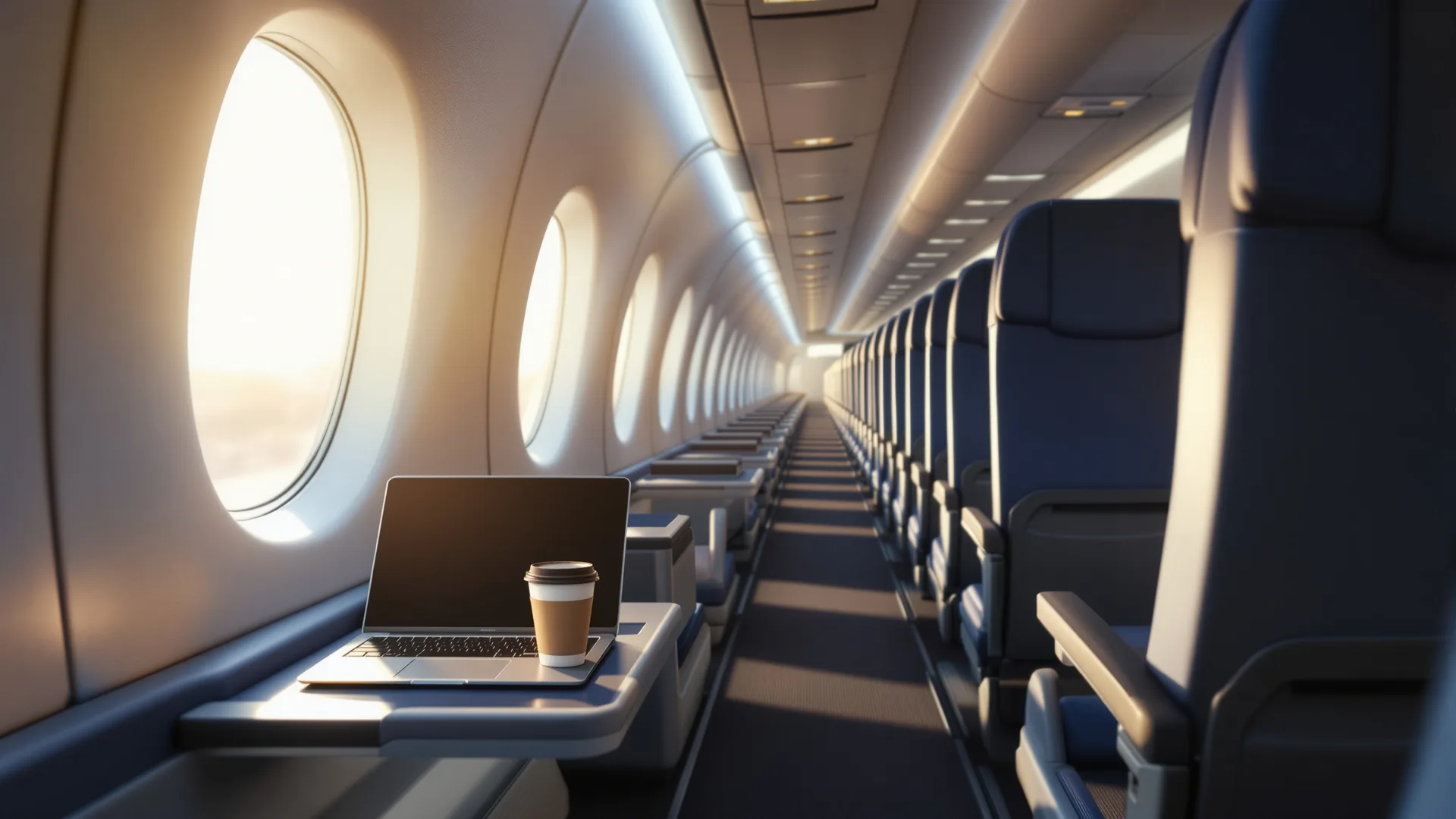
A few years ago I boarded a flight from London to Zurich with a client. Composite scene, as always in these pieces, but you will recognise the type. He had sold a business, not a huge one, and he was in the phase where the money was still new. At the aircraft door he turned left and I turned right, and the look on his face was something between confusion and mild social distress. Later, over coffee, he asked me about it. Carefully, the way you ask someone whether everything is all right at home.
"You do know what your own invoices look like," he said.
I do. I have advised entrepreneurs and wealthy families since 2006 in the UK and since 2008 in the US, and the fee notes of STM Corporate Group are not written in apologetic font. And still, on most flights, I sit in the back. Not out of penance. Not because I think suffering is noble. Because of a calculation I did many years ago and have never managed to argue myself out of.
Let me walk you through it.
The Maths, Done Conservatively
Take a typical European business trip. The business class fare is higher than the economy fare by some premium. The exact figure moves around by route, season, and how desperate the airline is that week, so let us not pretend precision. Call it 3,000 pounds on a decent long-haul return, often less within Europe, sometimes far more. The specific number does not matter. The structure of the calculation does.
Now assume you fly twice a year like this, and instead of buying the flat bed you invest the premium. Assume a boring, conservative 5 percent annual return. I am not promising you 5 percent. Nobody can promise you anything, and anyone who does should be avoided at airports and elsewhere. I am using it because it is a modest assumption that makes the arithmetic honest.
At 5 percent, money doubles roughly every fourteen years. A single 3,000 pound premium, left alone for twenty years, becomes about 8,000. Do it twice a year, every year, for twenty years, and the pot grows to just under 200,000 pounds. That is the compounded value of 6,000 pounds a year at 5 percent over two decades. Check the arithmetic yourself; it is a formula, not an opinion.
Two hundred thousand pounds. For sitting in a slightly narrower seat a few dozen times, eating the same chicken from a smaller tray.
Now scale that thinking to a family that flies four times a year, or to the person who upgrades every hop between London and Frankfurt out of principle. The premium is no longer a travel expense. It is a small pension fund being fed, year after year, into a seat cushion.
I want to be fair to the other side: if your time on board is genuinely productive, if the sleep genuinely changes what you can do the next day, the calculation shifts. I will get to that. But most business class purchases I observe are not that. They are something else, and the something else is the interesting part.
The Psychology, Which Is the Real Subject
Here is what two decades of sitting across the table from wealthy people has taught me: the most expensive purchases are not the large ones. They are the recurring ones that quietly redefine your baseline.
A one-off extravagance is survivable. You buy the watch, you enjoy the watch, the watch does not send you a monthly invoice. But status spending is rarely a one-off. It is a ratchet. The first business class flight is a treat. The fifth is a preference. By the fifteenth it has become part of your identity, and identity is the most expensive thing a person can maintain. Nobody downgrades their identity without feeling it as a loss, which is why the habit, once acquired, runs for decades. That is what makes it the costliest subscription most successful people own. Not the flights themselves: the fact that the flights stop being a decision.
And here is the observation that took me longest to believe, even as the evidence kept arriving in my own meeting rooms. The wealthiest clients I have, the genuinely heavy balance sheets, the families whose money has survived more than one generation, are almost never the loudest fliers. The pattern is so consistent it has become a private diagnostic. When someone books a first consultation and mentions their travel class within the opening ten minutes, the net worth is usually smaller than the presentation. The quiet ones, the ones who turn up in a plain jacket and ask precise questions about trust structures, frequently turn out to sit in economy on short-haul without thinking about it, the same way they drive cars several years old.
This is not my discovery. The research behind The Millionaire Next Door documented the same thing decades ago in America: the actual rich are disproportionately unflashy, and the flashy are disproportionately leveraged. And the canonical case is of course Ingvar Kamprad, the IKEA founder, a man worth tens of billions who flew economy and made his executives do the same, drove an old Volvo, and ate in the store cafeteria. You can call it eccentric. You can also notice that the company he built on that culture conquered every furniture market on earth while its competitors flew at the front of the plane.
I wrote once about a two euro bowl of soup and what it taught me about wealth. The flight question is the same question at higher altitude. Status purchases have one defining property: their audience is other people. The seat does not know who is sitting in it. The people you are trying to impress at the front of the cabin are, in my professional experience, mostly trying to impress you back, and a good number of them are doing it on borrowed money. The whole theatre cancels itself out, at a cost of several thousand pounds per performance, per seat, per direction.
There is a version of wealth that is visible and a version that is not, and after twenty years in this business I can tell you which one survives.
The Honest Exceptions
Now, before anyone files me under monastic: I am not running a morality play, and I do not always turn right. There are cases where the front of the plane is simply the correct purchase, and pretending otherwise would be its own kind of vanity.
The night flight before a negotiation. If I land at seven in the morning and sit down at nine across from people who want something from my client, arriving folded like a deck chair is not frugality. It is negligence with a boarding pass. Sleep is an input to the work. On those flights the flat bed is a business expense in the truest sense, and I book it without ceremony.
Long-haul over eight hours with a working day on the other end. Same logic. London to Singapore into a full schedule is a different animal from London to Malaga in August. The premium buys recovery time that would otherwise come out of the client's outcome. That is not status. That is maintenance of the machine that earns the fees.
Age and the human back. I am not twenty-five, and my spine has filed several formal complaints over the years. There is a stage of life where an eleven hour flight in economy stops being thrift and starts being a medical decision with a delayed invoice. I know clients in their seventies for whom the front cabin is the difference between arriving and arriving usable. Nobody should compound their way into a hospital.
And the honest miscellaneous: when the fare difference is trivial, when an upgrade costs points that would otherwise expire, when someone else insists on paying and it would be rude theatre to refuse. I take the seat. I enjoy the seat. The champagne is fine. The point was never that comfort is sinful. The point is that comfort should be a decision, priced and chosen, not a default that compounds against you for thirty years while you are not looking.
The test I apply is simple. Would I buy this seat if nobody I knew could ever find out about it? On the overnight to a negotiation, yes, instantly. On a two hour hop to a conference, if I am honest, no. Everything I buy in the second category is being bought for an audience, and audiences are the worst investment class I know.
What This Has to Do With Leaving Your Country
You might reasonably ask why a tax adviser is writing about seat selection. Here is why.
A large part of my work is helping people relocate: out of high-tax countries, into structures and jurisdictions that treat their capital better. The headline numbers in that business are seductive. Move from a marginal rate in the high forties to a regime taxing you at a fraction of that, and on a strong income the annual saving can fund a very comfortable life by itself. I have watched people run those numbers with shining eyes.
And I have also watched a certain type of client move to Dubai or Lisbon or the Caribbean, save six figures a year in tax, and be no wealthier five years later. Not poorer, usually. But not wealthier. The tax saving arrived and the lifestyle rose by precisely the same amount, the way water finds its level. The apartment got a sea view, the car got a second car, the flights all went to the front of the plane, because everyone in the new environment flies at the front of the plane, and what is the point of all this if not to live a little.
The saving was real. It was simply spent, immediately and invisibly, on a standard of living that adjusted itself upward the moment the headroom appeared.
This is the thing no relocation brochure will tell you: a jurisdiction can change your tax rate, but it cannot change your habits, and over twenty years the habits are usually the bigger number. The person who cannot walk past an upgrade in London will not walk past one in Dubai. The discipline question travels with you, in your hand luggage, through every border on earth. If you control lifestyle inflation, a good structure makes you seriously wealthy, and the freedom that buys back your time becomes real. If you do not, the best tax regime on the planet is just a longer runway for the same aircraft, heading the same direction.
So when I sit in row 34 with my laptop and my average sandwich, it is not an eccentricity and it is certainly not a hair shirt. It is the cheapest ongoing reminder I own that every recurring expense is a claim on my future capital, and that the claims I refuse are the only ones guaranteed to pay out. The seat is narrow. The margin is wide. On most days I know which one I would rather own.
And yes: the client from the Zurich flight eventually asked me to model what his travel pattern was costing him over twenty years. He still flies business on the long routes. He flies it less automatically. That, in my experience, is what progress actually looks like.
Work with Sebastian
If you are thinking about relocating, restructuring, or simply want an honest second opinion on whether your plan builds wealth or just relocates your spending, I do this for a living and have done since 2006. Book a consultation.