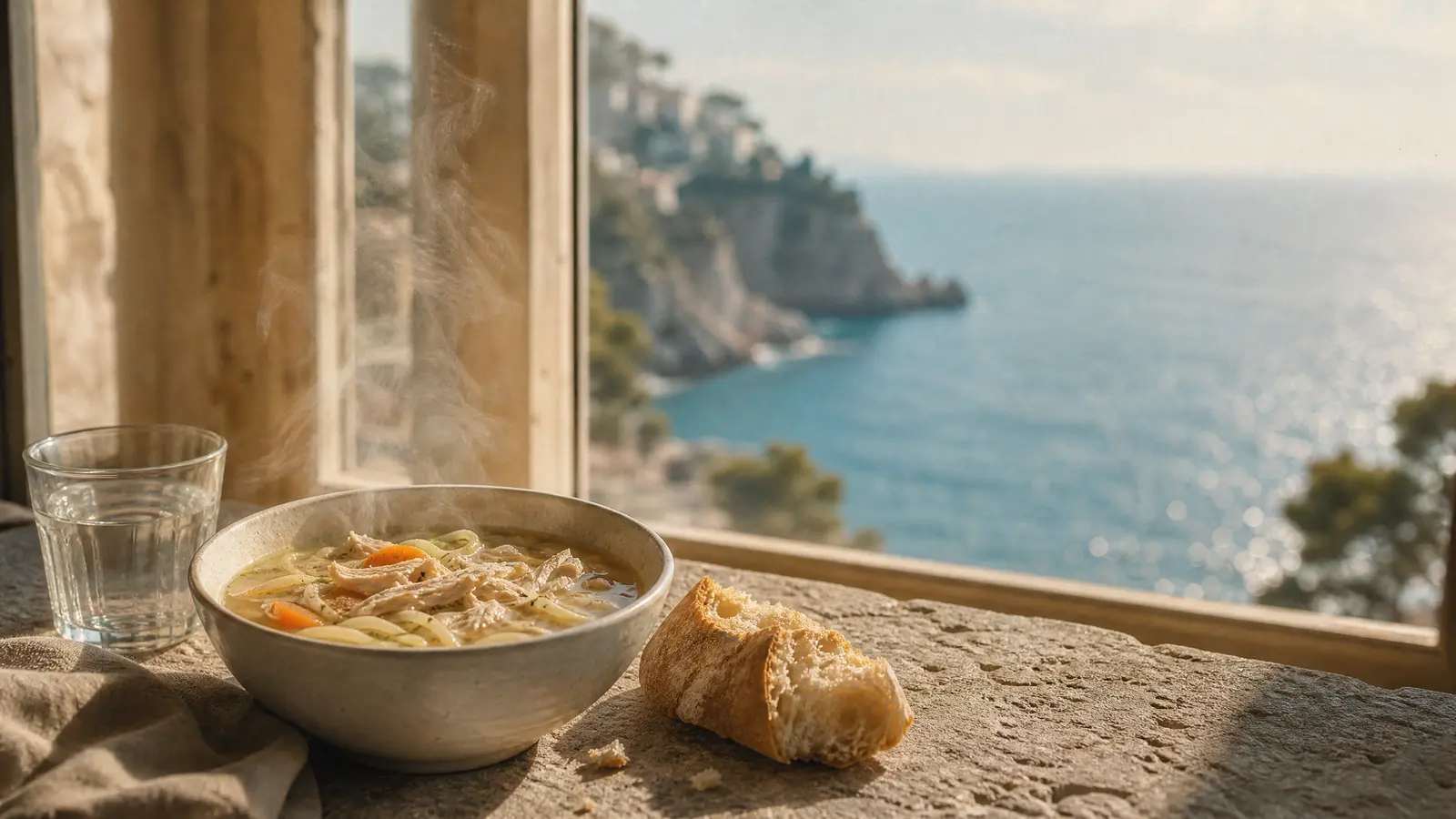
He poured it from a tin. A two euro tin. The kind you can still buy today, stacked on the bottom shelf of any supermarket, the label slightly faded, the chicken noodle soup inside more salt than chicken. He tipped it into a bowl, slid the bowl into the microwave, and waited with his back to one of the most expensive views in Europe.
I had flown in that morning from London to Nice, hired a car at the airport, and driven up into the hills above the Cote d'Azur. His summer house was built straight into the cliff, dramatic and impossible, the sort of place architects photograph and millionaires covet. His wife let me in and led me through to a kitchen the size of most people's homes, all stone and glass, the Mediterranean filling the windows like a painting that moved.
It was lunchtime. And there he was, one of the wealthiest men I had ever advised, microwaving the cheapest soup money can buy.
He caught my face before I could fix it. "Would you like one too?" he asked, holding up the tin. I declined. Too quickly. Too awkwardly. This was a man I had sat across from in the finest restaurants in Paris, a man whose wine list knowledge could embarrass a sommelier, and now he was eating processed food from a can like a student at the end of the month. I did not understand it. And he could see, plainly, that I did not understand it.
So he asked me to sit down.
The man who ate like a king
He ate slowly. That is the first thing I remember. He tore pieces from a fresh baguette, dipped them, chewed without hurry, and began to talk as though he had been waiting years for someone to ask the question I was too polite to say out loud.
"I was with the Boy Scouts my whole youth," he said. "From the age of seven to nineteen. The happiest days of my life."
His wife, passing through, rolled her eyes. She had clearly heard this before. He did not notice, or did not mind.
"With our troop we did long camps and hikes every summer. France, Italy, all across Europe. And when we were on the trail we carried everything we needed on our own backs. The tent. The sleeping bag. The food, mostly tins like this one. Water. The greatest adventures of my life."
He gestured at the bowl with his spoon, almost tenderly.
"So now I make a habit of it. This same soup, at least once a week, for lunch. And while I eat it I think about my friends from back then. It makes me happy. But it also reminds me of something I am afraid most people never learn."
He paused. The sea did its slow work behind him.
"To be truly rich"
What he said next I have carried with me for years. I will give it to you as close to his words as memory allows.
"To be truly rich, you do not need a five star hotel. A tent under the huge summer sky, or even no tent at all, just a bedroll on warm grass with the whole Milky Way spilled out above you and the smell of pine and woodsmoke in your clothes, will give you a night's sleep that no suite with a chandelier has ever matched. You wake with the light. You are cold, then the sun finds you. That is wealth. You simply have to be young enough, or wise enough, to notice it.
"To feel truly rich you do not need a Michelin star. A soup warmed on a gas cooker after a long day's hike, eaten with fresh bread and cold water, will be the tastiest meal of your entire life. I have eaten in the best rooms in the world. None of them beat that soup on that mountain. Not one.
"And none of the success I ever had in business made me half as happy as an evening spent around a fire with good friends. Singing badly. Talking until the embers died. Saying the true things you only say in the dark.
"Yes, I am a rich man. But not because of the money, which may all vanish tomorrow. I have never felt richer than I did in those days. Truly like a king of the world. And this soup, this stupid cheap soup, is how I keep my hand on that feeling. So I do not forget what it was."
I had nothing to say. For once in my professional life, I was completely silent.
Then I asked him for a bowl of soup.
What he was really telling me
I have thought about that lunch more than almost any deal I closed that year, and I have come to believe the man on the cliff understood something most of us only suspect.
He understood that wealth and richness are not the same word. Wealth is the number. Richness is the feeling, and the feeling does not live in the number. He had spent his life acquiring the first so he would never be at the mercy of anyone, and I respect that completely. It is, in many ways, my own life's work to help people build exactly that kind of freedom. But he refused to confuse the tool with the treasure. The house in the cliff was the tool. The soup was the treasure.
There is a reason this lands as true rather than as a cliche. The science is surprisingly on his side. Cornell psychologist Thomas Gilovich spent decades studying where lasting happiness actually comes from, and his finding is blunt: the joy we get from things fades fast, because we adapt to them, while the joy we get from experiences keeps growing because we relive them, retell them, and weave them into who we are. His research on experiences versus possessions reads almost like a footnote to a man eating tinned soup above the sea. The flat in the cliff is a possession. The hikes were experiences. One depreciates. The other compounds.
The Boy Scouts gave him that lesson before he had the vocabulary for it. A boy who learns to carry his whole life on his back, and to be completely content with a tent and a tin and a fire, has been handed a kind of insurance no bank sells. He knows the floor. He has stood on it. And a man who knows the floor is free in a way that frightened, grasping men never are. If you have ever wondered why Scouting survives a century of distraction and still pulls children out into the rain on purpose, the global movement is built on exactly this: that resilience and joy are not bought, they are practiced.
The Romans got there first
Two thousand years ago, a wealthy Roman wrote a letter to a friend about precisely this fear, the fear of losing it all, and how to defeat it.
Seneca was rich, fabulously so, and he knew his fortune could be taken in an afternoon. His advice was not to renounce wealth. It was to rehearse the loss. Set aside a few days, he wrote, live on the plainest, cheapest food and the roughest clothes, and ask yourself honestly: "Is this the condition that I feared?" You will find, he promised, that you can be happy on almost nothing, and from that day forward you will hold your wealth without being held by it. You can read the whole of Seneca's letter on the practice, and I would urge you to. It is two millennia old and it could have been written about a man microwaving soup on the French Riviera.
That is what the soup was. It was Seneca's exercise, disguised as nostalgia. Once a week, the rich man on the cliff sat down with poverty and shook its hand, just to remind himself that he and poverty were old friends and that he had never feared it. Fortune could not threaten him with anything he had not already chosen freely. That is not frugality. That is sovereignty.
Why this matters more now, not less
I work with people who have built or inherited real wealth, and I help them protect it, move it, and place it somewhere a grasping state cannot reach. I believe in that work completely. Freedom of movement, freedom of capital, freedom to raise your family under a sky of your own choosing: these are not luxuries, they are the scaffolding of a life lived on your own terms.
But the man on the cliff was warning me about the failure mode of my own profession. You can win the entire game of wealth and still lose the thing the wealth was for. You can build the house in the cliff and forget how to taste the soup. The money is meant to buy you back your time, your freedom, your evenings around the fire with people you love. If it instead becomes a thing you serve, a number you defend, a fear you manage from the moment you wake, then you are not rich. You are merely wealthy, and quietly poor.
The cure is almost embarrassingly cheap. It costs two euros and four minutes in a microwave.
What I do now
I am not going to tell you I eat tinned soup every week. I will tell you that the lunch changed me.
I notice now. I notice the first coffee, the cold water after a run, the evening around a fire with my children when the conversation goes deep and nobody is reaching for a phone. I have slept under that huge summer sky he described, with my own family, no chandelier in sight, and he was right. It beats the suite. It is not close.
Life is short and fleeting. One shot. The man on the cliff knew it, which is why he refused to wait for permission to feel rich. He had decided, with a tin of soup and a piece of baguette, that he would feel like a king of the world at least once a week, no matter how the markets moved or what the lawyers said.
So here is the question he left me with, and I will leave it with you.
When was the last time you felt truly rich? And what would it cost you to feel it again this week?
I suspect the answer is about two euros.