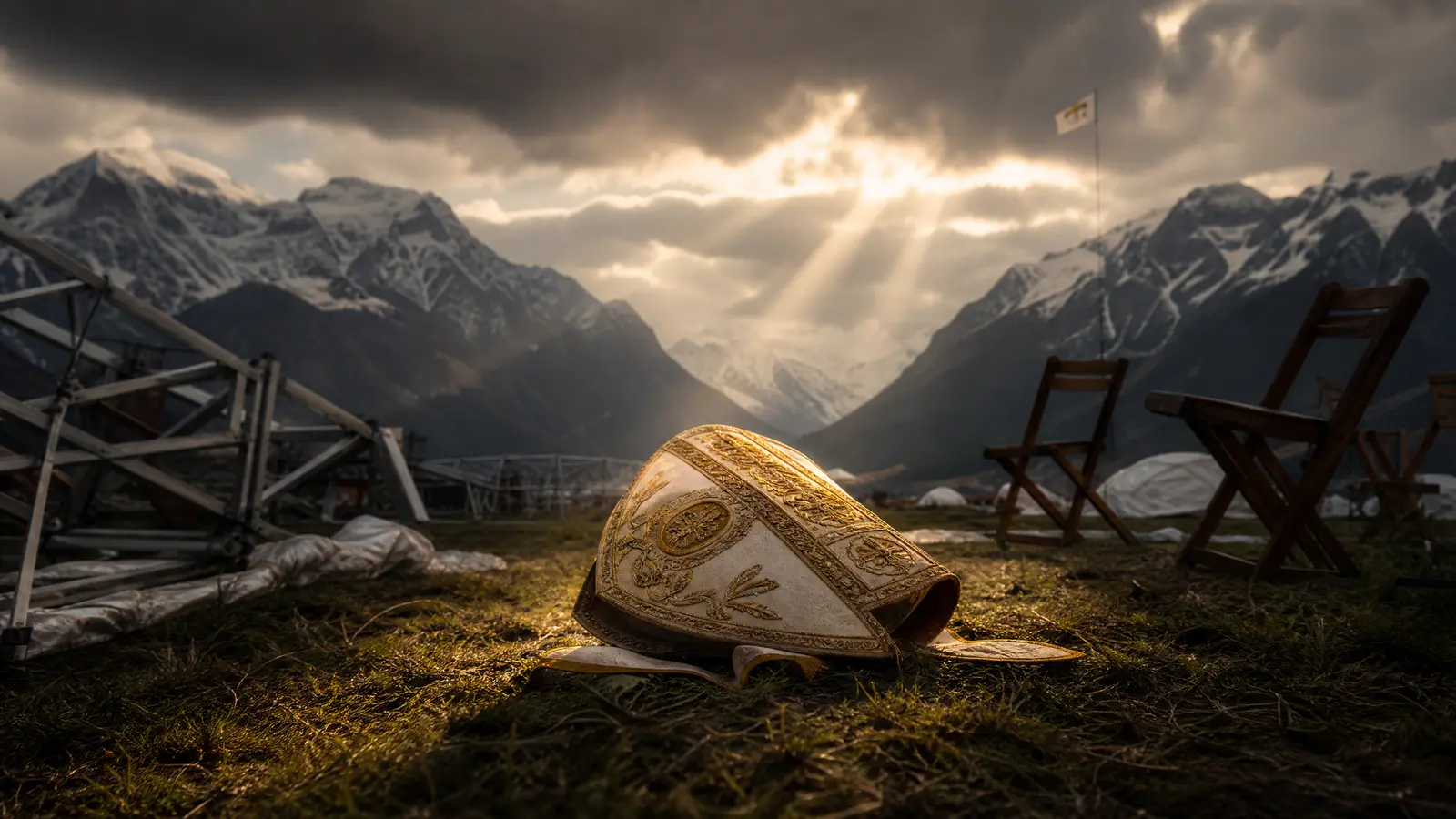
On the first of July 2026, on a hillside in the Swiss Alps, four men knelt down and stood up as bishops. Six thousand faithful bowed around them. Lace, incense, a beer tent in the meadow below, the whole thing staged like a victory festival. And in a sense it was a victory: the most complete victory pride has won inside the Catholic world in a generation.
Twenty-four hours later, Rome answered. The Dicastery for the Doctrine of the Faith, with the full authority of Pope Leo XIV, declared the Society of St. Pius X schismatic: the four new bishops excommunicated, the men who consecrated them excommunicated, and every cleric and lay person who formally adheres to the schism warned that they incur latae sententiae excommunication, automatically, by the act itself. Confessions heard by SSPX priests: invalid. Marriages witnessed by them: invalid. The privileges extended in mercy by Pope Francis: revoked.
Some Catholics are wringing their hands. I am not. The Vatican did the right thing, it did the only thing, and it should have been done with exactly this clarity. Let me tell you why, and let me tell you a story that is much older than Écône.
The Oldest Sin in the Book
Before there was a Lefebvre, before there was a Latin Mass to fight over, before there was a Rome, there was an angel. The most beautiful of them all, the most gifted, the most liturgically perfect creature God ever made. And that angel looked at the order God had established and said two words: non serviam. I will not serve.
That is the entire theology of schism in two words. Everything else is commentary.
The men who laid hands on four new bishops at Écône, in open defiance of the pope, did not do so because they lack learning. They know their Denzinger better than most diocesan priests. They did not do so because they lack zeal. They have zeal to burn. They did it because of the one thing they lack completely, and it is the only thing that matters: humble obedience.
The classic sign of the heretic has never been bad theology. It has been pride wearing the costume of purity. The heretic always believes he is holier than the Church. He always believes he knows the will of God better than the Vicar of Christ. He is always, in his own eyes, the last honest man, the remnant, the faithful one surrounded by a fallen institution. Scratch a schismatic and you will find, every single time, a man who has quietly promoted himself to a higher magisterium of one.
And here is the terrible irony that the SSPX has never grasped: to the Catholic, trust in the Church and the pope is not an obstacle to faith. It is the very sign of faith. Faith is not agreeing with God when you happen to find Him reasonable. Faith is Abraham walking up the mountain. Faith is Mary saying fiat to a plan she could not comprehend. Faith is the centurion saying "I too am a man under authority." The moment your Catholicism depends on the pope agreeing with you, you do not have faith. You have an opinion with candles.
We Have Seen This Movie Before
History does not repeat itself, but heresy absolutely does. It is the least original force in the world.
In the fourth century, the Donatists of North Africa decided the Catholic Church had become too compromised, too soft, too polluted by bishops who had wavered under persecution. They were the pure ones. They had the valid sacraments. They had the real tradition. St. Augustine spent decades demolishing them, and his answer echoes across sixteen centuries straight into that Swiss meadow: securus judicat orbis terrarum. The verdict of the whole world is secure. The universal Church, united with Rome, judges rightly, and the sect that separates itself in the name of purity has already lost the argument by the act of separating. Where are the Donatists now? Exactly. Purity cults do not survive. The Church does.
In 1870, after the First Vatican Council defined papal infallibility, a movement of professors and clerics, brilliant men, learned men, decided they knew the tradition better than the pope and the council. They called themselves, with magnificent self-awareness, the Old Catholics. The real ones. The faithful remnant. Today they are a rounding error with married bishops and empty pews, indistinguishable from the liberal Protestantism they swore they were saving the Church from. That is where every schism goes. Every single one.
And in 1988, an old French archbishop named Marcel Lefebvre stood in that very same field at Écône and consecrated four bishops against the explicit command of Pope John Paul II. The pope's response, the motu proprio Ecclesia Dei, named the act for what it was: a schismatic act, and it located its root with surgical precision, in "an incomplete and contradictory notion of Tradition." Incomplete, John Paul wrote, because it does not take into account the living character of Tradition, which comes from the apostles and progresses in the Church under the assistance of the Holy Spirit.
Read that again. Tradition is alive because the Holy Spirit is alive. The SSPX worships a photograph of the Church taken around 1958 and calls the photograph Tradition. But Tradition is not a photograph. It is a river. And the man who guarantees the river is still the same river, from Peter to Leo XIV, is the pope. Cut yourself off from Peter and you are not holding on to Tradition. You are holding on to a souvenir.
Thirty-eight years later, the sons repeated the sin of the father, in the same field, with the same self-pitying rhetoric of persecution, and they received the same answer. This is not Rome being cruel. This is Rome being consistent. A Church that means what it says.
The Pinnacle of Pride
Understand what an episcopal consecration is. A bishop is not a manager. He is a successor of the apostles, a principle of unity, a man who exists precisely to bind the local church to the universal Church and to Peter. To consecrate a bishop against Peter is therefore not merely disobedience. It is a contradiction in terms, like forging a wedding ring, like counterfeiting the currency of communion itself. You are using the machinery of unity to manufacture division.
That is why the Church treats it as the gravest of crimes. And that is why I say plainly: an act like this does not come from the Holy Spirit, who is a Spirit of unity. It comes from the father of pride himself. The devil has no interest in making you an atheist if he can make you a schismatic instead. An atheist might still convert. A schismatic already believes he is the better Catholic. It is the most fireproof form of pride ever devised: pride that kneels, pride that fasts, pride that says the rosary, and is therefore invisible to itself.
To the Whataboutists: Not Today
And now to the part that grieves me more than the schism itself. Because the SSPX, at least, is honest about what it is. What adds insult to injury is the chorus of so-called conservative Catholics rushing to their defense with the oldest rhetorical trick in the playbook: whataboutism.
"But Pride Masses don't get anyone excommunicated!" they cry. "But this dissenting theologian, but that German bishop, but, but, but."
Let me be clear. I take a dim view of Pride Masses too, insofar as any of them actually cross the line of Church teaching, and some do and some, frankly, do not. If and when they do, that is a matter for the Church to correct, and I will cheer the correction. But today we are not talking about Pride Masses. Today we are talking about the SSPX. We will deal with the other things on another day, and I will be just as blunt then.
Because whataboutism is not an argument. It is an anesthetic. It is what you inject into your conscience when you already know the verdict and cannot bear it. Two wrongs have never once, in the entire history of moral reasoning, added up to a right. And there is a special absurdity in defending men who consecrated bishops against the pope by pointing at people who, whatever their errors, have not left the Church. Sin inside the house is treated by the physician. Schism burns the house down and builds a shrine to the ashes.
A Word of Fraternal Correction to My American Brothers
I have spent a quarter century among conservative Catholics on three continents, and I will say this with love: most of them are wonderful people who stand one hundred percent behind the pope. They love the old devotions, they love large families, they love reverence, and they love Peter. That is Catholicism, full stop.
But especially in the United States something else has grown up alongside them: the MAGA Catholic, and sadly, so many of them converts. Men who swam the Tiber five years ago and now lecture the Barque of Peter on how to sail. And I understand it, I truly do. They came out of Protestantism, and the Protestant reflex does not die at the Easter Vigil. It is the deepest instinct of the Reformation: I read the sources, I judge the institution, I decide where the true church is. They have changed their liturgy but not yet their spine. The Church's DNA, the ancient instinct of sentire cum Ecclesia, thinking with the Church, is not yet in their bloodstream.
So hear me, brothers, because this is what the Church calls fraternal correction, and I owe it to you precisely because you are my brothers: you do not know better. Not better than the pope. Not better than the college of bishops in communion with him. Your conversion was real, and I rejoice in it. But conversion is not a single swim. It is a lifetime of drowning the old man, and the old man in you is a Protestant who trusts his own reading over the living voice of the Church. He needs to be corrected. Consider this me, doing it.
The Escrivá Standard
If you want to know how a saint handles a pope he struggles with, do not look to Écône. Look to St. Josemaría Escrivá, the founder of Opus Dei, writing about the critics of Pope Paul VI:
"The teachings of the Popes cannot be disregarded just like that. Nor ought they to allege, as [the Pope's critics] do with incredible flippancy, that the Pope, when he does not speak ex cathedra, is simply a private theologian subject to error. To say nothing of the tremendous arrogance it supposes to affirm that the Pope makes mistakes, while they do not. Besides, they forget that the Pope is not only a teacher, and infallible when he says so expressly, but also the chief Legislator. [...] To advise the contrary is, therefore, a serious act of disobedience to the Holy Father [...]. I prefer simply to obey the Pope. [...] I should adapt myself to whatever he [says]. And, following the norms established by the Pope and those of moral theology, I would examine in each case [...] and I would give my advice in conscience to each individual."
"I prefer simply to obey the Pope." Seven words. There is more Catholicism in those seven words than in every SSPX seminary on earth.
And here is what makes the quote devastating rather than merely pious: Josemaría did not find the post-conciliar years easy. He was a priest of profound liturgical sensibility, formed entirely in the old rite, a man who suffered in those turbulent years and made no secret in private of how much some of the changes and the surrounding chaos cost him. He had, humanly speaking, every one of the grievances that Lefebvre had.
And what did he do with them? He obeyed. He never voiced open criticism of the pope. Not one press conference, not one open letter, not one consecration in a Swiss meadow. He stood one hundred percent behind Paul VI, he embraced the Second Vatican Council, and he taught his sons and daughters to love the pope, in his words, with "one, holy, catholic, apostolic, and Roman" hearts. He took his pain to the tabernacle instead of to the barricades. That is the difference between a saint and a schismatic, and it is not a difference of sensibility. Lefebvre and Escrivá had similar sensibilities. It is a difference of faith. One man trusted that Christ keeps His promise to Peter even through a difficult pontificate. The other decided the promise had lapsed and appointed himself the executor of the estate.
Escrivá is on the altars. Lefebvre died excommunicated. The Church has already told you which path leads where.
Good Riddance, and Come Home
So no, I will not mourn this decree. Good riddance to the schism. Good riddance to the fiction, maintained for fifty years, that one can reject the Council, reject the pope's authority, reject the living magisterium, and still stamp "Catholic" on the letterhead. Rome has finally said what has been true since 1988 and arguably since 1970: this is not a stricter form of Catholicism. It is a different religion with better vestments.
But to the six thousand souls on that hillside, many of them born into this and given no choice, I say something different. The same decree that names your schism also, by its very precision, shows you the door back. Formal adherence is a choice. You can choose otherwise. The Church you think you are preserving is not in Écône. She is where she has always been: with Peter, in that great, wounded, glorious, two-thousand-year-old communion that has buried every single one of her purifiers.
The reporter at Écône noted one detail that no novelist would dare invent. As the SSPX brothers dismantled their scaffolding the morning after, the flag flying above them, one rung higher than all the national flags, was the flag of the Vatican.
They fly the flag of the kingdom they just walked out of. Deep down, they know where home is.
Come home, brothers. The door is heavy, but it is open. All it costs is your pride, and that was always the price.