I turned forty-nine last week. There was cake, there were candles, and somewhere between the singing and the washing up I made my wife a promise: next summer, we spend in the Philippines.
Amy has heard me talk about the islands for as long as she has known me. She has heard about the light there, which is not like light anywhere else, the way it comes up out of the sea in the morning as if the water itself were glowing from underneath. She has heard about the dolphins. She has heard, more times than she would probably like, about a visa.
Because here is the strange truth about this particular birthday: forty-nine is the year I could apply for Philippine residency, and fifty is the year I actually will. And the reason I am waiting is worth exactly twenty thousand US dollars.
An Archipelago I Have Loved Since 2006
I first came to the Philippines in 2006. I was young, a few years into my life outside Germany, and already convinced (correctly, as it turned out) that my life was going to happen in more than one country. The Philippines was not on anyone's list of sensible destinations back then. That was part of the appeal.
What nobody prepares you for is the scale of the place. Seven thousand six hundred and forty-one islands, give or take the tide. You could spend a lifetime island-hopping and die with most of the map still blank. Some are cities. Some are a single fishing village and a church. Some are just a curve of white sand with three palm trees, waiting for a boat that comes twice a week.
And the sea between them is alive in a way that European waters simply are not. Off Bohol, if you go out before sunrise, the spinner dolphins come to the boat in pods of a hundred and more, leaping and turning in the pink light as if the whole performance had been arranged for you personally. Further south, in the Sulu Sea, lies Tubbataha Reef, a UNESCO World Heritage site that divers speak about the way pilgrims speak about Compostela: walls of coral falling away into blue nothing, sharks patrolling the drop-offs, turtles hanging in the current like they have nowhere to be. I have dived in a lot of places. Nothing has ever matched it.
Davao, where our team is based, sits on a gulf of its own, with Samal Island twenty minutes across the water: beaches, giant clams in the sanctuary, and the kind of quiet that money cannot buy in Europe anymore. When I say I feel comfortable in the Philippines, this is what I mean. Not comfortable like a hotel is comfortable. Comfortable like a place you have known for the better part of two decades, where the smells and the sounds and the chaos of the jeepney traffic all say the same thing: you know how this works. You belong here well enough.
The Twenty-Thousand-Dollar Birthday
Now to the visa, because this is where sentiment meets arithmetic.
The Special Resident Retiree's Visa, issued by the Philippine Retirement Authority, is in my view one of the most underrated residency programmes in the world. Indefinite stay. Multiple entry. No annual immigration queue. And despite the name, you do not need to be retired at all: since the 2025 reform, anyone from age forty can apply, keep working, keep running businesses abroad, keep living exactly as before. The visa does not ask.
What the visa does ask for is a deposit, placed in a Philippine bank in your own name, refundable if you ever give the visa up. And the deposit is where age matters. Apply between forty and forty-nine, and the standard deposit is USD 50,000. Apply at fifty, and it drops to USD 30,000.
So there it is. I could walk into the PRA tomorrow as a forty-nine-year-old and park fifty thousand dollars. Or I can wait for one more birthday, apply the week after the candles are blown out, and park thirty. Same visa. Same rights. Same islands, same dolphins, same dawn light on the water. Twenty thousand dollars for the small service of becoming slightly older, which I was going to do anyway.
I advise people on decisions like this for a living. If a client asked me whether to pay a five-figure premium for impatience, I know what I would tell him. So I am telling myself the same thing. The full mechanics, deposits, documents, and the process our team runs on the ground are all laid out on our SRRV page at MyDavaoBase, and everything I would say to a client, I am about to do myself.
Practising What I Preach
That last point matters to me more than the money.
For years I have stood in front of cameras and clients and said the same thing: build your Plan B before you need it. A second residency is not a luxury and not a fantasy of running away. It is an anchor dropped in different waters, so that whatever storm comes through your home harbour, your family is never trapped in it.
It would be a strange thing to preach that for a decade and never do it. So the SRRV is not content for me, and it is not theory. It is the thing itself: a real residency, in a real country, with real money in a real bank, for a real family. When I tell a sixty-year-old client from Stuttgart that the deposit is not a cost but his own capital wearing a different uniform, I want to be able to add: mine is sitting in a bank in the Philippines right now.
And the timing is not incidental. Look around. The world is not getting calmer. Europe is busy building digital fences around its own citizens, the talk of wealth registries and exit taxes grows louder every budget season, and the map of places where a man can simply be left alone is shrinking year by year. I do not say this to frighten anyone. I say it because an anchor you drop in calm weather costs a fraction of one you scramble for in the storm.
The Honest Paragraph
I owe you one caveat, because I have promised myself never to write travel-brochure copy about any country, including ones I love.
During the pandemic, the Philippines ran one of the longest and harshest lockdown regimes on earth. Face shields on top of masks, provincial checkpoints, children kept out of classrooms for years, borders that at times were closed even to people with every right to enter. It was, not to put too fine a point on it, hell, and anyone considering the country as a Plan B should know that this is what its bureaucracy is capable of when frightened.
I hold that truth and I hold the islands in the same hand. It is why my own plan has never been one country deep. The Philippines is an anchor, not a cage: one of several, alongside the life we have built across the Atlantic. A real Plan B has more than one page. If the last few years taught us anything, it is that.
Next Summer
So here is how I picture it.
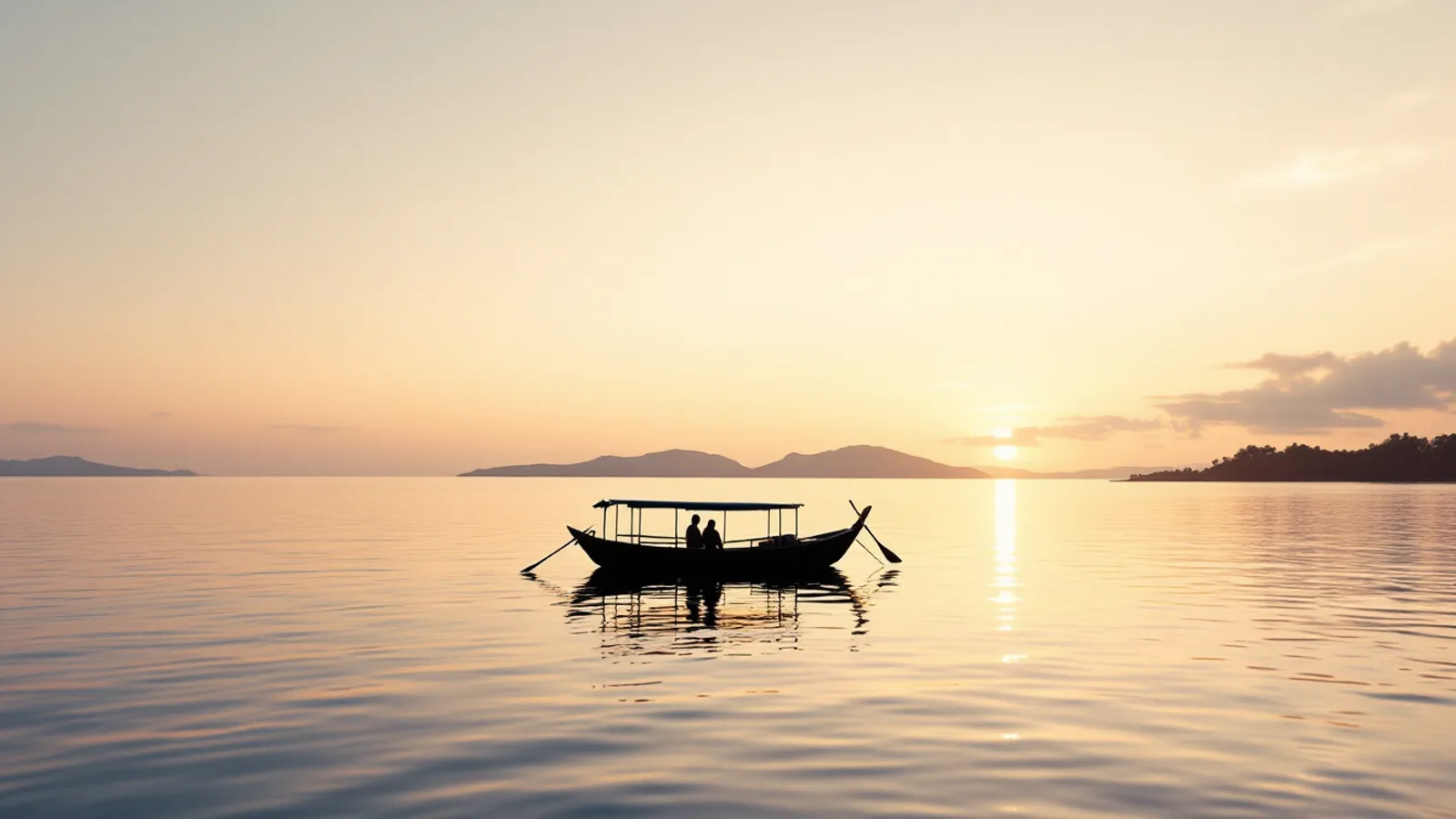
A morning in July, one year from now. The deposit is placed, the papers are filed, the card with my face on it is somewhere in a PRA office working its way through the machinery. Amy and I are on a banca headed out from Samal at first light, the outriggers slapping the swell, a thermos of bad instant coffee between us that somehow tastes better than anything from a machine in London.
And maybe, if the sea is kind, the dolphins come. They usually do, if you go early enough and quiet enough. They will not know or care that the man watching them has just halved a bank deposit by the elegant strategy of having a birthday. They will just turn in the light the way they have turned in that light for ten thousand years, in a country that will, by then, officially be one of my homes.
One year. One birthday. One more anchor in the water.
I can wait.