Contents
- 1. the Philippines: Country Overview
- 2. Putting the Philippines on the Map
- 3. What Others Say About the Philippines
- 4. Tax Benefits: What the Philippines Has to Offer
- 5. Tax Rates at a Glance
- 6. Tax Residency: What Triggers It
- 7. Double Tax Treaties
- 8. Avoid Remaining Tax Resident at Home
- 9. Tax Considerations When Leaving Your Home Country
- 10. Company Setup & Corporate Tax
- 11. Who Should (and Shouldn't) Move to Philippines
- 12. Visas and Residence Permits
- 13. Path to Citizenship
- 14. Banking in Philippines
- 15. What Makes Philippines Genuinely Attractive
- 16. Cost of Living in Philippines
- 17. Buying Real Estate in Philippines
- 18. Retiring in Philippines
- 19. US Citizens: What You Need to Know
- 20. Correct Preparation
- 21. Automatic Exchange of Information (OECD CRS)
- 22. Further Relocation Formalities
- 23. How We Help With Your Move to the Philippines
I.
the Philippines: Country Overview
The Philippines is an archipelago nation of approximately 115 million people spread across 7,641 islands in Southeast Asia, bordered by the South China Sea to the west and the Pacific Ocean to the east. The capital is Manila; the largest metropolitan area is Metro Manila with approximately 25 million people in its wider urban region. The Philippines has been an independent republic since 1946 (with brief interruption during the Japanese occupation in World War II); it is a member of ASEAN and a significant regional economy.
The Philippines operates a territorial tax system for non-resident individuals: foreign-source income earned by non-residents is not subject to Philippine income tax. Only income derived from Philippine sources is taxable in the Philippines. Resident aliens — foreign nationals residing in the Philippines with no definite intention as to length of stay — are taxed only on Philippine-source income under Section 23 NIRC. The protection of foreign-source income is not SRRV-specific: non-citizen residents do not fall into the worldwide-tax category. Philippine-source income is taxed at progressive rates from 0% to 35% on annual taxable income exceeding PHP 250,000, with separate final taxes on certain Philippine-source passive income.
Philippines has no inheritance tax on transfers to spouses and children within certain thresholds. There is a 6% estate tax on net taxable estate above PHP 5 million, with a standard deduction of PHP 5 million — making most modest estates effectively exempt. No wealth tax.
What to be aware of: The Philippines has a history of political volatility, though democratic institutions have remained functional. Infrastructure outside Metro Manila, Cebu, and major cities is limited. Traffic in Metro Manila is among the worst in the world. Private healthcare in Manila and Cebu is excellent at very low cost by Western standards; outside urban centres it is limited. The banking system is functional but not sophisticated for international private banking purposes. And typhoons — an average of 20 per year strike the country, with 5–10 making significant impact.
2026 Philippines resident-alien correction: only resident Filipino citizens are taxed on worldwide income. Foreign nationals who establish residence in the Philippines become resident aliens, and resident aliens are taxed only on Philippine-source income under Section 23 NIRC. This is the structural advantage for foreign HNW clients, not a temporary incentive or visa-specific carve-out.
II.
Putting the Philippines on the Map
Philippines — Southeast Asia; 7,641 islands; Manila capital; Cebu, Palawan, Boracay key locations
The Philippines announced itself to Western imagination through Magellan's arrival in Cebu in 1521 and has been announcing itself to travellers in one way or another ever since. The specific quality it offers — warm, immediate, genuinely joyful — is not easily manufactured and has survived 400 years of Spanish colonisation, American administration, Japanese occupation, and the particular pressures of late capitalism on a developing archipelago. The Filipinos are, by consistent measurement, among the happiest and most hospitable people on earth. This is not a marketing claim; it is a consistent finding of international wellbeing surveys, and it registers in daily life in ways that visitors from less demonstratively warm cultures find initially surprising and eventually miss when they leave.
- ›Palawan in the southwest is where the marine environment reaches its most extraordinary expression. The Tubbataha Reef — accessible only by liveaboard dive boat from Puerto Princesa — is one of the finest dive sites in the world: pristine coral walls, hammerhead sharks, manta rays, whale sharks at certain seasons, and a visibility that exceeds 30 metres. The El Nido limestone karst formations rising from the sea north of Puerto Princesa — navigable by outrigger boat through a maze of hidden lagoons — are a landscape that photographs travel further than the country's name. UNESCO has recognised the area; the boats are becoming more crowded. Go sooner rather than later.
- ›Cebu City is the second-largest metropolitan area and the gateway to the Visayas region — a cluster of islands that includes Bohol (with its perfectly conical Chocolate Hills, 1,268 of them, covered in grass that turns brown in the dry season, and the tiny endemic Philippine tarsier), Siquijor (sorcerers and pristine beaches), and the dive sites off Moalboal where sardine runs of millions of fish move as a single organism through the water.
- ›Metro Manila is too large for a single description — it is effectively several cities occupying the same metropolitan footprint, each with its own character: Makati is the financial district; BGC (Bonifacio Global City) is where the modern Philippines has built its aspirational version of itself in glass towers and international restaurants and weekend craft beer markets; Intramuros is the walled Spanish colonial city on the Pasig River, relatively intact despite extensive bombing in 1945; Binondo, the world's oldest Chinatown, is where the best Chinese food in the country is eaten standing at a counter at 7am.
Singapore is 3.5 hours by air. Hong Kong is 2.5 hours. Tokyo is 4 hours. Sydney is 8 hours.

III.
What Others Say About the Philippines
"The Filipinos are the most welcoming people I have encountered in 40 years of travel. I have never felt unwanted in this country. I have rarely felt wanted so immediately anywhere else."
— Pico Iyer, travel writer, The Art of Stillness, 2014
"Palawan is the most beautiful island I have visited. I have visited a lot of islands. I am making no qualification on this statement."
— Anthony Bourdain, Parts Unknown, Philippines episode, 2014
"I went to the Philippines expecting warmth and found something beyond that — a kind of joyfulness in daily life that you don't encounter in countries where material things have been available for longer."
— Simon Calder, The Independent, 2023

IV.
Tax Benefits: What the Philippines Has to Offer
The Philippines is structurally one of the most attractive HNW relocation jurisdictions in Asia, and the architectural reason most public commentary misses is simple: ONLY resident citizens (Filipino nationals) are taxed on worldwide income. Every other category — including RESIDENT ALIENS (foreign nationals residing in the Philippines) — is taxed ONLY on Philippine-source income under Section 23 of the National Internal Revenue Code. Foreign nationals who establish residence in the Philippines become resident aliens, and as resident aliens their foreign dividends, foreign interest, foreign capital gains, foreign rental, foreign business profits, foreign salaries (for work performed outside the Philippines), and foreign pensions are PERMANENTLY OUTSIDE the Philippine tax net. No time limit, no special status required, no IFICI-style regime needed — the Philippines simply does not claim taxing rights on foreign-source income of non-citizens. Philippine-source income is taxed on a graduated 0%–35% scale (first PHP 250,000 exempt). Corporate income tax is 25% (20% for qualifying SMEs). VAT is 12%. Combined with the SRRV (restructured September 2025 to admit applicants from age 40 with USD 10K–50K deposits), an English-speaking environment, a 40+ DTA network, and a low cost of living, the Philippines is functionally a territorial system from the foreign-resident's perspective.
- ›Foreign nationals taxed ONLY on Philippine-source income — foreign income permanently outside the Philippine tax net — under Section 23 NIRC, resident aliens (foreign nationals residing in the Philippines) are taxed ONLY on Philippine-source income. Foreign dividends, foreign interest, foreign capital gains, foreign rental, foreign business profits, foreign salaries (for work performed outside the Philippines), and foreign pensions are NEVER subject to Philippine tax for non-citizen residents. This is the architectural feature, not a workaround. Only RESIDENT FILIPINO CITIZENS are taxed on worldwide income.
- ›Resident alien classification — a foreign individual residing in the Philippines with no definite intention as to length of stay; an expatriate on an indefinite-period contract typically qualifies; foreigners present 2+ years generally qualify. Tax classification is independent of immigration status — substance over form (BIR and courts apply the substantive test, not the visa category).
- ›Personal income tax on Philippine-source income — graduated 0%–35% — first PHP 250,000 (~USD 4,300) exempt; top 35% bracket only above PHP 8,000,000 (~USD 138,000). Self-employed individuals and professionals with gross sales/receipts up to PHP 3M (VAT threshold) may elect a flat 8% tax on gross above PHP 250K (in lieu of graduated rates AND the 3% percentage tax) — typically the most efficient regime for consultants, freelancers, and small-scale local activities.
- ›Corporate income tax 25% / 20% qualifying SMEs; CREATE MORE Act incentives for export-oriented enterprises — 25% standard CIT; 20% for qualifying SMEs (income ≤PHP 5M AND assets ≤PHP 100M excluding land); 5% Special Corporate Income Tax (SCIT) on gross income for qualifying export-oriented Registered Business Enterprises under CREATE MORE Act (signed 11 November 2024). Pillar Two QDMTT NOT yet implemented as of 2026.
- ›Estate tax 6% flat / Donor's tax 6% flat — flat 6% rate on net estate value above PHP 5M (PHP 5M standard deduction + PHP 10M family home exemption); flat 6% on net gifts above PHP 250K/year. Among the simplest and lowest estate/gift tax regimes in Asia. NO annual wealth tax.
- ›SRRV restructured September 2025 — fast-track permanent residency from age 40 — Special Resident Retiree's Visa (SRRV) restructured September 2025: SRRV Smile and Human Touch abolished; SRRV Classic and Courtesy remain. Minimum age 40 (Classic 40-49: USD 25K deposit + pension OR USD 50K no pension; Classic 50+: USD 10K + pension OR USD 20K no pension). Application fee USD 1,500. Multiple-entry, indefinite stay, exempt from ACR I-Card requirements. Deposit convertible to investment (condominium, long-term lease).
- ›40+ DTAs including US, UK, Germany, France, Japan, Singapore, Korea, China, Switzerland — comprehensive DTA network; Philippines-Germany DTA in force; Philippines-US DTA (1976) provides explicit tie-breaker rules. CRS participating since 2021.
- ›VAT 12% standard; CGT 6% flat on real property; English-speaking environment — VAT 12% with 0% on exports; threshold PHP 3M; foreign digital service providers subject to 12% VAT from 2025. CGT on real property is 6% flat on gross selling price or FMV (whichever higher) — final tax. English is an official language used in business, government, and courts — major operational advantage for international clients.
- ›Cost of living substantially below Western Europe / North America; 7,000+ islands; tropical climate — Manila/Cebu offer comfortable expat living at USD 1,500–3,000/month; provincial areas substantially cheaper; world-class beaches (Palawan, Boracay, Siargao); strong English-language legal and medical infrastructure. Note: foreigners cannot own land directly (constitutional restriction) but can own condominium units (up to 40% foreign cap per project) and lease land for up to 50 years (renewable 25).
V.
Tax Rates at a Glance
| Tax | Rate (2026) | Notes |
|---|---|---|
| Tax basis — resident citizens | Worldwide | Filipino citizens only |
| Tax basis — resident aliens | Philippine-source ONLY | Foreign nationals residing in PH |
| Tax basis — non-resident citizens | Philippine-source only | |
| Tax basis — NRAETB | Philippine-source only | >180 days, graduated 0%–35% |
| Tax basis — NRANETB | Philippine-source only | ≤180 days, flat 25% on gross |
| Foreign-source income — resident aliens | 0% | Permanently exempt — no time limit |
| Personal Income Tax — bottom bracket | 0% | Up to PHP 250,000 |
| Personal Income Tax — top bracket | 35% | Above PHP 8,000,000 |
| 8% flat optional tax (self-employed, up to VAT threshold) | 8% | On gross sales/receipts above PHP 250K — in lieu of graduated + percentage tax |
| Capital Gains — listed Philippine shares | 0.6% stock transaction tax | On gross sale price |
| Capital Gains — unlisted Philippine shares | 15% | On net capital gain |
| Capital Gains — Philippine real property | 6% | Flat on gross or FMV (higher); final tax |
| Estate Tax | 6% flat | Above PHP 5M (PHP 5M standard deduction + PHP 10M family home exemption) |
| Donor's (Gift) Tax | 6% flat | Above PHP 250K/year |
| Wealth Tax | 0% | None |
| Real Property Tax | Up to 2% assessed value | LGU-set |
| Corporate Income Tax — standard | 25% | CREATE Act |
| Corporate Income Tax — qualifying SMEs | 20% | Income ≤PHP 5M AND assets ≤PHP 100M (ex land) |
| Corporate Income Tax — Special CIT (SCIT, CREATE MORE) | 5% on gross | Qualifying export-oriented RBEs |
| MCIT | 2% gross | From 4th year of operation |
| Fringe Benefit Tax | 35% final | On grossed-up monetary value |
| Pillar Two QDMTT | Not implemented | As of 2026 |
| Final WHT — passive Philippine-source income | Various | 10%–20% on most types |
| VAT — standard | 12% | |
| VAT — zero-rated | 0% | Exports, ecozone sales, specified services |
| VAT — registration threshold | PHP 3,000,000 | |
| VAT — foreign digital services | 12% | DSPs supplying PH consumers; in force 2025–2026 |
| Currency | PHP | ~PHP 56–58/USD 2026 |
| DTAs | 40+ | Including US, UK, DE, FR, JP, SG, CH, AU, CA |
| CRS | Participating | Since 2021 |
| SRRV minimum age | 40 | Restructured September 2025 |
| SRRV application fee | USD 1,500 | Plus PRA annual membership |
| SRRV deposit (40-49, with pension) | USD 25,000 | + USD 800/$1,000 monthly pension |
| SRRV deposit (40-49, no pension) | USD 50,000 | |
| SRRV deposit (50+, with pension) | USD 10,000 | + USD 800/$1,000 monthly pension |
| SRRV deposit (50+, no pension) | USD 20,000 | |
| SRRV Courtesy | USD 1,500 | Limited categories |
| 13A Visa (foreign spouse of Filipino) | Permanent residency | After 1-year probation |
| Naturalization | 10 years (5 in special cases) | Filipino citizenship |
| Foreign land ownership | Prohibited | Constitutional restriction |
| Foreign condo ownership | Up to 40% per project | Cap |
| Foreign land lease | Up to 50 years | Renewable 25 |
VI.
Tax Residency: What Triggers It
Philippine tax classification for foreign nationals is determined by facts and circumstances rather than by visa label alone. A resident alien is a foreign individual residing in the Philippines with no definite intention as to length of stay; an expatriate on an indefinite-period contract typically qualifies, and foreigners present for extended periods may also qualify depending on substance.
The key rule is Section 23 NIRC: resident aliens are taxed only on Philippine-source income. Foreign dividends, foreign interest, foreign capital gains, foreign rental income, foreign business profits, foreign salaries for work performed outside the Philippines, and foreign pensions are outside the Philippine tax net for resident aliens. Only resident Filipino citizens are taxed on worldwide income.
Key point: SRRV is a powerful immigration route, especially after the September 2025 restructuring, but it is not the only reason foreign income is protected. The deeper architectural feature is that foreign nationals who become resident aliens remain outside the worldwide-income category.
VII.
Double Tax Treaties
The Philippines has 40+ active DTAs including the United States, United Kingdom, Germany, France, Japan, Singapore, Korea, China, Spain, Netherlands, Switzerland, Australia, Canada, Italy, and most major Asian and Western European partners.
The US-Philippines DTA includes explicit tie-breaker rules, and the Germany-Philippines DTA is in force, which is relevant for DACH clients. For Sebastian’s resident-alien clients, treaty access is usually a secondary issue because foreign-source income is not taxed in the Philippines in the first place; treaties and credit mechanisms matter mainly for Philippine-source income and for source-country withholding.
The Philippines is CRS participating since 2021.

VIII.
Avoid Remaining Tax Resident at Home
The Philippines' territorial system exempts non-residents from Philippine tax on foreign-source income — but it provides no protection from home-country taxation if home-country tax residency continues. For most SRRV holders who are retiring abroad, the home-country departure is the first and most important planning step.
For German nationals, the §6 AStG exit tax applies to shareholdings of 1% or more at departure. The Germany-Philippines DTA is in force. For British nationals, the SRT governs the exit. The UK-Philippines DTA provides tie-breaker rules. For Australian nationals, the Australia-Philippines DTA is in force and CGT Event I1 applies on departure from Australian tax residency.
IX.
Tax Considerations When Leaving Your Home Country
Before you relocate, you need to understand what tax consequences arise in your current country of residence at the point of departure. These rules vary significantly by country and must be assessed individually — there is no universal answer.
Many countries impose an exit tax or deemed disposal charge when a tax resident leaves. This typically applies to unrealised capital gains on shares, business interests, real estate, or other assets — taxing you as if you had sold everything on the day you departed. The rules differ widely: some countries apply this to all assets above a threshold, others only to substantial shareholdings or business interests. Some have look-back periods that can catch you even after you have left.
The timing of your departure, the structure of your assets, and the sequence of any business disposals all have material consequences. In some cases, restructuring assets before departure — or deferring the move by a few months — can make a significant difference to the tax outcome.
- ›Germany. The §6 AStG exit tax on shareholdings of 1% or more applies at departure from German tax residency. German-source income paid to Philippine residents benefits from reduced withholding under the Germany-Philippines DTA. German statutory pension income paid to SRRV holders in the Philippines is governed by the DTA — typically taxable in the Philippines, and since Philippine law explicitly exempts SRRV pension income, the result can be effectively tax-free.
- ›United Kingdom. SRT exit date must be established. CGT on departure. The UK-Philippines DTA provides treaty protection. UK pension income paid to Philippine SRRV holders is governed by the DTA.
- ›Australia. CGT Event I1 applies on departure from Australian tax residency. The Australia-Philippines DTA governs Australian-source income paid to Philippine residents. Australian superannuation accessed after departure requires specific advice on Philippine and Australian tax treatment.
- ›United States. US worldwide taxation applies regardless of Philippine residency. The US-Philippines DTA is in force. SRRV pension exemption does not reduce US tax on the same pension income.
⚠ Obtain Local Tax Advice in Your Home Country The information above provides a general overview of the departure tax rules that commonly apply when leaving high-tax jurisdictions. It is not legal or tax advice. The rules in your specific home country — Germany, Austria, Switzerland, the UK, the US, or any other jurisdiction — are complex, change frequently, and depend entirely on your personal circumstances: your nationality, the nature and location of your assets, your business structure, your family situation, and the timing of your departure. Before you take any steps to relocate, obtain written advice from a qualified tax adviser who is licensed in your home country and experienced in international relocations. A consultation with us is a good starting point — but it does not substitute for country-specific legal advice from a practitioner in your jurisdiction of departure. The cost of getting this wrong is almost always greater than the cost of getting proper advice upfront.
X.
Company Setup & Corporate Tax
Philippine corporate tax is 25% (20% for small companies with taxable income below PHP 5 million). Foreign nationals can own up to 40% of most Philippine companies; 100% in certain sectors (export-oriented enterprises, IT-BPO companies in special economic zones, and others).
- ›PEZA (Philippine Economic Zone Authority) companies operating within designated special economic zones can access an Income Tax Holiday (ITH) of 4–8 years, followed by a preferential 5% tax on gross income (replacing all national and local taxes) — one of the most competitive corporate tax regimes in Southeast Asia for qualifying businesses.
- ›Is a local company always the right answer? Not necessarily. For SRRV holders and non-residents whose income is primarily from foreign sources, no Philippine company is needed.
Learn more about our company setup services →
Permanent establishment risk: A foreign company is not a magical solution. If the company is effectively managed from your country of residence, or if staff, sales activity, or day-to-day control are located there, local tax authorities may still tax the profits locally. Structure follows substance. Genuine management, banking, contracts, and operational substance in the foreign jurisdiction are essential.
2026 corporate update: Philippine corporate income tax is 25% standard, 20% for qualifying SMEs under CREATE, and 5% Special Corporate Income Tax on gross income for qualifying export-oriented Registered Business Enterprises under CREATE MORE. MCIT is 2% from the fourth year of operation, Pillar Two QDMTT is not implemented, and foreign ownership restrictions still apply in many sectors.
XI.
Who Should (and Shouldn't) Move to Philippines
Section 11 is where the relocation decision becomes practical. Philippines can be an excellent fit for some profiles and a poor fit for others; the decisive question is whether the tax rules, lifestyle, residence requirements, banking, healthcare, and family situation point in the same direction.
Good Fit
- › International entrepreneurs and investors whose income structure actually benefits from Philippines’s tax and residence rules.
- › Remote professionals and business owners who can move their centre of life genuinely, not merely change an address on paper.
- › Families or individuals who value Philippines’s lifestyle, geography, safety profile, and cost structure as part of the overall decision.
- › People willing to handle local banking, residency, healthcare, and administration properly rather than improvising after arrival.
- › Those who understand that relocation is a full tax-residency project, not a holiday with a lower tax rate.
Poor Fit
- × Those who cannot genuinely spend enough time in Philippines to support a defensible tax-residence position.
- × People who need a zero-friction, Western-European administrative environment from day one.
- × US citizens who expect the move to eliminate US tax filing, FBAR, FATCA, or citizenship-based taxation.
- × Those with income, companies, or family ties that keep them clearly taxable in their previous Philippines.
- × Anyone choosing the jurisdiction only because it sounds attractive online, without testing housing, banking, healthcare, and lifestyle fit.

XII.
Visas and Residence Permits
- ›SRRV Classic (post-September 2025 restructure): - Age 40–49: $25,000 deposit (with pension) or $50,000 (without pension) - Age 50+: $15,000 deposit (with pension of $800+/month) or $30,000 (without pension) - Annual membership fee: $360 (covers principal + 2 dependents) - Application fee: $1,500 - Processing time: 7–10 business days
- ›SRRV Courtesy: For retired diplomats, former Filipinos, and military personnel. Lower deposit requirements.
The SRRV provides indefinite stay, multiple-entry privileges, and exemption from the Bureau of Immigration annual report. Spouse and unmarried children under 21 can be included. The deposit must be maintained throughout the stay (can be invested in Philippine real estate or securities after issuance).
2026 residence update: SRRV was restructured in September 2025. The minimum age is now 40, SRRV Smile and Human Touch were abolished, SRRV Classic and SRRV Courtesy remain, and the application fee is USD 1,500. Other routes include 13A for foreign spouses, 9(G) employment visas, 47(a)(2), and SIRV. Tax classification is factual and independent of immigration status.
XIII.
Path to Citizenship
Philippine citizenship by naturalisation requires 10 years of legal residence, with 5 years of continuous residence immediately before application. Philippines generally does not permit dual citizenship for naturalised citizens. Former Filipinos can reacquire citizenship under RA 9225.
XIV.
Banking in Philippines
Major banks: BDO (Banco de Oro), Metrobank, BPI (Bank of the Philippine Islands), PNB (Philippine National Bank), Landbank. USD accounts are widely available. Account opening for SRRV holders through PRA-accredited banks is part of the SRRV process (deposit requirement). Philippine banking is functional but not internationally sophisticated for private banking purposes.
For a relocation to Philippines, the local account is normally the operational account: rent, utilities, cards, domestic transfers, local tax or residence registrations, and evidence that the move is real. It should not automatically become the main wealth-management account unless the local banking system offers the depth, multi-currency capability, private-banking service level, and long-term stability required for the client's assets.
Account opening in Philippines should be treated as a compliance exercise, not as an administrative formality. Expect passport checks, proof of address, residence or visa documentation where applicable, tax-identification details, source-of-funds evidence, and sometimes in-person attendance or a local phone number. The easiest applications are those where the residence story, income source, and banking purpose are consistent before the first form is submitted.
Where to hold your main accounts
- ›Singapore — 3.5 hours from Manila; deep private banking; USD and multi-currency; political stability
- ›United States — for US nationals maintaining US financial ties
- ›Australia — for Australian nationals
Learn more about our offshore banking services →
Important: not all banks are compatible with all residencies. Some Swiss and Singaporean private banks have restrictions on clients resident in certain jurisdictions, and compliance requirements vary. Residency status, income profile, source of wealth, and business type all affect which institutions will accept you and on what terms. We help clients navigate this before they commit to any banking structure.
XV.
What Makes Philippines Genuinely Attractive
Philippines is attractive when it is judged as a complete relocation platform, not as a slogan. The point is not that Philippines is perfect for everyone. The point is that, for the right person, the combination of tax position, residence practicality, lifestyle, geography, banking, language, and long-term stability can produce a genuinely coherent base.
- ›English-speaking Asian lifestyle with human warmth. The Philippines is attractive because it combines English usage, low costs, strong service culture, tropical lifestyle, and deep connections to the US and wider diaspora networks.
- ›The lifestyle case is not cosmetic. The lifestyle is social, warm, and varied: Manila, Cebu, Davao, Dumaguete, Palawan, and island locations all offer different trade-offs.
- ›It can function as a real operating base. For retirees, remote workers, outsourcing businesses, and Asia-focused entrepreneurs, the Philippines can be practical and cost-effective.
- ›It rewards the right profile. It suits people who value English, warmth, domestic help, and human connection over administrative efficiency.
- ›The attraction has to be handled honestly. Infrastructure, traffic, healthcare quality, and typhoon exposure vary sharply. The right city and support network matter enormously.
XVI.
Cost of Living in Philippines
The Philippines can be low-cost, but Manila, Cebu, private healthcare, schooling and secure housing quickly push the budget up for foreign families.
Typical monthly costs for an internationally mobile professional or family in the Philippines (2026 planning ranges):
| Category | PHP/month | GBP/month | USD/month |
|---|---|---|---|
| 1-bed apartment, desirable area | PHP 51,740–108,190 | £700–1,500 | $900–1,950 |
| 2-bed apartment / small house | PHP 99,010–212,800 | £1,400–2,950 | $1,750–3,800 |
| International school (annual per child) | PHP 160,160–532,000 | £2,250–7,400 | $2,850–9,500 |
| Private health insurance (annual individual) | PHP 30,800–105,840 | £450–1,450 | $550–1,900 |
| Restaurant meal, mid-range (per person) | PHP 1,120–3,080 | £0–50 | $0–50 |
| Monthly groceries, single person | PHP 22,180–51,740 | £300–700 | $400–900 |
| Utilities and internet, apartment | PHP 9,860–28,220 | £150–400 | $200–500 |
- ›Comfortable single professional (no children): PHP 123,200–235,200/month (£1,700–3,300 / $2,200–4,200)
- ›Family of four with private schooling: PHP 291,200–560,000/month (£4,050–7,800 / $5,200–10,000)
These figures are planning ranges, not promises. The actual budget in the Philippines depends heavily on housing quality, neighbourhood, school choice, healthcare needs, car ownership, travel frequency, and whether you are trying to live like a local or maintain a Western expatriate standard.
XVII.
Buying Real Estate in Philippines
Buying real estate in the Philippines can be useful for lifestyle, residence planning, and long-term anchoring, but it should not be treated as a simple shortcut to tax residence. Property is a factual tie; it can support a relocation story when used properly, but it can also create tax, inheritance, financing, and exit issues if bought before the wider plan is clear.
For internationally mobile buyers, the main points in the Philippines are:
- ›Ownership rules: Foreigners generally cannot own land directly but can own condominium units within the foreign-ownership cap; land is usually held through a long lease, corporation, or Filipino spouse structure.
- ›Transaction costs: Transaction costs include documentary stamp tax, transfer tax, registration, notarial fees, VAT on some new properties, and association dues.
- ›Market and rental profile: Manila, Cebu, Davao, Clark, BGC/Makati, and resort islands have very different risk and rental profiles.
- ›Residence and tax angle: The core issue is structure: foreigners must avoid nominee arrangements and understand land restrictions, condominium caps, and succession risks.
The practical approach is to decide first whether the property is primarily for living, residence support, rental yield, asset protection, or lifestyle. Those are different purchases. A good real estate decision in the Philippines begins with title due diligence, tax-residence planning, inheritance review, and a realistic exit strategy — not with glossy developer brochures.
Transaction cost table (Philippines):
| Cost item | Typical amount | Notes |
|---|---|---|
| Documentary stamp tax | ~1.5% | Typical on transfer documents |
| Transfer tax | ~0.5–0.75% | Local-government dependent |
| Registration fees | ~0.25% | Approximate |
| VAT | May apply to new/developer sales | Property-type dependent |
| Association dues | Ongoing | Especially condominiums |
XVIII.
Retiring in Philippines
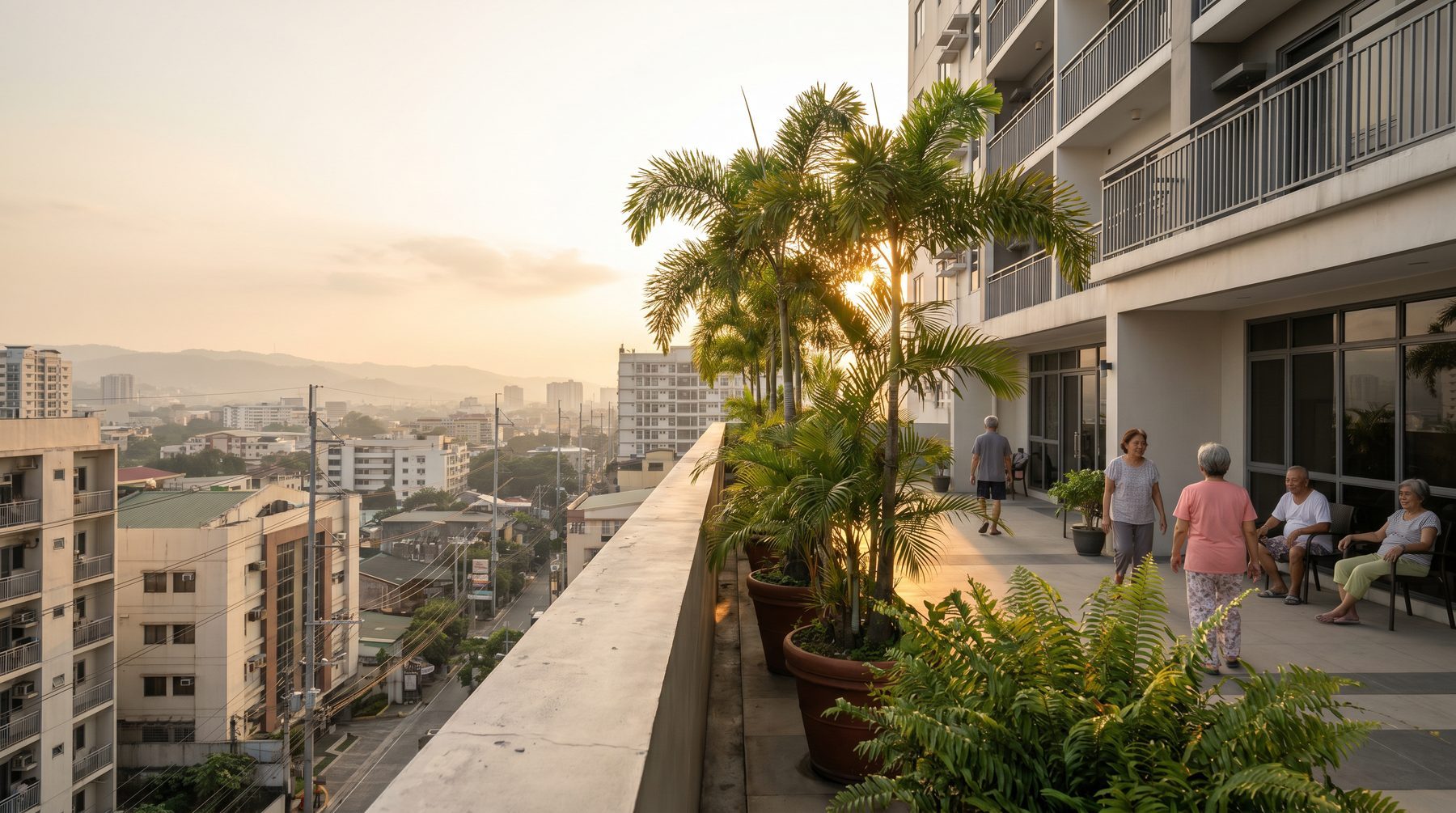
Retiring in the Philippines can make sense for the right profile, but it should not be reduced to a simple tax headline. The real question is whether the country gives you the right combination of residence security, pension treatment, healthcare access, cost of living, climate, and day-to-day comfort. A retirement move is harder to reverse than a business relocation, so practical quality of life matters as much as tax.
For retirees considering the Philippines, the main points are:
- ›Residence route: The practical route is usually the the SRRV and other residence options can make the Philippines accessible for retirees, depending on age, pension, and deposit requirements. This should be confirmed before making property commitments or moving assets, because a pleasant destination is not useful if the residence basis is weak.
- ›Pension income: Foreign pension taxation depends on source and residence status; many retirees focus on source-country rules and local remittance practice. The decisive point is often not only local tax, but whether the pension-paying country continues to tax the pension at source.
- ›Healthcare: Private healthcare in manila, cebu, and major cities is good and affordable; provincial care varies. Retirees should arrange private insurance or a clear local healthcare pathway before arrival, especially where pre-existing conditions are involved.
- ›Cost of living and lifestyle: English-speaking environment, island lifestyle, large expat communities, and low costs. The country can work well where the retiree’s lifestyle expectations match the local rhythm rather than an imagined expatriate brochure.
- ›Climate and practical fit: Tropical heat, typhoon exposure, and major differences between cities and islands. Climate, language, bureaucracy, transport, and access to family often decide whether the move remains attractive after the first year.
The Philippines should therefore be assessed as a full retirement platform, not merely as a tax jurisdiction. The best candidates are retirees who have stable foreign income, good health coverage, a realistic view of local bureaucracy, and a clear plan for where they will live, how they will receive care, and how their pension will be taxed both locally and at source.
XIX.
US Citizens: What You Need to Know
US citizens and long-term green card holders are taxed by the United States on their worldwide income, regardless of where they live. Relocating to the Philippines does not end US tax obligations — it changes the picture, but does not eliminate it.
Key considerations for US citizens in the Philippines:
- ›Foreign Earned Income Exclusion (FEIE): US citizens who qualify as bona fide residents of the Philippines or pass the physical presence test can exclude a significant amount of foreign earned income from US federal income tax. This applies to wages and self-employment income — not passive income such as dividends, interest, capital gains, pensions, or rental income.
- ›Foreign Tax Credit: Income tax paid in the Philippines can generally be credited against US tax on the same income, reducing or eliminating double taxation. The credit is particularly important for income not covered by the FEIE and for taxpayers whose income exceeds the annual FEIE threshold.
- ›Treaty position: The United States and the Philippines have an income tax treaty, but its practical use depends heavily on the type of income and the taxpayer’s facts. A treaty does not automatically remove US filing obligations, and most treaties contain savings-clause rules that preserve US taxation of citizens.
- ›FBAR: US persons with bank accounts in the Philippines exceeding $10,000 in aggregate must file FinCEN Form 114 (FBAR) annually. Failure to file can carry severe penalties, even when no tax is due.
- ›FATCA: US citizens may also need to report foreign financial assets on Form 8938. Banks in the Philippines may separately identify US account holders under FATCA procedures and report account information through the relevant channels.
- ›Social Security and self-employment tax: The FEIE reduces income tax but does not automatically eliminate US self-employment tax. Whether US Social Security tax applies depends on employment status, entity structure, and any applicable totalization agreement.
US citizens considering the Philippines should work with a qualified US international tax adviser alongside local counsel. The interaction between US tax law and Philippines tax law is manageable, but it requires careful planning before the move, not after the first filing deadline arrives.
XX.
Correct Preparation
- ›SRRV application process: Must be applied for at the PRA head office in Makati, Manila (or satellite offices in Cebu, Davao, Clark). The process takes 7–10 business days. Bring: apostilled police clearance from country of origin, medical certificate, proof of pension, passport, 2 passport photos.
- ›Recommended steps: 1. Home-country departure tax analysis. 2. Travel to Manila for SRRV application. 3. Open PRA-accredited bank account (required for deposit). 4. Submit SRRV application and complete deposit. 5. Receive SRRV and PRA ID. 6. Arrange long-term accommodation. 7. Notify home-country tax authority of departure.
XXI.
Automatic Exchange of Information (OECD CRS)
The Philippines does not appear as a participating jurisdiction in the OECD's CRS-by-jurisdiction implementation table. A Philippine bank holding your accounts is therefore not reporting under the standard OECD automatic exchange framework that applies in CRS jurisdictions. This is a factual observation, not a marketing point. The Philippines is not a secrecy jurisdiction, and the absence of CRS reporting does not extinguish tax obligations anywhere else. It simply means CRS is not the relevant transparency channel for accounts held there.
This is the moment most people draw the wrong conclusion — because most people misunderstand how CRS works in the first place.
The common assumption is that CRS follows nationality. It does not. CRS follows tax residence. A Swedish passport does not trigger Swedish reporting. A German passport does not trigger German reporting. What matters is where you are tax resident at the moment your bank performs its due diligence — not the country on your passport, not the country you used to live in, not the country where your family still pays tax.
Once you understand that, the Philippines picture becomes clear. A Swedish citizen who has genuinely become tax resident in the Philippines is not reportable to Sweden through Philippine channels for two independent reasons: CRS would not point to Sweden anyway, because Sweden is not the country of tax residence; and The Philippines is not operating as a CRS reporting jurisdiction in the first place. The real question is upstream of both points: does Sweden, or any other prior country, still regard the individual as tax resident under its own domestic rules? That is what determines tax exposure.
CRS creates transparency, not tax liability. The two are routinely confused. Even in a non-CRS jurisdiction, an unfinished or sloppy departure leaves your previous country in a position to tax your worldwide income — regardless of whether information is being exchanged automatically. The genuine risk is not the data flow. The genuine risk is a badly executed exit.
US citizens sit outside this framework entirely. Americans are not principally affected by CRS. They are affected by FATCA and by US citizenship-based taxation. Banks outside the United States — including in the Philippines — generally identify US persons and report account information through FATCA channels to the IRS, regardless of where the individual is tax resident. For Americans, the passport really does follow you. For everyone else, it does not.
Key point: Neither CRS nor the Philippines's non-participating status is a substitute for proper tax-residency planning. The decisive question is upstream: have you genuinely exited your previous tax residence, and have you built a defensible Philippine position? CRS follows tax residence where it applies. FATCA follows US-person status. Domestic tax-residency rules still decide who is allowed to tax you.
XXII.
Further Relocation Formalities
Upon establishing residence in the Philippines, you will need to obtain a TIN (Taxpayer Identification Number) from the competent local authority. This is required for most financial and legal transactions in the Philippines, including opening bank accounts, signing contracts, registering with tax authorities, and dealing with public offices.
You will also need to obtain or complete the relevant ACR I-Card or relevant residence documentation process once your residence status has been approved. This document or registration record becomes your practical proof of residence in the Philippines and is usually required for banking, telecom contracts, utilities, leases, property transactions, and day-to-day administrative matters.
- ›Driving licences from most countries are accepted only for a limited period after arrival. Once you become resident in the Philippines, you should verify whether your licence can be exchanged directly or whether a local medical certificate, translation, theory test, or practical test is required.
- ›Health insurance should be arranged before arrival unless you are immediately covered by a local public system. In many cases, private international cover is the safest bridge solution while residence, employment, or social-security registration is still being completed.
- ›Importing personal effects should be planned before shipping anything to the Philippines. Household goods may qualify for relief when imported shortly after taking up residence, but customs paperwork, inventory lists, timing rules, and vehicle-import duties can make late or informal shipping expensive.
- ›Proof of address and banking are often linked. Banks, telecom providers, and government offices may require a lease, utility bill, local address certificate, or residence registration before they will open an account or complete onboarding.
- ›Ongoing local compliance should not be treated as an afterthought. Calendar reminders for residence renewals, tax registrations, local filings, health-insurance renewals, and address updates help prevent administrative problems that can later undermine the tax-residency position.
XXIII.
How We Help With Your Move to the Philippines
We offer comprehensive tax and legal support for your relocation to the Philippines. We follow a proven process — and where the Philippines requires specialist local input, we involve appropriately qualified local tax, legal, immigration, and banking advisers on the ground, while remaining responsible for overall coordination.
The results speak for themselves: we have helped over 100 entrepreneurs and business owners significantly reduce their tax burden through carefully planned relocations. Careful planning, thorough advice, and comprehensive support are our standard. Legally sound structuring within the framework of international tax law is our highest priority.
Our services typically include one or more of the following:
- →Tax advice on the consequences of relocating abroad: analysis, projections, assessments
- →SRRV category selection and application guidance
- →Home-country departure tax analysis — pension tax treatment under DTA
- →Banking introductions — PRA-accredited banks for deposit and complementary international banking
- →Healthcare planning
- →Coordination between your home-country adviser and your the Philippines professional team
Our fees are generally billed on a time basis; fixed prices apply for certain services such as company formation.
As a first step, we recommend booking a consultation to discuss your plans — by phone, Zoom, or Signal. Together we find the best approach and establish contact with our local partner. As project coordinator, we keep all the threads in hand that are necessary for the successful implementation of your plans.