Imagine the scene.
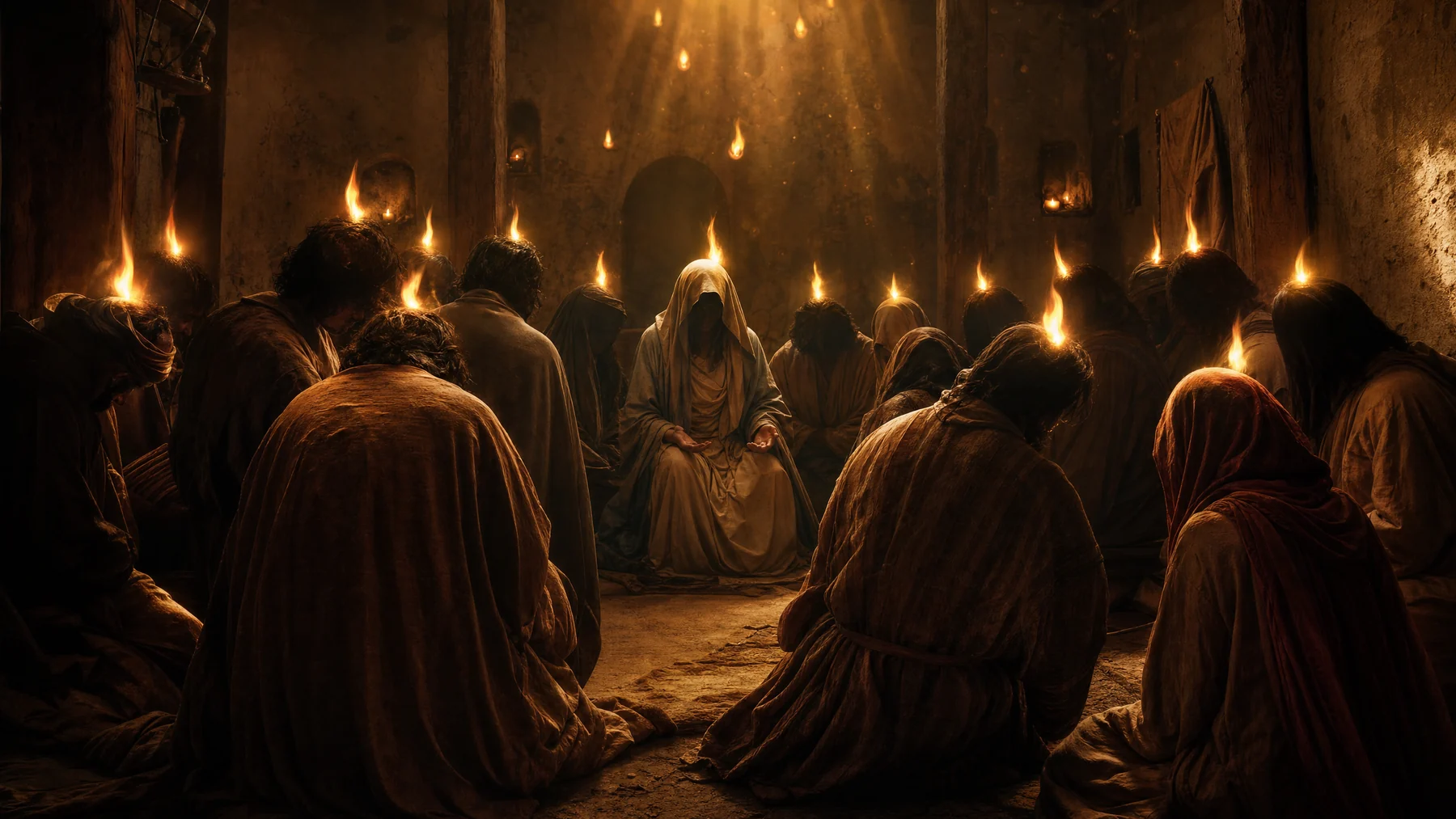
A room. Jerusalem. The city outside is loud with pilgrims, with the smell of bread and sacrifice, with the ordinary chaos of a feast day. But inside this room there is a silence that presses in on you. The kind of silence that follows catastrophe.
They are all there. The eleven. Mary, his mother. A handful of women who had stood at the foot of the cross when the men had fled. One hundred and twenty souls in total, scripture tells us. People who had followed a man across dusty roads and through storm-battered nights. People who had heard him say things no one had ever said. People who had watched him die.
Yes, he had risen. They knew that. Some had touched the wounds. Thomas had pressed his fingers into them, trembling, the doubt collapsing into that great cry: My Lord and my God. He had eaten fish with them on the shore of Galilee in the early morning, the charcoal fire going, the water still dark. He had walked with two of them all the way to Emmaus, their hearts burning within them, and they had not even known who he was until the breaking of bread.
And then he was gone. Ascended. The sky had swallowed him, and two men in white had told them to stop staring upward.
So now they waited. He had told them to wait. He had promised something, a gift, a Paraclete, a Comforter. But promises, however extraordinary, are still only promises until they are kept. And so they prayed. Huddled together in that upper room, grieving and hoping in the same breath, not quite knowing which was stronger.
Nine days. Nine days of this.
The Day Everything Changed
It was the feast of Shavuot. Pentecost. Fifty days after Passover. The Jews celebrated it as the giving of the Law on Sinai, the moment God had spoken from fire and thunder and the mountain had trembled. Every devout Jew in the known world either came to Jerusalem for it or turned his face toward the city in prayer. The streets were full.
And then it began.
Not gradually. Not politely. A sound like a rushing, violent wind, filling the entire house. Not a breeze. Not a gust. Something vast and ungovernable, like the breath of a God who had decided to stop whispering. The walls shook with it. The air changed. And then the fire came, not consuming them, but resting on them, a tongue of flame above each head, and they were filled, flooded, set alight from the inside with something that had no name yet, or rather, had the oldest name of all.
The Holy Spirit.
And they spilled out into the street.
You have to understand what happened next. These were Galileans. Fishermen. Tax collectors. A tentmaker. Men whose accents gave them away the moment they opened their mouths. And suddenly they were speaking, not in their own tongue, but in every tongue under heaven. Parthians heard their own language. Medes. Elamites. Visitors from Mesopotamia and Cappadocia and Pontus and Phrygia. Egyptians. Romans. Arabs. Each one turned to his neighbour with that look you only get when something impossible is happening right in front of your eyes.
Some mocked. They are full of new wine, someone called out. The easy explanation. The one that required nothing of you.
But Peter stood up. Peter, who six weeks earlier had warmed his hands at a fire in a courtyard and sworn three times to a servant girl that he had never met the man. That Peter stood up, threw his voice across that crowd of thousands, and preached with a force and a clarity that had nothing to do with his education or his courage, because six weeks ago he had neither.
Three thousand people were baptised that day.
That was the birthday of the Church.
Baptism: One of the Great Divides
Today is Pentecost Sunday. And it strikes me as a good moment to talk about something that divides Christians, quietly but persistently, and has done for five centuries. Not the biggest division. But a real one.
The question of baptism.
Do we baptise infants? Or do we wait until a person can choose for themselves, consciously, freely, with full understanding? It is a question that separates Catholics from many of our Protestant brothers and sisters, and it deserves a serious answer rather than a shrug in either direction.
Let me try to give one.
The Catholic Case: Rooted in Scripture
For Catholics, infant baptism is not a relic of medieval superstition or an administrative convenience. It is rooted in scripture, and more than that, in a theology that runs through the whole Bible from Genesis to Revelation: the theology of covenant.
Paul, writing to the Colossians, makes the connection explicit. He links baptism directly to circumcision, the ancient covenant sign that God commanded Abraham to give to every male child on the eighth day of life. Eight days old. Not old enough to walk, let alone to make a reasoned theological commitment. And yet God said: this is the sign of my covenant with you and your descendants. The child was marked. Claimed. Brought into the people of God not by his own choice but by God’s choice and the faithfulness of his family.
Baptism, Paul tells us, is the circumcision of Christ. The new covenant sign. The logic follows: if the old sign was given to infants, why would the new sign be withheld from them?
Then there is Acts chapter two, the very day we are celebrating today. Peter has just preached that first great sermon, and the crowd, cut to the heart, cries out: what shall we do? And Peter says: Repent and be baptised, every one of you, in the name of Jesus Christ for the forgiveness of your sins, and you will receive the gift of the Holy Spirit. The promise is for you and for your children and for all who are far off.
For you and for your children. That is not an accident of phrasing. It echoes the Abrahamic covenant deliberately. The promise reaches across generations. It lands on the children.
And when the early Church actually baptised, it baptised households. Lydia and her household. The Philippian jailer and his household. Cornelius and his household. Crispus and his household. The Greek word is oikos, and it meant everyone under the roof: servants, children, infants. There is not a single mention, in any of these passages, of children being excluded. If the apostles had done something as extraordinary as turning away the infants of new believers, someone would have noted it. They did not, because it did not happen.
Paul even tells the Corinthians that the children of a believing parent are hagios, holy, set apart. Covenantally included. Already belonging.
And Jesus himself, when his disciples tried to keep the children away from him, was indignant. “Let the children come to me and do not hinder them, for the kingdom of God belongs to such as these.” He took them in his arms. He blessed them. The kingdom, he said, belongs to them.
This is consistent with the Catechism of the Catholic Church, which grounds infant baptism precisely in this covenantal logic: the child is born into a fallen world and needs the grace of regeneration, which the Church, acting as mother, does not withhold.
God Chooses Us First
But here is the deeper theological point, the one that I find most compelling, and most beautiful.
We baptise infants because we believe that God chooses us before we choose him.
That is not a Catholic invention. It runs through every page of the Bible. God chose Abraham, not the other way around. God chose Israel, a small and stiff-necked people, not because of anything they had done. God chose Mary, a girl in an obscure village, before she had spoken a word. You did not choose me, Jesus tells his disciples at the Last Supper. I chose you.
Grace is not something we reach up and take. It is something that descends. It is gift before it is response.
And a baby, utterly helpless, unable to feed itself or speak or even hold up its own head, incapable of bargaining or performing or demonstrating its worthiness, is perhaps the most perfect image of how all of us stand before God. We receive. We do not earn. The faith comes first as a gift, carried by the family, by the community, by the Church, and the child grows into it the way a child grows into everything: gradually, stumblingly, with love around them.
The Objection, and Why It Doesn’t Hold
Now, the objection raised by our Baptist and evangelical friends is a serious one, and we should not be dismissive of it. They say: baptism should be the act of a free and conscious will, a genuine personal surrender to Christ, not something done to you before you can speak.
There is something true in that instinct. But here is the difficulty with requiring complete, fully-formed, rationally unimpeded consent as the basis for sacramental grace.
Are any of us, truly, ever in that position?
Can any human being grasp the full mystery of what they are saying yes to at the font? Can you, at seventeen or thirty-two or sixty, claim to understand completely what it means to die with Christ and rise with him? If the validity of the sacrament rested on the completeness of our understanding, none of our baptisms would hold.
And then there is this. What of the child with Down’s syndrome? What of the man with a profound intellectual disability who will never reach the cognitive threshold that some require for baptism? Is he excluded from the covenant forever? Is the grace of Christ withheld from him because his mind does not work in the way that a committee of theologians has decided is the minimum requirement?
That cannot be right. That cannot be the God of the Gospels.
Origen, writing around 185 AD, explicitly states that infant baptism was received from the Apostles, it is not a medieval innovation. It is there from the beginning.
Confirmation: Your Personal Pentecost
And yet, the Protestant instinct that faith must be personally owned, personally inhabited, personally chosen with the full weight of one’s freedom, that instinct is not simply wrong. It is pointing at something real. The covenant is not a piece of paper you inherit and file away. It is a living relationship. It asks something of you.
Which is exactly why we have confirmation.
Confirmation is the moment when what was given to you as an infant becomes yours. Consciously. Deliberately. You stand up and say: yes. I own this. I choose this. I am not simply repeating what my parents decided. I am making it mine.
And what is the sacrament of confirmation if not, in miniature, a personal Pentecost?
Think about it. In confirmation, the bishop lays hands on the candidate, just as the apostles laid hands on the newly baptised in the Acts of the Apostles. The Holy Spirit is invoked. The candidate is sealed, anointed with chrism, strengthened for the mission of a Christian life in the world. The gifts of the Spirit, wisdom, understanding, counsel, fortitude, knowledge, piety, and fear of the Lord, are imparted.
That is precisely what happened on this day in Jerusalem. The disciples had their faith. They had seen the risen Christ. But they were still hiding. It was the Holy Spirit, poured out at Pentecost, who transformed them from believers into witnesses. From a group of frightened people in a locked room into a Church that would turn the world upside down.
Baptism gives us the life. Confirmation sends us out to live it.
The infant, baptised, is brought into the covenant family. Given the gift they cannot yet unwrap. And the young person, confirmed, is lit from within, given the same fire that fell on the apostles in that upper room, and sent out into a world that is just as noisy and sceptical and full of people staring at the sky as it was two thousand years ago.
One Fire, Two Moments
On this Pentecost Sunday, whichever tradition you come from, it seems worth sitting with the wild audacity of what we are celebrating.
God did not wait for humanity to sort itself out before acting. He came. He chose. He gave. He poured himself out like wind and fire into a room full of frightened, imperfect, grieving people who had not fully understood anything yet.
That is grace.
That is what we pour over the heads of our children.
And that is what, in confirmation, we ask them to walk into with open eyes and open hands.
Carpe Diem, Sebastian
Published on Pentecost Sunday