A parable from 20,000 feet.
At 20,000 feet over the Aegean, a window on Ryanair flight FR1879 gave way and the sky reached into the cabin to take a man. A blade had broken from the engine and shattered the glass beside seat, and in that instant the pressure that keeps us alive up there turned into the pressure that wanted him gone. Ljubiša Karović was sitting next to that window. The upper half of his body was dragged out into the roaring cold, his head and shoulders hanging in the slipstream, inches from the end.
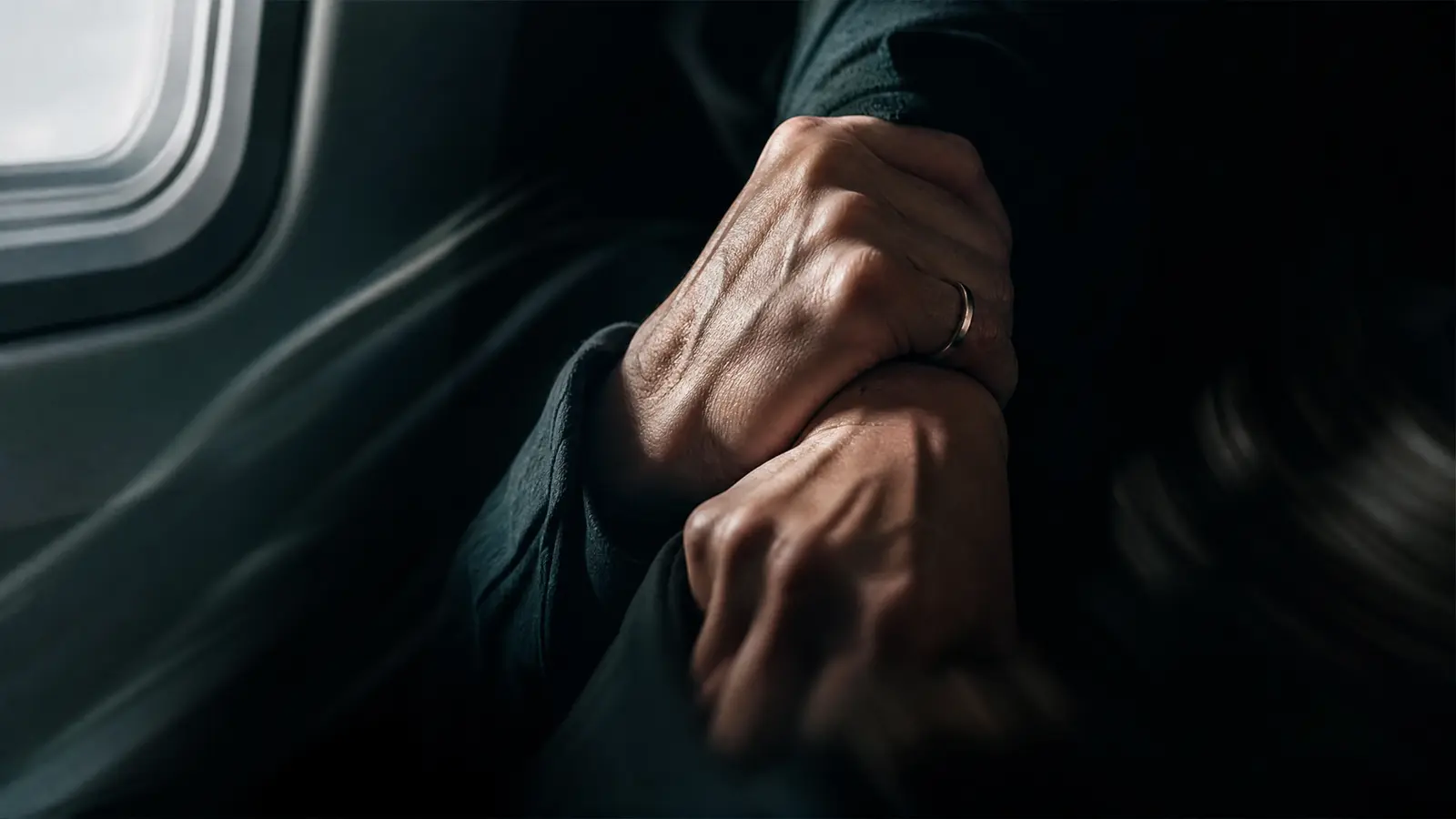
His wife did not scream and freeze. She did not faint into her armrest and wait to be widowed. Svetlana Grković grabbed her husband by the legs and held on.
Five minutes. Think about that. Not five seconds of adrenaline, but five full minutes of a two-hundred-kilometre-an-hour wind trying to tear a grown man out of her hands, while oxygen masks dropped, while strangers screamed, while the aircraft bled altitude and turned for home. She held. When they later asked her what went through her mind, she said something that ought to be carved somewhere permanent: "I reacted immediately and grabbed his legs. I thought: if we die, we die together."
Then, one by one, the passengers who found their courage came to help, and together they pulled him back into the world. He survived. Burned, bloodied, in shock, unable to speak, but alive. He is alive because his wife decided, in the first half-second of the worst moment of their lives, that she would not let go. You can read the full account of what happened on board here in the Daily Mail's report.
I cannot stop thinking about her.
No meekness. No hesitation. A lioness.
Notice what is absent from this story. There is no timidity. There is no paralysis. There is no waiting for permission, no looking around to see what everyone else will do, no polite hope that a man in a uniform will handle it. In the most panic-inducing situation a human being can imagine, a hole torn in the sky and her husband disappearing through it, Svetlana Grković moved before thought, before fear, before calculation. Her hands were on him while her mind was still catching up.
That is not weakness dressed up as devotion. That is ferocity in service of love. And I have come to believe it is the truest mark of a great wife.
Here is the hard question the story quietly asks. Would your best friend have done that? Be honest. Your closest friend, the one you'd trust with your life over a beer, the one who's known you thirty years. Faced with that window, would he have wrapped his arms around your legs and thought if we die, we die together? Maybe. But you don't actually know. A great wife, you know.
Because a wife of that calibre is not merely a companion or a co-signer on the mortgage. She is not just the person you like most in the room. She is the one who stands in your corner when the situation is hopeless, when the odds are humiliating, when a reasonable person would let go and save herself. She fights for her man and her family like a lioness, and the lioness does not weigh the odds before she moves. She simply refuses to lose what is hers.
I have seen this again and again
In my work I sit across the table from successful men at the most consequential crossroads of their lives. They are deciding whether to leave a country, restructure a fortune, protect a family, pull the ripcord on a life that no longer serves them. And I will tell you what I have learned watching hundreds of these decisions unfold: behind a great many rescued men stands a woman who refused to let him drown. Often, and I say this with love, she is saving him from himself.
I think of the client who spent three years explaining to me, patiently, why next year would be the right time to leave. The politics would settle. The business needed him. The moment wasn't ripe. Every objection was intelligent, and every one was fear wearing a suit. It was his wife who quietly booked the scouting trip, found the school, walked the streets of the new city, and came home and said: we are going, and you are coming with us. His Plan B became the family's Plan A because she would not let his caution become their cage. Today he thanks her in front of guests. He forgets it was ever her idea.
I think of the wife who sat in on a meeting where her husband was about to shake hands on a deal that would have swallowed everything he had built, a charming partner, a beautiful story, a hole in the numbers you could fly a 737 through. Her husband was dazzled. She was not. She asked three questions in a flat, unbothered voice, and by the third the whole thing came apart on the table in front of us. She saved him millions and let him believe he'd spotted it himself. That is grace on top of ferocity.
I think of the men pulled back from quieter cliffs. The drinking that was becoming a habit and then a life. The obsession with a single number on a screen. The slow disappearance into work until the family was a set of strangers sharing a surname. In case after case, the person who reached into that spiral and dragged the man back to his own flesh and blood was his wife, holding his legs while he hung half out of a window he couldn't even see.
This is the pattern, and once you notice it you cannot unnotice it. Men soar. Men build, conquer, abstract, obsess. We are magnificent at charging toward the horizon and terrible at remembering the ground. And the wife, the real one, the fierce one, is the tether that keeps the flight from becoming a fall.
The deeper thing
There is a spiritual architecture underneath all of this, and the airplane makes it visible.
Man goes out into the world as the archetypal hero: hunter, builder, founder, conqueror, driven by a restless will to impose order on chaos. It is a glorious drive and a dangerous one, because it tends toward fragmentation. Left untethered, the hero becomes Icarus, climbing toward achievement and power and pure abstraction until the wax melts and there is nothing beneath him but air. The ancients understood this perfectly. In Plato's Symposium, Aristophanes tells the strange and beautiful myth that human beings were once whole and were split in two, and that ever since we have wandered the earth searching for our other half. The wife is not an accessory to a complete man. She is the missing half that makes the circle whole. She calls the wandering hero home, not to make him smaller, but to make him entire.
She saves us, too, by seeing us. Carl Jung called it the anima, the soul's feminine face: receptive, intuitive, rooted in the rhythms of life, birth, and mystery. Where a man so often lives in his head and on the horizon, she lives in the heart and the hearth. She mirrors our blind spots back to us with an honesty that only love could dare. She sees the frightened boy behind the armour, the mortal man behind the provider's mask. In her gaze the false self dies a little, and something truer is born. Defences that no rival could breach simply fall open in front of her.
And she saves us by dragging us back into the body. Men are forever trying to spiritualise ourselves out of the flesh, up into doctrines and missions and screens. A wife returns you to the warmth of a hand, the vulnerability of sickness, the raw miracle of a child being born. She teaches, without a single lecture, that transcendence is not an escape from the material world but its sanctification. The ordinary things, the arguments over nothing, the folding of laundry, the cooking, the endless small forgiveness, become the fire that grinds down the ego's illusion of control. Marriage is the slow alchemy that turns a boy into a man.
She saves us, finally, by demanding our becoming. Love is not only comfort. It is fierce refinement. A great wife will not let you rot in boyhood. Her disappointment cuts deeper than any failure in the world, because it comes from the one person who chose you freely and could have chosen otherwise. In straining to be worthy of her, more present, more courageous, more tender, we are forged into something we would never have become alone. The warrior learns mercy. The thinker learns wonder. The wanderer, at last, learns belonging.
None of this is a fairy tale. Marriage exposes exactly how broken we both are; that is half its purpose. But the salvation is hidden in precisely that exposure: in choosing to stay, to forgive, to grow together across the fracture, two imperfect people become one flesh, and that union is a small mirror of the whole universe straining toward reconciliation. My own faith names this openly. Scripture holds up the wife of noble character as more precious than jewels, a woman clothed in strength and dignity who laughs at the days to come. It is not sentiment. It is a job description for a lioness.
What she was really holding
So return, one last time, to that cabin over the Aegean. To the wind. To the man half-swallowed by the sky. To the woman with her hands locked around his legs, deciding in a heartbeat that if the sky was going to take him it would have to take them both.
She was holding a husband, yes. But look closer and she was holding the oldest truth we keep forgetting: that we were never meant to be alone. The solitary hero's journey does not end at the mountaintop. It ends at the shared table, the shared bed, the shared life, where strength meets softness and giving meets receiving and two souls, gripping hard, walk each other home.
We tell ourselves we are the ones who provide, protect, and save. And then a window blows out at 20,000 feet, and we learn the humbling, glorious truth.
It was her holding us the whole time.
If you are lucky enough to have a woman like that, a fierce one, a lioness, one who would grab your legs without a thought, go and tell her today. Life is short and fleeting. You get one shot. Do not let go of the hand that refuses to let go of you.