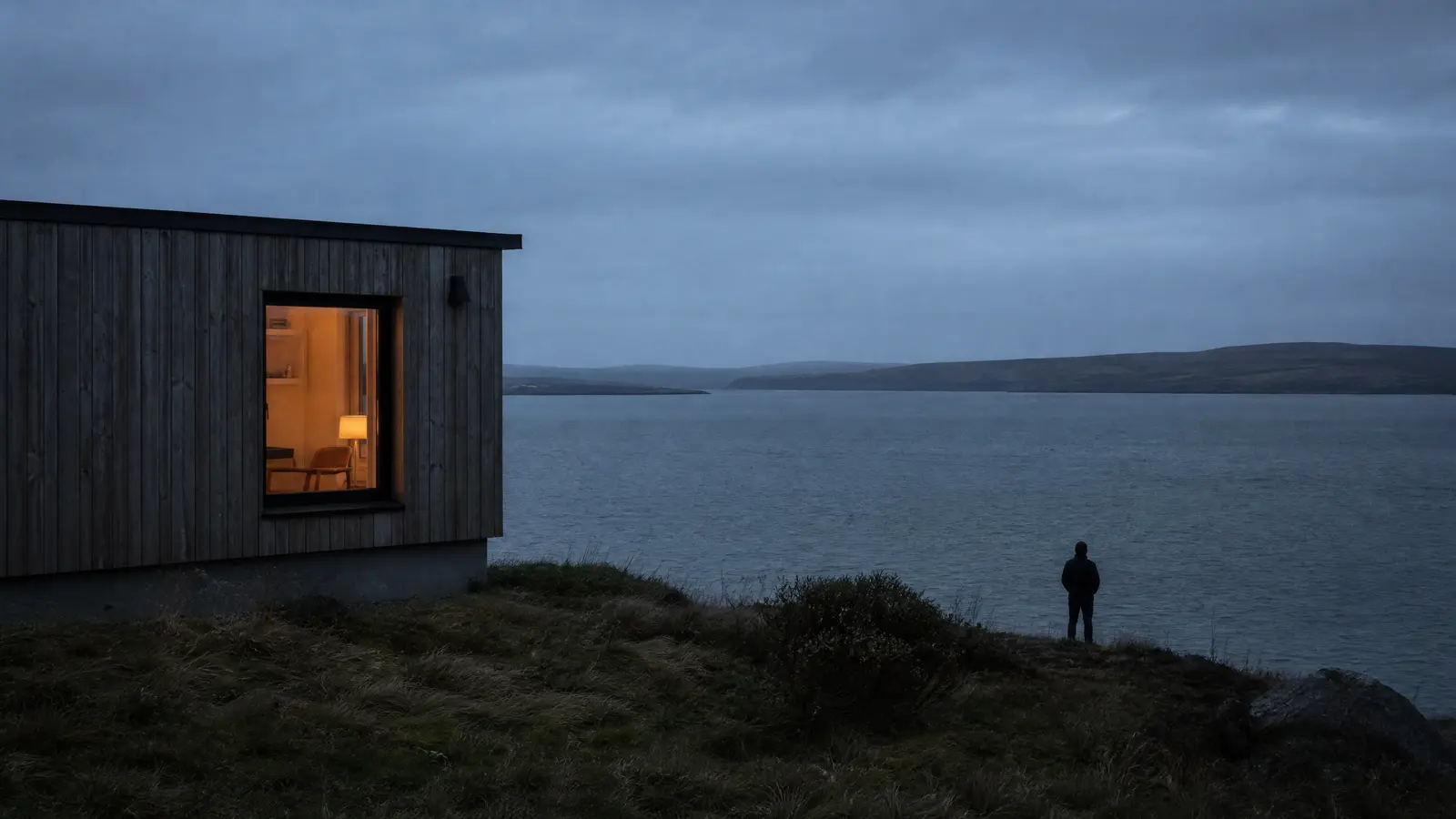
On the Granton waterfront in Edinburgh, sixteen small wooden houses now sit in a loop of green, facing the Firth of Forth. Each has a front door, a key, a kitchenette, a bathroom, a bed that belongs to one person and no one else. On 29 June the homelessness charity Social Bite reopened its flagship "village" here, expanding from ten homes to sixteen and moving the whole community five minutes down the road to a site with a sea view. The founder, Josh Littlejohn, says the village model is about more than "putting a roof over people's heads." It is meant to restore hope and dignity.
I read the announcement twice. And I felt two things at the same time, and they would not sit still together.
The first was love. I am a Catholic, and the picture is beautiful: the derelict land redeemed, the keys handed over, the man who once slept in a doorway now watching the light move across the water from his own window. Who could be against that? I am not. Part of me wants to write a cheque, say well done, and move on feeling warm.
The second thing was harder, and I have earned the right to say it. My family and I have done this. Not for a press release, but quietly, with our own money and our own front doors. We have given housing, no strings attached, to at least half a dozen people broken by homelessness and addiction. We wrapped it in everything the experts prescribe: medical care, therapy, patience, and the warmth of a community that actually knew their names. And I have to tell you the truth, because a lie here helps no one. Almost all of them fled. Some stole from us first, then ran. Not because we failed to love them. Because the walls could not hold what was wrong.
So let me be precise, because precision is its own form of mercy. There is no single thing called "homelessness." There is the young mother put out of her home, shuffled for a year between B&Bs with her children, rules and curfews and no visitors, lonely and exhausted through no fault of her own. And then there is the chronic street-dweller whose homelessness is knotted together with addiction and something older and deeper than any lease can reach. These are not the same problem, and they do not have the same answer.
If you ask me who should get the keys to those sixteen waterfront houses, my answer comes quickly. Give them to the single mothers stuck in the B&Bs. Give them to the families one bad month away from the street. For them a stable door is not a metaphor. It is the whole cure, and it works. (One former resident of the old village, a woman whose mother had died and who had been drifting between hostels, said the thing she loved most was simply the community, the friends who finally knew her.) I believe her completely.
Let me be clear about who I am not arguing with. I am not criticising the people who built this village. Social Bite and Cyrenians do not just hand over keys and walk away; they wrap those homes in real, on-site, ongoing support, and they choose carefully who is ready to receive one. If I sat down with them, I suspect they would nod along with most of what follows. My quarrel is not with the builders. It is with a wider narrative in our society, the comfortable assumption that if we simply give a person a key, the problem is solved.
Because for the classic, chronic homeless, the man who has lived rough for twenty years, the problem is not solved. Not by one house, and not by a thousand of them.
I learned this from a man we tried to help. He loved the idea of a home. He wanted it the way you want a country you can no longer return to. And he could not stay inside. More than a few hours under a roof and he told me he felt as though he were in a prison. Not ungrateful. Not lazy. Afflicted. The street had become the shape of him, or he had become the shape of it, and I am not wise enough to say which. Call it compulsion. Call it affliction. Whatever you call it, a kitchenette with a sea view does not touch it.
Here the evidence is more honest than the press releases. The research on Housing First and supported models is genuinely strong on one point: give people a stable home and most of them keep it. Housing retention goes up, and that matters. I will not pretend otherwise. But on the deeper wound, the active addiction, the results are mixed and modest at best. Walls keep people housed. Walls do not, on their own, keep people whole. We keep confusing the two, because the first is so much easier to photograph.
And that, I think, is the thing we do not want to admit. We cannot bear the thought of someone sleeping rough. It offends us. It sits on the conscience like grit. So when a village opens by the sea, a part of us wants to read the headline, feel the problem dissolve, and look away. The charity keeps working long after the ribbon is cut. We, the applauding public, tend to leave. For the families who needed a door, the story really is over, gloriously. For the man the street still owns, the headline changes nothing. A key can be the easy way out, and it is usually our exit, not his.
Do not mistake me. I am not arguing for less. I am arguing that we have mistaken the cheap thing for the costly thing. Believing the house is enough is the easy way out. It lets the rest of us keep our distance while congratulating ourselves. It quietly demands that the broken man reassemble himself into someone who lives the way we live, keeps the hours we keep, wants the life we want. And when he cannot, we file him under failure.
There is another way, and it is much harder, and it will never scale into a manifesto. Take people as they come. Love them without first requiring that they be fixed. Sit with the man who cannot stay indoors, on the ground if that is where he is, and give him the one thing no charity can institutionalise: your time, your attention, your presence. Listen until you have actually heard him. Embrace him though he smells of the street. Reach, really reach, into the abyss of another human being, instead of paying to have it fenced off somewhere you will not have to see it.
As a Christian I have had to make my peace with a sentence I resisted for years. We cannot solve every problem in this life. Some woundedness will not close on this side of the grave. That is not despair, and it is not a licence to do nothing. It is the beginning of the only honesty that leads to real love, the love that keeps showing up long after the intervention has "failed." For those we cannot house and cannot heal, there remains something the modern world has forgotten how to offer: we can love them anyway, we can pray for them, and we can trust the next life to finish what this one could not.
The waterfront houses are good. May they bless the families who need exactly that. But if we believe a key is a cure, we have understood neither homelessness nor ourselves. The deepest poverty is not the absence of a roof. It is the absence of someone willing to get dirty, and stay.