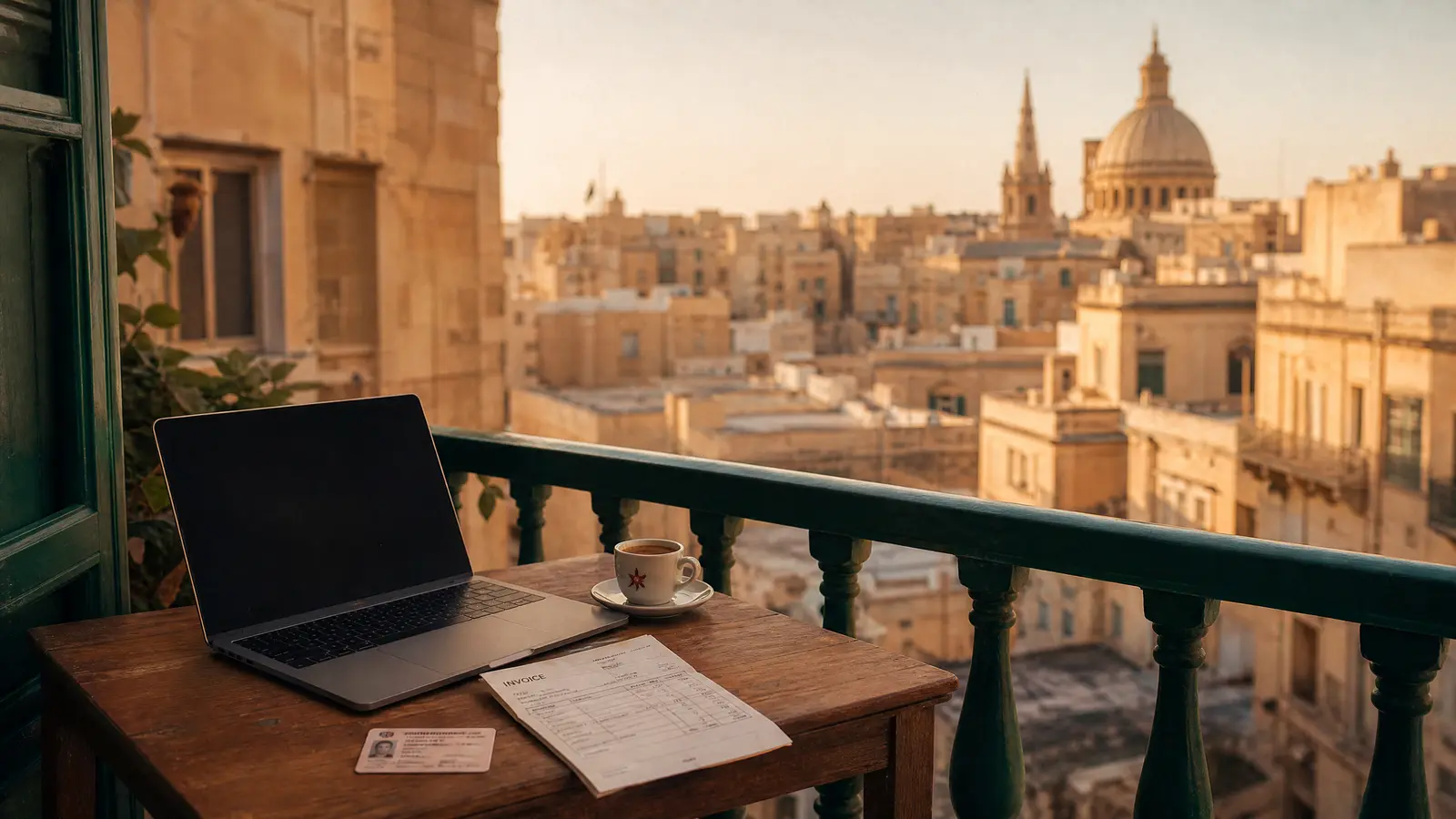
Let me tell you about the strangest piece of advice I give people moving to Malta, and why the ones who take it thank me years later.
If you relocate to Malta as a non-dom, the textbook play is well known. You live on the remittance basis, your foreign income stays offshore and untaxed unless you bring it in, and you keep your footprint on the island light. Elegant. Legal. Efficient. And for many people, incomplete in a way that quietly costs them for years.
Here is my heresy: register as a sole trader anyway. Set up a small self-employed business in Malta, invoice real work, pay real Maltese tax and social security on it, and do all of this knowing full well that it delivers precisely zero tax benefit. Not a cent saved. Possibly tax paid that you could have structured away.
Do it anyway. Here is why.
First, who this is actually for
Let me be precise, because this advice has an audience, and it is not everyone.
If you arrive in Malta and set up the full structure, a Maltese company with you on its payroll, then you already have everything this article promises. As an employee of your own Malta company you pay Class 1 contributions through the payroll, you are inside the social security system, you get the healthcare, the EHIC, the tax returns, the substance, the standing. The machine embraces you automatically. If that is your setup, read on for pleasure, but you need nothing from me.
This article is for the others, and there are far more of them than the brochures admit: the non-dom with no active income in Malta at all. The investor living on dividends parked offshore. The retiree. The founder whose operating companies sit abroad and who has no reason, or no desire, to build a Maltese corporate structure with its directors, accountants, audits, and annual fees just to get a payslip. For years the standard answer for these people was simply: stay passive, buy private insurance, keep your head down.
I think the standard answer is wrong. For anyone in Malta without a company structure and without local employment, the humble sole trader registration is the missing piece: the lightest possible doorway into the same system that employees and company owners enter automatically. No incorporation. No audit. No payroll software. One person, one registration, and every door below swings open.
The invisible resident
First, understand the problem you are solving. The modern non-dom does not live in the world of 1995, where a residence certificate and a tan were proof enough of a life abroad. You live in the world of CRS, source-of-funds questionnaires, and compliance officers who are paid to disbelieve you.
Picture yourself through their eyes. You are a foreigner in Malta with no employment, no business, no Maltese tax paid beyond the minimum, and money arriving from structures abroad. Every fact in that sentence is perfectly legal. And every fact in that sentence makes a banker's pen hover. To the algorithms and the analysts, a resident with no economic life is a ghost, and ghosts get questions. Frozen onboarding. Requests for "just a few more documents." The slow, grinding suspicion that follows people who exist on paper but not in payroll.
Now change one thing. You are a Malta-registered sole trader. You have a trading name, a VAT number, a tax return showing self-employment income, social security contributions paid three times a year like clockwork. Suddenly the file reads differently. You are not a ghost. You are a taxpayer. You have what the compliance world craves above all things: a coherent story, supported by boring documents.
Yes, you can invoice your own company
Here is where it gets interesting for readers who, like most of the international crowd Malta attracts, own companies abroad.
Your Maltese sole trader business does not need to conquer the world. It needs to be real. And one of the most natural forms of real work is this: you, personally, invoicing your own overseas company for services you genuinely perform. Consulting. Management support. Business development. Content. Whatever it is you actually do all day for that company anyway.
Done properly, at honest arm's-length rates, for work genuinely performed, this is not a trick. It is the truth, finally written down. You do work; the company pays for it; Malta taxes it. And in exchange for that tax, you acquire something no offshore structure can buy: a domestic paper trail. When a foreign tax authority asks what you actually do in Malta, you do not answer with a utility bill and a prayer. You answer with invoices, a Maltese tax assessment, and a social security record. When a bank asks where your money comes from, part of the answer is "from my registered Maltese business, here are the returns."
One warning, and I mean it: this only works if it is genuine. Fantasy invoices for fantasy work are not substance, they are evidence. Keep the rates defensible, keep the work real, and be mindful that running your foreign company's management from your Maltese kitchen table raises its own questions. Legitimacy is the entire product here. Do not counterfeit it.
The health insurance escape hatch
Now for the reason almost nobody talks about, and for some readers it will be worth more than everything above combined.
Most routes to Maltese residence for the economically inactive come with a standard demand: prove you hold private health insurance. For a healthy 40-year-old, that is a formality. For everyone else, it can be a wall. If you carry a pre-existing condition, private insurers will exclude it, surcharge it, or decline you outright. If you are in your sixties or seventies, comprehensive private cover can cost more than your rent. I have seen people whose entire relocation stalled on this single point: not the money, not the tax, the insurability.
The sole trader route walks around that wall entirely.
The moment you register as self-occupied and start paying Class 2 social security contributions, currently 15 percent of your prior-year net income, between roughly €32 and €84 per week, you are inside Malta's national insurance system. And Malta's public healthcare system does something no private insurer on earth will do for you: it takes you as you are. No medical underwriting. No exclusions. No questionnaire about your heart, your back, or your history. Mater Dei Hospital and the health centres treat insured persons, full stop.
And it does not end at Malta's shoreline. As a contributor, you are entitled to the European Health Insurance Card, which covers medically necessary state treatment across the EU and EEA, explicitly including treatment of chronic and pre-existing conditions. Read that again if you are one of the people I described. The condition that made you uninsurable in the private market is, under the public system, simply a condition that gets treated.
So the arithmetic changes completely. A modest sole trader operation paying a few thousand euros a year in contributions and tax is not an expense. For anyone with a health history, it is the cheapest comprehensive health coverage available in Europe, purchased not from an insurer but from membership itself. That is not a loophole. That is how national insurance is supposed to work: you contribute, you belong, you are covered.
Fully inside the machine
Which brings me to the last benefit, softer than the others but felt every single week you live here: once you are a sole trader, you are fully part of the Maltese system, and Malta treats its own very differently from its guests.
Anyone who has moved countries knows the purgatory of being half-registered. You exist, but every office needs to think about you. Every application is an "exception." In Malta, the registration as self-employed through Jobsplus, the social security number, the tax registration, the VAT number: these are the keys that turn you from an exception into a standard case. The Maltese ID card, the eID login that unlocks the entire digital state, the driving licence, the bank account, the doctor's registration: all of it flows more easily when the system already knows you as an economically active resident with a file, a history, and contributions on record.
I will not pretend Maltese bureaucracy becomes a pleasure. It becomes normal, and normal is the luxury. You stop being the foreigner whose paperwork requires a supervisor. You become Sebastian, self-occupied, tax number ending in whatever, next please. In a country of half a million people where reputation and recognition still matter, being legible is a form of wealth.
The honest accounting
Let me total the ledger, because I promised you honesty and the debit side is real.
You will pay Maltese income tax on your sole trader profits, at ordinary progressive rates. You will pay Class 2 contributions whether the year was good or bad. You will file returns, keep books, register for VAT or claim the small-undertaking exemption, and generally take on the small recurring friction of running a micro-business. None of this optimises anything. The whole point is that it does not.
Against that: a compliance narrative that turns bank onboarding from an interrogation into a formality. Substance that stands up when foreign authorities come asking what your Maltese life actually consists of. Public healthcare with no underwriting, and an EHIC that covers you and your pre-existing conditions across the whole of Europe. A pension record quietly accruing. And the daily, compounding ease of being a full member of the society you chose, rather than a well-documented visitor to it.
And remember the audience. If you have a Malta company employing you, you already enjoy all of this through your payslip. But if you came here with no active Maltese income, living on foreign dividends, pensions, or capital, then this modest registration is the difference between hovering above the system and standing inside it.
I have spent twenty-five years watching people move countries, and I will tell you the pattern that separates the ones who thrive from the ones who grind: the thrivers embed; the grinders hover. The sole trader registration is the cheapest, fastest, most honest way to embed in Malta that I know. It will never appear in a tax optimisation brochure, because there is nothing to optimise. There is only something to become: a real, contributing, insured, recognised resident of the place you now call home.
Zero tax benefit. Maximum life benefit. Some of the best investments return nothing at all, except everything.