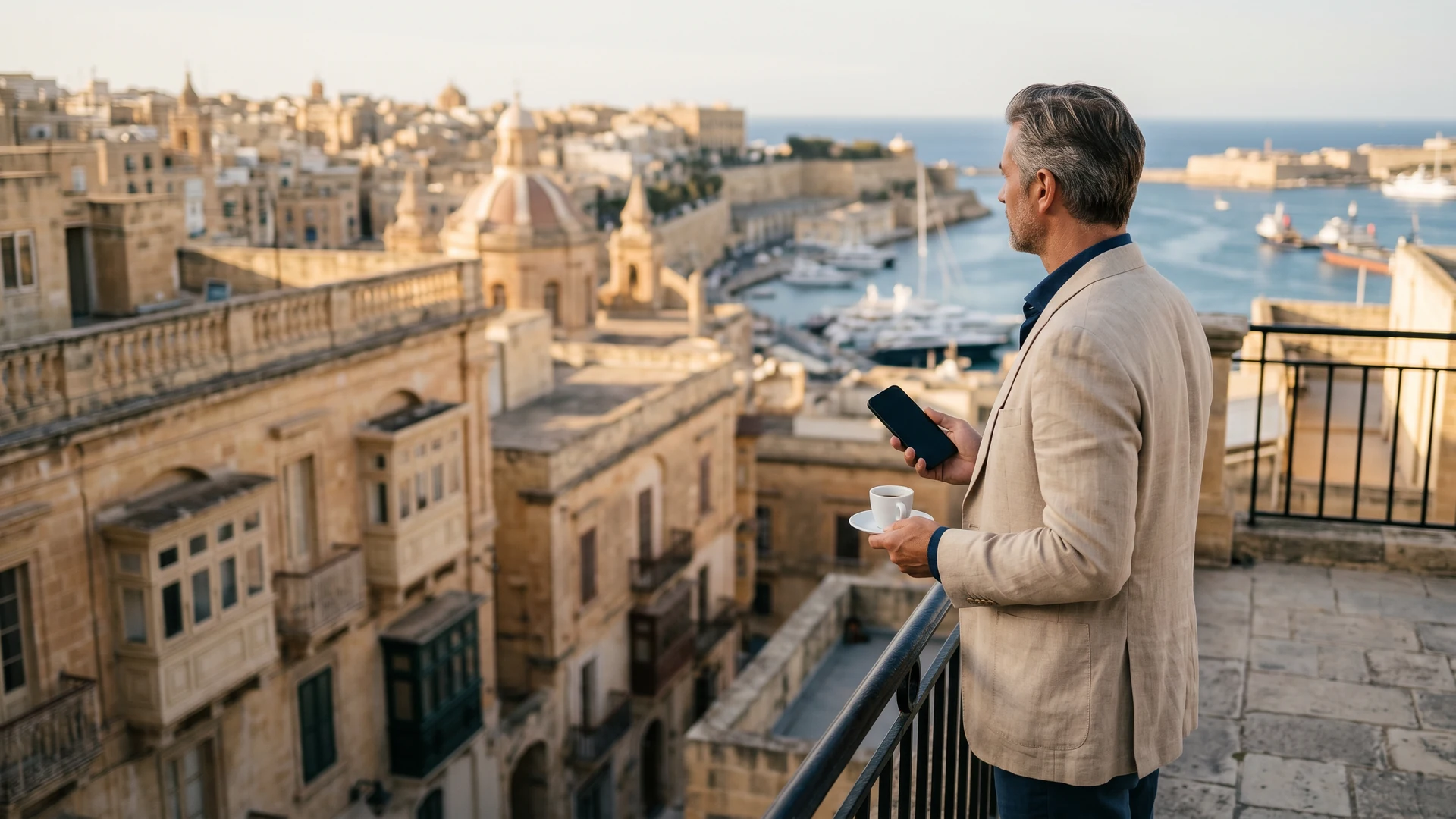
It usually starts with a phone call at an inconvenient hour.
A few months ago it was a Munich industrialist, a serious man who builds serious machines, ringing me from an airport lounge somewhere over the word "urgent." He had read something on a forum. Somewhere between his second espresso and his delayed flight he had convinced himself that his entire Maltese life would collapse unless he obtained, immediately, a tax residence certificate. He wanted it couriered. He wanted it apostilled. He may, briefly, have wanted it tattooed.
"And tell me," he said, "when did you last actually use yours?"
There was a pause, because the honest answer was that most of my clients go their whole Maltese lives without ever being asked for the thing he was now prepared to charter a jet to obtain. And the second honest answer, the one that matters more, is that the expensive solution he was about to demand would not have solved his problem anyway.
That phone call is the whole article in miniature. Moving your tax residence to Malta is not one decision, it is a choice between two doors. But there is a twist that the brochures will never tell you, and it is the reason I am writing this: the grand, expensive door does not buy you the certificate either. Let me show you both, and then show you the move that actually works.
The building they share
Before I send anyone through either door, I make them understand the engine humming underneath, because both doors open into the same machine.
Malta borrowed its personal tax system from the British, and along with the warm beer of administrative tradition it inherited one beautiful, profitable idea: the distinction between residence and domicile. Your residence is, roughly, where you live. Your domicile is where your heart claims home, the place you intend, one mythical day, to return to. The genius of Malta is that you can be resident there while remaining domiciled somewhere else, and unlike certain countries that shall remain the United Kingdom, Malta does not run a clock that quietly converts you to worldwide taxation after a few years. You can stay non-domiciled in Malta for as long as you like. Decades. Until they carry you out feet first, still non-dom.
For a non-domiciled resident, Malta taxes on the remittance basis, which works like a velvet rope outside a nightclub:
- Maltese income and gains pay full price at the door, up to 35%.
- Foreign income is taxed only if you bring it in.
- Foreign income left abroad is not taxed at all. It stays outside, untroubled, sipping its drink.
- Foreign capital gains are not taxed even if you remit them. You can sell a building in Singapore, realise a fortune, wire the proceeds to your Maltese account, and pay Malta precisely nothing on the gain.
That last point makes grown advisers a little emotional. It is one of the most underused features in European tax planning, and it powers both doors equally. The only thing that changes between them is how much you pay and what you must promise. Note what does not change: neither door hands you a certificate. Hold that thought.
Door one: the quiet door, also known as the €5,000 model
This is the lean door, the one I push most clients through, the one my Munich industrialist actually needed and was busy trying to escape.
You become resident in Malta as a non-domiciled individual. You file a tax return. You receive a Maltese tax identification number. You take your place inside that velvet rope. There is no special programme to apply for, no flat-rate election to make, no minimum price on your front door. You are simply a resident who happens to keep his domicile somewhere with worse weather.
What you really pay
The number most non-doms write on the cheque is the €5,000 annual minimum tax, and since half the internet describes it wrongly, here is how it truly behaves:
The €5,000 minimum bites when you have foreign income of at least €35,000 in the year that you have not fully remitted to Malta. Couples are weighed together against that €35,000 line. And the €5,000 is a floor, not a flat fee on a fixed allowance. It is figured before double taxation relief, and any Maltese tax you have already paid counts towards it. So if your ordinary bill lands below five thousand, you top up to five thousand. If it lands above, you simply pay the higher figure and there is no surcharge for the privilege.
Remember that line about Maltese tax already paid counting towards the minimum. It is small, and it is about to become the hero of this whole story.
In plain life: a client who keeps his remittances sensible, enough to cover rent, the good olive oil, school fees and a decent table at dinner, while leaving the bulk of his income and all of his capital gains offshore, settles on or near that €5,000 minimum, year after year, like clockwork. For the person who already lives half in the sky, it is plenty.
No company, no job, no theatre
Here is where I get to be smug about Malta, so indulge me.
Cyprus runs a famous 60-day rule, and clients arrive quoting it like scripture. Then I read them the small print. To use it you must not be tax resident anywhere else, you must keep a permanent home on the island, and you must run a business in Cyprus, be employed in Cyprus, or hold an office in a Cyprus company. Translated: Cyprus's fast lane quietly forces you to manufacture a local job or a company and act in the little play forever after.
Malta's ordinary non-dom door asks for none of that pantomime. No Maltese company required. No Maltese payroll required. No invented economic activity to keep up appearances. You can simply, gloriously, live there.
How you become resident depends on your passport, and this is the one spot where it pays to know your audience:
- If you carry an EU, EEA or Swiss passport, you register on the basis of economic self-sufficiency. Prove you can support yourself, carry health cover, take up residence. Done.
- If you are a third-country national, the Americans, the Canadians, the Australians who write to me having finally lost patience with their home tax codes, you need an underlying right to reside sitting beneath the tax position. The tax treatment is identical once you are in, but the immigration layer is not handed to you the way it is to an Austrian.
What this life feels like
Set up properly, the €5,000 model is almost suspiciously calm. You file. Unremitted foreign income sits outside the Maltese net entirely, so it is never dragged into charge. The authorities are not in the business of hunting down self-sufficient non-doms who file on time and pay their minimum. The Maltese state, in the nicest possible way, forgets you exist, which is precisely what most of my clients are paying for. There is no quota of days you are compelled to spend baking on the island to keep the status alive.
Which brings us, inevitably, back to the airport lounge and the certificate.
The certificate, and the lie people tell themselves about it
Understand this one thing and you understand the whole game: being a Maltese tax resident and being able to prove it to a stranger on demand are two separate achievements.
A Tax Residence Certificate, the TRC, is the formal document, issued by Malta's Commissioner for Tax and Customs, declaring you tax resident in Malta. You request it on the RCTR02 form, swearing to your ties and confirming your returns are filed. You need it when a foreign tax authority, a bank, or a counterparty demands official proof that Malta, and not your old country, holds the first claim on your taxes. Usually it surfaces in a fight over a double taxation treaty.
Now here is the part the glossy programme brochures bury. Malta issues the certificate on the facts, every single time. It does not matter which door you came through. The Commissioner is entitled to go looking for substance: your lease, your utility bills, your travel history, your bank statements and payslips. If the file makes it embarrassingly clear that you have set foot in Malta roughly never, the certificate can arrive slowly, or fail to arrive at all. This is the test, and nothing you buy makes it go away.
Two things are true at once, and I make every nervous client hold both in his head:
One. For ninety-nine clients out of a hundred, the certificate never comes up at all. Most non-doms are not asked for a TRC a single time across the entire life of their structure. The dread of it runs wildly ahead of how often it actually bites. My Munich friend has now held his status for years and has been asked for the certificate precisely zero times. He still mentions it occasionally, the way some men mention a war they were almost in.
Two. For the hundredth client, who genuinely needs one, the answer is substance, not status. And substance you can build. We will get to exactly how.
So the real question is never "how much tax will I pay." It is "will Malta ever need to vouch for me in writing, and if so, will the facts support it."
Door two: the grand door, and the expensive thing it does not do
For years the standard advice, mine included, was that the client who needs certainty should walk through Malta's grander entrance, the formal special tax status. So let me describe that door honestly, including the part where it fails to deliver what everyone buys it for.
The special status arrives today through two near-identical programmes:
- The Residence Programme (TRP) for EU, EEA and Swiss nationals.
- The Global Residence Programme (GRP) for third-country nationals.
The bargain reads like this. A flat 15% on foreign income remitted to Malta. A minimum annual tax of €15,000 covering you and your dependants. A qualifying property: buy from €275,000 (or €220,000 in the south or Gozo), or rent from €9,600 a year (or €8,750 in the south or Gozo). A promise not to be tax resident anywhere else, meaning no more than 183 days in any single other country. Application through an Authorised Registered Mandatary, with a government fee from €5,500. And, while we are being accurate, the old 2011 HNWI scheme that charged €20,000 was retired in 2013 and folded into exactly these programmes, so if anyone is still quoting you €20k they have not updated their notes since smartphones had keyboards.
Now the uncomfortable truth. None of that buys you a certificate. The special status confirms how your Maltese income is taxed. It does not confer tax residence by decree, and it does not exempt you from the facts test when you actually apply for the TRC. Malta still wants to see that you live there in some recognisable sense. The uncertainty does not vanish. It just acquires a €15,000 price tag and a property you are now obliged to keep. At best the paperwork is marginally smoother. It is nowhere near smooth enough to justify the cost and the lock-in if a certificate is your only reason for considering it.
So when is the grand door worth it? Honestly, only in two narrow cases. If you remit very large sums into Malta each year, the flat 15% can beat the progressive rates, and the maths starts to work. And if you are a non-EU national who needs the residence permit that the GRP carries, it solves an immigration problem the bare non-dom route does not. For the certificate, though, it is a beautifully appointed room that does not contain the thing you came for. Most clients should walk straight past it.
The move that actually works: substance behind door one
Here is what I tell the hundredth client, the one who really might need a certificate. You do not buy your way to it. You build your way to it, and you do it from inside the cheap door.
Three ingredients, and they are not expensive.
Visit Malta regularly. Not constantly, not 183 days, but enough that your passport, your card spending and your life leave a recognisable trail through the island. Substance is a story told by evidence, and evidence is just you, showing up.
Put yourself on a Maltese payroll. Local employment is the single strongest signal of substance, and it can be employment at your own Maltese company if you have one. If you do not, and you would rather not build one, we can place you on an Employer of Record arrangement, where an established Maltese entity legally employs you, runs the payroll and issues real payslips, all without you incorporating anything. Either way you take a modest salary.
And now the salary tax counting towards the €5,000 minimum, which I asked you to remember, earns its keep. The Maltese income tax on that modest salary is absorbed into the €5,000 you were going to pay anyway. Up to that floor, the employment adds essentially nothing to your tax bill (set aside the modest social security contributions, which are real but small). You are not spending new money. You are relabelling money you were already handing the Maltese treasury, and getting a contract, payslips and genuine substance in return.
Then, when the certificate is finally needed, you apply with a clean story that happens to be entirely true. You are employed in Malta, and your job, like a great many modern jobs, requires you to travel constantly. That single sentence reconciles a Maltese employment with a passport full of stamps, and it is exactly the kind of narrative the Commissioner can accept, because it is documented, coherent and real.
That is the whole trick. Non-dom for the economics, a modest Maltese job for the substance, and the travel-for-work argument to tie it together. It costs a rounding error against the €15,000 programme, and it puts you on far firmer ground for the certificate than special status ever would, because it gives Malta the facts the certificate is actually tested against.
Side by side, for the spreadsheet-minded among you
| Plain non-dom | Non-dom plus substance (the smart play) | Special status (TRP / GRP) | |
|---|---|---|---|
| Who it is for | The mobile majority who will never be asked | The few who might genuinely need a certificate | Big remitters, or non-EU clients needing a permit |
| Minimum annual tax | €5,000 | €5,000 (salary tax absorbed into it) | €15,000 |
| Tax on remitted foreign income | Progressive, near the minimum for modest sums | Same | Flat 15% |
| Foreign capital gains | Exempt, even if remitted | Exempt | Exempt |
| Property requirement | None | None | Buy from €275,000 / rent from €9,600 |
| Local employment | No | Yes, own company or Employer of Record | Optional |
| Certificate | Facts-tested, weak if you are never there | Facts-tested, strong, backed by payslips and travel story | Still facts-tested. Status does not grant it |
| Day-count promise | None | None | No more than 183 days in any other country |
My actual advice, after too many of these to count
Let me be unfashionable, because the unfashionable answer is the correct one. Use the non-dom status. For the overwhelming majority it begins and ends there, at €5,000 a year, with no property to keep and no days to count.
If you really might need a certificate, do not buy special status hoping it will hand you one, because it will not. Instead, visit Malta regularly, put yourself on a modest Maltese salary, ideally through your own company or through an Employer of Record solution we can arrange, and let that salary's tax disappear into the €5,000 you were paying regardless. Then, if the day ever comes, apply for the certificate and explain that your job keeps you on the road. True, documented, and persuasive.
Keep the grand door for the two people it genuinely suits: the client remitting enough to make the 15% flat rate pay for itself, and the non-EU client who needs the residence permit. For everyone else chasing a certificate, it is an elegant and expensive detour back to exactly the facts test they were trying to escape.
One last thing, said plainly
None of this runs on autopilot, and anyone who tells you otherwise is selling something, usually the expensive programme. Residence in Malta is a question of fact, which is the bad news if you wanted to buy your way out of it and the good news if you are willing to build it instead. Build it cheaply, build it honestly, and a modest Maltese job plus a few real visits will carry you further than fifteen thousand euros and a flat you never sleep in.
And if you ever find yourself in an airport lounge, espresso in hand, convinced you need a certificate by morning, do me one favour first. Ask yourself who, exactly, is going to ask you for it. Nine times out of ten the answer is nobody. And on the tenth, the thing that saves you is not a programme you bought, it is a life you actually built.