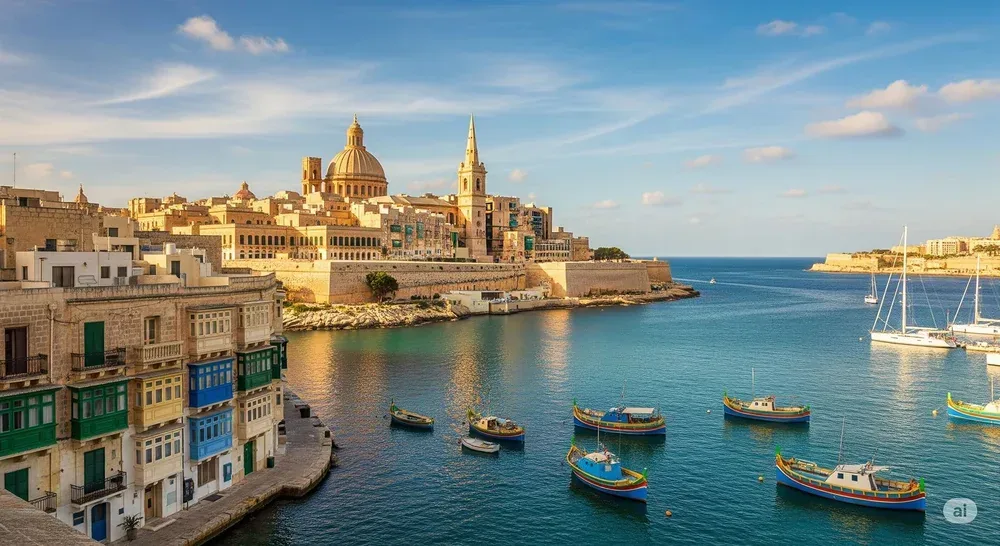
There's a certain rhythm to Malta. The stone walls glow honey-gold in the late afternoon sun, fishing boats bob on the sea with their painted eyes staring into eternity, and the island's lawyers and accountants sip espresso while waiting for the next EU directive to roll in like a storm.
I've been watching that rhythm since 2011. That's the year my family and my business first put down roots on the island — I've lived there twice myself, a year at a time, and I've spent the fifteen years since structuring Malta companies for entrepreneurs, investors, and family offices from Germany to Texas. In that time I've seen the island survive the Panama Papers, greylisting, Brussels’ periodic tantrums, and now the global minimum tax. Every single time, the obituaries were written. Every single time, they were premature.
So let me give you the complete picture of Maltese corporate tax as it actually stands in 2026 — not the version in the brochures, and not the panic in the Telegram groups. There are now two roads through the Maltese system, and choosing the wrong one is expensive. Here is how both work, what they cost to run, and who should take which.
The 35% Almost Nobody Pays
On paper, Malta has one of the highest corporate tax rates in Europe: a flat 35% on company profits. There is no separate corporate tax code — companies simply pay income tax at 35%, on a worldwide basis if incorporated in Malta.
If that were the whole story, this article would end here and the island would be empty of holding companies. It is not the whole story. Malta operates a full imputation system — the only complete one left in the EU — under which tax paid by the company is imputed to the shareholder when profits are distributed. And attached to that system is the refund mechanism that made Malta famous.
The Refund System: How 35% Becomes 5%
Here is the mechanism, stripped of mystique.
Your Maltese trading company earns €100,000 in profit. It pays €35,000 in tax — the full 35%, on time, to the Maltese exchequer. Then it distributes the remaining €65,000 as a dividend to its shareholder. Upon that distribution, the shareholder becomes entitled to a refund of 6/7 of the tax paid — €30,000 back. Net tax borne: €5,000. An effective rate of 5% on trading income.
The fractions vary with the character of the income: 6/7 refund on active trading income → effective 5%; 5/7 refund on passive interest and royalties → effective 10%; 2/3 refund where the company has claimed double-taxation relief on foreign income.
In practice, nobody structures this with the refund landing in a personal bank account — the standard architecture is two tiers: a Maltese trading company owned by a Maltese holding company. The refund flows to the holding company, where it can be received and redeployed without triggering personal tax in the wrong jurisdiction at the wrong moment. The holding tier also unlocks Malta's participation exemption — 0% on qualifying dividends and capital gains from subsidiaries — which is why family offices and private equity have quietly used Malta as a holding jurisdiction for two decades. There is no Maltese withholding tax on outbound dividends, and the island's treaty network spans some seventy countries.
Now, the honest part — the part the incorporation mills leave out. This structure has running costs: two companies, two sets of accounts, audits, a corporate services provider, compliance. Budget around €10,000 a year to maintain it at a professional minimum. For a high-margin business clearing several hundred thousand in profit, that is a rounding error against the tax saved. For a freelancer on €60,000 a year, it is a bad trade — and I tell those people so, usually in the first ten minutes of a call. The refund also takes time to arrive; it is a genuine refund from the tax authority, not a book entry, and your cash-flow planning must respect that.
And the system only works if the company is real. Management and control in Malta, board decisions actually taken there, a defensible answer to the substance question. If you live in Germany and run the "Maltese" company from your kitchen table in Munich, you don't have a Maltese company — you have a German tax problem with Mediterranean stationery. Home-country CFC rules are the single most common way I see these structures fail, and it is why the residence question and the company question must always be planned together, never separately.
The New 15% Election: What Legal Notice 188 Actually Changed
On the 2nd of September 2025, Malta published Legal Notice 188 — the FITWI Regulations — and the blogosphere exploded. "Malta has killed the 5%!" cried the headlines. "The golden goose of Europe is cooked!"
Let me stop you right there, as I did when the news broke. The refund system was not abolished. What Malta introduced is an elective regime: a company may choose to be taxed at a flat, final 15% on its chargeable income, computed under the ordinary rules. Key features: Elective, not mandatory — you opt in by filing an election; nobody is moved onto it automatically. Final — 15% is the end of the story, no refunds on distribution, no two-tier gymnastics, no waiting for money to come back. A five-year commitment — once made, the election binds the company for at least five consecutive years before it can apply to return to the standard system.
Why would anyone volunteer to pay 15% instead of 5%? Three reasons, and they are good ones for the right company. First, simplicity: one company instead of two, no refund timing risk, materially lower running costs — for some profiles the all-in cost difference nearly closes the gap. Second, optics and access: a flat 15% final tax reads cleanly to foreign banks, investors, and tax authorities in a way the refund mechanism — however legal — sometimes does not. Third, the global minimum tax: for groups in the Pillar Two orbit (€750 million+ consolidated revenue), a 15% domestic rate aligns with where the world is heading anyway.
The strategic point — and this is why I remain bullish on the island — is that Malta now bends where others bow. Cyprus is moving to a universal 15% with no alternative path. Malta kept both doors open: 5% effective under imputation for those who want it and can carry the structure, 15% flat for those who value simplicity. Choice is the product. It always was.
Where the Structures Go Wrong
Fifteen years of doing this teaches you the failure patterns, and they repeat with remarkable discipline.
The US LLC combination — Malta non-dom residence plus a "tax-free" US LLC — is the most seductive and the most fragile. The kitchen-table company fails on substance and CFC grounds, as above. The structure without an exit plan ignores that moving away — to the US especially — can detonate a Maltese setup that was perfectly sound while you stayed put. And the too-small structure simply burns its savings in fees. None of these are failures of Maltese law. They are failures of planning — usually planning done by whoever sold the company formation, rather than by anyone accountable for the client's whole picture.
The Questions I Get Every Week
Is the 5% effective rate legal? Completely. The full imputation and refund system is enshrined in Maltese law, has been examined by Brussels repeatedly, and survives because it is not a special regime — every shareholder of every Maltese company, local or foreign, sits in the same system.
Should I choose the refund system or the 15% election? As a rule of thumb: substantial profits, comfort with a two-tier structure, and patience for refund timing → the imputation route at 5% effective. Preference for simplicity, sensitivity to how the structure reads to banks and counterparties, or proximity to Pillar Two → the 15% election. But the rule of thumb is where the analysis starts, not where it ends — the right answer depends on where you are resident, what your home country's CFC rules say, and where the profits ultimately need to land.
Do I have to live in Malta? No — company and residence are separate questions. But they interact, and the interaction is where the real planning happens. Malta's non-dom regime for individuals and its residence programmes are the other half of this conversation.
I've been advising on exactly these decisions since 2011 — through every rule change, every panic, and every premature obituary. If Malta is on your shortlist, the sequence matters: residence, structure, substance, exit — in that order. Our German-language practice at malta1.de covers how we work in detail; English-speaking readers will find the rest of the Malta picture throughout Malta Unlocked.