After a calm summer, Malta's inflation rate moved up in September. The National Statistics Office published its harmonised consumer price figures for the month on 16 October: annual inflation of 2.4 per cent, up from 2.0 per cent in August. Three days later, on 19 October, the national Retail Price Index showed the same direction, rising to 2.9 per cent from 2.6 per cent.
Neither figure is alarming. Both are still far below the euro area, where prices rose much faster. But the September release breaks a run of very low readings, and the detail shows that the increase came from the parts of the budget that residents feel most: groceries, eating out and travel.
The headline: up, but still well below the euro area
The NSO's September HICP release (NR 183/2026) puts Malta's annual rate at 2.4 per cent. Through 2026 the rate had moved in a narrow band: 2.3 per cent in each of the first three months, 2.5 per cent in April, 2.1 per cent in May, 2.0 per cent in June, 2.1 per cent in July and 2.0 per cent in August. September is the highest reading since April.
Prices actually fell from August to September, by 0.9 per cent on the month, led by a 5.5 per cent monthly drop in restaurants and accommodation services and a 1.8 per cent drop in transport as the summer season ended. The annual rate still rose, because prices a year earlier had been lower relative to their own August level.
The 12-month moving average, which smooths out seasonal swings, was unchanged at 2.3 per cent. On that measure, nothing has shifted.
The comparison with the euro area remains the striking part. The NSO sets Malta's 2.4 per cent against a euro area flash estimate of 3.8 per cent for September, leaving Malta 1.4 percentage points lower. In August the gap was 1.2 points. For anyone whose pension, salary or investment income is linked to prices elsewhere in the euro area, Malta has stayed cheaper in relative terms, even as its own rate ticked up. The NSO notes that the euro area figure is still provisional.
What pushed prices up
The NSO splits the index into 13 spending divisions. In September, three of them did most of the work.
Restaurants and accommodation: still the biggest push
Restaurants and accommodation services contributed 0.52 percentage points to the annual rate, up from 0.41 in August, and the division's own annual rate rose from 2.9 to 3.5 per cent. The NSO attributes the contribution mainly to higher prices of restaurant services.
This division carries a weight of 154 out of 1,000 in Malta's index, which also covers spending by foreign visitors. For residents it is still the category that shapes everyday life, from a coffee on the seafront to a family lunch on Sunday. Anyone using the restaurant budgets in our cost of living guide should assume they have drifted up again since spring.
Food: the sharpest change of the month
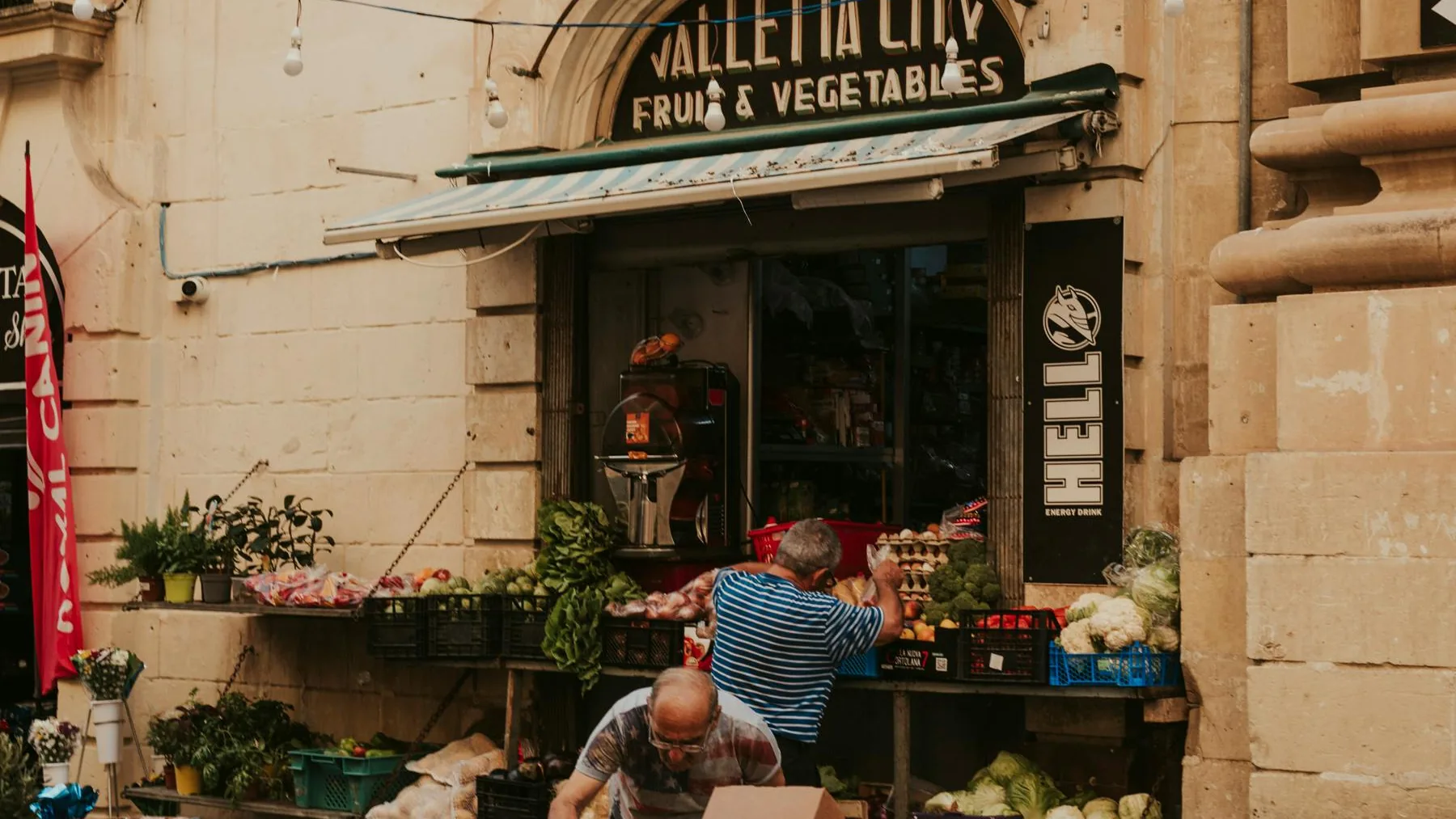
The bigger story is the weekly shop. The annual rate for food and non-alcoholic beverages jumped from 1.6 per cent in August to 2.5 per cent in September. Its contribution, 0.43 percentage points, was the second largest. The NSO names higher prices of vegetables as the main reason.
Food inflation had been unusually low in Malta for most of the summer: 2.0 per cent in May, 1.8 in June, 1.7 in July and 1.6 in August. A single month does not make a trend, and vegetable prices are among the most volatile in any index. But September brought the rate to its highest level since April, when it stood at 3.8 per cent, and households with a large grocery bill will have noticed.
Transport: air fares
Transport contributed 0.35 percentage points, with an annual rate of 2.9 per cent, up from 2.3 in August. Here the NSO points to higher prices of air transport services. For an island where almost every trip abroad starts with a flight, that is a direct cost for residents visiting family, travelling for work or taking a break in the off-season.
Where prices rose more slowly or fell
Information and communication was again the only division to pull the rate down, by 0.18 percentage points. Its annual rate was minus 3.7 per cent, mainly reflecting lower prices of mobile phone services. The trend has run all year: the division has been negative in every month of 2026 so far.
Insurance and financial services recorded the lowest positive rate, 0.8 per cent. Furnishings, household equipment and routine household maintenance eased to 0.8 per cent, from 1.1 per cent in August.
At the top of the table, recreation, sport and culture and personal care, social protection and miscellaneous goods and services both recorded 3.6 per cent, the highest annual rates of the month. The housing, water, electricity, gas and fuels division rose to 3.4 per cent, health was at 2.9 per cent and education services at 3.2 per cent.
The national index tells a sharper story on housing
The HICP is the measure used to compare inflation across the EU. Malta also publishes its own Retail Price Index, and the NSO's September RPI release adds useful detail.
The RPI rose to 2.9 per cent in September, from 2.6 per cent in August, with a 12-month moving average of 2.6 per cent. Its highest annual rates were in housing (7.3 per cent) and food (3.4 per cent). The largest contributions came from food (0.72 percentage points), mainly take-aways, from housing (0.58 points), mainly house maintenance services, and from transport and communication (0.31 points), mainly land transport services.
At the other end, water, electricity, gas and fuels showed 0.0 per cent annual inflation. That is the visible effect of the government's policy of keeping energy prices fixed.
Why do the two indices differ? According to the NSO's methodological notes, the HICP covers private households, institutional households such as retirement homes, and foreign visitors to Malta, while the RPI covers private households only. The two also use different weights and classifications. For a resident household, the RPI is closer to the shopping basket of a family living on the island, and in September it ran half a point above the HICP.
A year on: same headline, different mix
Set against September 2025, the headline looks unchanged. The NSO's table of inflation rates shows 2.4 per cent in September 2025 as well, and the same 12-month average of 2.3 per cent. A year earlier still, in September 2024, the annual rate was 2.1 per cent.
Underneath, the composition has shifted. Comparing September 2025 with September 2026 division by division:
- Housing, water, electricity, gas and fuels went from 0.7 per cent to 3.4 per cent, one of the biggest changes of any division. With energy prices held flat, the increase comes from the division's other components, such as rents and the upkeep of homes; the NSO's RPI release names house maintenance services as the main housing driver in September. The NSO's HICP release does not break the division down further, so the exact split cannot be read from it.
- Food and non-alcoholic beverages went the other way, from 3.6 per cent to 2.5 per cent, despite September's jump.
- Restaurants and accommodation services were almost unchanged, at 3.4 per cent a year ago and 3.5 per cent now.
- Transport rose from 2.3 to 2.9 per cent.
- Information and communication fell further, from minus 1.6 to minus 3.7 per cent.
In other words, a resident household that spends mainly on groceries is facing slower price growth than a year ago, while one that rents, owns or maintains a home is facing faster growth in the costs around the property.
What it means for residents
- Groceries and eating out. These are the two areas that pushed the rate up, and they make up a large share of most household budgets. If your spending leans on restaurants, take-aways and fresh food, your personal inflation rate in September was above the headline.
- Home upkeep. Both indices point to house maintenance services. Owners, and tenants who pay for minor repairs, are facing higher trade costs. Our where-to-live guide is a reminder to ask about a building's condition before signing.
- Utilities. Electricity, water and gas prices did not rise in the RPI over the past year. That stability is one of the clearest differences between Malta and most other EU countries in 2026.
- Mobile phones. Prices have been falling for months. Reviewing an old contract is one of the few easy savings available.
- Wages and pensions. Comparing your own income growth with 2.4 to 2.9 per cent inflation is the simplest test of whether your purchasing power is holding up. Typical pay levels by occupation are in our overview of what people earn in Malta.
How September compares with the summer
Our August note described inflation drifting down to 2.0 per cent, with restaurants, house maintenance, road transport and food as the main pressures. September kept restaurants at the top, but changed the rest of the picture: food jumped, air fares replaced road transport as the transport driver, and the overall rate rose by 0.4 points in a single month.
The 12-month average, however, did not move. On the NSO's figures, Malta's inflation in autumn 2026 is a little higher than in the summer, still low by European standards, and concentrated in services and fresh food rather than energy.
The October figures will follow in the NSO's next monthly release.
Work with Sebastian
If you are planning a move to Malta and want a realistic budget built on current prices, taxes and residence costs, book a consultation.